The Lazarus passage in the Bible is found in John 11. It tells how Jesus raised his close friend Lazarus from the dead after Lazarus had already been in the tomb for four days. The event is one of the most dramatic signs in the Gospel of John and presents Jesus as the one who has authority over death.
Lazarus lived in Bethany, the village of Mary and her sister Martha, near Jerusalem. The Gospel of John emphasizes that Jesus loved Martha, Mary, and Lazarus, making the account not merely a story about a miracle but also a deeply personal encounter with grief, delayed hope, faith, and divine compassion.
Where Is the Lazarus Passage in the Bible?
The main account is John 11:1-57, especially John 11:17-44, which describes Jesus comforting Martha and Mary and raising Lazarus from the tomb. John 11:1-16 introduces Lazarus’s illness, Jesus’s delay, and his decision to return to Judea.
The story continues in John 12. Six days before the Passover, Jesus came to Bethany, where Lazarus was, whom he had raised from the dead. Lazarus sat at the table with Jesus, and many people came not only because of Jesus but also to see Lazarus, whom he had raised from the dead.
| Passage | Main event |
|---|---|
| John 11:1-16 | Lazarus becomes ill, Jesus delays, and Lazarus dies |
| John 11:17-27 | Jesus speaks with Martha about resurrection and life |
| John 11:28-37 | Mary and the mourners meet Jesus; Jesus weeps |
| John 11:38-44 | Jesus raises Lazarus from the dead |
| John 11:45-57 | The miracle leads many to believe and intensifies opposition to Jesus |
| John 12:1-11 | Lazarus appears at a meal with Jesus, and leaders plot against him |

Who Was Lazarus in the Bible?
Lazarus was a man from Bethany, the village of Mary and her sister Martha. Bethany was near Jerusalem, about two miles away. Many people came to Martha and Mary to comfort them concerning their brother.
John identifies Lazarus as “the one you love” and later states that Jesus loved Martha and her sister and Lazarus. Lazarus was therefore not a stranger or a casual acquaintance. He was a close friend of Jesus, and the story repeatedly draws attention to that relationship.
John does not tell us what Lazarus experienced while he was dead. Lazarus does not speak about an experience beyond death, and the Gospel shows no interest in recording such a testimony. John is interested in the fact that Jesus overcame death and was able to speak the word and give life.
How Lazarus Became Sick
Now a certain man was sick, Lazarus of Bethany, the town of Mary and her sister Martha. It was that Mary who anointed the Lord with fragrant oil and wiped His feet with her hair, whose brother Lazarus was sick.
Therefore the sisters sent to Him, saying, “Lord, behold, he whom You love is sick.” The message was brief but urgent. Mary and Martha expected Jesus to respond to the illness of someone he loved.
When Jesus heard that, He said, “This sickness is not unto death, but for the glory of God, that the Son of God may be glorified through it.” The Gospel of John also records the words, “This sickness will not end in death. No, it is for God’s glory so that God’s Son may be glorified through it.”
Now Jesus loved Martha and her sister and Lazarus. So, when He heard that he was sick, He stayed two more days in the place where He was.
Why Did Jesus Wait Two More Days?
The delay is one of the most difficult parts of the Lazarus passage. The sisters sent an urgent message, but Jesus did not immediately go to Bethany. He stayed where he was for two more days before telling his disciples, “Let us go to Judea again.”
The disciples were concerned because the Jews in Judea had recently sought to stone Jesus. They asked, “Rabbi, lately the Jews sought to stone You, and are You going there again?” Jesus answered with an image of walking in the light: “Are there not twelve hours in the day? If anyone walks in the day, he does not stumble, because he sees the light of this world.”
Jesus’s delay does not mean that he did not love Lazarus. John places the statements side by side: Jesus loved Martha, Mary, and Lazarus, and therefore he remained where he was for two more days. The delay served the purpose that the glory of God might be displayed, but the later tears of Jesus show that the delay was not an expression of emotional indifference.
The sisters will each say that if Jesus had been there, Lazarus would not have died. Jesus was not going to leave those he loved in a lasting lurch, but he did leave them there for a time in order to reveal the glory he intended to display.
Jesus Tells the Disciples That Lazarus Is Dead
After saying these things, Jesus said to the disciples, “Our friend Lazarus has fallen asleep, but I go to awaken him.” The disciples replied, “Lord, if he has fallen asleep, he will recover.” They thought Jesus was speaking about natural sleep.
Jesus then told them plainly, “Lazarus is dead, and for your sake I am glad that I was not there, so that you may believe. But let us go to him.” Jesus’s statement does not celebrate death. It identifies the purpose of the sign: the disciples would see what Jesus could do and would be strengthened in their belief.
Thomas, who was called the Twin, said to his fellow disciples, “Let us also go, that we may die with him.” The disciples understood that returning to Judea involved danger because of the hostility toward Jesus.
Jesus Arrives in Bethany
When Jesus came, he found that Lazarus had already been in the tomb four days. The four-day period makes the situation unmistakable: Lazarus was not merely unconscious or near death. He had died and had been buried.
Bethany was near Jerusalem, about two miles away, and many people had come to Martha and Mary to console them concerning their brother. The presence of the mourners shows that the family’s grief was shared by the surrounding community.
When Martha heard that Jesus was coming, she went and met him, but Mary remained seated in the house. Martha’s response was direct and honest: “Lord, if you had been here, my brother would not have died.”
Her words express both sorrow and faith. Martha continued, “But even now I know that whatever You ask from God, God will give You.” She did not yet know exactly what Jesus intended to do, but she still believed that God would hear him.
Jesus and Martha: “Your Brother Will Rise Again”
Jesus said to Martha, “Your brother will rise again.” Martha answered, “I know that he will rise again in the resurrection at the last day.” Her response reflects the Jewish hope that the dead would be raised at the resurrection on the last day.
Jesus then gave one of the central declarations in the Gospel of John: “I am the resurrection and the life. Whoever believes in me, though he die, yet shall he live, and everyone who lives and believes in me shall never die. Do you believe this?”
Jesus did not merely say that he could perform a resurrection. He said, “I am the resurrection and the life.” Resurrection and life are presented as realities found in him. The promise concerns both the believer who dies and the person who lives and believes in Jesus.
Jesus’s words point beyond Lazarus’s temporary return to life. Lazarus would eventually die again, but the sign points to the greater hope of resurrection and life through Jesus.
Martha replied, “Yes, Lord; I believe that you are the Christ, the Son of God, who is coming into the world.” Her confession identifies Jesus as the Messiah and the Son of God.
Mary Comes to Jesus
After Martha had said these things, she went and called her sister Mary privately, saying, “The Teacher is here and is calling for you.” When Mary heard this, she rose quickly and went to Jesus.
Jesus had not yet entered the village but was still at the place where Martha had met him. The people who had been consoling Mary in the house followed her, supposing that she was going to the tomb to weep there.
When Mary came to where Jesus was and saw him, she fell at his feet and said, “Lord, if you had been here, my brother would not have died.” Mary spoke virtually the same words as Martha, but her response is described differently: she fell at Jesus’s feet and wept.
Martha was more direct in approaching Jesus, while Mary fell at his feet in grief. Both sisters bring the same painful question to him. Their words show that faith does not prevent lament, and trust does not require people to conceal their sorrow.
Why Did Jesus Weep?
When Jesus saw Mary weeping, and the Jews who had come with her also weeping, he was deeply moved in his spirit and greatly troubled. He asked, “Where have you laid him?” They said to him, “Lord, come and see.”
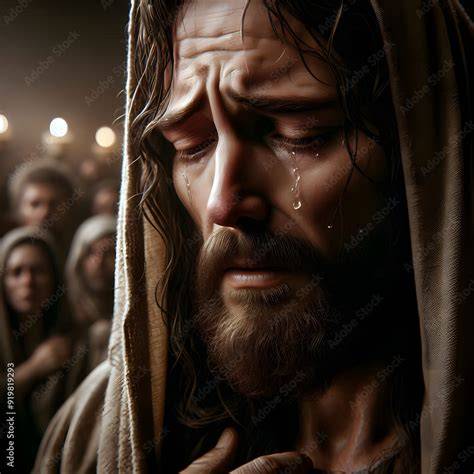
Jesus wept.
“Jesus wept” is one of the shortest and most powerful statements in Scripture. Jesus knew that he was about to raise Lazarus from the dead, yet he was not emotionally detached from the grief surrounding him.
The Jews said, “See how he loved him!” Others asked, “Could not this Man, who opened the eyes of the blind, also have kept this man from dying?” Their questions reveal the tension of the scene. They recognized Jesus’s power, but they wondered why he had not used it to prevent Lazarus’s death.
The tears of Jesus show that divine knowledge and divine compassion are not opposites. Jesus knew the outcome, but he still entered into the sorrow of Mary, Martha, and the mourners.
Jesus is no heartless judge withdrawn from the pain people feel. John tells us that Jesus was deeply moved, greatly troubled, and that he wept. No one knows better than Jesus what is going to happen in this episode, and no one is better at mourning with those who mourn than Jesus.
The Tomb of Lazarus
Then Jesus, again deeply moved, came to the tomb. It was a cave, and a stone lay against it. The setting resembles the familiar burial scene of Jesus, with a stone placed across the entrance of a tomb.
Jesus said, “Take away the stone.” Martha, the sister of the dead man, said to him, “Lord, by this time there will be an odor, for he has been dead four days.” Martha’s response acknowledges the physical reality of death and the length of time Lazarus had been in the tomb.
Jesus said to her, “Did I not tell you that if you believed you would see the glory of God?” The glory of God in this scene means that death will be overcome, a beloved brother and friend will be restored to life, and Jesus will be revealed as one who loves and is able to help.
Jesus Prays Before Raising Lazarus
They took away the stone from the place where the dead man was lying. Jesus lifted up his eyes and said, “Father, I thank You that You have heard Me.”
Jesus continued, “And I know that You always hear Me, but because of the people who are standing by I said this, that they may believe that You sent Me.” His prayer is addressed to the Father and is spoken for the benefit of the people standing around him.
The prayer does not represent a performance or an empty ritual. It reveals the relationship between Jesus and the Father. Jesus gives thanks because the Father hears him, and he speaks so that the people may believe that the Father sent him.
“Lazarus, Come Forth”
When Jesus had said these things, he cried with a loud voice, “Lazarus, come out.” In another translation, the command is, “Lazarus, come forth!”
The command is brief, direct, and authoritative. Jesus does not perform a complicated ceremony. He speaks, and the dead man responds to his voice.
The man who had died came out, his hands and feet bound with linen strips, and his face wrapped with a cloth. Jesus said to them, “Unbind him, and let him go.”
Lazarus walked out of the tomb still wrapped in his burial cloths. The command to unbind him completes the restoration. Lazarus is not only called out of death; he is released from the signs of the grave and returned to the community.
Jesus Raises Lazarus from the Dead
What Does the Raising of Lazarus Mean?
The raising of Lazarus is a sign that reveals who Jesus is. John is not primarily interested in Lazarus’s personal account of death. The focus is on Jesus’s ability to speak the word and give life.
The voice through which the worlds were made, by which babies are knitted together in their mothers’ wombs, by which all things hold together, and by which everyone will be judged, cries out words that roll back the deepest and darkest curse known to humanity: by his word he made the world, and by his word he undoes death.
The miracle displays Jesus’s authority over death, but it also reveals his love. The relationship between Jesus and his people is not a sham enacted to give Jesus opportunities to show off. Jesus loves his people, weeps with them, and weeps over them.
How the Lazarus Story Points to Easter
The raising of Lazarus was a preview of what Jesus would do through his own resurrection. Lazarus was brought back to ordinary earthly life and would eventually die again, while Jesus’s resurrection is presented by Christians as the decisive victory over death.
Lazarus coming back to life was a preview and a picture of what Jesus would do through his own resurrection on Easter Sunday. The event signals that Jesus is stronger than death and that death is not the final word for those who trust in him.
The Lazarus passage therefore connects present grief with future resurrection hope. Jesus does not say that life is easy or that pain disappears overnight. The message is that Jesus is stronger than death, stronger than failure, stronger than fear, and stronger than anything that feels final.
Faith, Waiting, and the Glory of God
The story teaches Jesus’s followers to wait and hope and to trust him even when he allows them to remain in a painful situation for a time. The sisters believed that Jesus could have prevented Lazarus’s death, yet Jesus’s delay created the setting in which his power over death would be openly revealed.
The statement that Lazarus’s illness was for God’s glory must not be understood as proof that God is emotionally distant from suffering. The events had a divine purpose, but Jesus’s tears show that purpose does not eliminate compassion.
Sometimes people are tempted to think that God does not care because he knows how everything will turn out. The Lazarus passage rejects that conclusion. Jesus knows exactly what he is going to do, yet he is deeply moved by death and pain.
The passage presents suffering and death as realities that trouble Jesus, even while he works through the situation for God’s glory. His sovereignty is not coldness, and his knowledge of the outcome does not make him indifferent to the people involved.
The Reactions to the Miracle
Many of the Jews who had come to Mary and had seen what Jesus did believed in him. The sign led people to recognize Jesus and put their faith in him.
But some went to the Pharisees and told them what Jesus had done. The chief priests and the Pharisees gathered the council and said, “What are we to do? For this man performs many signs.”
They feared that if Jesus continued performing signs, everyone would believe in him and the Romans would come and take away both their place and their nation. Their response was political and defensive rather than faith-filled.
The Plot Against Jesus
Caiaphas, who was high priest that year, said, “You know nothing at all. Nor do you understand that it is better for you that one man should die for the people, not that the whole nation should perish.”
John explains that Caiaphas did not say this on his own authority. Being high priest that year, he prophesied that Jesus would die for the nation, and not for that nation only, but also to gather into one the children of God who are scattered abroad.
From that day on, they made plans to put Jesus to death. Jesus therefore no longer walked openly among the Jews, but went to the region near the wilderness, to a town called Ephraim, and stayed there with the disciples.
The raising of Lazarus thus becomes a turning point. The miracle brings many people to faith, but it also intensifies the leaders’ determination to kill Jesus. The sign that reveals Jesus as the giver of life contributes to the plot that will lead to his death.
Lazarus in John 12
Six days before the Passover, Jesus came to Bethany, where Lazarus was, whom Jesus had made to come back from the dead. They made Jesus a supper; Martha served, and Lazarus was one of those seated at the table with him.
A great number of the Jews learned that Jesus was there, and they came not only because of Jesus but also to see Lazarus, whom he had raised from the dead. The chief priests plotted to put Lazarus to death also, because many of the Jews were going away and believing in Jesus on account of him.
Lazarus’s presence became evidence of Jesus’s power. His restored life was not presented as a speech or a written account, but as a living sign that caused people to consider who Jesus was.
Is Lazarus in Luke 16 the Same Person?
Luke 16 also mentions a man named Lazarus, but that passage concerns a poor man in a teaching about a rich man and the afterlife. The Lazarus in Luke 16 is not identified as the brother of Mary and Martha.
The Lazarus of John 11 lived in Bethany and was raised from the dead by Jesus. The Lazarus in Luke 16 is a poor man who was laid at a rich man’s gate and is later described with Abraham. The two passages use the same name but present different figures.
Key Verses from the Lazarus Passage
- “Lord, the one you love is sick.” - John 11:3
- “This sickness will not end in death. No, it is for God’s glory so that God’s Son may be glorified through it.” - John 11:4
- “Lazarus is dead.” - John 11:14
- “Lord, if you had been here, my brother would not have died.” - John 11:21
- “Your brother will rise again.” - John 11:23
- “I am the resurrection and the life.” - John 11:25
- “Do you believe this?” - John 11:26
- “Jesus wept.” - John 11:35
- “Did I not tell you that if you believed you would see the glory of God?” - John 11:40
- “Lazarus, come out.” - John 11:43
- “Unbind him, and let him go.” - John 11:44
Why the Lazarus Passage Matters
The story of Lazarus brings together several central themes of the Christian message: Jesus’s love, the reality of human grief, the problem of death, the promise of resurrection, and the glory of God revealed through the work of the Son.
The passage shows that Jesus is not distant from human sorrow. He enters the scene of mourning, listens to Martha and Mary, is deeply moved by their tears, and weeps with them. At the same time, he acts with authority and calls the dead man out of the tomb.
The story also offers hope to people who feel that a situation is finished. Lazarus had been dead for four days, and Martha recognized the physical reality of the grave. Yet Jesus showed that death was not beyond his authority.
Because of what John shows us of Jesus, the fearful finality of death for ourselves and those we love is softened by the empathy of Jesus, and we face death in hope because of the confident expectation of resurrection.