In the Bible, locusts primarily symbolize divine judgment, widespread destruction and devastation, and a call to repentance. They serve as powerful, often literal, instruments through which God demonstrates His sovereignty and the consequences of sin and disobedience.
Locusts are not common pests for those of us living outside of the Middle East, so we may not be as familiar with them. But because they are mentioned so frequently throughout the Bible, it's important to know what these bugs are, what they do, and what they symbolize.
The main biblical meaning of locusts
Locusts are commonly thought of in a Biblical context as an instrument of destruction because of the damage that they can do to crops that would be needed for food, or as a specific instrument that God may choose to use for punishment.
In the Bible, locusts are often associated with divine judgment and are depicted as instruments of God's wrath. They are mentioned in various contexts, symbolizing destruction and desolation.
- Divine judgment: God sends or permits locusts as a judgment against sin, rebellion, and disobedience.
- Destruction and devastation: Swarms consume crops, trees, and vegetation, threatening food supplies and producing famine.
- Overwhelming armies: Prophets compare invading armies with locust swarms because of their vast numbers, order, and unstoppable advance.
- A call to repentance: Locust imagery warns people to humble themselves, return to God, and seek mercy.
- Restoration after discipline: Joel 2:25 presents God as able to restore what the locusts have consumed.
- Protection and distinction: In Revelation, the locust-like beings are forbidden to harm those who have the seal of God.
However, an exception to the general theme of destruction, the prophet John the Baptist in the New Testament is described as eating locusts and wild honey (Matthew 3:4; Mark 1:6). Interestingly, however, locusts were also spoken of positively in Proverbs 30:24-28 as being among creatures that are small but wise.
What locusts are and why their image was so powerful
Locusts are grasshopper-like insects who are generally solitary. But under certain conditions, locusts can swarm, becoming a frighteningly destructive agent of crop devastation.
In this swarming phase, usually brought on by drought, they breed rapidly and travel in large clouds, consuming all vegetation in their path. When they impact several neighboring countries in this way, we refer to this as a “plague of locusts.”
Locust swarms appear in our times, especially in Africa, India, and the Middle East, although they’re not completely unknown in parts of the United States. According to the BBC, in 2020, locust swarms appeared in dozens of countries at once.
In an agrarian society that depends on crops for survival, a locust swarm can spell total destruction. A farmer can sit and watch his entire livelihood be devoured in a few hours. His family may starve to death now, and he can do nothing to stop it.
These dire consequences coupled with the attendant helplessness are critical for understanding the psychological terror behind the image of a plague of locusts in the Bible.
Locusts occur in great numbers, and sometimes obscure the sun. Their voracity is alluded to throughout Scripture. They make a fearful noise in their flight, and their irresistible progress is repeatedly emphasized.
They enter dwellings, and devour even the woodwork of houses. They do not fly in the night. The sea destroys the greater number.
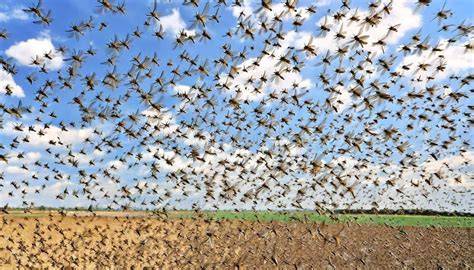
Locusts in the Egyptian plagues
Most famously, locusts played a starring role when Moses took on Pharaoh in Egypt. One of the 10 plagues Moses called down upon the Egyptians was locusts.
The Israelites had been enslaved for generations under cruel Egyptian Pharaohs. In the time of Moses, it was God’s plan to free them from slavery, but Pharaoh’s heart was hard.
God used the 10 plagues-blood, frogs, gnats/lice, flies, livestock pestilence, boils, hail, locusts, darkness, and death of the firstborn-to move Pharaoh’s heart to free the Israelites.
Pharaoh was still unrelenting, so God sent locusts to eat whatever the hail had not destroyed. They were the clean-up crew focused on leaving not a twig or leaf for food for Pharaoh’s people.
Exodus 10:14-15 says:
“The locusts swarmed across the land and settled over the entire territory of Egypt. Never before had there been such a plague of locusts, and never again will there be. They covered the face of all the ground until the land was black, and they consumed every plant in the land and all the fruit on the trees that the hail had left. Nothing green remained on any tree or plant in the field throughout the land of Egypt.”
The plague demonstrates that God rules over creation and over the powers trusted by Egypt. The locusts were one of the means by which God confronted Pharaoh’s refusal to humble himself and release Israel.
We see that locusts were followed only by two worse plagues-three days of complete darkness in the land and then the death of every firstborn son.
Exodus 10:3-6
“So Moses and Aaron went in to Pharaoh and said to him, ‘Thus says the Lord, the God of the Hebrews, ‘How long will you refuse to humble yourself before me? Let my people go, that they may serve me. For if you refuse to let my people go, behold, tomorrow I will bring locusts into your country, and they shall cover the face of the land, so that no one can see the land. And they shall eat what is left to you after the hail, and they shall eat every tree of yours that grows in the field, and they shall fill your houses and the houses of all your servants and all the Egyptians, as neither your fathers nor your grandfathers have seen, from the day they came on earth to this day.’”
Exodus 10:15
“They covered the face of the whole land, so that the land was darkened, and they ate all the plants in the land and all the fruit of the trees that the hail had left. Not a green thing remained, neither tree nor plant of the field, through all the land of Egypt.”
Locusts as a symbol of judgment in the Old Testament
Locusts are frequently used as symbols of judgment in the prophetic books. The biblical authors used this familiar phenomenon to convey messages of warning and the need for repentance.
The Bible represents countless swarms of locusts as directed in their flight and march by God, and used in the chastisement of guilty nations, Deuteronomy 28:38-42, 1 Kings 8:37, and 2 Chronicles 6:28.
Deuteronomy 28
In Deuteronomy 28 God declares a curse for disobedience using locusts. The harvest will be devoured.
1 Kings and 2 Chronicles
1 Kings 8, 2 Chronicles 6, and 2 Chronicles 7 mention locusts and devastation in Solomon's prayer. The prayer declares that calling on God and repenting is what we need to do in times of distress.
Amos 4:9
“I struck you with blight and mildew; your many gardens and your vineyards, your fig trees and your olive trees the locust devoured; yet you did not return to me,’ declares the Lord.”
Amos presents the locust as part of a series of judgments that should have moved the people to return to God. The repeated failure to repent is central to the passage.
2 Chronicles 7:12-15
“Then the Lord appeared to Solomon in the night and said to him: ‘I have heard your prayer and have chosen this place for myself as a house of sacrifice. When I shut up the heavens so that there is no rain, or command the locust to devour the land, or send pestilence among my people, if my people who are called by my name humble themselves, and pray and seek my face and turn from their wicked ways, then I will hear from heaven and will forgive their sin and heal their land. Now my eyes will be open and my ears attentive to the prayer that is made in this place.’”
This passage connects locust devastation with humility, prayer, repentance, forgiveness, and healing. Judgment is not presented as meaningless destruction; it is also a warning intended to turn people back to God.
Locusts in Joel: the Day of the Lord
The book of Joel opens with Joel recounting a literal locust plague that had just devastated Israel, but proceeds to use the locust plague as an analogy for what the dreadful “day of the Lord” will be.
This day will be a day of judgment not only for God’s enemies, but for unrepentant Israel herself. Joel's style is both vivid and expressive. He repeats for emphasis and uses striking similes.
Locusts are called a nation, a people, and an army. Their teeth are like those of lions, their appearance like horses, and their sound like chariots of an army drawn up for battle.
Joel’s description portrays an invasion that is terrifying because it is immense, organized, rapid, and seemingly impossible to stop. The land that was fruitful becomes barren, and the people are confronted with the seriousness of the coming judgment.
Joel 1:4
“What the devouring locust has left, the swarming locust has eaten; what the swarming locust has left, the young locust has eaten; and what the young locust has left, the destroying locust has eaten.”
The four insects specified in Joel 1:4-the palmer-worm, the locust, the canker-worm, and the caterpillar-are strictly, according to the Hebrew, only different forms of locusts, some perhaps without wings.
Whether the terms identify distinct species or stages of the locust’s development, the effect of the imagery is cumulative: one wave of devastation follows another until nothing remains.
Joel 2:1-11
Joel describes the locust army with military language. The army is compared to war horses, soldiers, and a force that advances in formation.
“Each [soldier] advances in his course. Into the city they rush, on the wall they run. Onto the houses they climb, through the windows they enter like a thief.”
Picture the scene? There are soldiers everywhere. There is nowhere to hide. No one can escape the sword of the Babylonians!
Joel’s imagery can refer both to an actual locust plague and to a military invasion. The locusts function as a picture of an advancing army and of the fear-inspiring Day of the Lord.
Joel 1 and 2 present the coming judgment as a warning to remember that there is eternity. The repeated call is to wake up, recognize the seriousness of sin, and return to God.
Locusts as a metaphor for invading armies
In prophetic literature such as Jeremiah and Joel, locusts also serve as a metaphor for large, overwhelming, and seemingly unstoppable invading armies sent by God to discipline His people or to judge nations.
In Numbers 13, the spies declare that they, meaning Israel, are like grasshoppers. This statement indicates a small size and expresses fear in comparison with the people of the land.
This report caused 40 years of mistrust in God, wandering, and the death of a generation. Numbers 14 shows the spiritual consequences of interpreting circumstances through fear rather than trust in God.
In Judges 7:12, the Midianites, the Amalekites, and all the other eastern peoples had settled in the valley, thick as locusts. Their camels could no more be counted than the sand on the seashore.
Here locusts symbolize an army’s enormous number. The comparison does not focus on the insects’ destructive effect alone but also on their overwhelming multitude.
Jeremiah 51 and the judgment of Babylon
Jeremiah 51 is an oracle of destruction over Babylon, Israel’s other prototypical enemy aside from Egypt.
Though written several centuries after the fall of the Babylonian empire, Babylon plays a central role in the book of Revelation as the personification of the nations of the world who have rebelled against God.
God promises Babylon that he is going to “fill you with men, as many as locusts, and they shall raise the shout of victory over you,” Jeremiah 51:14, and summon an army with “horses like bristling locusts,” Jeremiah 51:27.
In Revelation, the sound of the flapping of the wings of the locusts is compared to the “noise of many chariots with horses rushing into battle,” Revelation 9:9.
In the same way a horde of locusts can shear a field down to nothing, so God judged Babylon, and so too will He again devastate those “who do not have the seal of God on their foreheads.”
Locusts in Revelation 9
The Book of Revelation is categorized as apocalyptic literature, a genre characterized by its symbolic language, often used to convey messages about divine revelation, judgment, and the end times.
Revelation consists of 22 chapters and 404 verses, and is known for its imagery and the use of various symbols, such as beasts, angels, seals, trumpets, and even locusts.
The locusts appear during the fifth trumpet. They emerge from the smoke of the bottomless pit, indicating their supernatural origin.
Revelation 9:1-6
“And the fifth angel blew his trumpet, and I saw a star fallen from heaven to earth, and he was given the key to the shaft of the bottomless pit. He opened the shaft of the bottomless pit, and from the shaft rose smoke like the smoke of a great furnace, and the sun and the air were darkened with the smoke from the shaft. Then from the smoke came locusts on the earth, and they were given power like the power of scorpions of the earth. They were told not to harm the grass of the earth or any green plant or any tree, but only those people who do not have the seal of God on their foreheads. They were allowed to torment them for five months, but not to kill them, and their torment was like the torment of a scorpion when it stings someone. And in those days people will seek death and will not find it. They will long to die, but death will flee from them.”
Unlike natural locusts, which are known for destroying vegetation, these locusts are directed to harm only those people who do not bear the seal of God.
They are forbidden to kill anyone, but for five months “people will seek death and will not find it.” The five months may refer to the average lifespan of a locust, to the dry season in Israel in which locust swarms may come, or may simply be meant to convey a limited amount of time.
For this period, people will either be suffering from literal pain causing them to long to die or, more likely, they are suffering from a kind of emotional or psychological despair that fills them with a desire to die, but not enough courage to actually follow through on suicide.
The appearance of the Revelation locusts
Verse 7 provides a detailed description of these locusts:
“And the shapes of the locusts were like unto horses prepared unto battle; and on their heads were as it were crowns like gold, and their faces were as the faces of men.”
This description blends elements of warfare-horses prepared for battle-with features that are not typically associated with locusts, including human faces and crowns like gold.
In Revelation 9:8, the locusts' appearance is described in more detail:
“And they had hair as the hair of women, and their teeth were as the teeth of lions.”
The juxtaposition of traditionally feminine hair and masculine or ferocious lion’s teeth adds to their unnatural characteristics.
Verse 9 continues the martial imagery:
“And they had breastplates, as it were breastplates of iron; and the sound of their wings was as the sound of chariots of many horses running to battle.”
The locusts are not ordinary insects. Their appearance is a terrifying amalgamation of horses, locusts, scorpions, lions, and women clad in iron.
They possess the “sting of scorpions” that causes people to “seek death” but “not find it.” Jesus compares scorpions with demons in Luke 10:19, thus these “locusts” are likely demons who have merely taken the form of a locust in John’s vision.
The king of the locusts
The leader of these locusts is introduced in verse 11:
“And they had a king over them, which is the angel of the bottomless pit, whose name in the Hebrew tongue is Abaddon, but in the Greek tongue hath his name Apollyon.”
This verse identifies a specific demonic entity loosed as the ruler of the locusts. Apollyon means “Destroyer.”
The locusts described by John in Revelation are obviously not regular locusts. They come out of the “abyss,” the prison of Satan and demons, and have Satan or some demonic prince as their king.
Their supernatural origin, grotesque appearance, demonic ruler, and restricted mission all indicate that the vision uses locust imagery to portray a terrifying form of judgment rather than a normal agricultural infestation.
What the locusts in Revelation symbolize
The locusts in Revelation serve as an unsettling depiction of the tribulations of the end times. Their imagery represents darkness, invasion, torment, woe, and unstoppable devastation.
Only the devastation that these demon locusts exact is not physical but psychological. They are forbidden to kill anyone, but people will seek death and will not find it.
Their torment is limited by divine command. They are told not to harm the grass, any green plant, or any tree, and they are allowed to torment people for five months but not to kill them.
The command to spare those who have the seal of God shows that God distinguishes between His people and those under judgment. GOD IS IN CONTROL!
It certainly does not make sense for this plague to take place after some “secret rapture” takes place where the church is no longer present, otherwise the command for the locusts to only afflict those “who do not have the seal of God on their foreheads” makes little sense.
Why the locusts are probably symbolic rather than ordinary insects
One interpretation has claimed that the locusts described in Revelation 9 may be Apache helicopters, with the various details corresponding to different parts of the helicopter.
Suffice to say, this method of interpretation that views events and figures in the book of Revelation as a thinly veiled code for contemporary events or figures is likely an incorrect way to approach the book.
If this were correct, that would mean that the majority of the book would have little meaning to Christians across the past two millennia who, for instance, have had no idea what an Apache helicopter is.
We need to interpret Revelation on its own terms, which will require us to see the connections to the Old Testament that John expects us to see.
While Egypt was visited with literal locusts as a judgment, it is unlikely that these locusts will appear as actual locusts. Since the imagery of the locusts here is so fantastical, it likely is meant to convey the spiritual reality of the judgment the locust is intended to represent: total, unstoppable devastation.
There are still many details present in Revelation 9 that we do not find an Old Testament referent for: the locusts’ possessing the face of a man, the hair of women, and breastplates of iron.
All of these additional details are likely just further depictions of the ghoulish and terrifying demonic aspects of this plague, as well as the limited scope of this judgment.
Connections between Revelation 9 and the Old Testament
The primary Old Testament texts that John seems to be alluding to here are Jeremiah 51, Joel 1-2, and Exodus 10.
| Passage | Locust imagery | Connection with Revelation 9 |
|---|---|---|
| Exodus 10 | Locusts darken the land and consume every green thing. | Revelation presents supernatural locusts emerging from darkness and smoke, but commands them not to harm vegetation. |
| Joel 1-2 | Locusts are pictured as a devastating army associated with the Day of the Lord. | Revelation uses military imagery, including horses, battle, chariots, and overwhelming force. |
| Jeremiah 51 | Locusts represent the multitude and force of armies judging Babylon. | Revelation connects the sound and appearance of the locusts with armies rushing into battle. |
| Luke 10:19 | Scorpions are associated with spiritual enemies. | Revelation’s locusts have scorpion-like power and torment. |
How Revelation differs from Joel
An interesting question is how the locusts in Joel chapter 2 differ from those in Revelation chapter 9.
Joel 2:20-29 says that God drives the locusts away and promises to make compensation for their damage. After that, God pours out his spirit.
When we look at Joel's prophecy in its context, it reveals that the prophet was predicting a military attack. God said that he would use his “great army” to punish the disobedient Israelites.
The invading army is rightly called “the northerner” because the Babylonians would invade Israel from the north. That army is likened to a well-organized swarm of locusts.
In Joel, the locust imagery is closely connected with a literal plague and with a human military invasion. In Revelation, the imagery becomes an apocalyptic vision of demonic beings released from the abyss.
Both passages emphasize judgment, fear, overwhelming power, and the seriousness of rebellion against God. Joel also emphasizes repentance and restoration, while Revelation 9 emphasizes the torment and limitation of the judgment.
Locusts and repentance
The theological significance of locusts in the Bible includes both warning and mercy. Locusts illustrate the consequences of disobedience and the seriousness of divine judgment.
At the same time, the call to repentance in the face of such judgments underscores God's desire for His people to return to Him and seek His mercy.
Much as we, as human parents, will increase discipline with a stubborn child, hoping each elevation of restriction brings about a change of heart so they no longer repeat their unacceptable behavior, so God increases humanity’s discomfort to turn them from actions that will lead to eternal separation from Him.
As you can see, when locusts are mentioned in the Bible, it’s worth paying attention. What will follow is likely widespread devastation and sorrow. Of course, God’s desire is that this devastation and sorrow would lead to repentance.
Restoration after the locusts
While primarily a negative symbol, the imagery also carries a message of hope. In Joel 2:25, God promises to “restore to you the years that the swarming locust has eaten,” highlighting His mercy and ability to bring about renewal after a period of discipline and sincere repentance.
Joel 2:25-26
“I will restore to you the years that the swarming locust has eaten, the hopper, the destroyer, and the cutter, my great army, which I sent among you. ‘You shall eat in plenty and be satisfied, and praise the name of the Lord your God, who has dealt wondrously with you. And my people shall never again be put to shame.’”
God sends trials, including locusts, but His aim is restoration of relationship, repentance, renewal, and life eternal.
Sin may seem sweet, but it has a bitter aftertaste-God’s judgment. No people who persist in rejecting God will flourish.
Locusts as food in the Bible
Locusts have been used as food from the earliest times. The more common method was to pull off the legs and wings and roast them in an iron dish.
Sometimes the insects are ground and pounded, then mixed with flour and water and made into cakes, or they are salted and eaten; sometimes smoked, sometimes boiled or roasted, and again stewed or fried in butter.
In some countries, locusts are a source of protein, boiled with salt or roasted to a tasty crunch. Locusts are indicated as having served as food for John the Baptist during his ministry.
Leviticus 11:21-22
“Yet among the winged insects that go on all fours you may eat those that have jointed legs above their feet, with which to hop on the ground. Of them you may eat: the locust of any kind, the bald locust of any kind, the cricket of any kind, and the grasshopper of any kind.”
Locusts were among the insects permitted as food under the law of Moses. This means that their presence in the Bible does not always carry a negative symbolic meaning.
Did John the Baptist eat grasshoppers?
Matthew 3:4 mentions that John performed his ministry wearing a garment of camel’s hair and that his food was locusts and wild honey.
“Ewww!” crowed my children at each reading of the story. “He ate grasshoppers?! Why in the world would he do that?”
Looking very piously at their children, parents like me across the modern Western world fumble for a good answer before usually attributing this strange diet to some form of asceticism on John’s part.
But however we describe it to our kids, it’s unlikely that any of us would like to try a faddish version of the “Biblical Insect Diet.”
All across most of the Mediterranean world there is a tree called a carob tree. It grows in arid climates, even in deserts.
It can grow up to 50 feet tall, has thick, glossy evergreen leaves, and produces leathery brown bean pods that can grow up to 1 foot long, hanging down from branches in small clumps, almost like bananas.
These bean pods are edible. Inside are several brown seeds suspended in a sweet pulp. You can eat them straight from the tree, or you can grind the dried pods into a powder that tastes very much like cacao powder.
Carob beans, also known locally as “locust beans,” taste like chocolate.
John likely ate sweet seed pods and honey as his main diet in the wilderness and desert places where he ministered. It’s fairly unlikely that he ate grasshoppers. Perhaps as dessert.
It is not certain that the word “locusts” in the account of John the Baptist refers to the insect or to the fruit of the locust tree. The passage should therefore be distinguished from the symbolic locust imagery in Revelation.
Matthew 3:4
“Now John wore a garment of camel's hair and a leather belt around his waist, and his food was locusts and wild honey.”
The account also illustrates the importance of reading biblical words in their historical and cultural setting. The authors of the Bible at times use language and references that are completely lost on us if we aren’t careful to watch for them.
What these writers were trying to convey to their original audience is the very first layer of understanding the Bible and what it means to us.
Locusts, John the Baptist, and biblical context
In the study of hermeneutics, the first and possibly the most important step is trying to make sure that we clearly understand what the author’s intended message was to the people he was writing to.
The trick is that the author and the audience both lived long ago in a very different culture. And not everything that makes perfect sense in the context of the first century or before will automatically make sense to us.
In the context of the first-century people to whom Matthew was writing, everyone likely knew what a locust tree was, and not one of them ever thought John ate grasshoppers.
They knew what food was available in the rift valley of the Jordan for an itinerant prophet, knew what a locust tree was, and understood the reference.
If we forget that the Bible was written to very different people in a very different time and place, we’ll end up twisting the words of Scripture to mean something they were never meant to say.
The meaning of John’s clothing
Matthew points out the fact that John wore a garment of camel’s hair with a leather belt.
But most observant Jews in the first century would certainly have pricked up their ears at that detail. Why? Because of the only other person in the Bible who wore a garment of hair and a leather belt: the prophet Elijah.
He dressed like Elijah on purpose. Notice, he specifically said he wasn’t Elijah. However, in describing his ministry he alluded to passages that were commonly understood to refer to Elijah’s role as the predecessor of the Messiah.
He was claiming the prophesied role of the one who would precede the appearance of the Messiah by his clothing choice and where he worked.
That’s a very first-century Jewish way to communicate. And catching that message has massive theological implications for our understanding of him, Jesus, the Kingdom of God, prophecy, and many other things.
Other meanings associated with locust imagery
Locusts are mentioned at least 35 times in the Bible. They are part of a family of insects that include grasshoppers, crickets, palmer worms, and other related creatures.
There is a special one that goes through a gregarious phase. It affects the brain, size, and color of their body. When this happens, they band together in groups.
Locusts can coordinate formations and migrate. A report of a swarm 25 miles long and 37 miles wide has been recorded.
A fig tree in full bloom can be completely denuded in 15 minutes by locusts. If there is not enough food, they may become carnivorous and cannibalistic.
In Job 39:20, God asks Job if he has the power of a locust to frighten a horse. This little insect is powerful.
In Proverbs 30:24-28, four tiny creatures are declared amazing in behavior, and one of them is the locust. This passage shows that the locust can symbolize not only destruction but also remarkable order and wisdom in creation.
Proverbs 30:24-28
Locusts can therefore have a positive illustrative function when Scripture highlights their collective behavior, even though their dominant biblical association is judgment and devastation.
Psalm 109:23
“I am gone like the shadow when it declineth: I am tossed up and down as the locust.”
Here the locust illustrates instability and helplessness, like a swarm tossed about by the wind.
Nahum 3:15-17
In Nahum, locust imagery is connected with multiplication, robbery, and abandoning responsibility.
“There shall the fire devour thee; the sword shall cut thee off, it shall eat thee up like the cankerworm: make thyself many as the cankerworm, make thyself many as the locusts. Thou hast multiplied thy merchants above the stars of heaven: the cankerworm spoileth, and fleeth away.”
“Your guardsmen are like the swarming locust. Your marshals are like hordes of grasshoppers settling in the stone walls on a cold day. The sun rises and they flee, and the place where they are is not known.”
The image emphasizes people who cannot be found where they were, nor called upon to do their duty.
What locusts symbolize in different passages
| Biblical association | Meaning | Representative passages |
|---|---|---|
| Egyptian plague | Judgment, devastation, and God’s power over Pharaoh | Exodus 10:1-20 |
| Prophetic locust invasion | The Day of the Lord, military invasion, and a call to repentance | Joel 1-2 |
| Enemy armies | Overwhelming numbers and apparent helplessness | Judges 6:5; 7:12; Jeremiah 51 |
| Revelation locusts | Demonic torment, apocalyptic judgment, and limited devastation | Revelation 9:1-11 |
| Food | A lawful and practical source of nourishment | Leviticus 11:21-22; Matthew 3:4 |
| Small but wise creatures | Order, cooperation, and remarkable instinct | Proverbs 30:24-28 |
| Restoration | God’s ability to renew what judgment has consumed | Joel 2:25-26 |
When does the Revelation locust judgment take place?
Depending on how one understands the timeline of the trumpets, this trumpet either represents the judgment God pours out on unbelievers across time, from the beginning of the resurrection to the second coming of Christ, or something that happens directly prior to the second coming of Christ.
In favor of the first interpretation is that it appears that the seven trumpets are just a recursive telling of the seven seals, albeit from a different perspective.
However, because there is a unique interlude between the fourth and fifth trumpet, indicating that the next three trumpets possess a unique judgment, it is possible to understand the last three trumpets to occur distinctly from the first four trumpets, perhaps closer to Christ’s second coming.
However, there is nothing in the text that refers to a specific seven-year period prior to Christ’s return that these events take place during.
Practical meaning for readers today
The biblical accounts of locusts encourage believers to reflect on their own lives and consider areas where they may need to repent and turn back to God.
They also serve as a reminder of the importance of trusting in God's provision and protection, even in times of trial and hardship.
It is worthwhile that we pray for those who are unsaved that God would use every hardship to soften and not harden their hearts toward the Gospel.
The terrible locusts of Revelation, as horrific as they are, pale in comparison to the second death, which is life forever without God who is love, light, and life everlasting.
Just as God devastated Egypt and Babylon and unrepentant Israel, He will funnel that same judgment towards those who oppose Him once more.
Just as before, God has sovereignly ordained judgments, permitting crippling acts of devastation to befall those who rebel from Him-note the angel given the key to the shaft of the bottomless pit, that is given by God.
And just like last time, this judgment has been brought on by the presence of unrepentant sin.