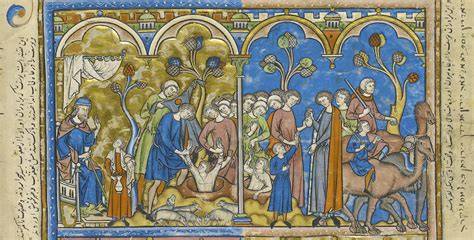
Medieval biblical art is a vast body of religious imagery created across Europe and the Mediterranean from late Antiquity through the sixteenth century to educate, inspire devotion, and communicate spiritual ideas visually. From manuscripts and frescoes to panel paintings, mosaics, sculptures, metalwork, and tapestries, these works transformed biblical narratives into visual forms that could be understood even without written language.
Across Europe, medieval art evolved over nearly a thousand years, shaping the visual culture of Europe through religious devotion and symbolic storytelling. Its principal subjects included scenes from the life of Christ, the Virgin Mary, biblical figures, saints, angels, apocalyptic visions, and episodes from both the Old and New Testaments. Medieval biblical art also developed alongside secular subjects and the visual traditions of medieval Jewish and Muslim cultures.
Historical Scope and Cultural Diversity
The collections include images and descriptive data related to the iconography of works of art produced between late Antiquity and the sixteenth century. Although the Index of Medieval Art was formerly known as the Index of Christian Art, it now includes secular subjects as well as a growing number of subjects from medieval Jewish and Muslim cultures.
Medieval biblical art was not a single, unchanging style. It developed over many centuries and differed according to region, patronage, medium, liturgical function, and cultural context. In cataloging and describing this material, we remain committed to pursuing the respectful and accurate representation of medieval visual traditions in all of their diversity.
What Defined Medieval Biblical Art?
Medieval art is primarily religious, created under Church patronage to educate, inspire devotion, and communicate spiritual ideas visually. Religious art was designed for churches, monasteries, and royal courts, often serving as visual scripture for largely illiterate audiences.
Biblical images therefore performed several functions at once. They decorated sacred spaces, supported prayer and contemplation, explained stories from scripture, communicated theological ideas, commemorated donors and saints, and made invisible spiritual realities visible through recognizable figures, gestures, colors, objects, and settings.
Religious Symbolism and Biblical Themes
Religious symbolism and biblical themes reflected the central role of Christianity in medieval life. Artists frequently represented events such as the Nativity, the Crucifixion, the Resurrection, the Transfiguration, the Annunciation, the Communion of the Apostles, and the lives of saints.
Narrative imagery was used to visually tell religious stories to audiences who could not read. A sequence of scenes could guide viewers through the chronology of salvation history, while a single image could combine several moments or place related episodes within one symbolic composition.
Hierarchical Scale and Flattened Perspective
Flattened perspective and hierarchical scale were central features of much medieval painting. Important figures were shown larger to emphasize their status, while secondary figures, architectural settings, and landscapes were arranged according to spiritual and narrative importance rather than optical realism.
This approach did not necessarily indicate a lack of artistic skill. It prioritized message and meaning over realism, allowing the composition to communicate theological hierarchy clearly. Christ, the Virgin Mary, angels, prophets, and saints could be enlarged or placed centrally because of their spiritual significance.
Gold, Color, and Decorative Pattern
Extensive use of gold leaf and decorative patterns symbolized divine light and heavenly spaces. Gold backgrounds could remove sacred figures from ordinary earthly surroundings and place them in a timeless spiritual realm.
Color also carried symbolic meaning. Gold backgrounds symbolized divine presence, while blue represented purity and holiness. The visual effect of luminous pigments, patterned surfaces, and reflective gold emphasized the sacred character of biblical scenes.
Simplified Figures and Expressive Gestures
Medieval artists often used simplified figures with limited anatomical accuracy, prioritizing message and meaning over realism. Bodies could be elongated, frontal, rigid, or arranged according to a formal visual scheme.
Gestures conveyed moral and religious meaning. Raised hands, pointing fingers, kneeling postures, embraces, blessings, and expressions of grief helped viewers identify the spiritual significance of an event and understand the relationships between the figures.
Major Forms and Media
From manuscripts and frescoes to panel paintings and tapestries, medieval artworks were created to educate, inspire faith, and convey spiritual truth. Biblical art also appeared in mosaics, sculptures, metalwork, ivory, enamel, stained glass, embroidered textiles, reliquaries, and liturgical objects.
Illuminated Manuscripts
Illuminated manuscripts combined biblical text with painted scenes, ornamental initials, borders, and symbolic imagery. Gospel books were especially important because they contained the accounts of Christ’s life and were often produced for churches, monasteries, bishops, and rulers.
The Nativity and the Transfiguration appear together in a Gospel Book from Bamberg, preserved at the Staatsbibliothek Bamberg as Msc.Bibl.94. Such combinations connected episodes from Christ’s earthly life with revelations of divine identity and glory.
Manuscript decoration could also incorporate botanical, medical, historical, and secular subjects. Galangal appears in Matthaeus Platearius’s Circa Instans, preserved at the Morgan Library & Museum in New York as MS M.873, folio 4, demonstrating the broader range of medieval illustrated books.
Frescoes and Wall Painting
Fresco cycles transformed church interiors into expansive visual narratives. They could cover apses, chapels, nave walls, vaults, and entrance areas, presenting biblical stories in a carefully ordered sequence.
The Scrovegni Chapel Frescoes by Giotto di Bondone transformed medieval painting by introducing believable human emotion, solid form, and coherent pictorial space, redefining how biblical narratives were visually communicated.
Frescoes and mosaics also emphasized the architectural structure of sacred spaces. A representation of the Virgin Mary and Christ Child occupies the semidome of the apse at Saint George in Kurbinovo, while a mosaic fragment depicting the face of a figure comes from the west wall of Santa Maria Assunta de Torcello.
Panel Paintings and Altarpieces
Panel paintings were central to medieval devotional practice and church decoration. They could be installed as altarpieces, displayed in chapels, used in private prayer, or assembled into complex structures with multiple wings and narrative compartments.
A landmark of late medieval painting, the Ghent Altarpiece is celebrated for its revolutionary use of oil paint, extraordinary realism, and complex religious symbolism. Van Eyck’s meticulous detail transformed European panel painting and influenced generations of artists.
Textiles and Orphrey Panels
Medieval biblical and religious imagery also appeared on valuable textiles and embroidered panels. Pairs of Angel Musicians and Heraldry are represented on orphrey panels preserved at the Victoria and Albert Museum in London, dated 1194-18.
Orphrey panels could enrich ecclesiastical garments and other ceremonial textiles through images of angels, saints, heraldic signs, and ornamental designs. Their visual language connected liturgical clothing with the sacred music, hierarchy, and ceremony of worship.
Mosaics
Mosaics used small pieces of stone, glass, or other materials to create durable images on walls, apses, and other architectural surfaces. Their reflective surfaces worked particularly effectively with gold and luminous colors, reinforcing the sense of divine presence.
The semidome of the apse at Saint George in Kurbinovo includes a detail of the Virgin Mary and Christ Child, while a mosaic fragment from the west wall of Santa Maria Assunta de Torcello preserves the face of a figure. These works demonstrate the importance of monumental images within medieval sacred architecture.
Metalwork and Small Devotional Objects
Small objects could carry biblical, saintly, and devotional imagery beyond the monumental environment of the church. A steatite plaque depicting Christ’s Crucifixion is preserved at the Victoria and Albert Museum in London as A.7-1932, obverse.
A gold ring associated with Thekla of Iconium is preserved at the Benaki Museum in Athens as ΓΕ 2107, obverse of bezel. Such objects connected personal devotion, commemoration, protection, and the veneration of holy figures.
An image of Christ receiving Communion appears on the Riazan’ Aër preserved at the Riazan’ Regional Art Museum as inventory number 3495. Liturgical textiles and objects could therefore represent central Christian mysteries as well as biblical figures and events.
Symbolism in Medieval Biblical Painting
Medieval artists relied on symbolism to communicate theological ideas clearly and effectively. These visual codes allowed paintings to function as spiritual texts, readable even without written language.
| Visual element | Symbolic meaning |
|---|---|
| Gold backgrounds | Divine presence |
| Blue | Purity and holiness |
| Size | Spiritual hierarchy |
| Gestures | Moral and religious meaning |
Symbolism could operate through individual objects, colors, gestures, facial expressions, spatial arrangements, and relationships between figures. A scene was often designed to communicate several levels of meaning simultaneously: the literal biblical event, its theological significance, and its relevance to prayer or salvation.
From Romanesque Solidity to Gothic Naturalism
Over time, medieval art evolved from the solid forms of Romanesque art to the elegance and naturalism of Gothic painting. This change affected the treatment of bodies, drapery, architecture, landscape, emotion, and pictorial space.
Romanesque works often emphasize solidity, clarity, formal structure, and monumental presence. Figures may appear strongly outlined and hieratically arranged, while compositions concentrate on legibility and symbolic order.
Gothic painting introduced greater elegance, more complex movement, refined linear rhythms, richer emotional expression, and increasing attention to the physical world. Biblical scenes became more intimate and narratively detailed without losing their devotional function.
Important Medieval Artists
Giotto di Bondone
Giotto revolutionized medieval painting by introducing believable human emotion, solid three-dimensional figures, and coherent spatial settings. His work marks a decisive break from flat Byzantine styles and signals the beginning of naturalism in European art.
Giotto’s Scrovegni Chapel cycle is especially significant because it makes biblical narratives emotionally immediate. Figures interact through recognizable gestures, grief, tenderness, fear, and compassion, while the arrangement of bodies and architecture creates a convincing sense of dramatic space.
Fra Angelico
A Dominican friar and painter, Fra Angelico combined medieval spirituality with emerging Renaissance techniques. His serene figures, luminous colors, and devotional clarity represent the spiritual refinement of late medieval art.
The Annunciation by Fra Angelico exemplifies late medieval spirituality through luminous color, balanced composition, and gentle emotional expression, blending medieval religious tradition with emerging Renaissance naturalism.
Jan van Eyck
Working at the transition between medieval religious paintings and Renaissance art, van Eyck perfected oil painting techniques, achieving extraordinary realism, symbolic detail, and surface depth that transformed Northern European painting.
His work demonstrates how a medieval biblical image could retain complex religious symbolism while incorporating meticulous observation of materials, textiles, architecture, faces, light, and reflective surfaces.
Famous Medieval Biblical Artworks
The Ghent Altarpiece by Jan van Eyck
A landmark of late medieval painting, the Ghent Altarpiece is celebrated for its revolutionary use of oil paint, extraordinary realism, and complex religious symbolism. Van Eyck’s meticulous detail transformed European panel painting and influenced generations of artists.
The altarpiece represents the capacity of late medieval art to combine theological complexity with technical precision. Its religious imagery is structured through a carefully coordinated ensemble of figures, symbols, surfaces, and narrative references.
The Annunciation by Fra Angelico
This serene devotional painting exemplifies late medieval spirituality through luminous color, balanced composition, and gentle emotional expression, blending medieval religious tradition with emerging Renaissance naturalism.
The subject presents one of the central biblical events in Christian art: the announcement to the Virgin Mary that she will become the mother of Christ. Its restrained atmosphere and carefully ordered composition support contemplation rather than dramatic spectacle.
The Scrovegni Chapel Frescoes by Giotto di Bondone
Giotto’s fresco cycle transformed medieval painting by introducing believable human emotion, solid form, and coherent pictorial space, redefining how biblical narratives were visually communicated.
The cycle demonstrates the power of sequential storytelling. Individual episodes become part of a larger theological and emotional structure in which the viewer follows the unfolding history of salvation through clearly organized scenes.
Together, these masterpieces by Jan van Eyck, Fra Angelico, and Giotto represent the height of medieval painting and its transition toward Renaissance art, remaining essential works in the study of Western art history.
Examples in Medieval Art Collections
The study of medieval biblical art brings together monumental works, manuscript pages, liturgical objects, fragments, and examples of personal devotion. A database devoted to medieval iconography can therefore include works made in different regions, media, and historical periods.
- Detail of the Virgin Mary and Christ Child, semidome of the apse, Saint George at Kurbinovo.
- The Nativity and the Transfiguration, Gospel Book, Bamberg, Staatsbibliothek Bamberg, Msc.Bibl.94.
- Face of a figure, mosaic fragment from the west wall of Santa Maria Assunta de Torcello.
- Christ, Communion, Riazan’ Aër, Riazan’ Regional Art Museum, Riazan’, inventory number 3495.
- Christ, Crucifixion, steatite plaque, Victoria and Albert Museum, London, A.7-1932, obverse.
- Thekla of Iconium, gold ring, Benaki Museum, Athens, ΓΕ 2107, obverse of bezel.
- Pairs of Angel Musicians and Heraldry, orphrey panels, Victoria and Albert Museum, London, 1194-18.
These examples show that medieval biblical art cannot be limited to large paintings. Biblical and Christian subjects were adapted to manuscripts, wall mosaics, devotional jewelry, liturgical textiles, stone plaques, and other objects whose functions ranged from public worship to private devotion.
How Medieval Biblical Art Communicated with Viewers
Medieval biblical artworks were created to educate, inspire faith, and convey spiritual truth. Their compositions made complex religious narratives accessible through repeated visual signs and recognizable narrative structures.
Viewers could identify sacred figures through attributes, gestures, clothing, halos, inscriptions, symbolic colors, and their position within the composition. The same visual codes could operate across different media, allowing a scene from scripture to remain legible in a fresco, manuscript, mosaic, textile, or small devotional object.
Images also encouraged emotional and spiritual participation. The suffering of Christ, the compassion of the Virgin Mary, the devotion of saints, the music of angels, and the revelation of divine glory were presented not only as historical or sacred events but also as subjects for contemplation and prayer.
The Continuing Importance of Medieval Biblical Art
Medieval art shaped the visual language of Europe for centuries and directly influenced the Renaissance art movement. Its focus on meaning, devotion, and craftsmanship continues to resonate with modern viewers and art lovers.
Today, medieval paintings are valued not only for their religious significance but also for their artistry, historical insight, and enduring beauty. They are essential to understanding the evolution of Western art.
The period also remains important because it reveals how different societies represented sacred history, organized visual knowledge, and connected images with ritual, authority, memory, and identity. Medieval biblical art is therefore both a history of religious representation and a record of changing ideas about space, bodies, emotion, materials, and artistic skill.