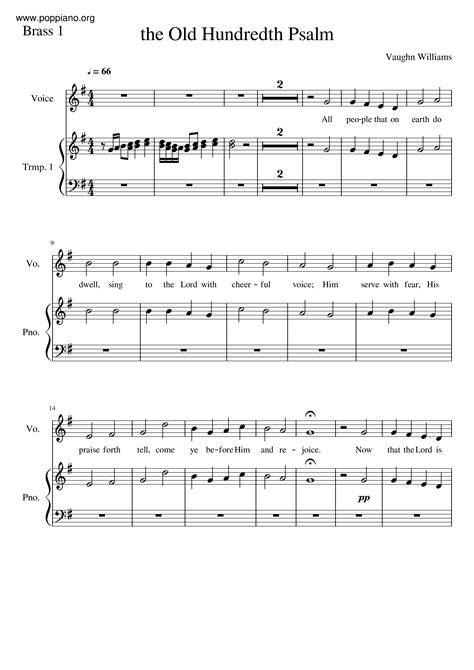
The Old Hundredth is the celebrated tune most closely associated with William Kethe’s metrical paraphrase of Psalm 100, “All People that on Earth Do Dwell.” Its melody was included in the Genevan Psalter and is generally attributed to the French composer and music theorist Loys “Louis” Bourgeois, while its English text was prepared by Kethe and published in the Anglo-Genevan Psalter of 1561.
The tune became one of the best-known melodies in Christian worship because a single long-meter melody could be paired with several texts. In the English-speaking world it was linked especially with Psalm 100, later became familiar as the tune of the Doxology, and was known among English Protestants, Puritans, Separatists, and the Pilgrims of Plymouth Colony.
Psalm 100 and the meaning of the Old Hundredth
One of the great psalms of thanksgiving in the Bible is Psalm 100. It reads: Make a joyful noise to the Lord, all the earth! Serve the Lord with gladness! Come into his presence with singing! Know that the Lord, he is God! It is he who made us, and we are his, We are his people, the sheep of his pasture. Enter his gates with thanksgiving, And his courts with praise! Give thanks to him; bless his name! For the Lord is good; His steadfast love endures forever, And his faithfulness to all generations.
Throughout church history, Christians have been taking psalms, like Psalm 100, and putting them to music so they can be sung in worship. Did you catch the thanksgiving part? Enter his gates with thanksgiving, . give thanks to him; bless his name!
The long meter tune (8.8.8.8.) to Psalm 100 in the Scottish Psalter is called the “Old Hundredth.” Its connection with Psalm 100 comes from the pairing of the melody with a metrical English version of the psalm rather than from the tune’s original use.
William Kethe’s “All People that on Earth Do Dwell”
Psalm 100 was actually paraphrased into a hymn during the Reformation period and first appeared in the Anglo-Genevan Psalter of 1561. The paraphrase is attributed to Scottish clergyman and Bible translator William Kethe (d. 1594).
Kethe fled his homeland for Switzerland due to the persecutions of the Catholic Queen Mary in England who went on a rampage against Protestants. While in Switzerland, Kethe helped translate the Geneva Bible into English. He also contributed 25 psalms to the Anglo-Geneva Psalter, and then carried that new hymnbook back to England after the restoration of Protestantism by Queen Elizabeth I.
The English-language text is attributed to William Kethe (d. c. 1594). According to the Rev. Carlton Young, editor of the UM Hymnal, very little is known about Kethe although he is believed to have been a Scotsman who was exiled to the European continent during the reign of Roman Catholic Queen “Bloody” Mary (1555-1558).
He may have served as a messenger to others in exile in Basel and Strassburg, working with scholars to translate the Geneva Bible (1560). After Kethe returned to England in 1560 or 1561, he served as a rector of the church of Childe Okeford until his death. From 1563-1569 he served as a chaplain to the English troops serving under the Earl of Warwick.
Kethe’s paraphrase of Psalm 100 is called “All People that on Earth do dwell,” otherwise known as the “Old Hundredth,” The words are usually sung to the tune of the “Doxology.”
All people that on earth do dwell,
Sing to the Lord with cheerful voice.
Him serve with fear, His praise forth tell;
Come ye before Him and rejoice.
The Lord, ye know, is God indeed;
Without our aid He did us make;
We are His folk, He doth us feed,
And for His sheep He doth us take.
O enter then His gates with praise;
Approach with joy His courts unto;
Praise, laud, and bless His Name always,
For it is seemly so to do.
For why? the Lord our God is good;
His mercy is forever sure;
His truth at all times firmly stood,
And shall from age to age endure.
To Father, Son and Holy Ghost,
The God Whom Heaven and earth adore,
From men and from the angel host
Be praise and glory evermore.
The source of the melody
The melody that Kethe used for the “Old Hundredth” is one of the most famous Christian hymn tunes. It goes back to the Geneva Psalter of 1562.
Its likely composer - a subject debated at some length in the nineteenth century - was the French music theorist and compiler of Calvinist hymns, Loys Bourgeois (c. 1510-c. 1560). Bourgeois’s tune was initially used to set the 134th Psalm.
Loys “Louis” Bourgeois (c. 1510-1560) was a French composer and the main compiler of tunes for the Genevan Psalter (first edition in 1539, with succeeding editions in 1542, 1543, 1551, and 1562). The tune OLD 100TH first appeared in the 1551 edition of the Psalter; it is unclear which tunes were composed by Bourgeois, but this one is generally attributed to him.
The tune was written by Louis Bourgeois for Psalm 134 in the Geneva Psalter and was adapted by William Kethe for Psalm 100 in the Scottish Psalter of 1561.
The melody that we sing to the “Old Hundredth” was included in the Genevan Psalter, but originally put to the French version of Psalm 134. It was William Kethe who wed this melody to his paraphrase of Psalm 100-All People That On Earth Do Dwell.
Louis Bourgeois and the Genevan Psalter
Bourgeois was invited to come to Geneva when John Calvin returned there in 1541 for the second part of his pastorate. In 1545 he became the chief musician of Geneva.
Calvin brought congregational singing back into the church and wanted to put an emphasis on singing God’s Word. He also wanted a psalter for use in worship.
So in 1547 Louis Bourgeois was given the job of providing tunes for a new metrical psalms. He was largely responsible for the Geneva Psalter. His job was completed two years before Calvin’s death in 1562.
The followers of John Calvin (1509-1564) sang only metrical psalms, or psalms set in poetic meter based the book of Psalms. According to Calvin, these metrical versions should neither add to nor take away from any portion of Scripture.
Calvin employed the skills of poet Clément Marot (1496-1544) to translate the psalms into French singing versions. The work was continued by Calvin’s successor and poet, Théodore de Bèze (1519-1605).
The French practice was to assign a different tune to virtually every psalm. The English approach to setting the psalms was to use a limited number of meters (short meter, common meter and long meter) and therefore sing all of the psalms to a relatively small number of tunes.
From the French Psalm 134 to English Psalm 100
The Old Hundredth melody therefore has two important stages in its history. It first appeared in the Genevan tradition as a setting for Psalm 134, and it later became attached to William Kethe’s English metrical paraphrase of Psalm 100.
The Geneva Psalter supplied the musical framework, while the Anglo-Genevan Psalter supplied the English text that made the melody famous throughout the English-speaking world. Then he included it in his Anglo-Genevan Psalter and shared it with the rest of the English speaking world.
In the Anglophone world the melody came to be linked with a translation of the 100th Psalm by William Kethe (d. 1594), who worked on both the Geneva Bible (1560) and the Anglo-Genevan ‘metrical’ Psalter (1561), which contained settings of the Book of Psalms in rhyming vernacular poetry.
| Element | Historical association |
|---|---|
| Psalm text | Psalm 100 |
| English paraphrase | William Kethe, “All People that on Earth Do Dwell” |
| Original Genevan association | French version of Psalm 134 |
| Melody | Generally attributed to Loys “Louis” Bourgeois |
| Meter | Long meter, 8.8.8.8. |
| Important psalters | Geneva Psalter; Anglo-Genevan Psalter; Scottish Psalter |
The text behind Kethe’s paraphrase
The Authorized (King James) Version of the Bible was not available until 1611. The version used as a basis for Kethe’s translation would have been Goostly Psalmes, a translation of Martin Luther’s psalm versions, available as early as 1539.
This translation by Miles Coverdale (c. 1488-1569) is the standard translation for the Anglican Church and is still used today. The complete Coverdale translation of Psalm 100 follows:
O be joyful in the Lord, all ye lands; serve the Lord with gladness, and come before his presence with a song. Be ye sure that the Lord he is God; it is he that hath made us, and not we ourselves. We are his people, and the sheep of his pasture. O go your way into his gates with thanksgiving, and into his courts with praise; be thankful unto him, and speak good of his Name. For the Lord is gracious, his mercy is everlasting, and his truth endureth from generation to generation.
Kethe’s version uses the same central themes: universal praise, joyful service, the sovereignty of God, the pastoral image of God’s people as sheep, entrance into God’s gates with praise, and the permanence of divine mercy and truth.
The long-meter structure
The Old Hundredth belongs to long meter, conventionally written as 8.8.8.8. This means that each stanza is made up of four lines, with eight syllables in each line.
This structure made the melody highly adaptable. The English approach to setting the psalms was to use a limited number of meters (short meter, common meter and long meter) and therefore sing all of the psalms to a relatively small number of tunes.
This long meter (L.M.) text has been modified in a few places for current hymnals. The original stanzas one and two follow with modifications in parentheses:
All people that on earth do dwell, sing to the Lord with cheerful voice: Him serve with fear (mirth), his praise forth tell, come ye before him and rejoice.
The Lord ye know is God indeed, (Know that the Lord is God indeed) without our aid he did us make; We are his flock (folk), he doth us feed, and for his sheep he doth us take.
Psalm 100 in the Scottish Psalter
Music score and words (Scottish Psalter)
Psalm 100 - Scottish Psalter
1 All people that on earth do dwell,
Sing to the Lord with cheerful voice.
2 Him serve with mirth, his praise forth tell,
Come ye before him and rejoice.
3 Know that the Lord is God indeed;
Without our aid he did us make:
We are his flock, he doth us feed,
And for his sheep he doth us take.
4 O enter then his gates with praise,
Approach with joy his courts unto:
Praise, laud, and bless his name always,
For it is seemly so to do.
5 For why? the Lord our God is good,
His mercy is for ever sure;
His truth at all times firmly stood,
And shall from age to age endure.
Other texts sung to the Old Hundredth melody
Because the tune is written in long meter, it can support more than one metrical paraphrase of Psalm 100. Isaac Watts’ rendition of Psalm 100 is written for long meter and can be sung to this tune.
Psalm 100 - Isaac Watts
Ye nations round the earth, rejoice
Before the Lord, your sovereign King;
Serve him with cheerful heart and voice,
With all your tongues his glory sing.
The Lord is God; 'tis he alone
Doth life, and breath, and being give;
We are his work, and not our own,
The sheep that on his pastures live.
Enter his gates with songs of joy,
With praises to his courts repair;
And make it your divine employ
To pay your thanks and honors there.
The Lord is good, the Lord is kind,
Great is his grace, his mercy sure;
And the whole race of man shall find
His truth from age to age endure.
Why the tune is also called the Doxology
The “Doxology” that is usually sung to the melody of OLD 100TH is not by Kethe, but is a later paring to this tune of a text by Thomas Ken (1637-1711).
The tune is used for the Doxology that appears in most Baptist hymnals (“Praise God from whom all blessings flow. ”).
Thus, the name “Old Hundredth” refers to the tune’s association with Psalm 100, while “Doxology” refers to another text commonly sung to the same melody. The melody itself is older than the Doxology pairing.
The melody in the English Reformation
The tune was sung by people of the English Reformation-including those Puritans and Separatists who believed in only singing psalms or psalm paraphrases in worship.
In this setting, the Old Hundredth was not merely a familiar hymn tune. It represented the Reformation emphasis on congregational singing and on using vernacular versions of biblical psalms in worship.
In Colossians 3.16 we are told to, Let the word of Christ dwell in you richly, teaching and admonishing one another in all wisdom, singing psalms and hymns and spiritual songs, with thankfulness in your hearts to God.
“Let the word of Christ dwell in you richly in all wisdom; teaching and admonishing one another in psalms and hymns and spiritual songs, singing with grace in your hearts to the Lord” (Colossians 3:16).
We urge churches to sing the Psalms as God commands and to continually expand their repertoire of songs and hymns to include an ever-increasing number of those of challenging theological depth.
The Old Hundredth and the Pilgrims
Do you ever wonder what songs the American Pilgrims sang? I know one of them. It is probably the only one still printed in some of our hymnbooks. It’s called the “Old Hundredth” and it may have been sung at the first Thanksgiving!
Which means, of course, that because of its popularity, the Pilgrims of Plymouth Colony would have known and sung this hymn in their worship. In fact, it’s probably the only hymn in our modern hymnbooks (for those who still use hymnbooks) that the Pilgrims actually sang.
This is probably the oldest continuously sung congregational song in North America. When the first British explorers arrived in Jamestown Island on May 14, 1607, to establish the Virginia colony on the banks of the James River near Chesapeake Bay, they undoubtedly brought with them a Psalter, a collection of metrical psalms.
Most likely, the book was Psalms of David in English Metre, by Thomas Sternhold and others (1561). The followers of John Calvin (1509-1564) sang only metrical psalms, or psalms set in poetic meter based the book of Psalms.
It was not long before a Psalter was published in the American colonies: The Bay Psalm Book (1640) was the first book published in North America.
The Old Hundredth’s connection with early American worship rests on the international circulation of English psalters and on the prominence of metrical psalm singing among English Protestants. The melody’s familiarity made it a natural candidate for worship among settlers who carried this tradition across the Atlantic.
The tune as an international phenomenon
Suppose we could name the most popular tune in Victorian Britain - what should we make of it, and how might we write its history? In this chapter I take up these questions by pursuing the case of the Old Hundredth psalm tune, which was, if not the most popular tune of the era, then certainly among the most widely known and performed.
One measure of its success is found in my epigraph, the opening line of an 1883 article in The Quiver, an illustrated London periodical aimed at a broadly middle-class readership, founded by the evangelist and temperance supporter, John Cassell (1817-1865).
I may safely presume, at the outset, that a very small proportion of my readers are in the unhappy position of a friend of mine, to whom I recently played the famous tune we are about to consider, and who surprised me with the remark, that he ‘could not say he had heard it before.’
What brings significance to this anecdote is not the author, who remains nameless, but the fact that it was also printed the same year on the other side of the Atlantic, in a Sunday Magazine founded by the English-born engraver Frank Leslie (1821-1880).
As we shall see, the Old Hundredth was a truly international phenomenon.
The melody in later public worship
Twentieth-century English composer Ralph Vaughan Williams (1872-1958) composed an arrangement of this hymn for the coronation of Queen Elizabeth II, June 2, 1953.
The tune was adapted by Vaughn Williams for the coronation of Queen Elizabeth II in 1953.
This arrangement demonstrated the melody’s ability to function not only as a congregational tune but also as a large-scale ceremonial setting. Its public use connected a Reformation-era psalm melody with one of the major state occasions of the twentieth century.
The Old Hundredth has also received extensive treatment in organ and congregational music. Its continued appearance in hymn accompaniments, introductions, harmonizations, descants, preludes, and arrangements reflects the tune’s durable place in church music.
| Period | Development |
|---|---|
| Sixteenth century | The melody appears in the Genevan Psalter and is associated with Psalm 134. |
| 1561 | William Kethe’s metrical paraphrase appears in the Anglo-Genevan Psalter. |
| English Reformation | The tune becomes known among English Protestants, Puritans, and Separatists. |
| Seventeenth century | The melody is carried into English-speaking settlements in North America. |
| Victorian era | The Old Hundredth is described as among the most widely known and performed tunes. |
| 1953 | Ralph Vaughan Williams prepares an arrangement for the coronation of Queen Elizabeth II. |
Psalm 100 and Christian worship
Psalm 100 is another psalm of praise in the Messianic kingdom. It is a little jewel of prophecy of infinite value. This is the theme of many psalms. See Ps. 22:25-31; 33:1-22; 48:10-11; 57:7-11; 66:1-8; 68:3-4, 24-29, 31-35; 71:22-24; 72:17-19; 81:1-3; 87:5-7; Ps. 92-100 and Ps. 145-150.
The whole earth will worship Christ as God (Ps. 100:1) and learn of Him (Ps. 100:3). Joy will abound (“a joyful noise . with gladness” Ps. 100:1-2).
The millennial temple will resound with praise by redeemed Israel, and the Church, and international pilgrims (“his gates . his courts” Ps. 100:4).
“The prevailing thought throughout this psalm is that Jesus is crowned on earth at last. He has been acclaimed the world’s rightful king. We are not merely following the plea of a godly Levite for the reunification of the tribes. This psalm goes far beyond that. Here we have the fulfillment of Isaiah’s vision of a millennial earth, of Jerusalem as the world’s capital, of Israel as head of the nations, of the Hebrew people as administrators of the new covenant, and of the Lord reigning in person as king. Isaiah envisioned the temple in Jerusalem as ‘a house of prayer for all peoples’ (Isa. 56:7). He foresaw the day when the Lord would ‘gather together all nations and tongues to come and see His glory,’ the day when ‘all flesh shall come in and bow down before Me, saith the Lord’ (Isa. 66:18,23). As Rotherham says: ‘Unless we are prepared to turn the whole Old Testament into allegory, a hundred texts are at hand to shew that there will be such a center in the final theocracy.’ . During the millennium the gatherings in Jerusalem will be joyous pilgrimages for all mankind. There will be so much to see, so much to learn. Jerusalem and the temple will be the fountainhead of everything. Jesus will be there. The twelve apostles will be there, sitting on twelve thrones and judging the twelve tribes of Israel” (John Phillips).
Psalm 100 can be applied to the church age, as the gospel call for all people to be saved and the call for believers to worship the Lord, but the literal fulfillment is in the millennial age.
“How often is this Psalm used in a spiritualised way, making the gates and the courts some church building. But we worship in Spirit and in Truth and not in an earthly house. The gates and courts have reference to that future Temple, which will be a house of prayer for all nations” ( Annotated Bible).
The Old Hundredth in hymnbooks and musical practice
The melody’s survival has been supported by its flexibility. It can be sung with Kethe’s Psalm 100, with Isaac Watts’ version, and with Thomas Ken’s Doxology. It can also be presented in harmonized congregational arrangements, organ settings, descants, introductions, interludes, and ceremonial adaptations.
This long meter (L.M.) text has been modified in a few places for current hymnals. The original stanzas one and two follow with modifications in parentheses: Him serve with fear (mirth), and We are his flock (folk).
The “Doxology” pairing has further strengthened the tune’s familiarity. A congregation may recognize the melody even when the name “Old Hundredth” is not used, because the tune is encountered through the text “Praise God from whom all blessings flow.”
Dr. Young notes that Kethe’s translation was alluded to in Shakespeare’s Merry Wives of Windsor.
Why the melody has endured
The Old Hundredth combines several features that helped it endure: a memorable melodic profile, a clear long-meter structure, a text based directly on Psalm 100, and the ability to carry other words without alteration.
Its history also follows the major channels through which Protestant congregational song spread: the Genevan Psalter, the English Reformation, metrical psalters, English-speaking colonial settlements, hymnbooks, public ceremonies, and church music collections.
It is probably the only hymn in our modern hymnbooks (for those who still use hymnbooks) that the Pilgrims actually sang. The words of Kethe continue to preserve that connection: Sing to the Lord with cheerful voice. Him serve with fear, His praise forth tell.