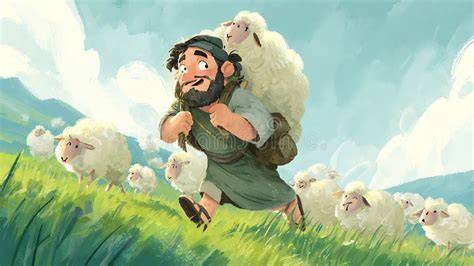
The Parable of the Lost Sheep in Luke 15:1-7 teaches that every person matters deeply to God, that Jesus actively seeks those who are spiritually lost, and that heaven rejoices when one sinner repents and is restored. The parable is Jesus’ response to Pharisees and scribes who criticized Him for receiving sinners and eating with them.
Jesus presents God as a shepherd who refuses to treat the loss of one sheep as insignificant. The ninety-nine are safe, but the one lost sheep is in danger; therefore, the shepherd searches until he finds it, carries it home, and celebrates its recovery.
The Context of Luke 15:1-7
In Luke 15 we encounter a new scene in which the Pharisees and scribes complain of Jesus’ association with publicans and sinners (15:1-2). We have already encountered this criticism in 5:27-32 (Matt 9:11; Mark 2:16), in Luke 7:39, and will encounter it again in 19:7.
Three parables follow that serve both as a defense of Jesus’ ministry to such outcasts (cf. 14:15-24) and an appeal to his opponents to join in celebrating their entrance into the kingdom (15:7, 10, 28, 31-32). The parables are connected by theme (the joy of the lost being found) and by key words (“lost” and “found,” 15:6, 9, 24, 32; “rejoice” and “celebrate,” 15:6, 9, 24, 32).
Together the three parables form a tightly knit unit with a single, strongly Lukan theme-God’s love for outcasts and sinners.
Jesus and Those Considered “Sinners”
“Then all the tax collectors and the sinners drew near to Him to hear Him. 2 And the Pharisees and scribes complained, saying, ‘This Man receives sinners and eats with them.’” - Luke 15:1-2 NKJV
According to the text, tax collectors and sinners drew near to Jesus because they longed to hear Him. It is significant that Jesus attracted sinners while the Pharisees repelled them.
This causes me to wonder how people feel about some of our churches today. Are the lost attracted or repelled by our church? Lost sinners came to Jesus, not because He catered to them or compromised His message, but because He cared for them.
He understood their needs and tried to help them, while the Pharisees criticized them and kept their distance (see Luke 18:9-14). The Pharisees had a knowledge of God and His laws. They desired personal purity, but they lacked a love for lost souls.
Yet Jesus associated with “sinners” to offer them salvation through repentance and faith, not to participate in their sin. It is not noble to simply mingle with the suffering, Jesus loved them and desired to save them.
Jesus was not trying to win a popularity contest. He honestly had their best interest at heart. “He receives sinners,” scoffed the scribes and Pharisees in an attempt to put Jesus down. But what a marvelous truth. He does indeed receive sinners.
The religious community might reject me, high society might refuse me-but Jesus Christ will always receive me.
The Contrast Between Jesus and the Pharisees
Another way to look at this is to consider that those who considered themselves paragons of righteousness felt so uncomfortable in the presence of Jesus, whereas those who admittedly made no claim to righteousness felt drawn to the Savior.
Undoubtedly it was the hypocrisy of the former and the lack of pretense of the latter that made the difference (see Luke 18:9-14). The one class felt no need of the blessings Jesus had to offer, the other class realized its need and made no effort to conceal it (see Matt. 5:3; Mark 2:5; Luke 4:26; 5:8).
The one was content with its own righteousness; the other knew that it had no righteousness of its own to offer. We would do well to ask ourselves how we feel in the presence of Jesus.
Jesus uses the parable not merely to defend His actions but also to expose the spiritual danger of self-righteousness. The people who admit their need come to Jesus, while those who believe they are already righteous may fail to recognize that they too need to be found.
The Three Parables in Luke 15
This collection of three parables highlights the lost among us: a lost animal (sheep), money, and a child (son). They include two living creatures and one object of exchange necessary for living.
Jesus deploys the parables because of the Pharisees and their scribes in his audience who object to Jesus’ regular and intimate association with so-called “sinners and tax collectors.” Yet if the Pharisees and scribes view “sinners and tax collectors” as lost, then all the more reason they should celebrate rather than complain about the time Jesus spends with them.
Jesus has come to call to repentance those who recognize they are spiritually ill to the degree that they need a physician (5:31), and to raise the consciousness of the self-righteous who think they have no need of repentance.
The three parables share a common structure:
- Something or someone considered valuable is characterized as out of place or lost.
- It or he is found, brought, or returns home.
- The owner, friends, family, and neighbors celebrate that what was lost is found.
- A relationship is restored.
Common language and themes are: lost (apolesa), home (oikos/oikia), found (euron), friends (philoi/philas), neighbors, community celebration, and joy over one sinner who repents.
The Meaning of the Lost Sheep
“So He spoke this parable to them, saying: 4 ‘What man of you, having a hundred sheep, if he loses one of them, does not leave the ninety-nine in the wilderness, and go after the one which is lost until he finds it? 5 And when he has found it, he lays it on his shoulders, rejoicing. 6 And when he comes home, he calls together his friends and neighbors, saying to them, “Rejoice with me, for I have found my sheep which was lost!”’” - Luke 15:3-6 NKJV
In the first parable a certain human (anthropos) discovered that out of one hundred sheep, one strayed from the fold. Thus, he leaves the ninety-nine together in the wilderness to bring the other one home.
The one lost sheep drifted from the fold and thus is in greater danger. Home should be a safe place for those that stray and those that stay. When the shepherd finds the one lost sheep, he calls his friends and neighbors-his community-together to celebrate.
Community is a place where we can lose and recover, without judgment.
Sheep Become Lost Gradually
Do you know how sheep get lost? They nibble their way into lostness. They move from one tuft of green grass to the next. They keep moving along from tuft to tuft, and when they’re done nibbling they can’t find their way back to the shepherd and they’re lost.
Some of us know what that is-to nibble ourselves bit by bit into the far country.
It has often been noted that the way a sheep gets lost is that it nibbles its way from tuft of grass to tuft of grass not looking up until it is out of sight of the flock.
Like sheep, we are all susceptible to slowly losing our center, not one dramatic event, but slowly eroding our commitments, holding back, making exceptions to our Christian values, then we look up and realize we have wandered far away and wonder how it happened.
The Shepherd Notices One Missing Sheep
You might think that if someone possesses 100 sheep he would not mind losing just one. Especially if it will take extreme effort to recover that one sheep.
It is very likely that the shepherd would not notice the sheep was missing until evening time when he would bring all his sheep to the sheep pen and count them. Oftentimes shepherds would bring their flocks together into one area wherein all of the shepherds would watch the combined flock.
The next day, they would take their individual flocks into separate feeding areas. How did they separate the sheep? Each had a different song, chant, or call that their own sheep recognized-even as Jesus alluded in John 10:4.
The shepherd knows exactly which sheep is missing, not a generic sheep. A good shepherd knows the personality of each sheep and which ones are more likely to get lost. In another place in the Bible, Jesus is depicted as the good shepherd, who calls the sheep by name.
Why the Shepherd Leaves the Ninety-Nine
When the shepherd leaves the ninety-nine sheep to go after the one it does not lower their value, they were safe, it is the lost sheep that is in danger. The shepherd’s determination to go after the one highlights how much he values each animal.
Imagine with me. It is the end of the day. The shepherd is tired, it is getting dark, and the temperatures are dropping. It’s becoming more dangerous and less comfortable to be wondering about.
Now it is time to cozy up next to a fire, eat, relax, and share stories and songs with the other shepherds. But instead, the shepherd leaves the ninety-nine sheep and goes after the one that is missing.
The shepherd ignores his aching feet, the cold air, and stumbles in the darkness looking for the lost sheep. Maybe he stubs his toe on a rock he didn’t see, or slips on some sand over a rock, scrapes his shins, maybe his throat hurts from calling for the sheep.
He is tired, it has been a long day already, but his love for the one sheep keeps him going. He may be uncomfortable but he knows the lost sheep is suffering even more.
The Danger of Being Lost
The lost sheep cannot save itself, she can’t defend herself against predators, and she can’t find her way back unless someone comes to her rescue that lost sheep will die.
The sheep is scared, paralyzed by fear and anxiety, it can barely cry for help. The shepherd knows this and refuses to give up on that one lost sheep.
Every single sheep matters. The shepherd finally finds the sheep. But he does not punish the sheep for getting lost.
He does not kick the sheep all the way back to the sheepfold to teach it a lesson. He takes the lost sheep, the sheep that caused him all this discomfort, hassle, and pain, and places that sheep on his shoulders and carries it back to safety.
The Shepherd as an Image of God
The metaphor of a shepherd is used for God in Ps 23:1-4; Ezek 34:11-16; and Jesus also uses it in John 10:11-15. The idea of God being a shepherd is not new. However, Jesus uses it to illustrate a specific point.
The shepherd in the parable is not indifferent to the missing sheep. He does not calculate that ninety-nine percent is sufficient. The missing sheep remains valuable because it belongs to him and because its life is in danger.
When the shepherd arrives back he does not tell all his friends about how much trouble this single sheep caused him. He does not describe how foolish the sheep is for getting lost, or how difficult it was to find and rescue the lost sheep.
Instead, he celebrates that the lost sheep has been found.
The Shepherd’s Personal Concern
The shepherd, on looking over his little flock of one hundred, can only count ninety-nine. He counts them again, and he notices that a certain one has gone: it may be a white-faced sheep with a black mark on its foot; he knows all about it, for “the Lord knoweth them that are his.”
The shepherd has a photograph of the wanderer in his mind’s eye, and now he thinks but little of the ninety and nine who are feeding in the pastures of the wilderness, but his mind is in a ferment about the one lost sheep.
This one idea possesses him: “a sheep is lost!” This agitates his mind more and more-“a sheep is lost.” It masters his every faculty.
The Lost Sheep Belongs to the Shepherd
What is it which makes the Great Shepherd lay so much to his heart the loss of one of his flock? What is it that makes him agitated as he reflects upon that supposition-“if he lose one of them”?
I think it is, first, because of his property in it. The parable does not so much speak of a hired shepherd, but of a shepherd proprietor. “What man of you having an hundred sheep, if he lose one of them.”
Jesus, in another place, speaks of the hireling, whose own the sheep are not, and therefore he flees when the wolf comes. It is the shepherd proprietor who lays down his life for the sheep.
It is not a sheep alone, and a lost sheep, but it is one of his own lost sheep that this man cares for.
This parable is not written about lost humanity in the bulk-it may be so used if you please-but in its first sense it is written about Christ’s own sheep; as also is the second parable concerning the woman’s own money; and the third, not concerning any prodigal youth, but the father’s own son.
Jesus has his own sheep, and some of them are lost: yea, they were all once in the same condition; for “all we like sheep have gone astray; we have turned every one to his own way.”
The parable refers to the unconverted, whom Jesus has redeemed with his most precious blood, and whom he has undertaken to seek and to save: these are those other sheep whom also he must bring in.
Christ’s Ownership and Redemption
The sheep of Christ are his long before they know it-his even when they wander; and when they are brought into the fold by the effectual working of his grace they become manifestly what they were in covenant from of old.
The sheep are Christ’s, first, because he chose them from before the foundations of the world-“Ye have not chosen me, but I have chosen you.” His, next, because the Father gave them to him.
How he dwells upon that fact in his great prayer in John xvii.: “Thine they were, and thou gavest them me. Father, I will that they also, whom thou hast given me, be with me where I am.”
We are the Lord’s own flock, furthermore, by his purchase of us; he says: “I lay down my life for the sheep.” It is nearly nineteen centuries ago since he paid the ransom price, and bought us to be his own; and we shall be his, for that purchase-money was not paid in vain.
And so the Saviour looks upon his hands, and sees the marks of his purchase; he looks upon his side, and sees the token of the effectual redemption of his own elect unto himself by the pouring out of his own heart’s blood before the living God.
This thought, therefore, presses upon him, “One of my sheep is lost.”
God’s Compassion for the Lost
Secondly, he has yet another reason for this all-absorbing thought, namely, his great compassion for his lost sheep. The wandering of a soul causes Jesus deep sorrow; he cannot bear the thought of its perishing.
Such is the love and tenderness of his heart that he cannot bear that one of his own should be in jeopardy. He can take no rest as long as a soul for whom he shed his blood still abides under the dominion of Satan and under the power of sin.
Therefore the Great Shepherd neither night nor day forgetteth his sheep: he must save his flock, and he is straitened till it be accomplished.
He has a deep sympathy with each stray heart. He knows the sorrow that sin brings, the deep pollution and the terrible wounding that comes of transgression, even at the time; and the sore heart and the broken spirit that will come of it before long.
And so the sympathetic Saviour grieves over each lost sheep, for he knows the misery which lies in the fact of being lost.
The Shepherd Searches Until He Finds
Our Lord Jesus Christ while he was here below was continually in the pursuit of lost souls. He was seeking lost men and women, and it was for this reason that he went down among them, even among those who were most evidently lost, that he might find them.
He took pains to put himself where he could come into communication with them, and he exhibited such kindliness towards them that in crowds they drew near to hear him.
He tells them that he was seeking the lost, and where should he be found but among those whom he was seeking? Should a physician shun the sick? Should a shepherd avoid the lost sheep?
Was he not exactly in his right position when there “drew near unto him all the publicans and sinners for to hear him”?
The shepherd pursues a route which he would never think of pursuing if it were only for his own pleasure; his way is not selected for his own ends, but for the sake of the stray sheep.
He takes a track up hill and down dale, far into a desert, or into some dark wood, simply because the sheep has gone that way, and he must follow it until he find it.
Our Lord Jesus Christ, as a matter of taste and pleasure, would never have been found among the publicans and sinners, nor among any of our guilty race: if he had consulted his own ease and comfort he would have consorted only with pure and holy angels, and the great Father above.
But he was not thinking of himself, his heart was set upon the lost ones, and therefore he went where the lost sheep were; “for the Son of man is come to seek and to save that which was lost.”
The Shepherd Carries the Sheep Home
The shepherd finally finds the sheep. But he does not punish the sheep for getting lost. He does not kick the sheep all the way back to the sheepfold to teach it a lesson.
He takes the lost sheep, the sheep that caused him all this discomfort, hassle, and pain, and places that sheep on his shoulders and carries it back to safety.
The image of the sheep on the shepherd’s shoulders emphasizes that restoration depends on the shepherd’s action. The sheep is not described as finding its own way back, repairing its own condition, or proving its worth before being welcomed home.
The shepherd finds, lifts, carries, restores, and rejoices.
The Joy of Finding the Lost Sheep
“And when he comes home, he calls together his friends and neighbors, saying to them, ‘Rejoice with me, for I have found my sheep which was lost!’” - Luke 15:6 NKJV
When the shepherd arrives back he does not tell all his friends about how much trouble this single sheep caused him. He does not describe how foolish the sheep is for getting lost, or how difficult it was to find and rescue the lost sheep.
Instead, he celebrates that the lost sheep has been found.
The recovery of the sheep is not treated as an inconvenience but as a reason for communal celebration. The shepherd calls his friends and neighbors because restoration is not merely private; it creates joy throughout the community.
When the shepherd finds the one lost sheep, he calls his friends and neighbors-his community-together to celebrate. Community is a place where we can lose and recover, without judgment.
“More Joy in Heaven”
“I say to you that likewise there will be more joy in heaven over one sinner who repents than over ninety-nine just persons who need no repentance.” - Luke 15:7 NKJV
The great emphasis on joy is inspirational. How much more is the joy of the Lord over one lost sheep that is now found?
Jesus’ love and compassion for those that are lost is unlimited. Ninety-nine percent is not good enough. He cares about all who wander away. He desires all have an opportunity to sit at his feet.
He has compassion for the tax collectors, the sinners and the religious leaders-compromisers, losers, you and me.
Who Are the “Ninety-Nine”?
It becomes clear that for Luke everyone had need of repentance, whether Jew or Greek (Acts 11:18; 17:30). If the ninety-nine refer to the Pharisees and scribes, then these words must be understood ironically as those who think they are righteous and have no need to repent.
Less likely is the view that Jesus assumed for the sake of argument the claim of his opponents that they were righteous.
In the context of Luke 15:1-3 the parable is in fact a call for “the righteous” to repent by sharing God’s joy in the salvation of “sinners.”
Most probably one should not press this detail in the parable and seek meaning with respect to who the ninety-nine represent. The basic reality to which this parable points is God’s great joy over the repentance of the lost as they receive life.
As Wiersbe puts it, “We must not make every part of the parable mean something, otherwise we will turn it into an allegory and distort the message.”
The Parable Is Not an Allegory of Every Detail
The central meaning of the parable is clear: God values the lost, seeks the lost, restores the lost, and rejoices when the lost are found.
The details should not be forced into a separate symbolic meaning for every element. The ninety-nine, the wilderness, the sheep’s exact behavior, and the shepherd’s route should serve the main point rather than obscure it.
Most probably one should not press this detail in the parable and seek meaning with respect to who the ninety-nine represent. The basic reality to which this parable points is God’s great joy over the repentance of the lost as they receive life.
Who Is the Lost Sheep?
One common interpretation identifies the lost sheep with people who have never accepted Jesus Christ as Savior. Sharing the Good News of Jesus Christ with the lost is important.
However, the setting of the story gives the parable a more direct connection with the tax collectors and sinners who are already gathering around Jesus. The rejects are already listening to Jesus, and it is the religious leaders that are opposing Jesus.
On its face, this story is not about us going to share the gospel with those that have never accepted Jesus Christ as Savior, although that is a good command. In the setting of the story of the lost sheep, it is the tax collectors and sinners-compromisers and losers-that are already with Jesus.
Another way to understand this story is that the lost sheep represents the religious leaders, those that are set in their ways, those that think they are better than others, those that are unteachable thinking they know it all.
Jesus is not saying to the religious leaders to go search for the lost sheep, he is saying, “You need to be found and I’m not giving up on you.”
The Lost May Be Near the Church
We do not have to leave or stray, physically, from church, home, or community to be lost. The younger son appears to care more about living life on his terms than about the wellbeing and feelings of his father and older brother.
The older son, the one who stayed home, is impacted by the father’s decision to give his younger brother what he demands. He has reason to feel slighted when his brother returns home to a lavish celebration.
Home is a place for the lost and the found, the “lost” who stay and the “lost” who leave.
Some Pharisees and their scribes fail to see their own lostness. People who only do good toward and love those who love them must change course and learn to love those they perceive to be enemies and “tax collectors and sinners” (6:32-36).
Some Pharisees publicly demonstrate piety but are greedy, wicked, hypocritical, and neglect the justice and love of God (11:39, 42-43).
God Does Not Give Up on Anyone
Underneath this scripture lies an important belief that makes a world of difference: Jesus Christ died for the sins of all people-not a predetermined few people, but for all. Nobody is beyond the reach of the love of Christ.
Nothing can cause the Lord Jesus Christ to give up on you. In the story of the lost sheep, the bottom line: a shepherd searches for the one lost sheep.
All are loved by Jesus Christ. Ninety-nine may be present and accounted for, but when even one is lost, God searches. God does not give up on anyone, and neither should we.
We think 99% is pretty good. It’s not for God! One person said it this way: “If a batter gets a hit 99 times out of 100, he is the greatest player in baseball history. If a coach wins 99 out of 100 games, he’s the greatest coach in history. If you get 99 out of 100 on every test, you’ll end up with straight A’s. For most of us, 99 out of 100 is good enough. But it’s not good enough for God. He cares about the 1 just as much as he does about the 99. That’s the kind of God he is. He doesn’t write anyone off. As far as heaven is concerned, there are no hopeless cases.”
The Church’s Responsibility Toward the Lost
We need to go to those that are lost, leave the comforts of the church family, the patterns, and go with the message of God’s salvation.
Search for the lost as Jesus taught us, go to where they are, welcome into the community of faith, never giving up on anyone the Lord has placed in your path.
Don’t you dare give up on the people you know too that need a family of faith. It’s not about numbers it’s about people.
The reason I want to grow is because I know at least 250 individuals that in my heart I am confident they would thrive in their faith among us and we would learn from them. They belong here, they just haven’t figured that out yet!
A healthy community of faith has room for people who don’t get each other.
God does wild things. Bless those whom you don’t understand, challenge yourself to put aside your prejudices, bad thoughts, divisions.
If God is not willing to let anyone stay lost, neither should we-even people we don’t like.
Christian Identity and the Problem of “Others”
Sometimes or too often Christian identity is predicated on the ideological and theological construction of a group of people we can perpetually and consistently identify as “other” or “sinners.”
We identify ourselves based on who we believe or convince ourselves we are not; we are not them.
Christian white supremacy and nationalism, for example, makes such claims.
The parable challenges every community that builds its identity by excluding people. Jesus welcomes tax collectors and sinners, while also confronting the self-righteousness of religious leaders.
He calls everyone toward repentance, humility, mercy, and shared joy in the restoration of the lost.
The Lost Sheep and Personal Spiritual Drift
Maybe you are that one sheep that needs rescuing.
We preachers make a mistake when we apply the teaching narrowly, proclaiming this is about evangelism and the need for the church to go to the lost people that are not Christians.
Sharing the Good News of Jesus Christ with the lost is important, but the story more directly points to Christians that are drifting away from God.
Like sheep, we are all susceptible to slowly losing our center, not one dramatic event, but slowly eroding our commitments, holding back, making exceptions to our Christian values, then we look up and realize we have wandered far away and wonder how it happened.
Whether we are talking about those that have never given their life to Jesus or those that loved the Lord with great conviction and have nibbled their way out of sight of the shepherd, the message of this story is the same: Lost people matter to God.
Allow Yourself to Be Found
And allow yourself to be found. When the Bible says sinners sat at the feet of Jesus, the invitation is for you and me.
When I start to feel sorry for myself, I feel alone, unloved, nobody cares, the Eeyore syndrome-nobody notices me-the clear truth of this scripture is that God does care.
He is not content with 99% but will start searching for the one that has wandered-even you.
And when he rescues the lost, there is great joy.
The Meaning of the Parable in One View
| Image in the parable | Meaning |
|---|---|
| One sheep is lost | Every person has value and no one is insignificant to God. |
| The shepherd searches | God takes the initiative to seek and save the lost. |
| The sheep is in danger | Spiritual lostness brings vulnerability and cannot be overcome by self-reliance. |
| The shepherd carries the sheep | Restoration depends on the shepherd’s rescuing action. |
| The sheep is brought home | Salvation includes recovery, belonging, and restored relationship. |
| Friends and neighbors celebrate | Restoration is a communal occasion rather than a private achievement. |
| Joy in heaven | God rejoices over one sinner who repents and receives life. |
| The ninety-nine | The detail should not be forced into a separate allegory; the main emphasis is God’s joy over the lost who are found. |
Luke 15:1-7 and the Character of God
The parable reveals a God whose holiness does not produce indifference toward sinners. Jesus does not approve of sin, but He moves toward sinners to offer them salvation through repentance and faith.
The parable reveals a God who knows each person personally, values each person individually, searches persistently, carries the helpless, restores the wanderer, and rejoices publicly when the lost are found.
The religious community might reject me, high society might refuse me-but Jesus Christ will always receive me.
Jesus love and compassion for those that are lost is unlimited. Ninety-nine percent is not good enough. He cares about all who wander away.
He desires all have an opportunity to sit at his feet. He has compassion for the tax collectors, the sinners and the religious leaders-compromisers, losers, you and me.