The Hebrew meaning of Pentecost is Shavuot, a word meaning “weeks.” Shavuot is also known as the Feast of Weeks, because it occurs seven weeks after Passover. Pentecost is the Greek name for the same festival, and it means “fiftieth,” referring to the fiftieth day after Passover.
In Jewish tradition, Shavuot commemorates the giving of the Torah to Moses and the Israelites at Mount Sinai. In Christian tradition, Pentecost commemorates the outpouring of the Holy Spirit in Jerusalem, as described in Acts 2. These two meanings are connected by the calendar, the themes of divine revelation, and the imagery of fire, sound, and God’s presence.
What Does Pentecost Mean in Hebrew?
In Hebrew, Pentecost is called Shavuot or Shavu’ot. The word is related to shavua, the Hebrew word for “week,” while Shavuot is the feminine plural form and means “weeks.” In our language it is commonly called “Feast of Weeks.”
In Hebrew, it is called Shavuot (rhymes with “a blue oat”), meaning “weeks”-and so it is known as the Feast of Weeks. “Shavua” is the term “week” in Hebrew. “Shavuot” is feminine plural and it means “weeks.”
The name describes the period that is counted between Passover and the festival itself. Shavuot follows seven complete weeks after the first-fruits offering associated with Passover. Because seven weeks contain forty-nine days, the festival is observed on the following day, the fiftieth day.
Why Is Shavuot Called Pentecost?
Pentecost is not a Hebrew word. It comes from the Greek word pentēkostē, meaning “fiftieth day.” “Pentekonta” means “fifty” in the Greek language and “Pentekostay” is “fifty” in the feminine form. Therefore, we have “Pentecost.”
Because Shavuot takes place on the fiftieth day after Passover, it is known as Pentecost. Pentecost comes from the Greek word pentēkostē, which literally means “fiftieth day.” The word Pentecost is Greek and means “fiftieth,” which is the name that Jews in the diaspora gave to the Hebrew festival of Shavuot.
| Name | Language | Meaning | Reason for the name |
|---|---|---|---|
| Shavuot | Hebrew | “Weeks” | The festival follows seven weeks after Passover. |
| Pentecost | Greek | “Fiftieth day” | The festival occurs on the fiftieth day after Passover. |
| Feast of Weeks | English translation | “Weeks” | It translates the Hebrew name Shavuot. |
Shavuot and Pentecost in the Jewish Calendar
Shavuot occurs in the third month of the Jewish calendar, called Sivan. In Israel, Shavuot is celebrated for one day on the sixth of Sivan. Outside Israel, Shavuot is a two-day festival that takes place on the sixth and seventh of Sivan.
On the Gregorian calendar, Shavuot usually falls in late May or early June. Shavuot is a one- or two-day Jewish holiday with both religious and agricultural significance. It takes place on the fiftieth day after Pesach, or Passover.
Both Shavuot and Pentecost refer to the length of time that had passed on those days since Passover. Shavuot occurs after seven weeks, or forty-nine days, since Passover. Pentecost means fifty in Greek.
The Counting of the Weeks and the Omer
To understand this feast we have to have some understanding of Passover, at least as far as timing goes. Deuteronomy 16:8-9 says: “Six days you shall eat unleavened bread, and on the seventh day there shall be a sacred assembly to Yahweh your Mighty One. You shall do no work on it. 9 ‘You shall count seven weeks for yourself; begin to count the seven weeks from the time you begin to put the sickle to the grain.’”
We see here, during this Week of Unleavened Bread, the Feast of Unleavened Bread, we have a special way of counting seven weeks after this Feast of Unleavened Bread. And the Hebrews today call it “the counting of the Omer.” The Omer is in reference to the Omer of Barley that was offered to Yahweh on the Day of First-fruits.
Leviticus 23:15-16 describes the same calculation: “You shall count seven full weeks from the day after the Sabbath, from the day that you brought the sheaf of the wave offering. You shall count fifty days to the day after the seventh Sabbath. Then you shall present a grain offering of new grain to the LORD.”
So you count seven times seven and come to forty-nine days after the day of Firstfruits, then one more day until the day after the seventh Sabbath until you come to fifty days. That is how we count the omer, counting each day after the Day of Firstfruits until Pentecost, or Shavuot, fifty days.
- Passover marks the beginning of the count.
- The first-fruits offering is associated with the beginning of the barley harvest.
- Seven complete weeks, or forty-nine days, are counted.
- The following day is the fiftieth day, known as Pentecost or Shavuot.
The Agricultural Meaning of Shavuot
Shavuot was originally a harvest festival, the second of two firstfruits occasions. In Leviticus 23, following the description of Passover, the Israelites are instructed to bring the sheaf of the firstfruits of the harvest to the priest, who would wave it before the LORD.
This was the first firstfruits offering, the harvest of barley, which included sacrifices. Next came the second firstfruits occasion, the holiday of Shavuot. This time, it was the wheat harvest.
Shavuot is the second of the Jewish pilgrimage festivals and represents the beginning of the wheat harvest. Passover occurs first and marks the start of the planting season. Shavuot follows seven weeks later and represents the beginning of the wheat harvest. Sukkot occurs in autumn and represents a time of thanksgiving for the fall harvest.
The three pilgrimage festivals found in the Hebrew Bible all mark important moments in the annual harvest calendar: Passover is the beginning of the barley harvest; Shavuot marks the end of the wheat harvest and beginning of the fruit harvest; and Sukkot marks the end of the fruit harvest.
Barley, Wheat, and the First-Fruits Offerings
They began to harvest barley around the time of Passover and the Feast of Unleavened Bread. They would harvest barley, and when the barley was mature enough, they would take the sickle to harvest it. They would cut the barley down, and then they would extract the seeds out of the barley.
Then with the seeds, if they were dry enough, they would grind them into powder to make flour, or if they were still a little bit wet inside, they would dry them out by roasting them over the fire and then eat the kernels raw, or actually cooked and roasted that way.
The feasts had significance in that they were connected to the harvests. During the harvest time it is really a time to give thanks to Yahweh. He provided food from the ground.
Fifty days after the barley harvest, the wheat would ripen. Both are planted in the winter time. This is called the winter wheat, and both the barley and the wheat ripen by the time of spring. So this is giving thanks for the wheat harvest that Yahweh provided.
Leviticus 23 describes the offering of two loaves of fine flour baked with leaven. These loaves were the firstfruits of the wheat harvest and were presented before Yahweh with additional offerings.
The two loaves we see is “two-tenths of an ephah.” That is about one-and-three-quarters gallon worth of wheat. These are the wheat offerings. The wheat is brought to the priest, and that is the commanded offering that the priest would offer before Yahweh.
Shavuot as the Festival of Reaping and First Fruits
Shavuot has several alternative names based on its religious and agricultural origins. Based on its agricultural significance, Shavuot is sometimes called the “Festival of Reaping.” It marks the time when first-fruit offerings could begin.
Additionally, Shavuot may be called the “Day of the First Fruits.” In ancient times, people brought the best fruits from their first harvest to the Holy Temple as an offering on that day.
During the days of the First and Second Temples, Shavuot was a harvest festival. Called the “Festival of Harvest,” sheaves of barley were brought to the Temple in Jerusalem each day, beginning on Passover until the Shavuot holiday for fifty days.
It was a joyous celebration, with the people bringing the firstfruits of their harvest to the Temple. When an Israelite saw the first emergence of one of the seven species of the land-wheat, barley, grapes, figs, pomegranate, olives, or dates-he was to tie a string around it, designating it as the firstfruits.
Bringing the First Fruits to Jerusalem
At the appointed time during Shavuot, these firstfruits of the land would be presented to God at the Holy Temple, or before Temple times, at the Tabernacle. With great pomp and ceremony, the people would travel to Jerusalem carrying their firstfruits in baskets on their shoulders.
An ox with gilded horns and a crown of olive tree branches would lead the way. The journey would be accompanied by music and song. When the pilgrims arrived at the foothills of Jerusalem, they would adorn their fruit and baskets.
A musician playing the flute would lead the procession and accompany the pilgrims to the Temple. Upon reaching the Temple, the firstfruits would be given to the priests.
Prescribed passages from the Bible, specifically from Deuteronomy 26:5-11, would be read, recounting the difficulties the Israelites encountered before settling in the land of Israel. The ceremony would conclude with giving thanks to God for bringing the people to “a land flowing with milk and honey.”
The people would then present their baskets to God, after which there was much rejoicing and feasting before returning home. The Jewish people recounted the journey of faith of the entire nation. This holiday was more than just the bringing of the first of the crops to present before God-it was a time to remember how Israel arrived in the land, which was something not to be taken for granted.
The Religious Meaning: Receiving the Torah at Sinai
Shavuot is a Jewish holiday that honors the giving of the Torah to Moses and the Israelites at Mount Sinai. Also known as the Five Books of Moses, or the Pentateuch, the Torah comprises the first five books in the Old Testament of the Bible. The term can also refer more broadly to Jewish teaching.
The Torah teaches that after Passover, the first of the three Jewish pilgrimage festivals, Moses led the Israelites, who were freed from the bonds of slavery, out of Egypt. After leaving Egypt, the Israelites traveled through the Desert of Sinai. These events, detailed in the second book of the Torah, are also known as the Exodus.
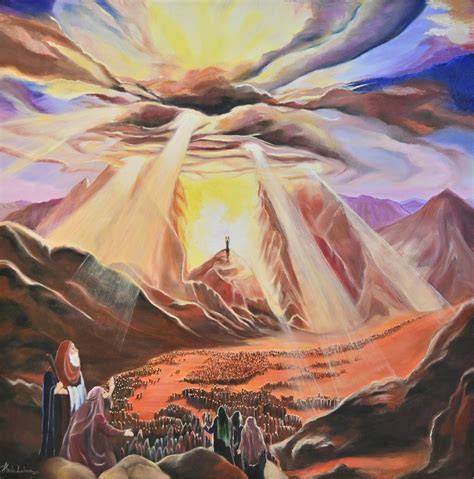
The Israelites then gathered at the base of Mount Sinai. Moses climbed to the top of the mountain, where the Lord appeared to him in a cloud of smoke and gave the Israelites the Ten Commandments, which were later inscribed on two stone tablets.
Shavuot celebrates these events. Sometimes Jews refer to Shavuot as the “Festival of the Giving of the Torah,” as it commemorates the very first time the Lord gave the Torah to the Israelites.
The Torah and the Sinai Covenant
When Moses received the Law, all of Sinai was smoking, because the Lord had descended amid the fire, and the smoke rose like a furnace, and all the people trembled. The sound of the trumpet became louder and louder.
The Law, or Torah in Hebrew, is the set of rules that constitute Judaism and are found in the first five books of the Bible, the Pentateuch. Jewish tradition identifies 613 rules that range from prayer to the most ordinary things like food, clothing, hairstyle, hygiene, work, and rest, but Christian tradition has seen them summarized essentially in the Ten Commandments of Sinai.
This detailed and exhaustive Law is the most incredible pride of the Jewish people and its seal of identity. It is God’s wisdom shared with His People to make them a holy People of His own, wise and chosen.
“If you will indeed obey my voice and keep my covenant, you shall be my treasured possession among all peoples.” This is what is celebrated in Shavuot, the goodness of God who wanted to give this unique and exclusive Law to His People.
Shavuot and the Three Pilgrimage Festivals
Passover, Shavuot, and Sukkot are the three great Jewish pilgrimage festivals. Passover celebrates the liberation of the Israelites from slavery in Egypt. Shavuot celebrates the giving of the Torah at Mount Sinai and the wheat harvest. Sukkot commemorates the forty-year period during which the Israelites wandered in the desert and lived in temporary shelters called sukkot.
Since ancient times, the Jewish people have celebrated Passover, Shavuot, and Sukkot as agricultural holidays. Passover occurs first and marks the start of the planting season. Shavuot follows seven weeks later. Sukkot occurs in autumn and represents a time of thanksgiving for the fall harvest.
| Festival | Historical meaning | Agricultural meaning |
|---|---|---|
| Passover | The liberation from slavery in Egypt | The beginning of the planting season and barley harvest |
| Shavuot | The giving of the Torah at Mount Sinai | The wheat harvest and first-fruits offerings |
| Sukkot | The Israelites’ forty years in the desert | Thanksgiving for the fall harvest |
The Spiritual Shift After the Temple’s Destruction
Though Shavuot continued to be oriented around agriculture and firstfruits, it was felt that this was the only holiday without a connection to Israel’s history. The ritual of Deuteronomy 26 made reference to that history, but most of that ritual was contained already in the holiday of Passover.
And so over time, Shavuot took on a new character. The day God gave the Torah, or Law of Moses, on Mount Sinai was calculated as falling exactly on the day of Shavuot. By the time of Jesus, in addition to being the first-fruit holiday, it had also become the anniversary of the giving of the Law.
With the destruction of the Second Temple and the expulsion of the Jewish people from their land in 70 C.E., the celebration focused more on the anniversary of the giving of the Torah to Moses at Mount Sinai, fifty days after the first day of Passover.
The Exodus from Egypt, which Passover celebrates, marked the beginning of physical freedom for the Jewish people. But the true Shavuot meaning is a reminder for the Jews that physical liberation was incomplete without the spiritual redemption represented by receiving God’s Law.
The Meaning of Pentecost in Acts 2
Pentecost is a biblical holiday that celebrates the outpouring of the Holy Spirit in Acts 2. The word Pentecost means “50” in Greek because it occurs 50 days after Passover. Rooted in the Jewish Feast of Weeks, or Shavuot, Pentecost connects the giving of God’s Law at Mount Sinai with the giving of the Holy Spirit to believers.
It was on this very holiday, when tens of thousands of pilgrims were bringing their firstfruits, that the events of Acts 2 took place. Acts 2 tells the story of the giving of the Holy Spirit on Pentecost, after Jesus’ ascension.
When the day of Pentecost came, the disciples were all together in one place. Suddenly a sound like the blowing of a violent wind came from heaven and filled the whole house where they were sitting. They saw what seemed to be tongues of fire that separated and came to rest on each of them.
All of them were filled with the Holy Spirit and began to speak in other tongues as the Spirit enabled them. Jews from every nation under heaven were staying in Jerusalem, and each person heard the disciples speaking in their own language.
A History of Fire, Wind, and Smoke | Acts 2:1-13 Sermon (Pentecost / Glory Cloud Theme in Bible)
Fire, Wind, and Sound at Sinai and Pentecost
There are many similarities between the Sinai event and the event on Mount Zion thirteen hundred years later. At Sinai, there were thunders and lightnings, a thick cloud on the mountain, and a very loud trumpet blast. The mountain was wrapped in smoke because the LORD had descended on it in fire.
In Acts 2, there was a sound like a mighty rushing wind, and tongues that looked like fire appeared and rested on each person. These specific elements-fire, clouds or wind, and sounds-often signal a theophany, a manifestation of God.
A theophany is simply a manifestation of God. We find several references to fire and clouds throughout the Scriptures. We see fire and clouds while the Israelites wandered in the wilderness after leaving Egypt. There are fire and clouds at Mount Sinai when God gives the Ten Commandments.
Soon after, fire and clouds appear at the building of the Tabernacle. Finally, fire and clouds accompany the building of the Temple. Each of these theophanies indicates the presence and guidance of God.
The stories of Moses and the burning bush, Mount Sinai, the Tabernacle, and the Temple all include fire that shows up when God’s presence arrives and marks his dwelling space or temple.
From Stone Tablets to Human Hearts
At Sinai, Moses receives the Torah from the hand of God in the form of stone tablets. At Pentecost, the Law is not written on stone tablets but on the hearts of His people by the giving of the Holy Spirit.
Many believers see the later Pentecost as a mirror of Mount Sinai: at Sinai God wrote His Law on stone tablets, while at Pentecost He wrote His Law on human hearts through the Holy Spirit.
This Law that God now gave would no longer be only in Hebrew, but the Torah would be given to all the world’s peoples. The gift of God’s Law would now be universal.
And this Law would be written, “not on tablets of stone, but on tablets of flesh hearts.” That is, it would not be a law of letters, of external obligations, of precepts and prescriptions, but a law that must spring from within, a law of the Spirit, born of love and surpassing any external fulfillment.
Pentecost as a Reversal of Sinai
Back at Sinai, when Moses comes down from the mountain to share what God revealed to him, he finds the people engaging in sin. They are worshiping a golden calf and thanking the object for their delivery from Egypt. At this moment, the people are rebuked and three thousand are struck down.
Oddly enough, this is another parallel to Acts 2, but more than that it is a reversal of the events at Mount Sinai. In Acts 2, when the people speak in other languages, the surrounding crowds are skeptical.
When Peter offers an explanation, he shares the Scriptures with those present and three thousand people are saved and baptized in the Holy Spirit. The giving of the Holy Spirit in Acts redeems the sins of the nation at Sinai. Three thousand are won for the three thousand lost.
A rebuke is returned for a harvest, and not just a harvest of grain but a harvest of hearts on the harvest festival of Shavuot.
Languages and the Universal Meaning of Pentecost
The disciples began to speak in different languages. The difference is that the disciples began to speak in different languages. This Law that God now gave would no longer be only in Hebrew, but the Torah would be given to all the world’s peoples.
God chose to extend His power to everyone by allowing all to hear of His wonders. Thus, the meaning of Pentecost is that God’s presence and salvation are open to all people.
The Jewish followers of Jesus were together in Jerusalem to celebrate Shavuot. The festival brought people from many regions to Jerusalem, creating an international setting for the events described in Acts 2.
In Greek, “tongues” can refer to real human languages, and that seems to be Luke’s point in Acts 2:8. The people asked, “How is it that we each hear them in our own language to which we were born?”
In Acts 2, the proclamation goes out to both Jewish people and non-Jews, so that all the world will eventually get to hear the message. In Genesis 11, at the Tower of Babel, God confused the languages of the world so that people could no longer understand one another. In Acts 2 that confusion, at least for the moment, was undone.
The New Temple: God’s Presence in His People
The divine fire had previously rested on Yahweh’s temple spaces, so where does it rest in the scene in Acts 2? It rests on each person.
It is a temple made out of each one of them. It is made of people. People will meet with God not in a geographic place or constructed space but in connection with those who choose to trust and follow Jesus.
Fire, the sign of God’s presence, no longer marked a mountain or a temple, but each individual, the living temple of the presence of the Spirit.
This signifies that God now dwells in His people, not on a mountain or in a structure. The story tells us that God now dwells within the community of Jesus followers.
Pentecost and the New Covenant
At the establishment of the Shavuot festival in Deuteronomy, we find an open invitation. All are welcome to celebrate the giving of the Law at Sinai and the writing of the Law on the hearts of the people.
God opened the door for Jews from other nations and eventually Gentiles to enter into a new covenant with Him. He chooses a festival when Jews from every nation under heaven are present.
By giving the gift of tongues to the disciples, the Jews from other nations can also receive the Holy Spirit. Many consider Pentecost as the establishment of the Christian church. When God gives the disciples the Holy Spirit, this opens the door for Gentiles to be grafted in.
As Christians, we are welcomed to join this new covenant. Pentecost marks the fulfillment of the promise that God would send His Spirit to give His people a new heart and a new spirit.
Pentecost and the Holy Spirit
For Christians, the meaning of Pentecost centers on the gift of the Holy Spirit. Jesus promised His disciples that after His ascension, God would send a Helper and Counselor to empower believers, guide them in truth, and strengthen them for ministry.
Pentecost marks the fulfillment of that promise in Acts 2. The disciples experience the equivalent of a storm, fire on their heads, and the ability to speak in other languages. This odd combination results in the gift of the Holy Spirit.
Just as at Sinai, where there was the sound of trumpets, on Mount Zion in Jerusalem there was also the sound of a mighty wind. And just as God descended amid fire before Moses, in the Upper Room there appeared tongues of fire that settled on each of the disciples.
Instead of being freed from slavery in Egypt, the disciples and all believers after them are freed from the slavery of sin and empowered to walk in freedom by the power of the Holy Spirit.
The Prophetic Meaning of Pentecost
The promise of the Spirit had been made by the prophets. Ezekiel 36:26-27 says: “I will give you a new heart and put a new spirit within you; I will remove your heart of stone from you and give you a heart of flesh. I will put my Spirit within you and cause you to walk in my statutes, and you will keep my judgments and do them.”
Joel 2:28 says: “I will pour out my Spirit on all flesh; your sons and your daughters shall prophesy, your old men shall dream dreams, your young men shall see visions.”
Peter’s explanation is that Acts 2 is a fulfillment of the prophet Joel, that in the last days God’s Spirit would be poured out, with one of the results being prophecy, or speaking forth God’s words.
The promise is for you and your children and for all who are far off-for all whom the Lord our God will call. Pentecost reminds believers today that God still leads, transforms, and dwells within His people through the Holy Spirit.
The Book of Ruth and Shavuot
The Book of Ruth is traditionally read on Shavuot morning because of its link to the harvest season and because of Ruth’s acceptance of the Jewish faith and God.
When the Moabite Ruth and her Jewish mother-in-law, Naomi, returned to Bethlehem, it was at the very beginning of the barley harvest. The story of Ruth takes place against the backdrop of the harvest season, from the reaping, gleaning, threshing, and winnowing of the wheat.
Ruth was a brave Gentile woman whose love for God and the Torah led her to convert to Judaism. Her pledge to Naomi is among some of the most stirring words in Scripture: “Don’t urge me to leave you or to turn back from you. Where you go I will go, and where you stay, I will stay. Your people will be my people and your God my God.”
Ruth has a further connection to Shavuot. At the end of Ruth’s story, she and Boaz are married and have a son named Obed. His son was Jesse, and Jesse was the father of David. So Ruth was the great-grandmother of King David who, according to tradition, was born and died on Shavuot.
Shavuot Customs and Observances
Jews engage in a number of customs and rituals in observance of Shavuot. These include attending special prayer services, eating holiday meals, and refraining from work.
According to the Midrash, the Israelites wanted a good night’s sleep before the giving of the Torah, so they turned in early the night before. The next morning, however, they overslept, and Moses had to rouse them from their slumber.
For this reason, on the eve of Shavuot, many Jews read and study the Torah all night to prepare for the giving of the Torah the next day and to atone for their ancestors’ mistake. Many also pray as early as possible on the morning of Shavuot.
It is customary to adorn homes and synagogues with flowers and foliage for Shavuot. These greens serve as a reminder that Shavuot was first and foremost an agricultural harvest festival and that today, too, we are to feel indebted to God for our material blessings.
Why Do Jews Eat Dairy on Shavuot?
Another Shavuot custom is to eat dairy foods for at least one meal. Common foods include cheese blintzes, which are thin pancakes filled with cheese, and cheesecake.
The reasons for this tradition vary, but a number of explanations have been offered. In the Book of Exodus, the Lord promises Moses that he will bring the Israelites into “a good and spacious land, a land flowing with milk and honey.” Some, therefore, believe that the dairy meal honors Israel, “the land of milk and honey.”
Another explanation is that Shavuot takes place during the growing season, when lands are especially fertile, and livestock produce an abundance of milk.
A third opinion is that because Shavuot celebrates the giving of the Torah, the Israelites had just received the dietary restrictions that prohibit them from preparing meat and dairy in the same dishes, and they likely did not have separate cookware available.
On the holiday in ancient times, a two-loaf bread offering was brought to the Temple. To commemorate this, Jews today eat two meals on Shavuot-a dairy meal and, after a short interruption, a traditional holiday meal.
First Fruits as a Picture of Future Redemption
Shavuot and Pentecost carry a broader meaning through the symbolism of firstfruits. When the first of the crop came in, it was a visual promise that the rest of the crop would follow. The idea of firstfruits therefore became a metaphor for the first of anything that would follow in larger measure.
The New Testament applies this image to the resurrection of believers. Jesus’ resurrection is like the first of the crops. It is a promise and guarantee that more resurrection will follow, namely of those who place their faith in him.
Believers are also described as having the firstfruits of the Spirit. The fullness of what that means lies in the future, when believers experience the fullness of the Spirit’s work in their lives.
James writes that believers are the first evidence that God will redeem the universe on a grand scale. With all our imperfections and failings, God tells us that we are the first of something much greater. We are the firstfruits of redemption, God’s harbinger of the future.
How the Hebrew and Christian Meanings Relate
The Hebrew meaning of Pentecost is found in the name Shavuot, “weeks.” The Greek meaning is found in Pentecost, “fiftieth day.” The Jewish meaning centers on the harvest, firstfruits, the giving of the Torah, and the covenant at Sinai.
The Christian meaning centers on the outpouring of the Holy Spirit, the fulfillment of prophetic promises, the formation of the Church, and the proclamation of God’s message to people from every nation.
The two meanings are joined by the same festival calendar. Shavuot is the Jewish Feast of Weeks, while Pentecost is the Greek name used in the New Testament for the same fiftieth-day festival.
From Mount Sinai to Jerusalem, God reveals His desire to dwell among His people. At Sinai, He gave His Law to guide them. At Pentecost, He gave His Spirit to empower them.