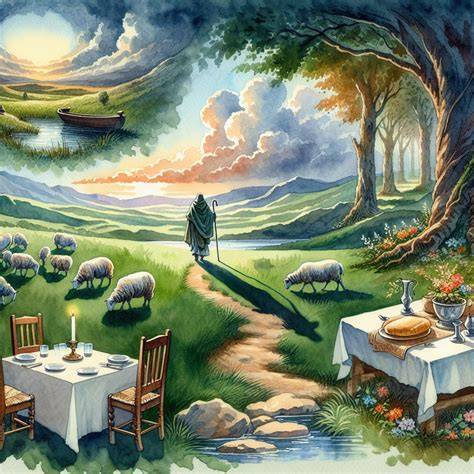
Psalm 23 means that God can be trusted to provide, protect, guide, restore, and remain present with his people through danger, suffering, and death. Its central confession is that because “The LORD is my shepherd,” the psalmist will not lack what is needed, will not fear evil, and will ultimately dwell in God’s presence.
The psalm presents God not only as a gentle shepherd but also as an undefeatable shepherd-king and a generous host. Its imagery recalls God’s rescue of Israel from Egypt, his care for Israel in the wilderness, his guidance toward the promised land, and, in Christian interpretation, Jesus as the Good Shepherd who gives his life for the sheep.
Psalm 23 at a glance
| Psalm image | Meaning |
|---|---|
| The shepherd | God personally provides, protects, guides, and cares for his people. |
| Green pastures | Rest, nourishment, abundance, and security. |
| Still waters | Refreshment, peace, and a place of repose. |
| Paths of righteousness | Guidance into faithful and morally upright living. |
| The valley of the shadow of death | A place of profound darkness, danger, suffering, or death through which God remains present. |
| Rod and staff | Authority, protection, discipline, guidance, and comfort. |
| The prepared table | God’s abundant provision, honor, fellowship, and protection in the presence of enemies. |
| Oil and overflowing cup | Welcome, honor, abundance, blessing, and generous hospitality. |
| Goodness and loyal love pursuing the psalmist | God’s steadfast love actively accompanying and overtaking his people throughout life. |
| The house of the LORD | Permanent fellowship with God and the hope of dwelling in his presence. |
Who wrote Psalm 23 and what is its setting?
Psalm 23 begins with the title “A Psalm of David.” David was traditionally understood as its author, and his personal history makes the shepherd imagery especially meaningful. David changed careers from shepherd to king, with years as a wandering fugitive in between.
David’s life was in constant danger as the previous king, Saul, burned with envy against him and wanted him dead. David was a wanted man on the run, ducking and diving through the Judean hills and deserts, in search of escape and safety.
David therefore understood both sides of the psalm’s central image. He knew what it meant to be a shepherd responsible for vulnerable sheep, and he also knew what it meant to be exposed, pursued, and dependent on protection. The psalm can be read as the testimony of someone who has experienced danger but has learned that God’s care is more reliable than his circumstances.
Although the psalm stands on its own, its position within the Psalter also contributes to its interpretation. Psalm 23 has been strategically placed between Psalms 22 and 24, which share the theme of God ruling as king.
Psalm 22 is associated with suffering and the cross, while Psalm 24 points toward the coming kingdom of glory. Psalm 23 lies between these two movements as a song for the valley where people live: between suffering and glory, between the cross and the crown, and between present trials and future hope.
“The LORD is my shepherd”: the meaning of Psalm 23:1
God’s personal care
The opening declaration is, “The LORD is my shepherd; I shall not want.” David thinks about God, the God of Israel, and compares his relationship with God to the relationship between a shepherd and sheep. God is like a shepherd to David, and David is like a sheep to God.
“The LORD is my shepherd” is personal language. It does not merely say that God is a shepherd in theory or that God cares for humanity in general. David says that the LORD is my shepherd. The statement expresses belonging, intimacy, confidence, and dependence.
In the ancient world, kings were often portrayed as shepherds. Shepherds cared for large flocks and kept them safe from dangerous predators. Shepherd language was used to define a king’s role as just ruler, benevolent provider, and powerful defender.
The shepherd metaphor is also widespread throughout the Bible. Jacob called the LORD the Shepherd, the Stone of Israel. Psalm 28 asks the LORD to shepherd his people and carry them forever, while Psalm 80 describes the LORD as the Shepherd of Israel.
Isaiah 40:11 says that the LORD feeds his flock like a shepherd, gathers the lambs with his arm, carries them close to his chest, and gently leads those who have young. Micah 7:14 asks the LORD to shepherd his people with his staff, as in days of old.
David’s metaphor is especially intimate because the shepherd lives with the flock and is everything to it: guide, physician, protector, and caretaker. In Israel, shepherding could be regarded as a lowly occupation, yet Psalm 23 presents the great God of the universe as willing to stoop down to care for his people.
“I shall not want” means “I shall not lack”
The final phrase of verse 1 is often translated, “I shall not want.” This does not mean that the psalmist has no desires or that every desire will be removed. It means, more precisely, “I shall not lack anything” or “I shall not be in want.”
The Hebrew expression refers to lack and need rather than to the elimination of desire. The psalm is not teaching that people should become free from all desires or passions. It expresses confidence that God will provide what is necessary.
This is a promise of God’s provision: he gives people what they need rather than simply taking away their desires. He works with people in their hopes, dreams, and longings, even though this does not mean that people receive everything they want.
The psalmist declares that because God is his shepherd, he lacks nothing essential. The statement is both a confession and a decision: “All my needs are supplied by the LORD, my shepherd,” and “I decide not to desire more than what the LORD, my shepherd, gives.”
The wilderness generation provides an important biblical background. The Israelites wandered for forty years, yet they “did not lack anything.” In a desolate wilderness with little food and thirsty ground, God gave them water from a rock and bread from heaven.
David was in danger and sometimes needed safety, food, and water, yet God provided for him and protected him. Psalm 23 assures the reader that whatever happens in the future, good or bad, God will be there to care for his people.
The statement also challenges a culture of perpetual dissatisfaction. People are often conditioned to believe that they are unhappy because they need more possessions, experiences, or achievements. Psalm 23 resets that mentality by declaring that the presence and care of God are enough to prevent ultimate lack.
“He makes me lie down in green pastures”: rest and provision
“He makes me to lie down in green pastures” portrays God as a shepherd who brings his sheep to nourishment, safety, and rest. The shepherd knows where the good places are and faithfully guides the flock there.
The Hebrew imagery conveys pleasantness, loveliness, and something to be enjoyed. The expression does not necessarily imply harsh compulsion. It can be understood as the shepherd causing or enabling the sheep to lie down, much as a host seats a guest at a table.
Sheep do not lie down easily unless several conditions are met. Because they are timid, they will not rest if they are afraid. Because they are social animals, they will not rest if there is conflict among them. If flies or parasites trouble them, they will not lie down, and if they are hungry or anxious about food, they will not rest.
Rest comes because the shepherd has dealt with fear, friction, flies, and famine. The image therefore communicates more than attractive scenery. It describes a condition in which the needs that prevent rest have been addressed.
The psalm places rest and refreshment near the beginning because God often deals with people through gifts of renewal. When people look back over life, their trials can be outweighed by God’s love. “Weeping may endure for a night, but joy cometh in the morning.”
A troubled conscience cannot find genuine rest until guilt has been addressed. God heals the troubled soul when he forgives sins, and in spiritual communion with him the hungry heart finds food that satisfies.
Psalm 23 therefore invites people to stop running, savor God’s gifts, and receive nourishment for body and soul. The shepherd’s care includes the restoration of a life exhausted by fear, guilt, anxiety, or ceaseless activity.
“He leads me beside still waters”: refreshment and peace
“He leads me beside the still waters” describes the shepherd guiding the sheep to quiet, restful, and comforting water. The Hebrew word translated “still” carries associations of comfort and repose.
The image is not merely of water that is motionless. It is water that offers safety and refreshment. The shepherd knows when the sheep need green pastures and when they need still waters.
The image recalls God’s care for Israel in the wilderness. Although the wilderness was a desolate place with little food and “thirsty ground,” God supplied water from a rock and bread from heaven.
The psalm also evokes the purpose of Israel’s wilderness journey: God was leading his people toward a suitable resting place. The shepherd’s restful waters therefore point beyond temporary relief to God’s intention to bring his people into true rest.
The image of gentle waters can also be associated with God’s good intentions toward his people. The language recalls the gently flowing waters of Siloam and the picture of a mother gathering her children under her wings.
In this sense, Psalm 23 does not portray God as eager to drive people into exhaustion. God invites them into the good he offers: rest, restoration, refreshment, and a secure relationship with him.
“He restores my soul”: renewal and recovery
“He restores my soul” can also be understood as “he gives me back my life” or “my soul comes back to me.” The phrase describes the recovery of a person who has been depleted, distressed, sick, lost, or spiritually disoriented.
People sometimes say, “I feel like myself again” after recovering from a period of intense stress or illness. Psalm 23 uses comparable language to describe God’s restorative care.
The word translated “restores” can also carry the sense of rescuing someone who has strayed. The image may be that of a lost sheep brought back by the shepherd.
Restoration can also imply repentance or conversion. God does not merely make life more comfortable; he brings the person back to a right relationship and a faithful direction.
The psalm’s restoration is therefore comprehensive. God renews the inner life, brings back what has been lost, and reorients the person toward the path God intends.
“He leads me in paths of righteousness”: guidance and formation
“He leads me in the paths of righteousness for His name’s sake.” The shepherd is not only a provider of food and water. He is also a guide who leads the sheep where they should go.
The sheep do not need to know where the green pastures or still waters are. They need to know where the shepherd is. In the same way, the psalm emphasizes trust in God’s guidance rather than complete knowledge of the route ahead.
“Paths of righteousness” means that God’s guidance has a moral dimension. God leads his people into faithful, upright, and obedient living. The shepherd’s direction does not merely make life easier; it forms the character of those who follow him.
The restored soul is led into work and service. Rest and refreshment prepare the sheep for movement, responsibility, and faithful action. Rest comes before work in the gospel pattern: people are not saved by their works, but they work because they have been saved.
God’s guidance can sometimes feel like a circle. The Hebrew word used for “paths” is unusual and can be associated with a circle or circuit. Life may seem to repeat itself, with familiar patterns and recurring challenges.
Yet walking with God through these cycles can be understood as growth in a spiral. A person may appear to return to a familiar place but arrive with greater maturity, a wider perspective, and a deeper understanding.
Sometimes God takes people around the same block several times so that they can learn what he is teaching. At other times, recurring circumstances bring closure and completion to unresolved issues.
God leads in these cycles of righteousness for the sake of his name. He is committed to the growth of his people and to the revelation of his goodness through their journey.
“For His name’s sake”: God’s character and reputation
The phrase “for His name’s sake” means that God acts consistently with his character and goodness. God guides his people not because of their independent merit but because he is faithful to who he is.
The phrase can also mean that God acts for the sake of proclaiming his name in the world, helping people understand his glory and goodness. Walking toward justice can therefore become a way of proclaiming and honoring one of God’s names.
The shepherd’s guidance serves both the good of the sheep and the honor of the shepherd. God’s reputation is displayed through his faithful care, moral direction, and restoration of those who trust him.
“Though I walk through the valley of the shadow of death”: darkness, danger, and transition
Psalm 23:4 introduces the darkest image in the poem: “Yea, though I walk through the valley of the shadow of death, I will fear no evil: for Thou art with me.” The phrase describes a place of profound darkness, danger, suffering, or death.
The Hebrew word can describe a valley of deep darkness, but it also resembles a combination of the Hebrew words for “shadow” and “death.” The phrase is therefore poetic and expansive: it can refer to the experience of facing mortality, but also to any situation of overwhelming darkness.
A valley suggests enclosure and vulnerability. It is not a mountaintop or a broad meadow but a place where the traveler can feel hedged in and surrounded. The shadow of death suggests the dark outline of what appears to be ultimate defeat.
Yet the psalmist says that he walks through the valley. It is not his final destination or permanent dwelling place. The shepherd may lead his sheep through a dangerous place, but he does not abandon them there.
The valley imagery recalls Israel’s wilderness journey. Jeremiah describes the wilderness as a land of drought and death-shadow. Israel faced hunger, thirst, venomous creatures, enemies, and uncertainty, yet God continually shielded and sustained the people.
God protected Israel from hunger and thirst, dangerous desert creatures, and attacks from enemies. Psalm 23 uses the same pattern to express confidence that God remains present while his people pass through threatening circumstances.
“I will fear no evil”
The psalmist does not claim that evil is unreal or that the valley is harmless. He declares that he will not fear evil because God is with him. God’s presence does not necessarily eliminate every danger, but it removes the conclusion that danger has ultimate authority.
The psalm’s confidence is not based on the strength or wisdom of the sheep. Sheep are dependent, vulnerable, and unable to save themselves from every threat. The confidence comes from the shepherd who knows the way and possesses the power to protect.
“I will fear no evil” is therefore a statement of trust rather than a denial of pain. The psalm does not promise a life without suffering. It promises that suffering will not be faced alone.
Psalm 23 has become especially precious to people who are dying or grieving because it does not require them to pretend that death is easy. It gives them words with which to affirm that the shepherd remains present even at the edge of death.
Near death, the saint still walks calmly rather than rushing in panic. The saint does not remain forever in the valley but passes through it. The image of a shadow also suggests that death’s power has been limited: a shadow cannot bite, kill, or destroy.
The Christian interpretation of the valley
Christian readers often interpret the valley through the death and resurrection of Jesus. A shadow is not tangible but is cast by something that is. Christians can therefore say that they face the shadow of death because Jesus has entered into the full reality of death and overcome it.
Psalm 23 is sometimes read as a Messianic psalm in connection with Psalm 16, where David says that God will not abandon his soul to Sheol or allow his holy one to see corruption.
The valley can be understood as a passage that must be crossed before emerging into resurrection life. Jesus knew where he had come from and where he was going, and he endured suffering for the joy set before him.
For Christians, those who are in the Messiah possess eternal life, and death cannot ultimately take it away. The Good Shepherd cares for his people so deeply that he dies for them and gains victory over death.
“For You are with me”: the turning point of the psalm
At the center of the psalm, the language changes. The psalmist has spoken about God as “he,” but in the valley he begins speaking directly to God: “You are with me.”
This shift from third person to second person is significant. The danger does not merely lead the psalmist to think about God; it brings him into immediate awareness of God’s presence.
The words “You are with me” are the foundation of the psalm’s courage. The psalmist is neither alone nor helpless. God’s presence is more decisive than the darkness surrounding him.
This confidence can be applied to every form of suffering. God does not always prevent his people from entering sorrow, but he remains with them in sorrow. The divine presence accompanied the three young men in the flames and stood with Paul when others abandoned him.
People may not understand the reason for every experience, but they can trust that the shepherd knows. The psalm’s faith is not based on possessing an explanation for everything; it is based on knowing the one who leads through everything.
“Your rod and Your staff”: authority, discipline, and protection
“Your rod and Your staff-they comfort me.” At first, sticks and rods may not sound comforting, but in the hands of a good shepherd they represent protection, guidance, authority, and care.
The rod was an instrument of punishment and justice. It could represent the authority of a king and the power to restrain evil. The staff could provide support, guide the flock, and help keep sheep from wandering.
There is some debate about whether the psalm refers to two separate instruments or one instrument used in two ways. Either interpretation leads to the same central meaning: the shepherd protects and leads.
The rod and staff therefore signify that God’s care is not passive. God does not merely watch vulnerable people from a distance. He exercises authority, confronts threats, corrects wandering, and keeps his people on the path.
The word for “rod” can also be translated as “scepter,” linking the image to royal authority. The scepter is associated with the ruler who has the right to govern and with the messianic promise connected to Judah.
God’s discipline can also be a source of comfort because it confirms that his people belong to him. A loving father does not simply allow a child to wander into danger without correction.
God respects human freedom, yet he cares for the soul and is willing to reprove and discipline his people to keep them on track. The rod and staff are comforting because they reveal that the shepherd is attentive enough to guide and strong enough to protect.
God as the shepherd-king
Good shepherds and bad shepherds
Psalm 23 does not portray God as merely any shepherd. It presents him as the truly good shepherd. The Bible distinguishes between shepherds who protect and shepherds who exploit.
The pharaoh in Exodus uses power to oppress the Israelites through forced labor and violence. The prophet Ezekiel describes Israel’s neglectful and power-hungry leaders as bad shepherds who exploit the flock for their own advantage.
Even David, the great shepherd-king traditionally associated with Psalm 23, sometimes uses power to harm others. The contrast emphasizes that human rulers can fail, while God is the shepherd-king whose authority is joined to justice, protection, and generous care.
In the ancient world, kings were often called shepherds because they ruled, provided, and defended. Psalm 23 takes this familiar royal imagery and applies it to the LORD in its fullest sense.
The shepherd-king and the Exodus
The meaning of Psalm 23 becomes deeper when it is read against the Exodus story. The psalm does not mention the Exodus by name, but its language is saturated with images and vocabulary associated with Israel’s rescue, wilderness journey, and entrance into the promised land.
The Exodus pattern includes three key movements: rescuing people from slavery or oppression, making a way through dangerous wilderness, and guiding people into life in the promised land.
This pattern can be described as out, through, and in. God brings his people out of oppression, leads them through danger, and brings them into rest, blessing, and his presence.
The pattern begins in Exodus through Deuteronomy and repeats throughout the Hebrew Bible. Later biblical authors portray God as rescuing people from other oppressors and eventually from Babylonian exile.
Early interpreters noticed the wilderness connections in Psalm 23. Aramaic translators of the Hebrew Bible offered an interpretive translation that explicitly connected the psalm to God’s care for Israel in the desert: “It is the LORD who fed his people in the desert; they lacked nothing. … He restores my soul with manna.”
The first three verses of Psalm 23 particularly emphasize the second and third movements of the Exodus: God guides Israel through the fearful wilderness with care and provision, and God brings Israel into comfort and true rest in his presence.
Green pastures and manna in the wilderness
The psalmist declares, “I will not lack,” using language that recalls the Israelites who “did not lack anything” during their forty years in the wilderness.
Although the wilderness was desolate and contained little food, God gave Israel bread from heaven and water from a rock. In Psalm 23, the shepherd leads the sheep into abundant pasture where they can eat their fill and rest without immediately needing to search for their next meal.
The abundant pasture communicates more than survival. It presents God as a provider who gives his people enough to rest in security and satisfaction.
Still waters and the resting place
The restful waters of Psalm 23 recall God’s purpose in leading Israel through the wilderness toward a suitable resting place. The shepherd’s care is directed toward a destination where God’s people can dwell securely.
The psalm therefore moves from immediate provision to the larger promise of rest. God does not merely sustain people in a temporary crisis; he guides them toward a life ordered around his presence.
Guidance after the Red Sea
The verbs translated “guides” and “leads” in Psalm 23 echo the song of Moses and Miriam after the Red Sea crossing: “In your faithfulness you have led the people whom you have redeemed; in your strength you have guided them to your holy habitation.”
The connection is important. The shepherd is also the God who redeems, leads, and brings his people toward a holy dwelling. Psalm 23 compresses the Exodus journey into the personal experience of one worshiper.
Protection in the wilderness
The valley of death-shadow recalls Israel’s journey through a desolate wasteland. God protected Israel from hunger, thirst, venomous creatures, and hostile armies.
The psalmist’s confidence is therefore history-based. He trusts God not because he is making an abstract guess about divine goodness but because God has already demonstrated his character through the rescue and preservation of Israel.
“You prepare a table before me”: God as host
In Psalm 23:5, the metaphor shifts from shepherd to host: “You prepare a table before me in the presence of mine enemies.” The change in imagery does not change the central message. God continues to provide and protect.
The table is not a small emergency ration. God sets a feast. He invites the psalmist to sit, rest, and enjoy fellowship rather than merely grabbing food while passing through danger.
The table in the wilderness
The language recalls Psalm 78, where people question whether God can “set a table in the wilderness.” The psalm goes on to describe God’s provision of water, bread, and meat.
By describing a heavily laden table in a dangerous valley, Psalm 23 alludes to the incredible moment when God provided for Israel in the wilderness. The table becomes a sign that God’s abundance is not limited by hostile surroundings.
A feast in the presence of enemies
The table is prepared “in the presence of mine enemies.” The enemies are present, but they have been rendered harmless. The psalmist can eat under God’s protection while enemies look on without controlling the situation.
The image is often understood as a display of wealth and self-confidence, but it can also be read as an image of forgiving hospitality. God may be setting a full table so that the poet can invite enemies to sit down and break bread with him.
This interpretation transforms the enemies from a permanent category into people who may become former enemies. If everyone is sitting at God’s table, all must accept the responsibility and gift of forgiveness.
The table also contrasts the destiny of the righteous and the unrighteous. God honors his people in the presence of those who oppose them, while the wicked are excluded from the banquet.
The table and the temple
The table can also evoke the table of the bread of the presence in the holy place of the temple. God’s provision in Psalm 23 is therefore connected with God’s presence among his people.
Most Israelites could visit the temple’s outer court only a few times a year, and only priests could enter the holy place. Yet the psalmist looks forward to a time when God’s presence will not be limited to a particular place or occasion.
The table thus points toward permanent fellowship. Just as God led Israel into the promised land, the psalmist trusts that God will ultimately draw his people into his presence forever.
“You anoint my head with oil”: honor and welcome
“You anoint my head with oil” describes a customary act of hospitality. A generous host refreshed and honored a distinguished guest by applying fragrant oil.
The anointing expresses welcome, dignity, and special favor. God does not treat the psalmist as a tolerated stranger. He receives him as an honored guest.
The imagery also recalls David’s own anointing. David was chosen and favored by God and destined to be king with divine approval. The word “messiah” means anointed one, someone anointed for a purpose.
At the same time, the Hebrew word used in Psalm 23:5 differs from the more familiar word associated with royal anointing. It can evoke grass and the fat or oil associated with sacrificial ashes, which fits the theme of green pastures and may also connect with sacrificial imagery.
In Christian interpretation, the oil can point toward the Spirit with which Jesus anoints his people. It can also evoke the priestly and royal identity of those welcomed into God’s presence.
“My cup overflows”: abundant provision
“My cup runneth over” describes more than adequate supply. The cup is filled to overflowing, expressing satisfaction, delight, and abundant blessing.
David’s life was not easy. He had a high calling with a high cost, but he could still rejoice in the generous life God had given him.
The cup also recalls Psalm 16: “The Lord is my chosen portion and my cup.” The image refers to what God has apportioned to the psalmist and to the satisfaction found in receiving life from God’s hand.
In Christian interpretation, the cup can also recall Jesus’ cup of suffering, the new covenant in his blood, and the promise of drinking wine anew in the kingdom of God.
Oil and wine are both produced through crushing, yet they result in valuable and life-giving gifts. The overflowing cup can therefore represent calling, challenge, blessing, and the abundance God gives in this life and the next.
“Goodness and mercy shall follow me”: love in pursuit
“Surely goodness and mercy shall follow me all the days of my life.” The Hebrew verb is stronger than the ordinary idea of following behind. It can mean “pursue,” “chase,” or “hunt down.”
The same root is often used to describe what an enemy does. Pharaoh and his army pursued Israel with horses and chariots after the Israelites escaped from Egypt.
Psalm 23 reverses that pattern. The psalmist does not need to fear that enemies will have the final pursuit. Instead, God’s goodness and loyal love pursue him throughout his life.
The Hebrew word for loyal love is khesed. It expresses steadfast, covenantal, and faithful love. It is not a temporary emotion or occasional kindness but a persistent commitment to the well-being of the one God has taken into his care.
People can often feel as if troubles follow them everywhere. Psalm 23 announces the opposite for those under the shepherd’s care: goodness and mercy are the forces doing the pursuing.
Goodness and mercy do not simply meander somewhere in the background. They actively chase, surround, and overtake the psalmist with God’s faithful care.
This promise extends through all the days of life. God is present not only in the remembered past or the immediate crisis but also in the unknown future.
In one interpretation, the phrase can be read as an aspiration: by modeling virtue, a person may be followed by people who perform virtuous actions modeled after those actions. In another, it is a direct confession that God’s goodness and loyal love actively pursue the believer.
“I will dwell in the house of the LORD”: the final destination
The psalm concludes, “And I will dwell in the house of the Lord forever” or “for length of days.” The final image is not merely of reaching a safe building. It is of permanent fellowship with God.
The house of the LORD refers to the temple, the place where God’s presence took up residence among Israel. Yet the psalmist expects a future in which fellowship with God will not be restricted by time, location, or limited access.
The psalm’s movement is therefore complete: the shepherd provides in the pasture, guides beside the waters, leads through the valley, protects in the presence of enemies, welcomes the guest at the table, and finally brings the worshiper into God’s house.
The three personal statements that punctuate the psalm summarize this movement: “I will not lack,” “I will not fear,” and “I will dwell.” God provides what is needed, remains present in danger, and brings his people into lasting fellowship.
Psalm 23 and the New Testament
Jesus as the Good Shepherd
In the New Testament, Jesus identifies himself as the Good Shepherd: “I am the good shepherd. I know my own and my own know me, just as the Father knows me and I know the Father. And I lay down my life for the sheep.”
Jesus has compassion on crowds because they are like sheep without a shepherd. He tells the parable of the shepherd who searches for the lost sheep, and he comforts his disciples by saying, “Do not fear, little flock, for your Father is well-pleased to give you the kingdom.”
Jesus says that he knows his sheep, that his sheep know him, and that he lays down his life on their behalf. Hebrews calls him the great Shepherd of the sheep, while Peter calls him the Shepherd and Overseer of souls and the Chief Shepherd.
For Christians, Psalm 23 is therefore not only a general description of God’s care. It becomes a testimony about Christ. The story of God and David becomes the story of Christ and his people.
The Exodus fulfilled in Jesus
Jesus’ death and resurrection provide another Exodus moment. He leads his followers out of enslavement to the powers of sin and death, through the wilderness of life in a broken world, and into a transformed way of life with him in God’s restored creation.
Christians read Psalm 23 against this larger pattern of promise and fulfillment. Jesus is the shepherd who guides people safely through death’s dark valley, serves them his Supper, gives the present gift of forgiveness, and promises the future feast of God’s kingdom.
Jesus anoints his people with his Spirit and fills their cups with grace and mercy. He gives them a permanent dwelling with him, and the table of the present becomes a foretaste of the feast at the end of time.
In this interpretation, Psalm 23 brings Christ to the reader in tenderness and compassion. He is the shepherd who provides, the king who protects, the host who welcomes, and the redeemer who gives his life for the sheep.
Why Psalm 23 is so widely loved
Psalm 23 is one of the most widely known passages in the Bible. It is memorized and repeated in many lands and has been called the universal psalm, the chief psalm, and the pearl of the Psalms.
Millions of people have memorized it even when they have learned few other biblical passages. Ministers have used it to comfort people facing severe trials, illness, grief, imprisonment, or death.
For some people, the words of Psalm 23 have been the last words they have spoken in life. The psalm has comforted the poor, given courage to the disappointed, and poured consolation into the hearts of the sick, captives, widows, and orphans.
People often want Psalm 23 read at a funeral because it allows them to warm themselves against a cold reality. Friends share it when they are afraid, not only because they may not know what else to say, but because its words express what is most important: God is present, and the shepherd leads through the valley.
The psalm can function both as a funeral reading and as a prayer for ordinary days. Its meaning is not limited to the moment of death. The words describe daily nourishment, refreshment, rest, guidance, protection, and home.
Psalm 23 as a pattern for everyday life
The psalm presents a progression through several dimensions of life: rest, work, sorrow, conflict, abundance, and home. God’s care is not restricted to one emotional state or one type of circumstance.
The shepherd gives nourishment in green pastures, refreshment beside quiet waters, and restoration to the soul. The shepherd then leads the restored person into paths of righteousness and faithful service.
The shepherd does not always prevent the valley of sorrow, but remains present in it. The rod and staff provide protection and direction, while the prepared table declares that God can give peace and nourishment even in the presence of enemies.
The overflowing cup reveals that God’s provision is more than bare survival. The pursuit of goodness and loyal love carries the promise through every day, and the house of the LORD provides the final image of belonging.
For believers, “The Lord is my Shepherd” means that they will not lack nourishment, refreshment, rest, protection, guidance, or home. In the great Shepherd lies strength for weakness, hope for despair, food for hunger, satisfaction for need, wisdom for ignorance, healing for wounds, and power for temptation.
Psalm 23 can therefore be prayed in both ordinary and extraordinary circumstances. It speaks to people whose lives are peaceful, to people recovering from exhaustion, to people facing conflict, and to people approaching death.
Psalm 23 and the life of faith
The psalm’s central confidence is rooted in the character of God rather than in the stability of circumstances. The psalmist does not say that every path will be easy. He says that the shepherd will be present on every path.
The shepherd leads people through the varying terrain of life. Sometimes the path runs through green grass and quiet waters; sometimes it passes through a dark valley; sometimes it leads to a table surrounded by enemies.
The response to God’s mercy is trust. God gives peace in the midst of conflict and life in the shadow of death. Yet the shepherd also calls people to follow in a world where God’s mercy is often scorned.
Walking in paths of righteousness for the sake of God’s name can put people at odds with the surrounding culture. Psalm 23 does not promise that faithful living will eliminate opposition. It promises that opposition will not separate God’s people from God’s care.
The psalm invites people to “sit with” the mercy of God and allow their hearts and minds to be shaped by what is good, worthy, and praiseworthy. Its words reset both consumer dissatisfaction and hyperactivity by teaching people to receive, rest, and follow.
Psalm 23 expresses a history-based confidence in God. The psalmist has good reason to trust that God will preserve life through the dark valley and pursue his people with goodness and loyal love every day.
As creation’s ultimate king, God liberates with infinite power. As creation’s good shepherd, God guides people into his presence so that they may dwell with him, alive and resting in true peace.