Real exorcism cases are documented historical, medical, legal, and religious records-not verified proof that demons exist. The strongest files usually establish that an exorcism occurred, who participated, what witnesses reported, and what happened afterward, while leaving the supernatural interpretation disputed.
The most thoroughly investigated cases reveal a recurring tension between religious conviction, psychological or neurological illness, social pressure, unreliable testimony, sensational reporting, and genuine uncertainty. Some ended without lasting harm; others resulted in criminal convictions and deaths caused by neglect, restraint, dehydration, suffocation, or violence.
What counts as documented evidence?
Documentation does not automatically confirm possession. A case may be supported by diaries, letters, court records, medical files, audio recordings, newspaper reports, witness statements, or religious publications, yet the evidence may still describe only what people believed they observed.
Of these cases, it is also impossible to determine whether the possession narratives were misrepresented, exaggerated, or even invented in order to boost sales. What is certain, the number of possessions at this time was exceptionally large and likely greater than anytime before or since.
The most useful investigations therefore separate several questions: Did the person display unusual behavior? Did an exorcism take place? Were the reported phenomena independently witnessed? Were medical explanations considered? Did investigators examine the possibility of fraud, coercion, suggestion, or deliberate staging? What did courts, physicians, clergy, and later researchers conclude?
How the Catholic Church defines exorcism
Exorcisms are much older than the Catholic Church-there are several depictions of exorcisms in the Bible, which necessarily came from pre-Christian sources-and have been performed in various ways by various cultures for thousands of years. The precise details of those prayers, rites, and rituals change from culture to culture and over time as our relationship with the concept of evil evolves.
It wasn’t until 1614 that the Vatican first released guidance on exorcisms. That guidance remained in place and unchanged for nearly four centuries before it was revised in 1999.
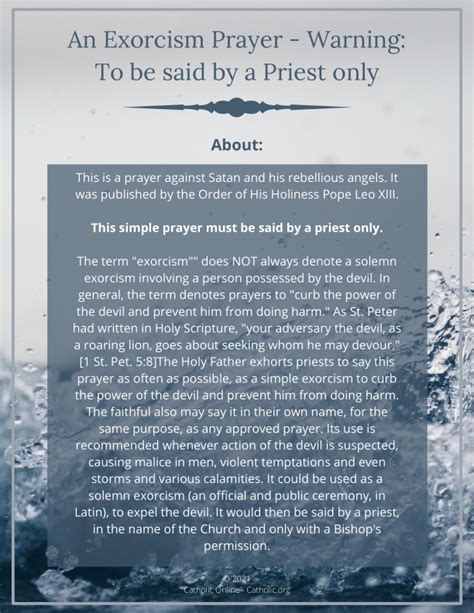
The document, known as De Exorcismis et Supplicationibus Quibusdam (Of Exorcisms and Certain Supplications) refers to exorcism as a special kind of prayer, protecting a person against the devil or pulling them away from his dominion.
In the modern Catholic Church, there are two kinds of exorcisms, the first of which hearkens back to a more historical definition of exorcism. Even now, the rites for both adult and child baptism call for a person to receive one or more “minor exorcisms” before the actual baptism.
The purpose of a minor exorcism is not to cast out demons but to help a person step away from the influence of the devil. By contrast, a “major exorcism” is intended to expel the literal presence of the devil in a person’s literal body.
These kinds of exorcisms can only be performed officially by a bishop or a priest who has received permission from the Church. The first part of any exorcism proceeding, often skipped over in the movies, involves the engagement of earthly doctors and psychiatrists.
Nearly agreeing with non-believers, the Catholic Church notes that the vast majority of suspected demonic possessions are caused and solved by more terrestrial forces. In most cases, a reported possession is treated by doctors, not by clergy.
However, if Church officials determine that conventional medicine and treatment is insufficient, they may refer a person to an exorcist. First, they will begin by reading the Psalms, other scriptural excerpts, and reciting an exorcistic prayer.
Water is blessed and sprinkled on the possessed, mirroring the baptism. A priest or bishop may place their hands on a person and even blow on their face, recalling the exsufflation of old.
Lastly, the possessed is shown the Lord’s Cross and the Sign of the Cross is made over them, according to the United States Conference of Catholic Bishops.
Why The Exorcist became associated with real cases
The 1973 horror classic The Exorcist was written by William Peter Blatty and adapted from his own novel of the same name. According to Blatty, the story was inspired by a Washington Post article he read about the exorcism of a possessed Maryland boy.
In it, the author Bill Brinkley reports that a devoted Catholic priest remained with a 14-year-old boy for two months while fighting the devil inside him. Allegedly, the boy broke out in Latin, a language he didn’t speak, and the bed sometimes moved spontaneously across the room.
They also reported fruit leaping from the fridge top and flying across the room. Later investigation revealed that the details of the exorcism had been sensationalized and were largely unconfirmed.
We do know that there was an exorcism, but that’s about it. The fantastical details which dominate our image of exorcisms were likely exaggerated or entirely invented.
Historical cases and the problem of sensational evidence
Denise de La Caille, France, 1623
One such possession narrative came out of the Saint-Gilles parish in France. Published in 1623, this histoire veritable, or true story, recounts the possession and various exorcisms of Denise de La Caille-a widowed weaver from Beauvais.
The story is told as an eyewitness account made by the court’s clerk over the course of eighteen weeks, wherein public and private exorcisms were performed by a Dominican priest, Father Laurent Le Pot.
The possessed De La Caille was covered in lice, immobile, nearly blind, and unable to eat or drink. In addition, she was prone to violence, hallucinated frequently, and would speak in tongues.
The records also describe her several times in the act of levitation. The exorcisms began on August 1, with Father Le Pot summoning the evil spirits through a series of conjurations.
Medieval and early modern writers would use the words “exorcism” and “conjuration” interchangeably, in that they both involved the commanding of the evil spirit by invoking the name of God.
Once the demon had been conjured and commanded to speak, the task of the exorcist was to discover his identity. In the case of Denise de la Caille, more than forty demons had been conjured and named, including the most prevalent demon, Beelzebub.
The next step was to expel, or exorcise, the demons from the human body. Though the purpose of this act was to heal the victim of possession, it often only aggravated the symptoms further, causing more suffering.
Due to the complexity of the interrogation and expulsion process, the exorcism would continue for weeks. Though exorcisms were performed by Catholic and Protestant clergy alike, the Catholics made use of the practice as an effective form of anti-Protestant propaganda within France, Southern Germany, England and the Netherlands.
Catholics argued that they were more successful in casting out demons, while Protestants made the claim that the Catholic practice of conjuration should be seen as a magical and superstitious act, rather than a religious one.
Between the two, it was clear that the concept of possession was not a stable category. As such, exorcisms and the possession narratives that followed simultaneously influenced and were influenced by society and culture at large.
Both the exorcists and the readers and witnesses of the practice equally attempted to scrutinize, discern and attribute meaning to physical and psychological phenomena.
The Loudun nuns, France, 1632-1634
Beginning in 1632, a convent of Ursuline nuns accused priest Urbain Grandier of bewitching them, displaying public fits, levitation, and blasphemies-their prioress had never even met the man.
Grandier had also mocked Cardinal Richelieu and opposed his plan to demolish Loudun’s walls, which historians consider the real crime. He was burned at the stake in 1634 after prosecutors produced a “devil’s pact” written in mirrored Latin and signed by Satan, Leviathan, and Astaroth-a document historians describe as an obvious forgery.
This particular story of possession, religious fanaticism, sexual repression, and mass hysteria would later become the influence for one of Aldous Huxley’s best works of historical non-fiction, The Devils of Loudun (1952).
“No man can concentrate his attention upon evil, or even upon the idea of evil, and remain unaffected. To be more against the devil than for God is exceedingly dangerous. Every crusader is apt to go mad. He is haunted by the wickedness which he attributes to his enemies; it becomes, in some sort, a part of him.”
Barbe Hallay, New France, 1662
A laywoman, Marie Regnouard, exorcised her teenage servant Barbe Hallay in 1662 at Beauport, New France, pressing a rib bone of the martyred Jesuit Jean de Brébeuf against the possessed girl.
Hallay’s demon allegedly fled through her mouth-expelled not by a priest with the Roman ritual, but by her employer improvising with a relic.
Elizabeth Knapp, Massachusetts, 1671-1672
In 1671, Elizabeth Knapp, a 16-year-old servant in the household of Groton minister Samuel Willard, fell into fits of blasphemous speech, violent contortions, and-per Willard’s own account-a tongue drawn out to inhuman lengths.
There was no exorcism: Puritans rejected the Catholic rite as popish superstition, so Willard fought back with prayer, fasting, and theological argument, documenting every episode.
Two decades later, the same afflictions in younger girls would ignite the Salem witch trials.
María Trujillo and Francisca Varela, New Mexico, 1764
In 1764, in the genízaro settlement of Abiquiú, New Mexico-a community of Hispanicized Indigenous people-María Trujillo’s post-childbirth sickness was blamed on witchcraft, and a possession outbreak followed.
Fray Juan José de Toledo’s letter to the Inquisition’s delegate records the exorcisms: Francisca Varela heard phantom pigs, convulsed, cursed the priest’s lineage, and reportedly threw a shoe at him mid-rite.
Historians now read the decade-long outbreak as resistance to forced conversion dressed in the Church’s own vocabulary of witchcraft accusations.
George Lukins, England, 1788
Known as the “Yatton Demoniac,” tailor George Lukins sang the Te Deum backward, convulsed violently, and insisted his seven demons could only be expelled by seven clergymen.
He got them: vicar Joseph Easterbrook plus six Methodist ministers gathered in the vestry of Bristol’s Temple Church on Friday, June 13, 1788-a genuine Friday the 13th-and declared him cured.
Anna Ecklund and the Earling exorcism
The 1928 exorcism of Anna Ecklund, whose real name was Emma Schmidt, remains one of the most extensively described American possession cases. Anna Ecklund, born Emma Schmidt in 1882 in Marathon, Wisconsin, grew up in a deeply religious household.
However, her family life was far from peaceful. Her father, Jacob Schmidt, was reportedly abusive and antagonistic toward the Church and rumored to engage in occult practices.
Compounding the tension was his sister, Mina, who was rumored to practice witchcraft and curses. Family accounts suggested that Mina and Jacob may have placed a curse on Anna after she resisted their influence.
By her teenage years, Anna began showing disturbing signs of possession: she spat out holy wafers, recoiled in holy water, and could not enter churches without intense physical distress.
Local priests attempted blessings, prayers, and minor exorcisms, but nothing calmed her. By the time she was twenty, Anna experienced violent mood swings, sudden rages, and inexplicable bruises.
Some even claimed that her body would contort in unnatural ways, foreshadowing the extreme manifestations to come. In 1912, Father Theophilus Riesinger, a Capuchin priest trained in exorcism, attempted the first major ritual.
Though initially successful, the relief was temporary. Anna’s condition returned, escalating in both intensity and danger.
The 1928 intervention
By 1928, Anna’s afflictions had intensified dramatically. She refused to eat, cursed religious figures in multiple languages, and experienced violent seizures.
Her family, desperate for help, contacted Father Riesinger once again. Riesinger arranged for her to be quietly transported to a Franciscan convent in Earling, Iowa.
There, a team of nuns prepared a room specifically for the exorcism, ensuring absolute secrecy to avoid scandal. Over several months, the exorcism was performed intermittently, lasting more than 23 days in total.
Emma Schmidt, a 46-year-old Iowa woman, endured 23 days of exorcism at a Franciscan convent in Earling, Iowa-not in one stretch, but across three sessions in August, September, and December 1928.
Reported manifestations
During this time, Anna displayed extraordinary and terrifying phenomena. She spoke in languages unknown to her, levitated from her bed, emitted guttural screams, and exhibited incredible physical strength, even pinning several nuns to the walls during fits of rage.
Witnesses reported levitation, superhuman strength, grotesque swelling of the body, and vomiting of foreign debris. The entities identified themselves as Judas Iscariot and others tied to her family’s sins.
Anna’s body would twist and contort unnaturally. Her face occasionally transformed into horrifying visages, including her father Jacob and Aunt Mina, whom she claimed were among the demons possessing her.
She spoke in multiple simultaneous voices, sometimes as demons, sometimes as tortured spirits claiming familial ties. During fits, she vomited nails, tobacco leaves, and other objects, while objects flew around the room.
The air carried an unbearable stench, and even crucifixes bent or were displaced. The nuns noted that she could levitate, cling to walls, and emit sounds resembling multiple voices speaking at once.
Despite the terror, there would be moments of lucidity, where Anna would plead for help and show some human emotion, which only elevated the horror and the drama of her plight.
Documentation and later criticism
Father Riesinger and the nuns were deeply affected by what they witnessed. Daily prayers, fasting, and spiritual fortitude were required to maintain control over the exorcism.
The convent became charged with supernatural activity-bells rang without cause, doors slammed, and temperature shifts occurred without explanation.
Even the most devout observers questioned whether these events were manifestations of genuine evil or the limits of human perception under extreme stress.
Riesinger’s careful documentation in diaries and letters, later published, serves as one of the most detailed accounts of an American exorcism.
America’s most documented exorcism was also its best marketed. Capuchin friar Theophilus Riesinger led the rites; pastor Joseph Steiger hosted them; and a 1935 pamphlet, Begone Satan!, turned the whole affair into a national sensation once Time magazine covered it in 1936.
“Anna Ecklund” was the pamphlet’s pseudonym-Emma Schmidt was her real name, though researchers still dispute what became of her, with candidate death records as far apart as 1941 and 1964.
The final session
The exorcism reached its peak on December 23, 1928. Anna convulsed violently, shrieking the names of the demons within her: Beelzebub, Judas Iscariot, her father Jacob, and Aunt Mina.
After an intense prayer ritual with a relic of the Virgin Mary, Anna collapsed and then awoke serene, whispering, “Praise be Jesus Christ.”
The nuns and Father Riesinger reported that the oppressive spiritual presence had left the convent entirely. The rite ended December 23 with the words witnesses recorded as her own: “My Jesus! Mercy!”
Anna remained under Church care for the rest of her life, living quietly until her death in the 1940s. Emma Schmidt lived quietly until her death in 1941.
Father Riesinger’s firsthand account was published in 1935 as Begone Satan!, shocking readers worldwide. The story was covered in Time magazine and influenced both Catholic exorcism procedures and the broader study of possession.
Skeptics suggest psychological or medical explanations, but believers view it as undeniable proof of spiritual warfare. The case influenced modern media, inspiring films such as The Exorcism of Anna Ecklund (2016) and contributing to the ideas behind The Exorcist (1973).
Anna’s story continues to spark debate, highlighting the tension between faith, the human psyche, and the unexplained forces that may exist in the world.

Roland Doe and the birth of The Exorcist
In 1949, a thirteen-year-old boy known publicly only as Roland Doe-later identified as Ronald Hunkeler-became the unwitting catalyst for one of horror cinema’s defining works.
Shortly after the death of his spiritualist aunt, who had introduced him to the Ouija board, the family home in suburban Maryland descended into chaos. Furniture shifted without touch.
Scratching sounds issued from within the walls. Most disturbingly, the boy’s mattress began to levitate and shake with violent force.
When medical and psychiatric explanations failed, the family turned to the Church. Jesuit priests in St. Louis conducted a series of exorcisms marked by trance states, guttural voices, and welts that appeared spontaneously on the boy’s flesh-at times spelling out the word “LOUIS.”
In one documented session, Roland snapped a bedspring and slashed a priest across the shoulder. The rites culminated in April 1949 when the boy cried out that the entity had departed.
The phenomena ceased. Ronald Hunkeler lived an unremarkable life thereafter, but the claustrophobic terror of that quiet St. Louis house lingers as one of the most influential demonic possession narratives of the twentieth century.
Later investigation
The most famous exorcism in history is the 1949 Roland Doe case-the month-long Jesuit ritual in St. Louis that inspired The Exorcist.
The Roland Doe case of 1949 inspired The Exorcist. The story goes that a 13-year-old Maryland boy exhibited levitation, supernatural strength, and guttural voices.
Scratches spelling “LOUIS” appeared on his body, prompting a month-long ritual by Jesuit priests in St. Louis that ended April 18, 1949.
For 72 years nobody knew who the boy was. In 2021, Skeptical Inquirer named him as Ronald Edwin Hunkeler-an engineer who spent roughly four decades at NASA’s Goddard Space Flight Center and had died the year before.
A longtime colleague said Hunkeler left his house every Halloween, afraid someone would come looking for the boy from The Exorcist.
Investigator Mark Opsasnick tracked down childhood neighbors who remembered a clever prankster, not a demoniac, and Father Walter Halloran-who held the boy down during the rites-declined to vouch for a single supernatural event, admitting no one ever checked the boy’s fingernails when the scratches appeared.
Clara Germana Cele, South Africa, 1906
In 1906, Clara Germana Cele, a 16-year-old orphan at a Natal mission school, reportedly levitated five feet, spoke Polish and French-languages she had never learned-and stretched her limbs unnaturally.
Mission accounts claim some 170 witnesses saw the rites, during which she hurled nuns across the room and nearly strangled a priest with his own stole.
When the symptoms returned in 1907, Cele requested the second exorcism herself. The case is documented primarily through mission accounts, and the reported languages, levitation, and physical feats were not independently verified by modern investigators.
Anneliese Michel and the tragedy of Klingenberg
Nowhere is the collision between extreme religious conviction and severe mental illness more harrowing than in the case of Anneliese Michel.
A devout Catholic from Bavaria, she began suffering convulsions and hallucinations at sixteen. Diagnosed with temporal lobe epilepsy, she found no relief in medical treatment.
Convinced she was possessed, Anneliese exhibited grotesque behaviors-consuming spiders, licking urine, barking like a dog-and claimed to be inhabited by six entities, including Lucifer, Judas Iscariot, and Adolf Hitler.
Over ten months, two priests performed sixty-seven exorcisms with the local bishop’s approval. The surviving audio recordings remain among the most disturbing artifacts in the genre.
On July 1, 1976, Anneliese died of malnutrition and dehydration, weighing just sixty-six pounds. The subsequent trial resulted in negligent homicide convictions for the priests and her parents.
Anneliese Michel was a 23-year-old German student who underwent 67 exorcism rites in ten months, dying of starvation and dehydration on July 1, 1976-the day after the final session.
She allegedly barked, ate insects, and spoke as six demons, Hitler and Judas Iscariot among them. Courts had a different diagnosis: doctors had documented her temporal lobe epilepsy since 1969, and in 1978 her parents and both priests were convicted of negligent homicide.
It remains a bleak monument to the question of where faith ends and unchecked delusion begins. The case is especially important because it contains medical documentation, religious authorization, audio evidence, a death certificate, and a criminal trial.
Arne Cheyenne Johnson and the “Devil Made Me Do It” defense
In 1981, Arne Cheyenne Johnson became the first defendant in United States history to mount a formal legal defense of demonic possession.
The case began with his fiancée’s eleven-year-old brother, David Glatzel, who exhibited classic signs of oppression: growling, visions of a black-eyed old man, and invisible attacks.
Ed and Lorraine Warren were brought in. During one intense exorcism, Johnson reportedly challenged the entity directly: “Take me on.”
Witnesses described an immediate transfer. Johnson began slipping into trance states and, on February 16, 1981, stabbed his landlord Alan Bono to death in a dissociative rage.
The defense was swiftly ruled inadmissible. Johnson was convicted of first-degree manslaughter.
The “Devil Made Me Do It” case began in 1981, when Arne Cheyenne Johnson killed his landlord Alan Bono in Brookfield, Connecticut, after allegedly absorbing a demon during the exorcism of his fiancée’s 11-year-old brother, David Glatzel.
His lawyer planned America’s first demonic-possession defense-but the judge barred it before the jury ever heard the word, and Johnson was convicted of first-degree manslaughter, serving about five years of a 10-to-20-year sentence.
The case endures as a singular courtroom collision between demonic possession and the rational-one that still divides believers and skeptics decades later.
Michael Taylor and the Ossett murders
In 1974, Michael Taylor-a mild-mannered butcher from Ossett, West Yorkshire-descended into religious fanaticism after joining a local Christian fellowship.
Following a violent outburst, two ministers performed an all-night exorcism, claiming to cast out forty demons. They warned that three remained: insanity, violence, and murder.
After an all-night exorcism at a church near Barnsley cast out “at least forty demons”-but left three, clergy admitted, still inside him-Michael Taylor went home to Ossett and murdered his wife Christine in October 1974.
He was found wandering the streets naked and blood-soaked, screaming that the blood was Satan’s. Inside his home, police discovered his wife Christine murdered with unthinkable brutality-eyes and tongue torn out by hand-and the family dog strangled.
A jury found him not guilty by reason of insanity. Acquitted of murder by reason of insanity, Taylor’s case stands as a chilling illustration of the dangers when religious fervor meets an already fragile psyche.
He spent two years in Broadmoor and two more in a secure ward before being released.
Maricica Irina Cornici and the Tanacu crucifixion
Even in the twenty-first century the rite has not lost its capacity for tragedy. In 2005, twenty-three-year-old nun Maricica Irina Cornici began uncontrollable giggling during Mass at the Holy Trinity convent in Tanacu, Romania.
Diagnosed with schizophrenia and briefly hospitalized, she was returned to the convent where Father Daniel Petre Corogeanu declared her possessed.
Bound, gagged, and chained to a wooden cross, she was subjected to a three-day exorcism without food or water. She died of dehydration and suffocation.
Maricica Irina Cornici, a young Romanian nun, died in June 2005 during an exorcism at the Tanacu monastery-chained to a cross, gagged with a towel, and denied food and water for three days.
Her priest claimed she was “rejecting the cross”; the autopsy said dehydration, exhaustion, and suffocation.
The case provoked international outrage, led to the monastery’s closure, and resulted in murder convictions for the priest and nuns.
Father Daniel Corogeanu drew 14 years, cut to seven on appeal; his four assisting nuns received five to eight. It remains a stark reminder that medieval practices can still claim lives in the modern era.
Other fatal modern exorcism cases
Susan Kay Clark, Texas, 2008
Susan Kay Clark of Odessa, Texas was suffocated by her husband during a do-it-yourself exorcism in 2008.
Jan David Clark wrapped her body in a sheet and laid a cross and a sword on top, telling deputies the demon had left her and entered him. A jury sentenced him to life in prison.
Kyung Jae Chung, California, 1996
Kyung Jae Chung died during an ansu kido ritual in Los Angeles in 1996. The ritual crushed sixteen of Chung’s ribs, and three people were convicted.
Terrance Cottrell Jr., Wisconsin, 2003
Terrance Cottrell Jr. died during a religious ritual in Milwaukee in 2003. The pastor involved was convicted of felony child abuse.
Zakieya Avery’s children, Maryland, 2014
In Germantown, Maryland, in 2014, two children were killed during an alleged exorcism. Both women involved were committed.
Amora Bain Carson, Texas, 2008
Amora Bain Carson died in Rusk County, Texas, in 2008. The killer was executed in 2025.
Maxi Castro, Sri Lanka, 2013
In Pelanwatte, Sri Lanka, in 2013, the exorcist himself died during an alleged exorcism.
The Catholic Church has made efforts to formalize the exorcism process with a focus on the protection of the “afflicted” in large part because exorcisms do have a tragic relationship with abuse and death.
As recently as 2022, members of a family in California were arrested and charged with murder of a 3-year-old during an alleged exorcism.
Cases with disputed or weak evidence
Gottliebin Dittus, Germany, 1841-1843
Pastor Johann Christoph Blumhardt spent roughly two years, from 1841 to 1843, battling the affliction of Gottliebin Dittus in Möttlingen, Germany-a woman who convulsed, vomited sand, glass, and nails, and was tormented by what Blumhardt described as fallen angels.
The fight ended at 2 a.m. on December 28, 1843, when the cry “Jesus ist Sieger!”-Jesus is victor-erupted through her sister Katharina.
The phrase became Blumhardt’s lifelong motto. The principal evidence comes from the pastor’s account, making independent verification difficult.
David Berkowitz, New York, 1976-1977
Serial killer David Berkowitz claimed a demon spoke through Harvey, his neighbor Sam Carr’s black Labrador, commanding the 1976-77 murders that terrorized New York-“Son of Sam” meant Carr, not the dog.
No exorcism was ever performed; this one is a possession claim only. Berkowitz admitted to FBI interviewers in 1979 that he’d invented the demon story with an insanity defense in mind, borrowing the material from The Exorcist.
Salvador Dalí, France, 1947
Salvador Dalí, the surrealist showman, allegedly underwent an exorcism in France in 1947 at the hands of Italian friar Gabriele Maria Berardi.
The evidence is a thank-you gift: a small wood sculpture of Christ on the cross, found among Berardi’s belongings in 2005, two decades after the friar’s death.
No document confirms the rite ever happened-the entire story rests on Berardi’s own account and an art attribution experts would only call plausible.
“Julia,” United States, 2008
In 2008, psychiatrist Richard Gallagher published the case of “Julia,” a self-described satanic high priestess whose exorcism team reported her speaking unknown languages, revealing hidden details of strangers’ deaths-including the exact cancer that killed one team member’s relative-and sending objects flying off shelves.
Gallagher, a board-certified psychiatrist who has evaluated hundreds of claimed possessions, called hers one of the very few he couldn’t explain.
The case remains an account published by a participating psychiatrist and an exorcism team rather than independently verified proof of supernatural activity.
Gina, Florida, 1991
On April 5, 1991, ABC’s 20/20 aired footage of a six-hour exorcism performed on a 16-year-old girl called Gina in a Palm Beach, Florida chapel-cut to a 26-minute segment that drew roughly 29 million viewers.
Strapped to a chair, she growled, cursed, and babbled; the priests claimed she nearly levitated.
Critics inside the Church called the broadcast indefensible-exorcism, they argued, was never meant for prime time. Television exposure made the event widely known, but it did not establish independent confirmation of the reported phenomena.
The Smurl family, Pennsylvania, 1980s
The Smurl family of West Pittston, Pennsylvania claimed a demon haunted their home through the 1980s-assaulting them in their sleep and hurling their dog against walls.
Paranormal investigators Ed and Lorraine Warren took up the case and arranged three exorcisms by clergy, all of which the family said failed.
Skeptics were blunter: CSICOP chairman Paul Kurtz called the whole affair “a hoax, a charade, a ghost story.”
The Perron family, Rhode Island, 1970s
The Perron family haunting of 1970s Harrisville, Rhode Island inspired The Conjuring. The family reported apparitions, physical attacks, and-during a séance led by Lorraine Warren-the violent possession of matriarch Carolyn Perron.
No exorcism ever took place: by the Warrens’ own account, the family wasn’t religious enough to qualify for one, and the séance went badly enough that father Roger Perron threw the investigators out.
This case is therefore often described as an exorcism story even though the available account specifically states that no exorcism was held.
How investigators evaluate alleged possession
Documented evidence should be examined in layers rather than treated as a single yes-or-no question. A witness may honestly report an event without correctly identifying its cause.
- Medical and psychiatric assessment: The first question is whether neurological disorders, psychosis, trauma, seizures, dissociation, substance use, sleep disorders, or other conditions were evaluated.
- Independent observation: Reports are stronger when several observers record the same event without relying on a single participant’s later memory.
- Contemporaneous records: Diaries, letters, medical notes, police files, court transcripts, and recordings are more useful than accounts published many years later.
- Control of the environment: Investigators must consider hidden assistance, staged effects, suggestion, restraints, intimidation, and the possibility that observers influenced the person’s behavior.
- Consistency over time: A claim becomes weaker when accounts change substantially, witnesses disagree, or extraordinary details appear only after the case becomes famous.
- Outcome verification: An apparent recovery may reflect treatment, removal from a stressful environment, changing expectations, or temporary remission rather than proof that a demon was expelled.
- Legal accountability: Deaths and injuries provide objective records of harm, but criminal convictions establish responsibility for conduct-not the existence of a supernatural entity.
Both the exorcists and the readers and witnesses of the practice equally attempted to scrutinize, discern and attribute meaning to physical and psychological phenomena.
Demonic possession has long blurred the boundary between psychological fracture and genuine supernatural infestation, remaining one of the most unsettling frontiers in the dark arts.
Cases frequently confused with exorcism
| Case | Year | Place | Outcome or evidence status |
|---|---|---|---|
| Anneliese Michel | 1975-76 | Klingenberg, Germany | Died July 1, 1976; four convicted of negligent homicide |
| Roland Doe | 1949 | Maryland / St. Louis | Survived; named as Ronald Hunkeler in 2021 |
| Clara Germana Cele | 1906 | Natal, South Africa | Survived two rites |
| Emma Schmidt | 1928 | Earling, Iowa | Survived 23 ritual days across three sessions |
| George Lukins | 1788 | Bristol, England | Declared cured |
| The Loudun nuns | 1632-34 | Loudun, France | Urbain Grandier burned at the stake |
| Arne Cheyenne Johnson | 1981 | Brookfield, Connecticut | Convicted of first-degree manslaughter |
| Michael Taylor | 1974 | Gawber, England | Killed his wife; insanity verdict |
| The Smurl family | 1980s | West Pittston, Pennsylvania | Three failed rites; claims never verified |
| The Perron family | 1970s | Harrisville, Rhode Island | Séance went wrong; no exorcism ever held |
| Maricica Irina Cornici | 2005 | Tanacu, Romania | Died; priest and four nuns convicted |
| Susan Kay Clark | 2008 | Odessa, Texas | Died; husband sentenced to life |
| Gina | 1991 | Palm Beach, Florida | Televised on ABC’s 20/20 |
| Julia | 2008 | USA | Published by psychiatrist Richard Gallagher |
| Salvador Dalí | 1947 | France | Story unconfirmed; sculpture surfaced 2005 |
| David Berkowitz | 1976-77 | New York City | Possession claim only; later called a hoax |
Why documentation does not settle the supernatural question
These six demonic possession cases do not offer easy answers. They exist in the uneasy space where documented evidence meets the limits of human understanding-part clinical record, part spiritual testimony, part unresolved tragedy.
Whether one sees genuine demonic possession or profound psychological collapse, the cultural and emotional weight is undeniable. They continue to haunt not only the pages of exorcism literature but the darker corners of our collective imagination.
Possession narratives can be viewed as a way for people to understand the dichotomies of ideas such as good and evil, body and soul, interiority and exteriority, natural and supernatural, psychological and physiological, experience and explanation, along with the boundaries of what is deemed normal and what is considered extraordinary.
Are exorcisms real? Sure! They’ve been around for millennia and have shifted over time to fit the prevailing image of evil. Today, they happen both inside and outside of official religious channels all over the world.
Is there evil involved? Maybe, sometimes. It’s hard to see a story about a child killed by their family over an invisible threat and not see something evil there.
But are they what they claim to be, a battle between good and evil, a physical fight for the immaterial soul on the material plane? That depends on who you ask.
They are not entertainment; they are case files in the long, shadowed archive of human confrontation with the unknown. The most disturbing monsters rarely announce themselves with green vomit or spinning heads.
Sometimes they arrive quietly, behind the closed doors of ordinary homes, and refuse to leave.