Relics associated with Jesus Christ include objects connected by Christian tradition with his birth, ministry, Passion, Crucifixion, burial, and the events surrounding his death. Among the best-known are the Shroud of Turin, the Crown of Thorns, fragments of the True Cross, the Holy Nails, the Holy Lance, the Seamless Robe, the Scala Sancta, the Veil of Veronica, the Holy Grail, and the Pillar of Scourging.
These objects remain among the most famous and venerated relics in Christian history, although their authenticity is disputed in many cases. The existence of a Jewish man called Jesus of Nazareth is supported by strong historical evidence, but the question of whether particular artifacts truly belonged to him cannot always be established through historical records, archaeology, or scientific testing.
Why relics became important in Christianity
In the early days of Christianity, after the era when Christians were martyred but while that memory was still fresh, Christians would go to the graves of the martyrs. They believed in the bodily resurrection, but they knew that while their bodies waited in the ground, the spirits of the martyrs were alive in the presence of God. They sought out a relationship with those martyred saints by being close to them.
These early Christians believed that by going to the martyrs’ tombs they would be in the presence of the saints’ physical bodies. The saints’ physical remains provided a means of contact with beings in the presence of God. In time, the saints’ remains became more mobile. Through relics, the physical remains of the saints, along with their holiness, could be moved to other sites and thereby become accessible for more people.
Relics became even more important as the early Middle Ages moved toward the central Middle Ages-it became a requirement that churches be built on the site of a martyr’s body. As Christianity spread further north, beyond the range of the early martyrs, the movement of relics was essential to spread the holiness they were believed to embody.
In addition to having a relic under the high altar, displaying relics for pilgrims also became an important draw for churches. Relics were placed in reliquaries that were sometimes designed like miniature gold- and gem-encrusted caskets or churches; they also sometimes depicted the shape of an arm or a head. People longed to be in contact with the holiness represented by these saints, and many traveled long distances to churches with relics.
The rise of Passion relics
The focus on Christ gradually moved away from the perception of a distant divinity, removed from human experience and sympathy that had required the saints to act as patrons. Instead, the focus on the humanity of Christ as the source of salvation grew. This devotion to Christ’s mortal life led to new ways of thinking about salvation.
This later focus on the humanity, or physical aspect, of Christ emphasized his suffering as a substitute for our suffering. During this later medieval period we start to see many more images of the suffering Christ in art as a way to show God’s love. The devotional practices of that era reflect an extremely deep appreciation and gratitude for the love of God manifest in the suffering and death of Christ.
This is what we call passion piety, devotion focused on his passio or suffering. A focus on Christ’s passion means a focus on Christ’s suffering. Medieval religious meditations on the suffering and death of Christ didn’t deny the reality of the resurrection but were instead expressions of gratitude that we could be saved in and through the atoning blood of Jesus Christ.
Throughout the Middle Ages, pilgrims had traveled to Jerusalem, but with the rise of the Crusades in the eleventh and twelfth centuries, a greater number of Europeans traveled to the Holy Land. Pilgrims and crusaders brought back not just descriptions of the holy sites of Jerusalem but also physical remnants that connected people with the life of the Savior-things like stones, earth, or objects associated with the birth or the passion of Christ, such as fragments of the cross, sponge, nails, spear, and so forth.
In the later Middle Ages, physical connections to the life and death of the Son of God became treasured as passion relics. Just as the faithful could look at what they understood as Christ’s body in the form of the sacramental host visibly displayed in a monstrance, relics were also increasingly displayed in reliquaries that were made of glass or crystal.
A classic example of a passion relic is the crown of thorns displayed in Sainte Chappelle in Paris. In addition to this premier relic of passion piety, the church’s collection included other objects associated with Christ’s suffering, including fragments of the lance, sponge, cross, and burial shroud.
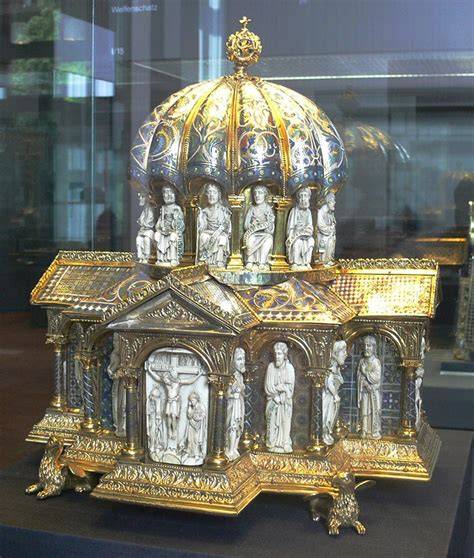
Major relics associated with Jesus
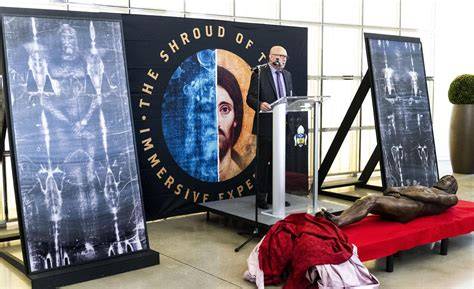
1. The Shroud of Turin
The Shroud of Turin is the best-known relic of Jesus and one of, if not the, most studied artifacts in human history. Believers contend that the shroud is the cloth placed on the body of Jesus Christ at the time of his burial, and that the face image is the Holy Face of Jesus. Detractors contend that the artifact postdates the Crucifixion of Jesus by more than a millennium.
The most famous and venerated relic of Jesus Christ is an enigma that challenges the most advanced scientific knowledge, a simple linen sheet with an imprinted mystery, capable of justifying the religious belief of millions throughout the centuries. The Shroud of Turin resides at the Cathedral of St. John the Baptist in Turin, Italy.
Before the results obtained in recent times by sindonologists-the experts of this new scientific discipline-the Gospels tell that Jesus, taken down from the cross, was wrapped in a linen sheet before being taken to the tomb. John tells of when, on Easter morning, Peter, having entered the tomb, saw the bandages on the ground and the shroud folded in another place.
A millenary tradition of faith identifies that shroud with the precious relic that arrived in Turin in the 16th century after countless adventurous events between Edessa, Constantinople, France and Piedmont. Whoever has the privilege of admiring the shroud during one of the rare public displays sees a single piece of linen cloth, herringbone fabric, 4.37 meters long and 1.13 wide.
On the cloth are visibly imprinted the frontal and dorsal images of a human body with various wounds and injuries. Science has never determined how the images appeared. Various traces of blood are also recognized, first of all on the hands, feet and ribs.
The striking negative image was first observed on the evening of May 28, 1898, on the reverse photographic plate of amateur photographer Secondo Pia, who was allowed to photograph it while it was being exhibited in the Turin Cathedral. The image can be seen much more clearly in a black and white negative photo and specific details on the shroud are not easily observed with the naked eye.
There have been a series of tests run against the shroud including three radiocarbon dating tests in 1988 and several restorations. Despite the carbon-14 test, carried out in 1988, which traced the shroud back to the 13th or 14th century, many tests and researchers support the possibility of authenticity.
The Catholic Church has neither formally endorsed nor rejected the shroud, but in 1958 Pope Pius XII approved of the image in association with the Roman Catholic devotion to the Holy Face of Jesus. It is kept in a temperature-controlled environment under bulletproof glass in an air-tight case and is kept on aluminum support.
All the data obtained from the observation of the cloth extraordinarily coincide with the Gospel narration. The shroud always has been the subject of extraordinary veneration and also heated scientific debate. No other item has been the subject of such a systematic examination involving a wide range of disciplines, from history to genetics.
At least one point is clear: Even if the truth of Christianity does not depend on the shroud, the mystery hidden in it will never cease to fascinate.
2. The Crown of Thorns
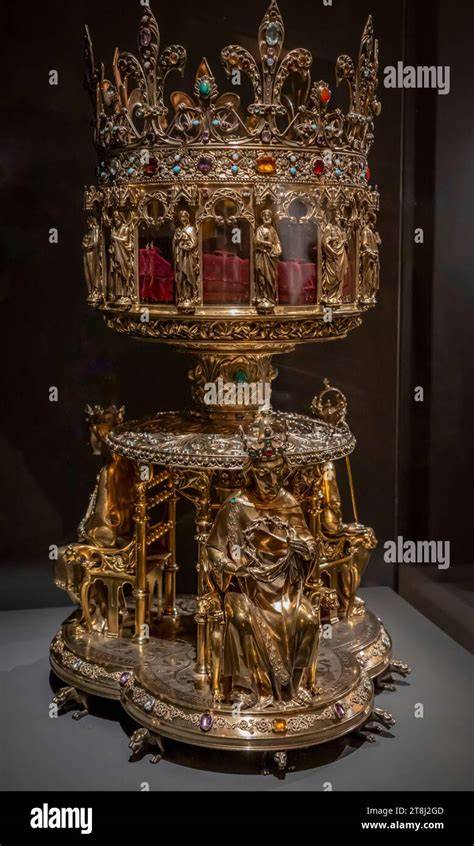
Saint John tells that, in the night between Maundy Thursday and Good Friday, Roman soldiers mocked Christ and his Sovereignty by placing a thorny crown on his head. The Crown of Thorns is thought to have been worn by Jesus during events leading up to the Crucifixion, when the woven crown was used to cause him pain and to mock him.
The crown housed in the Paris cathedral is a circle of canes bundled together and held by gold threads. The thorns were attached to this braided circle, which measures 21 centimeters in diameter. The thorns were divided up over the centuries by the Byzantine emperors and the Kings of France.
The Crown of Thorns is kept in Paris. It was rescued from the Notre Dame cathedral fire on April 15. The relic was once owned by Louis IX, and the crown was kept at Sainte-Chapelle after the French king obtained it from Constantinople.
In 1870, Charles Rohault de Fleury, a French architect, counted 139 thorns throughout all Europe venerated as belonging to Christ’s Crown of Thorns. At least half of them are fake relics on the basis of the studies carried out in Paris, where the true crown has been located for almost 800 years.
The hoop of the crown, about 12 centimeters large, is made of Juncus balticus, a plant species typical of the Eastern Mediterranean basin. According to some botanists, in the crown there were no more than 50 or 60 thorns.
There is a noteworthy clue in favor of the authenticity of the thorns: In the famous Turin shroud, scientists discovered a very high concentration of pollen grain from Gundelia tournefortii, a species of thistle only found in Judea, around the head area on the linen. This same thistle is one of the plants used in the Crown of Thorns.
Despite numerous studies and historical and scientific research efforts, its authenticity cannot be certified. It has been the object of more than sixteen centuries of fervent Christian prayer.
3. Fragments of the True Cross
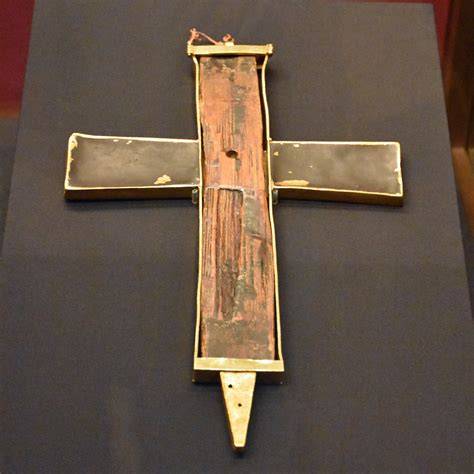
In the Christian tradition, the True Cross refers to the actual cross used in the Crucifixion of Jesus. Today, many fragments of wood are claimed as True Cross relics, but in most cases it is hard to establish their authenticity.
The history of the Holy Cross begins with Constantine the Great, the Roman emperor famous for having granted religious freedom to all Christians in 313. At this time there was a belief, kept alive by the Christians of Jerusalem, that the material evidence of Christ’s crucifixion was buried there.
Constantine, the first Christian emperor of Roman history, sent his mother, Helena-who is regarded today as a saint by both the Catholic and Orthodox Churches-to Jerusalem. On September 14, which would become the Feast of the Exaltation of the Holy Cross, she discovered three wooden crosses and three nails in an old cistern not far from Golgotha, where Christ was crucified.
She divided Jesus’ cross into three pieces, to be sent to Rome, Constantinople and Jerusalem. Even the titulus, stating “Jesus of Nazareth, King of the Jews,” as stated in St. John’s Gospel, was divided into two pieces.
Upon her return to Rome, she converted a part of her house into a chapel, to host the relics she brought to Rome: a fragment of the cross, the half of the titulus and three nails. Today, this is the site of the Basilica of the Holy Cross in Jerusalem, although in 1629 some of the relics were transferred to the newly constructed St. Peter’s Basilica by Pope Urban VIII.
Pieces of the purported True Cross, including the half of the INRI inscription tablet, are preserved at the ancient basilica Santa Croce in Gerusalemme in Rome. Very small pieces or particles of the True Cross are reportedly preserved in hundreds of other churches in Europe and inside crucifixes.
The other two parts of the cross mentioned above were divided again into smaller parts, currently spread throughout Europe. In the past it was common to divide a relic into smaller fragments, according to the belief that even the smallest fragment had the same sacred power as the whole relic.
The spread of the story of the fourth century discovery of the True Cross was partly due to its inclusion in 1260 in Jacopo de Voragine’s very popular book The Golden Legend, which also included other tales such as Saint George and the Dragon.
Fragments of the True Cross, one of the nails and part of the titulus are found at the Basilica of the Holy Cross in Jerusalem. The term True Cross-links to the actual cross used in the Crucifixion of Jesus and there are known to be several pieces with a legitimate claim to the title scattered across Europe.
The authenticity of these relics is not accepted universally by those of the Christian faith and the accuracy of the reports surrounding the discovery of the True Cross is questioned by many Christians. According to meticulous research carried out in the 19th century, all the known fragments of the Holy Cross amount to less than one-ninth of its original volume.
4. The Holy Nails
How are we to establish which are the true ones, given that there are 36 “holy nails” in Europe, but only three of them nailed Jesus to the cross? Unexpected help came in 1968 from an archaeological discovery near Jerusalem.
Four tombs were excavated and found three nails near the body of a young man, crucified supposedly between 6 and 65 A.D. They are rectangular in shape, 16 centimeters long and 0.9 centimeters wide at their thickest point.
The comparison suggests that some “holy nails” are not genuine, since some are too long or made of silver. Two of the alleged Holy Nails are still venerated today.
Let us take into account the oldest sources, according to whom Helena discovered three nails of Jesus’ cross in Jerusalem. The first one is venerated today in the Roman Basilica of the Holy Cross in Jerusalem. The second nail was brought to Constantinople in 1354 by a Venetian merchant, Pietro Torrigiani.
The fate of the third Holy Nail of St. Helena is more difficult to clarify. According to Theodoret of Cyrus, a part was embedded in the helmet of Constantine, while another part was melted into his horse’s harness. There are two places now where the emperor’s harness is venerated: the first is in Carpentras, France, and the second is in Milan, Italy.
Another nail, or part of a nail, is said to be located in the Iron Crown of Lombardy in the Cathedral of Monza although it is unclear when the nail became part of the crown. Other nails or parts of them are thought to exist in churches or cathedrals in Siena, Catiana, and Bamberg.
Another long-debated topic is whether Jesus was crucified with three or four nails, and there is even a story from Socrates that two were cast into the Adriatic Sea.
5. The Holy Lance
The Holy Lance, also known as the Spear of Destiny, Holy Spear, Lance of Longinus, Spear of Longinus or Spear of Christ, is the name given to the lance that pierced Jesus’ side as he hung on the cross in John’s account of the Crucifixion.
The lance is mentioned only in the Gospel of John and not in any of the Synoptic Gospels. The gospel states that the Romans planned to break Jesus’ legs, a practice known as crurifragium, which was a method of hastening death during a crucifixion.
Just before they did so, they realized that Jesus was already dead and that there was no reason to break his legs. To make sure that he was dead, a Roman soldier, named in extra-Biblical tradition as Longinus, stabbed him in the side.
“But one of the soldiers pierced his side with a lance, and immediately there came out blood and water.”
According to the legend, the Roman soldier Longinus was cured of cataracts when he pierced the side of Jesus on the cross and the blood and water flowed out. Longinus was later baptized and martyred.
The spearhead of Longinus’ spear resides in the Vatican. Pilgrims reporting from the Holy Land mention his spear up to the eighth century, not later.
The history of this relic goes on from Constantinople. At the time of the Fourth Crusade, in 1204, Franks and Venetians invaded Constantinople and stole many relics, but not the spear.
The Latin Empire of Constantinople founded by the Crusaders was repeatedly threatened by the Greeks and Bulgarians. Therefore, the ruler, Baldwin II, was forced to sell to King Louis IX of France the spear staff, in order to collect resources to defend his Empire.
One of the best-preserved relics sits beneath the dome of Saint Peter’s Basilica, however, the Roman Catholic Church does not comment on its authenticity. This spear is thought to have been split into two parts with the second larger piece lost sometime around 615 A.D.
In 1492, Sultan Bayerid II proposed an agreement to Pope Innocent VIII: to welcome the sultan’s brother, Cem, a dangerous pretender to the Ottoman throne, to Rome. The agreement was that the brother had to remain in Rome in exchange for the return of the Longinus headspear.
The relic arrived in Rome from Ancona, an Italian city on the Adriatic Sea, delivered by two eminent cardinals. Pope Benedict XIV, in the 18th century, had many doubts on its authenticity. He asked the King of France to send the spear’s staff to Rome to verify the authenticity. The two pieces fit together perfectly.
6. The Seamless Robe of Christ
The Holy Robe, Holy Tunic, Holy Coat of Thieves, and Holy Coat of Trier are names associated with the Seamless Robe of Christ. The Holy Tunic of Christ is said to have been worn by Jesus during or shortly before his Crucifixion.
It is preserved at the Cathedral of Trier in Germany. In the Gospel of John, the soldiers cast lots on who would receive the tunic because it was woven in one single piece. Hence the name, the Seamless Robe.
“Then the soldiers, when they had crucified Jesus, took His garments and divided them into four parts, to every soldier a part, and the coat. Now the coat was without seam, woven whole from the top down. Therefore, they said among themselves, let us not tear it, but cast lots for it, whose it will become.”
According to legend, Helena, mother of Constantine the Great, discovered the seamless robe in the Holy Land in the year 327 or 328 along with several other relics, including the True Cross. According to different versions of the story, she either bequeathed it or sent it to the city of Trier.
The history of the Trier robe is certain only from the 12th century. On May 1, 1196, Archbishop Johann I of Trier consecrated an altar in which the seamless robe was contained.
Its history includes three mysterious, bolted-shut chests discovered in Trier, Germany, on April 14, 1512, in a hidden chamber hollowed under the cathedral floor. The discovery quickly excited everyone, given an old legend suggesting that Christ’s vestment was hidden in Trier Cathedral.
Even the Emperor Maximilian was in Trier, eight days later, when they opened the chests and found in the first the relics of St. Maternus, an old bishop of Trier; in the second a knife, possibly from the Last Supper, and a die, suggested to be the one used by the Roman soldiers to cast lots for Christ’s robe; in the third, finally, a folded garment.
There is also a biography of Bishop Agritius of Trier, written between 1050 and 1072, stating that St. Helena, the mother of Constantine, returning from her famous trip to the Holy Land, donated several relics to Agritius, including a knife from the Last Supper and the Holy Coat.
Regardless, it was enough for the two million pilgrims who came to Trier in 1891 to venerate the relics, since the Holy Coat was very rarely displayed. In 1933, when the coat was put on public display again, the pilgrimage turned into a demonstration against the Nazi regime.
It is no longer possible to determine the exact historical path that the robe took to arrive there, so many hold it to be a medieval forgery. The various attempts at preservation and restoration through the centuries have made it difficult to determine how much of the relic, if genuine, actually stems from the time of Jesus.
A scientific examination of the specimen has not been conducted. The stigmatist Therese Neumann of Konnersreuth declared that the Trier robe was authentic.
7. The Veil of Veronica
The Veil of Veronica, which according to legend was used to wipe the sweat from Jesus’ brow as he carried the cross, is also said to bear the likeness of the Face of Christ.
Known simply as the Veronica, this Christian relic is thought to have been used by Saint Veronica to wipe the blood and sweat from the face of Jesus during the Crucifixion. During this moment it is thought that the face of Jesus appeared on the veil and has stayed there ever since.
Today, several images claim to be the Veil of Veronica. There is an image kept in Saint Peter’s Basilica in Rome which purports to be the same Veronica as was revered in the Middle Ages.
The veil was thought to have been displayed in Rome during the Thirteenth, Fourteenth and Fifteenth Century, however, there are conflicting reports to this. Some scholars claim that the veil was destroyed during the Sack of Rome in 1527, some claim it was stolen, and others claim the Veil still exists today in the Vatican.
Several relics claiming to be the original veil are in existence and are located in Rome, Vienna, and Spain. Very few inspections are recorded in modern times and there are no detailed photographs.
The most detailed recorded inspection of the 20th century occurred in 1907 when Jesuit art historian Joseph Wilpert was allowed to remove two plates of glass to inspect the image.
8. The Holy Stairs
The Scala Sancta, or Holy Stairs, are, according to Christian tradition, the steps that led up to the praetorium of Pontius Pilate in Jerusalem, which Jesus Christ stood on during his Passion on his way to trial.
Thought to be the steps that Jesus climbed during his trial, these large marble steps are located in the extraterritorial property of the Holy See in Rome, Italy. There are 28 steps in total that are encased in a protective wooden framework.
The stairs were reputedly brought to Rome by St. Helena in the 4th century. Legend has it that St. Helena, mother of Emperor Constantine the Great, brought the Holy Stairs from Jerusalem to Rome circa AD 326.
For centuries, the Scala Santa has attracted Christian pilgrims who wished to honor the Passion of Jesus. The stairs can only be ascended on the knees, and the stairs also have two other modern-day staircases on either side for traditional use.
The Scala Sancta are located next to a church which was built on ground brought from Mount Calvary. The stairs lead to the Sancta Sanctorum, or Holy of Holies, the personal chapel of the early Popes in the Lateran palace, known as the chapel of St. Lawrence.
The stairs are decorated with magnificent frescos that underwent significant restoration in 2007. They were even visited by Charles Dickens in 1845.
9. The Holy Grail
The Holy Grail is a sacred object figuring in literature and certain Christian traditions, most often identified with the dish, plate, or cup used by Jesus at the Last Supper and said to possess miraculous powers.
Possibly one of the most well-known and talked-about relics from the life of Jesus was the Holy Grail, which he is said to have drunk from at the Last Supper. The Grail, which is also described as a bowl, dish or a stone in several publications, is thought to contain powers that provide both happiness and eternal youth.
The connection of Joseph of Arimathea with the Grail legend dates from Robert de Boron’s Joseph d’Arimathie, written in the late 12th century, in which Joseph receives the Grail from an apparition of Jesus and sends it with his followers to Great Britain.
Building upon this theme, later writers recounted how Joseph used the Grail to catch Christ’s blood while interring him and that in Britain he founded a line of guardians to keep it safe.
The quest for the Holy Grail makes up an important segment of the Arthurian cycle, appearing first in works by Chrétien de Troyes. The early Grail romances centered on Percival and were woven into the more general Arthurian fabric.
The legend may combine Christian lore with a Celtic myth of a cauldron endowed with special powers. The Grail legend’s development has been traced in detail by cultural historians: it is a legend which first came together in the form of written romances, deriving perhaps from some pre-Christian folklore hints, in the later 12th and early 13th centuries.
Some of the Grail legend is interwoven with legends of the Holy Chalice. In 2014, two Spanish researchers claimed to have found the Grail and said it was located in a Spanish church in the city of León.
The Grail has been hunted for many years by explorers and historians alike and was heavily featured in the film Indiana Jones and the Last Crusade, where it was shown as a simple carved wooden cup. The Grail also features heavily in the legend of King Arthur and in the film Monty Python and the Holy Grail.
The work of Leonardo da Vinci presents the Holy Grail as derivative of sang real, literally meaning holy blood, or the blood lineage of Jesus with his alleged wife Mary Magdalene, which has been kept hidden to date.
10. The Iron Crown of Lombardy
The Iron Crown of Lombardy is both a reliquary and one of the most ancient royal insignia of Europe. The crown became one of the symbols of the Kingdom of Lombards and later of the medieval Kingdom of Italy.
It is kept in the Cathedral of Monza, in the suburbs of Milan. The Iron Crown is so called from a narrow band of iron about one centimeter, or three-eighths of an inch, within it, said to be beaten out of one of the nails used at the Crucifixion.
The outer circlet of the crown is composed of six segments of beaten gold partly enameled, joined together by hinges and set with twenty-two gemstones that stand out in relief, in the form of crosses and flowers.
Its small size and hinged construction have suggested to some that it was originally a large armlet or perhaps a votive crown. For others, the small size of the present crown was caused by a readjustment after the loss of two segments, as described in historical documents.
One part of a Holy Nail is said to be incorporated into the crown, although it is unclear when the nail became part of it. In 1576, Bishop Charles Borromeo carried the relic three times through the streets of Milan, praying for the end of a deadly plague.
Since the plague ended, they had no doubt: the holy nail made the miracle.
11. The Pillar of Scourging
The Pillar of Scourging is venerated at the Roman Basilica of Santa Prassede. Here visitors can venerate one of the most relevant relics related to the Passion of Christ: the Pillar of Scourging, made of Egyptian marble, whose shape is the same as the architectural style of the Hellenistic age.
There is no evidence that the pillar is the one at which Jesus was beaten and scourged in Pilate’s praetorium; nevertheless, it is very likely. The first mention comes from the journal of Egeria, a pilgrim who visited the Holy Land in the late fourth century, who observed, “Many devotees went to Zion to pray before the pillar at which Jesus was scourged.”
It is worth noting that in this place, Mount Zion, outside Jerusalem’s walls, there was a temple of the Judeo-Christian community. They preserved many Old Testament traditions, beliefs and precepts neglected by other Christians, including the prohibition of any contact with bodily remains within the city walls.
In 1009, Caliph Al-Hakim ordered the destruction of the Church of the Apostles, where the pillar had been moved. To avoid destruction, it was brought first to Constantinople, then to Rome in 1223, thanks to the papal legate to Constantinople, Cardinal Giovanni Colonna.
The rulers of the Latin Emperor gave him the pillar as a gift for Pope Honorius III in order to get his support. The cardinal very happily accepted the gift, since colonna in Italian means “pillar,” and in his crest, there was precisely a pillar.
12. The Holy Blood
Located in the Basilica of the Holy Blood, this relic is a piece of cloth that is said to contain the blood of Christ and is more well known as the Relic of the Precious Blood.
It is said that Joseph of Arimathea preserved the Precious Blood after he had washed the body of Christ, and legend says that the artifact was taken to Bruges during the Second Crusade.
The Basilica where the artifact is held consists of a lower and upper chapel, with the relic being held in the latter part.
13. The Veil of Manoppello
The Veil of Manoppello is presumed to be the same veil used by Veronica. Like other images associated with the Holy Face, it is connected by tradition with the belief that an image of Jesus’ face was miraculously impressed on a cloth.
14. The Image of Edessa
The Image of Edessa, also known as the Mandylion, was allegedly sent by Jesus himself to King Abgar V of Edessa to cure him of leprosy, with a letter declining an invitation to visit the king.
The story of this image is the product of centuries of development during which the image was lost and reappeared several times. Today, two images claim to be the Mandylion: one is the Holy Face of Genoa at the Church of St. Bartholomew of the Armenians in Genoa, and the other is the Holy Face of San Silvestro.
The Holy Face of San Silvestro was kept in the Church of San Silvestro in Capite in Rome up to 1870 and is now in the Matilda Chapel of the Vatican Palace. The theory that the object venerated as the Mandylion from the sixth to the thirteenth centuries was in fact the Shroud of Turin has been the subject of debate, but is now mostly rejected as a hypothesis.
How authenticity is assessed
Relics associated with Jesus are evaluated through a combination of biblical comparison, historical documentation, archaeology, material analysis, conservation studies, and the history of custody. The evidence is often incomplete because many objects were transferred between Jerusalem, Constantinople, Rome, France, Germany, and other parts of Europe over long periods.
Historical continuity can strengthen a claim, but it does not by itself prove that an object belonged to Jesus. A relic may have been venerated for centuries while its earlier history remains uncertain. Scientific testing can also be limited by restoration, contamination, lack of suitable samples, or the impossibility of identifying a unique individual from the material.
The various attempts at preservation and restoration through the centuries have made it difficult to determine how much of a relic, if genuine, actually stems from the time of Jesus. Some relics have never received a complete scientific examination, while others have been subjected to extensive testing that still has not resolved the debate.
Relics and history are therefore related but not identical. The history of relics-authentic or fake-is an amazing, fascinating chapter of Christian history through the centuries, especially the relics of Jesus Christ, which remain the most venerated and famous.
Relics, pilgrimage, and religious meaning
People longed to be in contact with the holiness represented by these saints, and many traveled long distances to churches with relics. Relics provided a material connection to the presence of holy beings whose spirits were with God.
In the later Middle Ages, seeing holy objects that pointed to Christ became a central concern. Crystal and gold reliquaries pointed to the spirit of the saint dwelling in heaven. Along with the jewels and gold that often were part of these reliquaries, the crystal containers of these relics pointed to the heavenly status of the saint whose bodily fragment was displayed in the reliquary but whose spirit was in the presence of God.
What can be made of this as a matter of religious history is that tangible connections with the life of Christ helped worshippers focus on his suffering, death, humanity, and atoning significance. Even when authenticity could not be demonstrated, the relics continued to shape pilgrimage, architecture, art, prayer, conservation, historical research, and the devotional imagination of generations.
tags: #relics #associated #with #jesus