Italian rosary beads combine a long Catholic devotional tradition with skilled work in glass, wood, metal, and stone. Their significance lies not only in their appearance or country of origin, but in the way they serve as tactile aids to meditation on the life, ministry, Passion, death, and Resurrection of Jesus Christ.
The traditional five-decade Catholic Rosary follows the same basic prayer structure regardless of where it is prayed. Its familiar sequence includes the Our Father, Hail Mary, Glory Be, and meditation on the mysteries, while Italian craftsmanship has given the physical object distinctive materials, construction, and artistic detail.
The Origins and Development of the Rosary
For centuries, the rosary has been one of the most cherished objects in Catholic devotional life - a tactile prayer tool, a family heirloom, and increasingly, a prized collector's item. The rosary as we know it today developed gradually over the medieval period, with its modern form largely attributed to the Dominican Order in the 13th century.
The rosary as a structured prayer devotion was popularized in the thirteenth century through the preaching of Saint Dominic and the Dominican Order - an order that found its earliest and strongest foothold in Italy. The word “rosary” comes from the Latin “rosarium,” meaning “rose garden,” reflecting its beauty and complexity.
Traditionally, the rosary consists of a cross, a string of beads divided into five sets of ten decades, and a few additional beads for introductory prayers. Each bead represents a prayer, typically the Hail Mary, while the larger beads denote the Our Father. The entire structure facilitates a meditative journey through the mysteries of the life of Jesus and Mary.
By the 15th and 16th centuries, the rosary had become a central devotional object across Catholic Europe, and skilled craftsmen in France, Italy, and Germany began producing them in increasingly refined materials: coral, jet, amber, rock crystal, silver, and gold.
Why Italy Became a Centre of Rosary Craftsmanship
Italy has been an important center of Catholic religious art and craftsmanship for centuries. Rosaries made or sold in Italy can range from very simple wooden designs to elaborate glass and metalwork.
The story of rosaries from Italy cannot be separated from the story of the Catholic Church itself. Rome has been the seat of the papacy since the first century. Italy gave the Church some of its greatest saints - Francis of Assisi, Dominic, Thomas Aquinas, Catherine of Siena, Padre Pio - and some of its greatest artists - Michelangelo, Bernini, Fra Angelico - all of whom understood their work as an act of worship.
This deep integration of faith and craft created a culture in which the making of sacred objects was never a secondary occupation but a primary vocation. The Italian rosary is not a product. It is a tradition - one that stretches from the medieval monasteries of Tuscany to the artisan workshops of Rome, Venice, and the hill towns of Umbria, where the making of sacred objects has been understood as its own form of prayer.
As the rosary spread through Catholic Europe, Italian craftsmen were already producing the finest beads, crosses, and centerpieces the devotion demanded. By the Renaissance, Italian workshops had developed techniques in glassmaking, metalwork, and stonecutting that made their rosaries the standard against which all others were measured.
- The Murano glassmakers of Venice, producing crystal beads of extraordinary clarity and color.
- The goldsmiths of Florence, crafting crucifixes and centerpieces of unmatched detail.
- The stone carvers of Rome, cutting beads from jasper, coral, onyx, and agate that carried the weight and beauty of the earth itself.
This is the tradition behind every authentic rosary from Italy - not a marketing claim but a historical reality built over seven hundred years of continuous craftsmanship.
Italian Rosary Materials and Their Traditions
The Italian rosary tradition encompasses a remarkable range of materials - each with its own history within Catholic devotional culture. The material primarily affects practical characteristics such as appearance, weight, durability, texture, and portability.
Rosaries around the world can be made from an enormous range of materials, including wood, glass, crystal, natural stone, pearl imitation beads, seeds, metal, and paracord. None of these materials changes the spiritual purpose of the Rosary.
Murano and Italian Glass
One particularly recognizable material associated with northern Italy is Venetian and Murano glass. Glassmaking on Murano developed into one of Venice's most famous craft traditions, and glass beads have historically been used for both jewelry and rosaries.
The crystal rosary from Italy represents perhaps the most iconic expression of Italian rosary craftsmanship. Italian crystal beads - produced in the tradition of Murano glass - are distinguished by their exceptional clarity, the depth of their color, and the way they interact with light during prayer.
A crystal rosary from Italy catches the light differently at every angle - creating a visual experience during prayer that devotional tradition has always connected to the divine light breaking through the material world. The clarity of crystal has been associated in Catholic thought with the transparency of a soul opened to grace - nothing hidden, nothing opaque, the light of faith passing through without obstruction.
Crystal rosaries from Italy are produced in every color of the rosary spectrum - the deep red catholic rosary in rich garnet crystal, the navy blue crystal rosary in Marian blue, the soft pink catholic rosary necklace in rose crystal - each one carrying both the color theology of Catholic devotion and the craftsmanship of the Italian tradition.
Italian crystal beads - produced using traditional Murano techniques or similar Italian glassmaking methods - have a clarity, weight, and light-catching quality that mass-produced plastic beads cannot replicate.
Olive Wood, Walnut, and Fruitwood
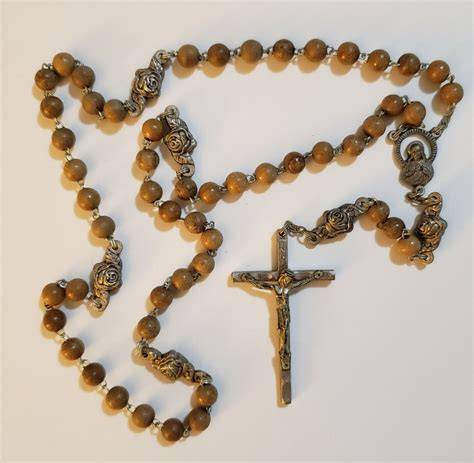
Wood has been used in Catholic sacred objects since the earliest centuries of the Church - a connection to the Cross that gives wooden rosary beads a theological dimension beyond their material beauty. Natural wood beads from Italian olive wood, walnut, or fruitwood carry the warmth and grain of materials that have been used in sacred objects since the earliest centuries of the Church.
Italian wood rosary beads are crafted from several traditional materials:
- Olive wood - The most theologically resonant of all Italian rosary materials. The olive tree appears throughout sacred scripture - the Mount of Olives where Christ prayed in agony, the olive branch of peace, the oil of anointing. Italian olive wood rosary beads carry this scriptural weight in their grain, their warmth, and their natural fragrance.
- Walnut wood - Italian walnut is prized for its deep, rich grain and the darkness of its natural color. A Italian walnut wood catholic rosary carries the solemnity of its material - the dark wood evoking the wood of the Cross with a beauty that deepens over years of handling.
- Natural wood - Lighter Italian wood rosary beads carry a simplicity and warmth that connects the prayer of the rosary to the natural world - the creation that the Incarnation sanctified by God taking flesh within it.
Our Italian natural wood rosary is crafted from this tradition - each bead carrying the warmth of Italian wood and the weight of centuries of sacred use.
Stone, Coral, Onyx, Jasper, and Agate
The stone carvers of Rome cut beads from jasper, coral, onyx, and agate that carried the weight and beauty of the earth itself. Across Catholic Europe, rosaries were also made from coral - particularly Bavarian and Mediterranean coral, prized for its warm colour and rarity - as well as rock crystal, amber, and other natural materials.
Natural stone can give a rosary a greater sense of weight and a distinctive tactile character. Its importance, however, remains cultural, historical, aesthetic, or personal rather than supernatural.
Metalwork and Precious Materials
Italian workshops developed techniques in metalwork that contributed to the detailed crucifixes and centerpieces found on fine rosaries. Silver and gold were among the refined materials used by craftsmen across Catholic Europe, while Italian goldsmiths became known for producing crucifixes and centerpieces of exceptional detail.
The crucifix and centerpiece are treated as the theological heart of the devotion - the Cross where the rosary begins and ends, and the image of Our Lady around whom the mysteries rotate. Italian craftsmen have always given these elements the greatest care, producing crucifixes of genuine artistic quality rather than the flat, featureless crosses that characterize mass production.
What Makes an Italian Rosary Authentic?
The question of authenticity matters deeply for those who seek an Italian rosary for devotional use - not as a collectible or a fashion accessory but as a genuine instrument of Catholic prayer. An authentic rosary made in Italy carries several distinguishing characteristics.
Material Quality
Genuine Italian rosary beads are produced from materials chosen for their beauty, durability, and tactile quality during prayer. Genuine Italian crystal beads have a weight and density that distinguishes them immediately from plastic imitations.
The beads should feel substantial in the hand - not light or hollow. Italian crystal beads catch and refract light with a depth and clarity that plastic cannot replicate. Hold the beads in natural light and observe how the color moves through them.
Craftsmanship in the Connections
The wire, the links, the centerpiece, and the crucifix of an Italian rosary are assembled with precision that ensures both beauty and durability. An authentic Italian rosary is built to last - to accompany decades of daily prayer without the links weakening or the beads losing their finish.
The Crucifix and Marian Centrepiece
In Italian rosary tradition, the crucifix and the Marian centerpiece are treated as the theological heart of the devotion - the Cross where the rosary begins and ends, and the image of Our Lady around whom the mysteries rotate.
A genuine Italian rosary carries a crucifix with genuine detail - the corpus of Christ rendered with care, the cross itself finished with precision. A flat, featureless crucifix is the clearest indicator of mass production.
Provenance
A rosary made in Italy carries a traceable connection to the workshops and regions where Italian Catholic craftsmanship has been concentrated for centuries. Provenance is especially important for antique rosaries, signed pieces, and objects made with precious metals or rare materials.
| Feature | What it indicates |
|---|---|
| Substantial bead weight | Material quality and density |
| Clarity and light refraction | Fine glass or crystal craftsmanship |
| Detailed crucifix | Careful devotional metalwork |
| Precise links and wire | Durability and skilled assembly |
| Traceable origin | Connection with Italian artisan traditions |
Italian Rosaries in the Wider Catholic World
The Rosary is prayed in countless languages and cultures, yet its essential structure remains remarkably recognizable around the world. A Catholic in Ireland, Mexico, the Philippines, Italy, Poland, or the Holy Land may hold beads made from very different materials and live within very different local traditions.
What changes from place to place is often not the purpose of the Rosary, but the way local history, craftsmanship, Marian devotion, and family traditions surround it. The traditional five-decade Catholic Rosary follows the same basic prayer structure regardless of where it is prayed.
A local rosary may reflect materials available in the region, traditional craftsmanship, devotion to a local Marian title or saint, periods of persecution or social hardship, family and community prayer customs, and pilgrimage traditions.
These variations reveal something characteristic of Catholicism itself: a universal faith lived within many different cultures.
Italy
In Italy, the rosary holds deep cultural and religious significance. It is often prayed during family gatherings and religious festivals. The Italian rosaries are known for their artisanal craftsmanship, featuring materials like Murano glass and intricate silver work.
The rosary is also integral to processions and Marian feasts, such as the Feast of Our Lady of the Rosary on October 7th, celebrating the Battle of Lepanto's victory attributed to the Virgin Mary's intercession.
Italian rosaries may also feature medals connected with widely venerated saints such as Saint Benedict, Saint Francis of Assisi, Saint Padre Pio, and Saint Anthony of Padua. These features reflect devotional preferences and craftsmanship rather than a separate “Italian Rosary” with different prayers.
France
France has played an important role in the development of several well-known modern Marian devotions. Our Lady of Lourdes is particularly significant. The apparitions reported by Saint Bernadette Soubirous in 1858 and the pilgrimage tradition that developed at Lourdes became closely connected with prayer and the Rosary.
Rosaries associated with Lourdes may include a Lourdes centerpiece, Marian medal, or imagery connected with the grotto. France is also closely associated with the Miraculous Medal, originating from the Marian apparitions reported by Saint Catherine Labouré in Paris in 1830.
Miraculous Medals are frequently incorporated into rosaries around the world. Again, these medals add a particular devotion without changing the essential structure of the Rosary.
Mexico
In Mexico, the rosary is profoundly linked to the Virgin of Guadalupe, the country's patroness. The rosary is prayed daily by many faithful, particularly during December's festivities leading up to the Feast of Our Lady of Guadalupe on December 12th.
Mexican rosaries often incorporate vibrant colors and materials, reflecting the country's rich cultural heritage. For this reason, rosaries used by Mexican Catholics may feature images or medals of Our Lady of Guadalupe.
A Guadalupe medal on a rosary does not change how the Rosary is prayed. Instead, it expresses a particular Marian devotion within the wider Catholic tradition.
The Philippines
The Philippines, another predominantly Catholic nation, deeply venerates the rosary. The country celebrates October as the Month of the Holy Rosary, culminating in the grand celebration of the Feast of Our Lady of the Rosary.
Filipino rosaries are often made from materials like wood, pearl, and shell, reflecting the archipelago's natural resources. The family rosary is a common practice, and many Filipinos carry their rosaries wherever they go, reflecting the integration of faith into daily life.
One distinctive Filipino tradition is the Block Rosary. Rather than describing a special physical type of rosary, the term refers to a communal devotional practice. Neighbors or families within a community gather to pray the Rosary, often around an image or statue of the Blessed Virgin Mary.
In some communities, the Marian image moves from one home to another, allowing different families to host the prayer gathering. This transforms the Rosary from an exclusively private devotion into an expression of neighborhood faith and community life.
Ireland and the Penal Rosary
One of the most distinctive rosary forms associated with a particular historical setting is the Irish penal rosary. It is traditionally connected with the period when Catholics in Ireland lived under restrictive Penal Laws and Catholic religious practice faced serious limitations.
The penal rosary was compact and typically contained a single decade rather than the complete five decades found on a standard Rosary. Its small form made it easier to conceal.
A ring could be moved from finger to finger to help keep track of the five decades while using the same set of ten beads repeatedly. The design demonstrates how a devotional object could adapt to difficult historical circumstances without changing the prayer itself.
Today, the Irish penal rosary remains a powerful historical reminder of Catholics who maintained their devotional life when practicing the faith could carry serious consequences.
Poland
Polish Catholic spirituality has a particularly strong Marian dimension. One of its most important devotional images is Our Lady of Częstochowa, commonly called the Black Madonna of Częstochowa.
The shrine at Jasna Góra has been a major pilgrimage destination for generations of Polish Catholics. Rosaries associated with Polish devotion may therefore incorporate Marian imagery connected with Częstochowa or other national Catholic traditions.
The Rosary has also played a visible role within Polish family and public Catholic life, especially during periods when religious identity became closely connected to cultural perseverance.
It is better, however, not to speak of one standard “Polish rosary style.” Polish Catholics use rosaries made from many different materials and designs, just as Catholics elsewhere do.
The Holy Land
The Holy Land offers another distinctive connection between material and place. Olive wood has long been used by Christian artisans in Bethlehem and the surrounding region to create religious objects.
Rosaries made from olive wood are valued not because the wood has supernatural properties, but because of its connection with the land of the Bible. Olive trees appear repeatedly in Scripture, and the Mount of Olives is associated with several major events in the life of Jesus.
A Holy Land olive wood rosary can therefore carry a geographical and devotional significance for Christians who want a tangible reminder of the places where Christ lived. The spiritual value, however, remains in the prayer rather than in the material itself.
Medals, Centres, and Local Devotions
The centerpiece or additional medal is another area where local and personal devotions appear. A rosary may feature the Blessed Virgin Mary, Our Lady of Guadalupe, Our Lady of Lourdes, the Miraculous Medal, Saint Benedict, Saint Michael the Archangel, Saint Joseph, or a locally venerated saint.
These medals do not create different versions of the Rosary prayer. They normally reflect a devotion that is particularly meaningful to the person using it.
In Italian rosary tradition, Marian centerpieces and crucifixes are not merely decorative additions. They direct attention toward the theological structure of the devotion: the Cross where the rosary begins and ends, and the image of Our Lady around whom the mysteries rotate.
The Religious Significance of Italian Rosaries
The rosary, a string of prayer beads used predominantly in the Catholic faith, serves as a powerful tool for meditation and prayer. Its beads provide a physical rhythm for repeated prayers and help the person praying maintain attention while contemplating the mysteries of Christ.
There is a dimension to praying with an authentic rosary from Italy that goes beyond the quality of the materials or the precision of the craftsmanship. When a Catholic holds an Italian rosary during prayer, they enter a communion that stretches across centuries.
The same tradition that produced this rosary produced the rosaries held by Italian peasants in medieval hill towns, by Renaissance cardinals in Roman basilicas, by missionaries who carried the rosary from Italy across the world, and by the saints whose intercession the Church invokes in every rosary.
Saint Padre Pio - born in Pietrelcina, Italy in 1887 - is perhaps the most famous rosary devotee of the modern era. He is said to have prayed fifteen decades of the rosary every day without fail, and he regarded the rosary as the most powerful weapon available to the Catholic soul.
His rosary - simple, worn smooth by decades of constant prayer - was Italian. The tradition that shaped his devotion was Italian. To pray with an Italian rosary is to pray within that same tradition - not as a historical curiosity but as a living reality that connects the person praying to the vast communion of saints who prayed with the same beads, in the same language of faith, before the same mysteries.
Blessing and Sacramental Use
An authentic Italian rosary, like any Catholic rosary, becomes a fully empowered sacramental when blessed by a priest. The blessing does not add to the beauty or craftsmanship of the rosary - it adds the Church’s official prayer over the object, dedicating it to sacred use and attaching to it the indulgences associated with the rosary devotion.
Italian rosary beads are not automatically blessed at the point of purchase. A Catholic rosary becomes a fully empowered sacramental when blessed by a Catholic priest.
A rosary made in Italy, blessed by a Catholic priest, and prayed with daily attention becomes over time one of the most powerful sacramentals a Catholic can possess. The oil of the hands working their way through the decades, the slight wearing of the beads at the most frequently touched points, the associations of prayer and grace that accumulate over years of faithful use - all of these make the Italian rosary not just an object but a history.
Many Catholics treasure Italian rosaries passed down through generations - grandmothers to mothers to daughters, fathers to sons - each generation adding its prayers to the object until it becomes a physical record of a family’s faith.
Italian Rosaries as Family Heirlooms and Collectors’ Objects
For centuries, the rosary has been one of the most cherished objects in Catholic devotional life - a tactile prayer tool, a family heirloom, and increasingly, a prized collector's item.
Each antique rosary carries with it a history of faith, prayer, and human craftsmanship. Some were carried by soldiers, given as baptism gifts, or passed down through generations of devout families.
Collecting them is not merely an aesthetic pursuit - it is a way of preserving and honouring a rich spiritual and cultural heritage. Whether you are a devout Catholic, a history enthusiast, or an antique collector drawn to the beauty of fine craftsmanship, antique rosaries offer a remarkable window into European religious culture, artisanal tradition, and personal faith.
Materials in Antique Rosaries
The beads of an antique rosary reveal much about its age, origin, and value. Common materials include coral, particularly Bavarian and Mediterranean coral, prized for its warm colour and rarity; rock crystal, a clear, luminous quartz associated with purity and often used in Art Deco pieces; mother of pearl, a classic material with a soft iridescence, popular in late 19th-century French rosaries; jet and black glass, associated with mourning rosaries, particularly from the Victorian era; and amber and bone, more rustic materials found in folk rosaries from Central and Eastern Europe.
The Cross and Medals
The crucifix and any accompanying medals are often the most artistically significant elements of a rosary. Look for fine detailing, hallmarks indicating silver or gold content, and the quality of the corpus, the figure of Christ.
French rosaries frequently feature vermeil, or gold-plated silver, crosses with intricate engraving. Although French examples belong to a separate national tradition, they demonstrate the wider European relationship between rosary devotion and jewellery craftsmanship.
Hallmarks and Maker’s Marks
French antique rosaries produced after 1838 were subject to hallmarking regulations, making it possible to identify the metal content, date, and sometimes the maker. A hallmarked rosary by a known maker like Adolphe Penin commands a significant premium and provides important provenance.
For Italian rosaries, provenance and traceable connection to the workshops and regions where Catholic craftsmanship has been concentrated for centuries are similarly important when assessing an older or particularly fine object.
Condition and Originality
Examine the thread or chain linking the beads - original silk thread is fragile and often replaced, while original metal chains are a sign of better preservation. Check for missing beads, repairs, or replaced components.
A rosary in original, unrestored condition is generally more desirable to serious collectors. At the same time, a repaired rosary may retain considerable devotional and historical significance if its construction and alterations are clearly understood.
Age and Style
Rosaries from the Art Deco period, the 1920s-1930s, often feature geometric designs and materials like rock crystal and rolled gold. Victorian-era rosaries tend toward more ornate, naturalistic designs. Earlier pieces from the 18th century are rarer and typically more valuable.
How Rosaries Are Prayed Around the World
The essential structure remains recognizable throughout the Latin Catholic tradition, but local customs can differ. Some communities add prayers before or after the traditional Rosary. Others sing hymns between mysteries. A family may pray one decade together each evening, while another community may gather publicly for all five decades.
Particular intentions may also reflect local circumstances. What remains central is meditation on the mysteries of Christ through the traditional sequence of Rosary prayers.
The Rosary is not tied to Latin, Italian, English, or any other single language. Catholics pray it in languages spoken throughout the world. The language changes. The mysteries do not.
A Hail Mary prayed in Spanish, Polish, Tagalog, Arabic, French, Italian, or English belongs to the same Catholic devotion. This is one of the simplest ways the Rosary expresses the universality of the Church.
How to Pray the Rosary with Bishop Barron
Material, Origin, and Spiritual Power
None of these materials changes the spiritual purpose of the Rosary. A stone rosary is not spiritually stronger than a wooden one. A particular bead color does not automatically produce grace, protection, healing, or another spiritual effect.
A rosary does not become more spiritually powerful because it was made in Jerusalem, Rome, Lourdes, Mexico, or another sacred or culturally significant place. Its origin may give it important personal or devotional meaning.
A pilgrim may treasure a rosary from Lourdes because it recalls a pilgrimage. A Catholic of Mexican heritage may feel particularly connected with a Guadalupe rosary. A Holy Land rosary may remind someone of the places associated with the life of Christ.
But Catholic prayer should not treat geographical origin or material as a source of supernatural power. The rosary is an aid to prayer.
Caring for Italian and Antique Rosaries
Antique rosaries require gentle handling. Store them flat or loosely coiled in a soft cloth pouch, away from direct sunlight and humidity.
A soft pouch or case also helps protect Italian crystal beads from scratching. Clean the beads gently with a soft, damp cloth if needed. Avoid chemical cleaners, harsh chemicals, perfumes, or prolonged direct sunlight, which can affect the finish of the wire and the vibrancy of crystal beads over time.
A soft, dry cloth is sufficient for most metals. If the thread needs replacing, seek out a conservator experienced with religious objects to preserve the integrity of the piece.
The Rosary as a Sign of a Universal Church
The rosary's universal appeal lies in its adaptability to various cultures and traditions, each bringing a unique perspective and style to this ancient form of prayer.
Perhaps the most interesting thing about rosaries around the world is not how different they are. It is how much remains the same. The languages change. The beads change. The local saints and Marian images change. The customs surrounding the prayer change. Yet Catholics return to the same mysteries of Christ.
A family praying a Block Rosary in the Philippines, a pilgrim holding beads at Lourdes, and someone quietly praying one decade at home participate in the same basic devotion. This combination of unity and cultural diversity is one reason the Rosary has endured across centuries and continents.
From the artisanal rosaries of Italy to the vibrant beads of Mexico, the rosary continues to be a powerful symbol of faith and devotion across the globe. As Catholics from different backgrounds come together to pray the rosary, they not only honour their individual traditions but also contribute to a rich tapestry of global spiritual practice.