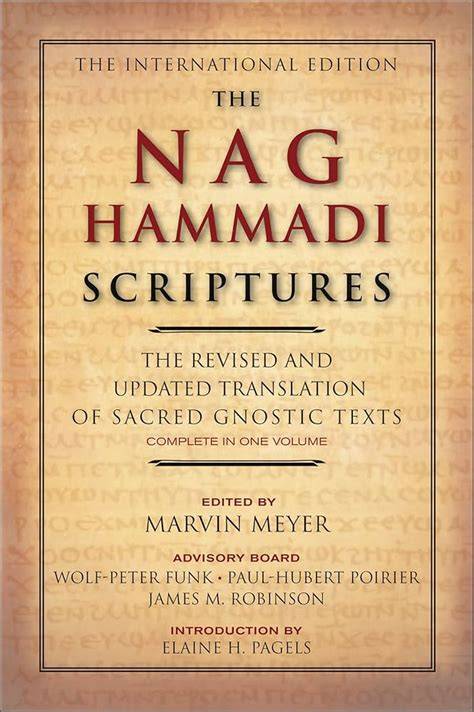
The Gnostic Bible: Revised and Expanded Edition, edited and translated by Willis Barnstone and Marvin Meyer, is an 896-page collection of Gnostic writings published by Shambhala Publications on June 30, 2009. It brings together texts from centuries, geographical regions, and cultural traditions, presenting Gnostic spirituality through poetic, readable translations, introductions, notes, an extensive glossary, and suggestions for further reading.
Gnosticism was a wide-ranging religious movement of the first millennium CE-with earlier antecedents and later flourishings-whose adherents sought salvation through knowledge and personal religious experience. The book gathers Jewish, Christian, Hermetic, Mandaean, Manichaean, Islamic, and Cathar expressions of Gnostic spirituality, with texts originating in Egypt, the Greco-Roman world, the Middle East, Syria, Iraq, China, and France.
What the book covers
The Gnostic Bible attempts to bring together a corpus of major gnostic works drawing on many sources, many from the Nag Hammadi library. It does a wonderful job of drawing from many sources and selecting the most important and well preserved texts. Gnostic writings offer striking perspectives on both early Christian and non-Christian thought.
Only in the past fifty years has it become clear how far the gnostic influence spread in ancient and medieval religions-and what a marvelous body of scriptures it produced. For example, some gnostic texts suggest that god should be celebrated as both mother and father, and that self-knowledge is the supreme path to the divine.
The selections gathered here in poetic, readable translation represent Jewish, Christian, Hermetic, Mandaean, Manichaean, Islamic, and Cathar expressions of gnostic spirituality. Their regions of origin include Egypt, the Greco-Roman world, the Middle East, Syria, Iraq, China, and France.
What Gnosticism means in the collection
The Gnostics proclaimed “gnosis”, or “knowledge”, as the way of salvation. This did not mean merely “book learning” but a mystical knowledge involving an examination of one’s self, i.e. who you are, where you are from, how you exist and where you are going, essentially the soul’s journey.
The Gnostics long preceded the Protestant notion that men and women may know God directly, without any need for the mediation of rabbis, priests, bishops, imams or other religious officials. The Gnostics were declared heretics because this belief naturally subverted the power of the orthodox church’s hierarchy of priests and bishops.
Ironically, however, it was this process of refuting Gnosticism that generated much of the theology that eventually gained domination as orthodoxy. Gnostics were not afraid to read and study diverse religions and philosophies, often developing innovative variations from other mythologies.
The Gnostic view of creation and the divine
Because they observed so much evil, pain, and death in the world, the Gnostics couldn’t attribute it to a good creator, so they envisioned a lessor creator, which they referred to as the demiurge. Because the Gnostics saw the creation as flawed, they envisioned this lesser creator as an imperfect being.
Alternatively, the Gnostics refer to the larger, transcendent deity as: the Good, the One, the Father, the True God, the Good God, the Exalted King, etc. The Gnostics perceived human spirits as imprisoned within bodies that are asleep, drunken or ignorant, from which they must be awakened, freed, and made enlightened through knowledge.
For some Gnostics, the world is but soil from which we blossom into transcendent oneness with God. We utter but meager attempts to describe this Godly oneness (ineffable, limitless, unfathomable, immeasurable, invisible, eternal, unutterable, unnamable, holy, immaculate, incorruptible) because it is so far beyond us that it is impossible for us to say.
Godliness transcends us and is only faintly represented by our most profound utterances such as: life that gives life, blessedness, awareness, knowledge, goodness, mercy, redemption and grace. A name implies equivalence with other names or comparisons thereto but the ineffable is above all names declaring: “I am that I am”.
Awakening, awareness, and salvation
The Gnostic gospels quote Jesus as referring to his body as “the man who bears me” and in popular scripture Jesus often refers to Himself as “the Son of Man”. Jesus called men to awaken to a greater awareness.
Gnosticism is a gospel of wisdom rather than a gospel of the cross and proclaims that Jesus saves us, not by dying, but by disclosing the light of knowledge, i.e. “unveiling the God who operates inside you”. The Gnostics perceived the dawning of awareness as a call to knowledge.
Awareness is the human ability to perceive and act beyond the mere instinctual programming pertinent to animals. Awareness embodies afterthought and conscience. The Gnostics asserted that we must become “aware” of the Kingdom of God in order for it to be discerned and realized.
Jesus did not leave writings because the Word is beyond reduction to mere human scribbling. God is beyond the merely human concept of existence. Jesus encourages humans to understand who their Father is, as the precursor of the light within, from which awareness grows, and as that which one must come to recognize and nurture.
Growing this awareness is the purpose of our existence: to grow the light within, to become sufficiently illuminated and thus enabled to endure beyond the demise of the flesh.
Wisdom, Logos, and the Gospel of John
For Gnostics, wisdom plays a key role in the process of salvation and is experienced as the divine Logos, or Word, such as is portrayed in the Gospel of John, which is considered a Gnostic text. Clearly, the Gospel of John differs extraordinarily from the other, synoptic New Testament gospels.
In the Gospel of John, Jesus is identified as the divine word or reason of God; or as the logos who descends in human form so that the Word may become manifest in flesh: “In the beginning was the Word and the Word was with God and the Word was God -John 1”.
Many of the wisdom sayings present an almost Zen Jesus, much different from the Jesus of the synoptic gospels. Many of the works, while having the same overall themes, vary in their cosmogony, roles of various biblical and extra-biblical characters.
Texts and recommended starting points
The collection contains many different kinds of writings, and a reader may approach it selectively rather than reading all 896 pages in sequence. Most of the works are either cosmogonies, often revealed in a platonic dialog-cum-gospel, or wisdom sayings.
For readers interested in a shorter route through the collection, the following works provide a representative starting point:
- Gospel of Thomas
- Gospel of John
- Gospel of Judas
- Secret Book of John
- Thunder, Perfect Mind
- Gospel of Truth
- Gospel of Philip
- The Round Dance of the Cross
- The Prayer of the Messenger Paul
- The Songs of Solomon
- The Song of the Pearl
- The Gospel of Mary
- Poimandres
- Songs from the Mandaean Liturgy
- Parthian Songs
- A Nun's Sermon
Gospel of Thomas is probably the best of the wisdom books. Thunder, Perfect Mind is particularly suitable for a reader who wants to read only one text, because it is short.
The Gospel of John is important in the context of gnosticism, and its translation is presented as the work of Willis Barnstone rather than a religious committee, allowing attention to the poetic beauty of the Bible that so often suffers at the hands of approved translations.
The Secret Book of John offers a particularly satisfying cosmogony. The Gospel of Mary, the Gospel of Judas, the Gospel of Truth, and the Gospel of Philip represent other important perspectives within the collection.
Of the major periods discussed by the book, only Islam is not represented in this shorter list; if you're curious you could check Mother of Books. Its the only Islamic gnostic work included and is quite long.
Translation and editorial approach
The translations by Myers and Barnstone are really quite good. In the introduction, Barstone discusses how important translating the spirit of the work is in the introduction, and it really comes through.
In a few cases, generally when neither Myers nor Barnstone understood the language in question, another translation was used. Who translated and the primary sources consulted are well discussed in the notes.
A few of the text's, however, have been poorly translated, edited, or transcribed when the initially translation from Greek to Coptic. This comes through strongly a few times and the translators refer to these works as challenging.
Still they can be interesting and are generally worth reading. The introductory texts and notes do a very good job of explaining the general ideas of the writing, showing similarities and differences between other works, and giving historical context.
Also included are introductions, notes, an extensive glossary, and a wealth of suggestions for further reading. These materials make the volume useful not only as a collection of translations but also as a guide to the historical and conceptual relationships among the texts.
Historical and religious context
This work consists of a wide collection of writings associated with Gnosticism, many of which are deeply steeped in myth and most of which were repressed by the Catholic Church. Much extant Gnostic writing exists in mere fragments because the Catholics destroyed and stamped out every occurrence of Gnostic writing they could find.
In fact, most of what is known about Gnosticism is gleaned from the writings of Catholic heresiologists that sought to refute it, like Irenaeus of Lyon (130 AD -202 AD). Irenaeus was a disciple of Polycarp who in turn was a disciple of the Apostle John.
Although the diversified mythologies of Gnosticism are quite elaborate, it is enlightening for a reader to gain enhanced understanding of the sort of contentious debate that preceded the eventual domination of orthodoxy.
The collection therefore presents Gnosticism not as a single, uniform system but as a broad field of related religious expressions. Its writings differ in their accounts of creation, their treatment of biblical and extra-biblical figures, and their descriptions of the relationship between humanity, the world, and the transcendent divine.
How to read the collection
As alluded to above, this book can be read as a work of religious history, a collection of mythological and philosophical literature, or a body of sacred writing. It can also be approached in much the same way one would read The Iliad or Beowulf.
It is not necessary to accept Gnostic religious claims in order to engage with the texts. Gnosticism is also an inspiration for many great authors including William Blake, Jorge Luis Borges, etc.
Reading the works side by side makes their shared themes visible, but their differences can make it a little confusing at times. The introductory materials, notes, glossary, and historical context help clarify those differences without reducing the texts to one unified doctrine.
“To know [the] principles of Gnostic Christianity is to court disaster.” --Philip K Dick
Why the edition is significant
Overall, Myers and Barstone have done an wonderful job with this collection. The Gnostic Bible brings together a large and varied body of writings that would otherwise be difficult for many readers to encounter in one volume.
The book offers striking perspectives on early Christian thought as well as Jewish, Hermetic, Mandaean, Manichaean, Islamic, and Cathar spirituality. Its range makes it possible to compare different ways of imagining the divine, creation, human consciousness, revelation, and salvation.
Gnosticism is something I've been curious since high school and recently my Philip K Dick addiction^Winterest has rekindled my curiosity in ancient writing, my interest goes beyond just gnosticism and into other esoteric religion. I'm really glad I finally got around to reading this.
It's not for everyone though. Some of the works can be challenging because of their fragmentary condition, difficult transmission history, varied cosmologies, and differences in translation, but they remain generally worth reading.