The Great Commission in the English Standard Version is Jesus’s command to his disciples to go, make disciples of all nations, baptize them in the name of the Father, Son, and Holy Spirit, and teach them to observe everything he commanded. The passage grounds this mission in Jesus’s universal authority and concludes with his promise to be with his people always, to the end of the age.
Matthew 28:16-20 presents the Great Commission as a global charge rather than merely a general encouragement to practice faith during ordinary activities. Jesus directs his followers toward all nations, while also giving the church the ongoing responsibilities of disciple-making, baptism, teaching, and obedience.
The Resurrection and the Setting of the Commission
Now after the Sabbath, toward the dawn of the first day of the week, Mary Magdalene and the other Mary went to see the tomb. And behold, there was a great earthquake, for an angel of the Lord descended from heaven and came and rolled back the stone and sat on it. His appearance was like lightning, and his clothing white as snow. And for fear of him the guards trembled and became like dead men.
But the angel said to the women, “Do not be afraid, for I know that you seek Jesus who was crucified. He is not here, for he has risen, as he said. Come, see the place where he lay. Then go quickly and tell his disciples that he has risen from the dead, and behold, he is going before you to Galilee; there you will see him. See, I have told you.”
So they departed quickly from the tomb with fear and great joy, and ran to tell his disciples. And behold, Jesus met them and said, “Greetings!” And they came up and took hold of his feet and worshiped him. Then Jesus said to them, “Do not be afraid; go and tell my brothers to go to Galilee, and there they will see me.”
The Report of the Guard
While they were going, behold, some of the guard went into the city and told the chief priests all that had taken place. And when they had assembled with the elders and taken counsel, they gave a sufficient sum of money to the soldiers and said, “Tell people, ‘His disciples came by night and stole him away while we were asleep.’”
And if this comes to the governor’s ears, we will satisfy him and keep you out of trouble. So they took the money and did as they were directed. And this story has been spread among the Jews to this day.
The Disciples Go to Galilee
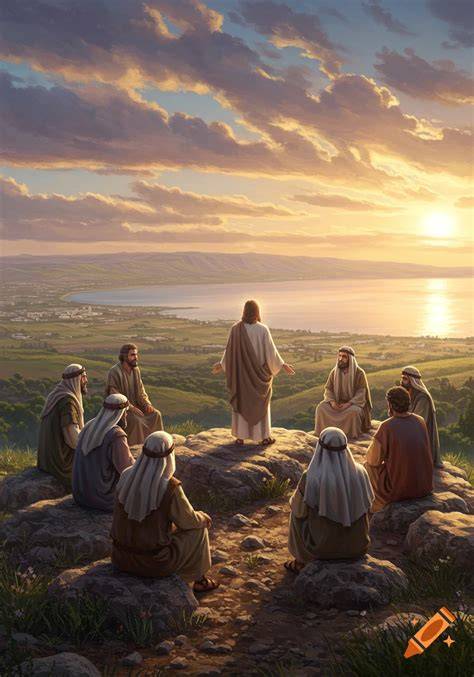
Now the eleven disciples went to Galilee, to the mountain to which Jesus had directed them. The location fulfills the direction given after the resurrection: the disciples are to meet Jesus in Galilee, where they will see him.
And when they saw him they worshiped him, but some doubted. The scene therefore includes both worship and uncertainty. The commission is given to the gathered disciples despite the fact that some doubted, and Jesus’s authority and promise provide the foundation for their mission.
“All Authority in Heaven and on Earth”
And Jesus came and said to them, “All authority in heaven and on earth has been given to me.” The command that follows is based on this declaration. Jesus does not send his disciples on the basis of their own strength, status, or influence, but on the basis of authority that extends over heaven and earth.
The statement also connects the Great Commission with the biblical expectation that the Son of Man would receive dominion. The passage identifies Jesus’s authority as universal, and the mission that follows is correspondingly directed toward all nations.
From Genesis to Revelation, God discloses his plan to gather a people from every language, tribe, and tongue. The Great Commission, as Matthew and the other Gospel writers recorded it, reveals how that’s going to happen.
“Go Therefore”
Jesus said, “All authority has been given to Me in heaven and on earth. Go, therefore, and make disciples of all nations…”
The word “therefore” connects the disciples’ movement and mission to Jesus’s authority. Because all authority in heaven and on earth has been given to him, the disciples are commanded to go and make disciples among all nations.
The command in Matthew 28:18-20 is actually a call for God’s people to “go” and “make disciples of all nations.” Jesus gave his disciples an intentional global charge that required their strategic movement from one location to another to make disciples among all peoples.
“Make Disciples of All Nations”
Go therefore and make disciples of all nations, baptizing them in the name of the Father and of the Son and of the Holy Spirit, teaching them to observe all that I have commanded you.
The central command is “make disciples,” but it is not an isolated instruction. The object of the command is “all nations.” The mission is therefore not limited to personal spiritual growth or to disciple-making among people who already live nearby.
The verbal phrase in the Great Commission is not merely to “make disciples” in general but to “disciple-ize all nations.” This necessarily means that some Christians must move from their current location to those where there are nations, or peoples, with no gospel access. They must go.
When Jesus gave his command in Matthew, he alluded to Daniel 7:14 and was in effect saying, “The Son of Man has received his dominion, as prophesied, and, therefore, it’s time for the ingathering of nations to begin, as prophesied. So go out there and get them!”
“Baptizing Them”
Baptizing them in the name of the Father and of the Son and of the Holy Spirit is one of the practices Jesus includes within the commission. Baptism is connected with the making of disciples and is carried out in the singular name of the Father, the Son, and the Holy Spirit.
The wording places the baptized person in relation to the Father, the Son, and the Holy Spirit. The command therefore includes both the expansion of the disciple community and its identification with the triune name.
“Teaching Them to Observe”
The commission continues with teaching them to observe all that I have commanded you. Disciple-making is not complete when people first respond to the message or receive baptism. Jesus’s disciples are to be taught to observe everything he commanded.
The phrase joins instruction and obedience. The objective is not simply to transfer information, but to form disciples whose lives are shaped by Jesus’s commands.
It’s a commission that makes disciple making the normal agenda and priority of every church and every Christian disciple.
Is the Great Commission “As You Go”?
Some well-intentioned teachers say that William Carey got it wrong-that the Great Commission is not a global mandate but simply a summons to be on mission wherever we are. Their argument is that the word “go” in the original language is more accurately translated “as you go” in English, and so the phrase means something more along the lines of “be a disciple maker as you go about your daily life.”
To be fair, few proponents of this view would say that global mission is not important. Most have simply utilized this increasingly popular interpretation as a prod to move their people to be engaged in God’s mission.
It is absolutely true that we should strive with all of our energy to make disciples “as we go.” God’s people are to engage in evangelism and discipleship wherever they are regardless of whether they are missionaries, pastors, engineers, pilots, or janitors.
But the Great Commission is so much more than a lifestyle command. It’s a summons to join God on his mission to redeem a people from every single tribe and language and people and nation.
Why the Translation Matters
Proponents of the “as you go” interpretation note that the word “going” is a participle, a verb that acts like an adjective, rather than a command. But their rendition stems from an inadequate understanding of Greek grammar.
The word for “go” in Greek is something called a “participle of attendant circumstance,” which means it takes the full force of the imperative, the command, that follows, “make disciples.” One Greek scholar writes, “Recognition of participles of attendant circumstance is important. It would be a mistake to render this [word] ‘as you go.’ The command is to go and make disciples.”
Additionally, the main verb, “make disciples,” or “disciple-ize,” is actually a single word in the original language and is what grammarians call a transitive verb. This means there is an object in the sentence that is receiving the action of that verb. In this case, the object is “all nations.”
In English, it’s easy to separate the verb from its object, because “make disciples” seems complete on its own, much the way “smell the flower” or “teach the boy” are complete thoughts. But if one were to simply give the commands “smell!” or “teach!” the listener would need more information to obey. Smell what? Teach whom?
The main verb in the sentence is indeed “make disciples,” but it is not an isolated verb, nor is it intended to be emphasized to the exclusion of the other important details in the command.
The Global Scope of the Mission
When we reduce this to an “as you go” lifestyle command, we are promoting less than full obedience to perhaps the most climactic imperative in the Bible-one that for centuries has donned the nickname, “the Great Commission.”
The Great Commission is not fundamentally restricted to mission “out there somewhere else in another country,” but neither is it exhausted by disciple-making among the people a Christian happens to encounter in daily life. The command joins ordinary faithfulness with an intentional concern for all nations.
John’s vision of the innumerable assembly around the heavenly throne doesn’t merely depict a multiethnic gathering comprised of peoples around whom Christians happen to live. John depicts an omni-ethnic gathering-one from which no people group on the earth is missing.
And it’s a vision that Jesus demands his church actualize by strategically relocating some from among her ranks to proclaim the gospel.
Why Is It Called The Great Commission - Peter Tanchi - 34th Anniversary Snippets
Sending and Going
The implications are clear. Some Christians must send. The others must go.
This understanding of Matthew 28:18-20 has been largely accepted by evangelicals for hundreds of years since then. In 1792, a twenty-nine-year-old British pastor and shoemaker named William Carey shook the evangelical world with the publication of a controversial missionary essay.
In his essay, “An Enquiry,” Carey challenged his contemporaries by arguing that the Great Commission in Matthew 28:18-20, to make disciples of all nations, was intended not only for Jesus’s immediate disciples but for all of God’s people in the present.
This meant that God’s people were responsible for going to places without gospel access and that those who didn’t go were responsible for sending them.
Jesus’s Presence to the End of the Age
And behold, I am with you always, to the end of the age.
The Great Commission ends with a promise of Jesus’s continuing presence. The disciples are commanded to undertake a worldwide mission, but they are not told to accomplish it independently of him.
The promise extends always, to the end of the age. It therefore frames the entire commission: Jesus possesses all authority, his disciples are sent to all nations, they are to baptize and teach obedience, and his presence remains with them throughout the mission.
“Go therefore, and make disciples of all nations…”
tags: #the #great #commission #esv