The scars in the hands, feet, and side of Jesus are enduring signs of His crucifixion, bodily resurrection, sacrificial love, and victory over sin and death. After rising from the grave, Jesus did not appear as a disembodied spirit; He showed His disciples the wounds He had received on the cross and invited Thomas to touch them.
Jesus’ scars confirm that the same body that was crucified was raised and transformed into glorified humanity. They are not defects in His perfected body but marks of love, redemption, identity, and triumph that remain significant in heaven.
Jesus’ scars confirm His bodily resurrection
We know precious few details about Jesus’s resurrection body. It was the same body in which he died, and yet it was not only restored to life but changed. He was still human, but now glorified. What was sown perishable was raised imperishable (1 Corinthians 15:42).
He could pass through doors and walls (John 20:26), yet eat solid food (Luke 24:42-43). His “natural body,” which died at Calvary, was raised and transformed into a “spiritual body” (1 Corinthians 15:44), new enough that those who knew him best didn’t recognize him at first (Luke 24:16, 37; John 20:14; 21:4), but also, soon enough, knew it was indeed him (Luke 24:31; John 20:16, 20; 21:7).
That Jesus’s resurrected body would still show evidence of his wounds, that the scars of crucifixion could still be seen and touched, was both a confirmation and a surprise. The confirmation was that this was in fact him - and him risen. The same body that was killed on the cross rose from the grave.
He was not a spirit or ghost. He was risen, fully alive, now in glorified humanity. After the resurrection, Jesus ate with His disciples (Luke 24:42-43) and allowed them to touch Him (John 20:27-28). These actions confirm a literal, bodily resurrection, distinct from a purely spiritual or symbolic event.
What the Gospels say about the scars
When Jesus first appeared to them, according to Luke, “they were startled and frightened and thought they saw a spirit” (Luke 24:37). Then he showed them the scars.
“See my hands and my feet, that it is I myself. Touch me, and see. For a spirit does not have flesh and bones as you see that I have.” And when he had said this, he showed them his hands and his feet. (Luke 24:39-40)
John records that Jesus “showed them his hands and his side” (John 20:20). His wounds were not incidental details; they were part of how He identified Himself to His frightened disciples.
John 20:19-29 describes the event in detail:
19 That Sunday evening the disciples were meeting behind locked doors because they were afraid of the Jewish leaders. Suddenly, Jesus was standing there among them! “Peace be with you,” he said. 20 As he spoke, he showed them the wounds in his hands and his side. They were filled with joy when they saw the Lord!
21 Again he said, “Peace be with you. As the Father has sent me, so I am sending you.” 22 Then he breathed on them and said, “Receive the Holy Spirit. 23 If you forgive anyone’s sins, they are forgiven. If you do not forgive them, they are not forgiven.”
24 One of the twelve disciples, Thomas (nicknamed the Twin), was not with the others when Jesus came. 25 They told him, “We have seen the Lord!” But he replied, “I won’t believe it unless I see the nail wounds in his hands, put my fingers into them, and place my hand into the wound in his side.”
26 Eight days later the disciples were together again, and this time Thomas was with them. The doors were locked; but suddenly, as before, Jesus was standing among them. “Peace be with you,” he said.
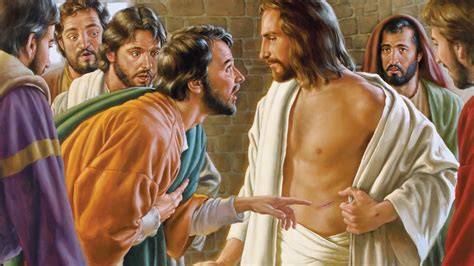
27 Then he said to Thomas, “Put your finger here, and look at my hands. Put your hand into the wound in my side. Don’t be faithless any longer. Believe!” 28 “My Lord and my God!” Thomas exclaimed. 29 Then Jesus told him, “You believe because you have seen me. Blessed are those who believe without seeing me.”
Thomas insisted he must see Jesus’s scars for himself, to confirm it was in fact him. In divine patience, Jesus waited eight days to answer Thomas’s prayer, and when he finally visited, he offered him the scars.
“Put your finger here, and see my hands; and put out your hand, and place it in my side. Do not disbelieve, but believe” (John 20:27).
The scars were the main way he confirmed to his disciples that it was truly him, in the same body, now risen and transformed.
Why did Jesus retain the scars?
If Luke and John didn’t tell us about the scars, we likely would assume that a glorified, resurrected body wouldn’t have any. At first thought, scars seem like a surprising feature of perfected, new-world humanity.
In fact, they sound initially like a defect. Would we not expect that such an upgrade - from a perishable body designed for this world to an imperishable body designed for the next - would mean he would no longer bear the marks of suffering in this world?
We might assume the Father would have chosen to remove the scars from his Son’s eternal glorified flesh, but scars were God’s idea to begin with. He made human skin to heal like this from significant injury.
That Luke and John testify so plainly to Jesus’s resurrection scars must mean they are not a defect, but a glory. Jesus’s scars are marks of his love. His scars tell the good news that he did not die for his own sins but for ours.
“Isn’t it curious that God could raise Jesus from the dead but didn’t heal the nail wounds in his hands? Was this an oversight? Surely not. The power of death is conquered, but the [scars] remain.”
When Jesus showed the disciples his scars, he was saying, “Here is my signature.” Jesus, our Lord and our God in the glory of the resurrection, still bears the wounds of his experience of God with us on earth.
The scars reveal Jesus’ identity
Jesus’ scars identify Him as the crucified and risen Lord. They distinguish Him from a spirit, ghost, or symbolic apparition and connect His resurrection directly to His death on the cross.
What if Jesus had appeared to the disciples without scars? They would not have been able to trust that this man was truly their risen Lord, the one who died on the cross. No trace of scars on him would also have made them question if Jesus was fully human as well as fully divine.
The scars demonstrate continuity between the historical Jesus who suffered at Calvary and the glorified Christ who rose from the grave. The body was transformed, but the person and the sacrificial history of that body were not erased.
It is often thought that the disciples and Thomas asked to see the wounds. But if you look closely at the text, you’ll see that it was Jesus who initially offered to show his scars to them. The disciples responded with joy, and likewise, Thomas replied with what many theologians describe as the central truth of this Gospel, as he declared, “My Lord and my God.”
In this proclamation, Thomas uttered the most powerful confession of Jesus’ identity in the Gospel. When the resurrected Jesus showed Thomas his scars, Thomas recognized God fully revealed in Christ, the Word made flesh.
The scars testify to Jesus’ suffering
First, Jesus’s scars tell us that he knows our pain. He became fully human, “made like [us] in every respect” (Hebrews 2:17), that, as one of us, he could suffer with us, and for us, as he carried our human sins to die in our place.
His scars remind us that he knows human pain. Jesus intimately understands what it means to carry scars. He endured emotional wounds-the betrayal of those closest to Him, the sting of rejection by His own people, and the soul-crushing agony of feeling abandoned by the Father (Matthew 26:56; Isaiah 53:3; Matthew 27:46).
His body bore the marks of physical suffering-the nails and spear-scars that, though brutal in their origin, remained even after His resurrection (John 20:27).
The scars also show us that Jesus sympathizes; they remind us that God has been with us, He has felt what we feel and He understands our pain.
Hebrews 4:15 says, “For we have not an high priest which cannot be touched with the feeling of our infirmities, but was in all points tested like as we are, yet without sin.”
The risen Lord still bears the wounds that speak of his solidarity with human suffering in all of its forms. These scars serve as a reminder that God is with us through all things, especially the appalling, destructive and death-dealing times.
The image of the risen Christ with wounds in his hands and his side reminds us when we suffer that so did our God; when we cry out in loneliness, so did our God.
When we feel abandoned and alone, we remember that Christ hung on a cross and yelled for us, “My God, my God, why have you forsaken me?”
We don’t have a God who stands at a distance but rather one who entered fully into the reality of our pain. So when we suffer, we know that Christ can say, “I’ve been there, and I have the wounds to prove it.”
The scars reveal the cost of salvation
Finally, these scars reveal to us that Jesus saves. He received these scars when He died upon the cross for our sins. He did not have to suffer. Yet, He moved into our suffering, took it on Himself, so that we could be saved from our sins.
Jesus’s scars are an outward sign of the price paid for humanity’s redemption. As Isaiah writes, “He was pierced for our transgressions, He was crushed for our iniquities” (Isaiah 53:5).
Isaiah 53:5 says, He was pierced for our transgressions; he was crushed for our iniquities; upon him was the chastisement that brought us peace, and with his wounds we are healed.
The eternal Son of God took on human flesh and blood and went to that rugged, offensive, horrific, shamefully public cross, as the spotless Lamb, to die for our sins.
For our rebellion, for our countless sinful boasts in our own flesh, we were the ones who deserved to spill our own blood in violent death and be eternally separated from God. But the wonder of Christianity, the heart of our faith, the very good news which we call “the gospel,” is that Jesus went to the cross for us - for all those who would take Paul’s invitation to turn our boasting upside down and rejoice in words, “Jesus is Lord.”
Jesus’s wounds were not for his own sins, but for ours. These scars tell the good news that he did not die for his own sins, but for ours. His wounds are invitations to sinners and assurances to his saints.
The scars are an assurance of forgiveness
The scars on Christ’s body serve as a perpetual witness that His blood has cleansed sin (1 John 1:7). Those who look upon these marks in faith are assured of the completed nature of His work.
They declare that the punishment for sin has been borne, and the debt is satisfied. This unchanging reality fosters confidence in the believer’s standing before God.
Jesus’ scars teach that grace is not merely an abstract concept but a historically anchored reality. They avert the notion that the work of the cross is relegated to the past; rather, it endures as a living testimony of covenantal love.
They are marks of Easter glory, the very glory that makes the horrors of his death into what we now call “Good Friday.”
The scars remind believers that salvation flows from the atoning sacrifice-the ultimate act of love. They remain visible evidence that the crucifixion was real, that Christ truly bore sin, and that His saving work was completed through His death and resurrection.
The scars proclaim victorious love
Jesus’s scars - as healed wounds - forever tell us of our final victory in him. As the book of Revelation unfolds to us that ultimate triumph, it is our scarred Savior - “the Lamb who was slain” - who stands at the center of heaven and sits, with his Father, on the very throne of the universe (Revelation 7:9-10, 17; 22:1, 3).
In Revelation, Christ appears as “a Lamb who appeared to have been slain” (Revelation 5:6), emphasizing that His sacrifice, though completed, stands victorious.
From that first introduction as “a Lamb standing, as though it had been slain” (Revelation 5:6), Jesus is referred to (27 more times) as “the Lamb.”
Heaven’s worshipers fall down before him, saying, “Worthy is the Lamb who was slain!” (Revelation 5:12), and the book of life is said to be “the book of life of the Lamb who was slain” (Revelation 13:8; also 21:27).
Far from forgetting his suffering and shed blood, it is a glory beyond compare that his people forever celebrate him as the Lamb who was slain, the sheep with the scars, in whose blood they have been washed (Revelation 7:14), and by whose blood, once shed through his still visible scars, they have conquered (Revelation 12:11).
The visible wounds serve not as symbols of defeat but as emblems of conquest over death and sin. The scars manifest the victorious love that overcame the grave (Romans 8:37-39).
The marks of His crucifixion form part of the worship scene in Revelation, where the heavenly hosts cry out, “Worthy is the Lamb who was slain” (Revelation 5:12). Jesus’ scars remain a key feature at the center of heavenly adoration, testifying to His identity as the ultimate sacrificial Lamb.
We will worship him forever with the beauty of his scars in view. They are no defect to eyes of the redeemed but a glory for saved sinners beyond compare.
Chris Tomlin - Revelation Song (Live) ft. Kari Jobe Carnes
The scars connect history and eternity
These wounds belong to a specific time (the crucifixion) yet persist forever, illustrating how God’s redemptive plan transcends human chronology.
They unify Old Testament prophecy, Gospel fulfillment, and eternal glory, coherent within the unified message of Scripture.
Long before Jesus’ earthly ministry, Zechariah prophesied, “They will look on Me, the One they have pierced” (Zechariah 12:10). This reference indicates the enduring nature of the wounds inflicted at the crucifixion.
Revelation later depicts Christ as a Lamb who had been slain (Revelation 5:6), further highlighting the continuity of His sacrificial marks into eternity.
Jesus’ scars in heaven serve as a visible declaration of His finished work: the atoning sacrifice for sin, the certainty of bodily resurrection, and His eternal reign.
The scars are a sign of hope
The presence of Jesus’ scars changes the meaning of scars themselves. A scar is a visible reminder of a wound, but it is also evidence that the wound did not have the final word.
Some of our scars carry little meaning, but some have a lot to say, whether to our shame or to our glory, depending on the injury.
There truly is a story behind every scar. Some of the stories are painful; others are funny. Some are significant, while others, less so. Some are filled with shame, while others are full of pride. Yet without exception, every scar serves as a visible reminder of wounds we’ve incurred.
In our Christian faith, hope is symbolized by the death and resurrection of Jesus Christ. Many of us wear the cross as a sign of hope around our necks.
And yet the scars of Jesus remind us that we cannot simply skip from the celebrations of Palm Sunday to Easter morning. The scars help us remember the dark days between the two and the suffering Jesus went through to justify our sins.
Christ suffered on the cross and endured unimaginable pain for us. His is the greatest scar story ever told.
The scars of Jesus - the scars of hope - are significant to our faith. The scars become scars of hope as we deal with our own wounds in life.
It seems that this is the predominant reason why Jesus wanted the disciples to see his wounds, so that they could understand the hope the scars represented.
Notice that before his appearance, the disciples were hunkered down in fear together, locked in a house. Yet once they saw the scars of Jesus, a transformation occurred, and they began to rejoice.
How ironic that seeing scars, which were produced by pain, provided joy and hope.
Jesus’ scars and the believer’s suffering
Those who suffer and endure trials often find solace in knowing that their Savior still bears marks of His own suffering. This solidarity underlines the message in Hebrews: “For we do not have a high priest who is unable to sympathize with our weaknesses…” (Hebrews 4:15).
These scars testify that He suffered for us, and still suffers with us, whether in grief, in persecution, or when the Church is unfaithful.
Pain has a protecting purpose; it warns us to pivot away from the things that harm us. Pain also has a unifying purpose. As the physical human body comes to the aid of a suffering member, pain draws people together.
Instead of boasting in comfort and ease in this life, Paul says in Romans 5:3, “We boast in our sufferings.” If God works the greatest good through the greatest evil - that is, the crucifixion of the Son of God - then our sufferings in this life are turned upside down.
We grieve them, yet even as we do, we rejoice in what God is doing in and through them.
And instead of boasting in our own strengths and abilities, Paul says in 2 Corinthians 11:30, “I will boast of the things that show my weakness.” And in 2 Corinthians 12:9 he says, “I will boast all the more gladly of my weaknesses, so that the power of Christ may rest upon me.”
Jesus turns our boasting upside down. Instead of boasting in our comforts, we boast in our sufferings. Instead of boasting in our strengths, we boast in our weaknesses. Instead of boasting in natural human conceptions of glory and power, just like the world, we boast in the offense of the cross.
Paul’s “marks of Jesus”
On Easter Sunday, we come to the end of Galatians, and one of the last things Paul writes with his own hand is this: “I bear on my body the marks of Jesus” (Galatians 6:17).
Like Jesus, Paul also had gospel scars - scars which pointed not to his own work, but to Jesus’s work. Just as sinners had struck and killed the Son of God, so too sinners had struck and scarred his messenger.
In 2 Corinthians 11, Paul mentions some of what he has suffered for the sake of Christ: “. countless beatings, and often near death. Five times I received at the hands of the Jews the forty lashes less one. Three times I was beaten with rods. Once I was stoned” (2 Corinthians 11:23-25).
Paul’s scars, “the marks of Jesus” he received from preaching the resurrection of Christ, are his final argument in Galatians.
Before he closes in Galatians 6:18 with, “The grace of our Lord Jesus Christ be with your spirit, brothers. Amen,” he puts the final period in place with his own life - with what he has been willing to suffer in order to preach and defend the meaning of Good Friday and the news of Easter Sunday.
Jesus’s scars point away from human achievement and toward divine grace. Paul’s scars likewise testify that the gospel is not merely an idea but a message for which he was willing to suffer.
Christian boasting in the cross and resurrection
Humans are born to boast. God made us to boast in him - that is, to not only know him with our minds, but rejoice in him in our hearts, and to not only live in obedience to him, but speak words out of our hearts that point others to him.
Because of sin, our natural inclination to boast often becomes sinful boasting. Instead of rejoicing out loud about God, we rejoice out loud about ourselves in all the various and complex forms this takes.
The question isn’t whether we will boast, but in what and in whom we will boast.
Paul contrasts their sinful boast with his own holy boast, which he wants the Galatians, and us, to join him in. This is how he wants us to rejoice in words.
Christian boasting is not like the natural, sinful boasting into which we’re born. It is not boasting in the flesh. It is not boasting in outward appearance. It is not boasting in our own strength.
Christian boasting is boasting turned upside down because of the worth and beauty and power of Jesus Christ.
“But far be it from me to boast except in the cross of our Lord Jesus Christ, by which the world has been crucified to me, and I to the world” (Galatians 6:14).
The cross was horrific. It was reserved for the worst of rebels against the Roman empire, and it was designed to not only make death literally excruciating and lengthy, but also utterly shameful.
And Paul says, “May I never boast, except in the cross of our Lord Jesus Christ.”
What a turn, that the very thing - a crucified Messiah - that seemed so shameful, such a stumbling block to Jews, and such folly to Gentiles, would be not only a critical truth for Christians, but central.
We talk about the cross every Sunday. We remember it at the Lord’s Table. We depict it in baptism. The cross - the public execution of the Son of God - is not just a barrier to overcome to embrace the Christian faith, but it is at the very heart of our faith.
We celebrate it, and we draw attention to it. We boast in it.
The answer is that, yes, we boast in the resurrection, but it is a certain kind of boasting. It is a humbled boast. It is a God-magnifying boast. It is a Christ-treasuring boast.
It is a cross-conscious boast. It is a boast in the surpassing power of God uniquely on display in and through human weakness, and suffering, and even death.
It is the kind of boasting that comes on the other side of the grave, on the other side of crucifixion, on the other side of Christ turning the world, and us, upside down.
We boast in the cross because the one who died there for our sins rose again Sunday morning to be our living, breathing, loving, reigning Lord.
The scars and the new creation
Galatians 6:15-16 says, “For neither circumcision counts for anything, nor uncircumcision, but a new creation. And as for all who walk by this rule, peace and mercy be upon them, and upon the Israel of God.”
The first and most obvious link to resurrection is “new creation.” New creation points to God’s action and initiative and power, not ours.
That is the contrast between circumcision and new creation. In this context, circumcision would be an action the Galatians would take in an effort to make sure they’re in right standing with God.
And remarkably, Paul says uncircumcision doesn’t count either. Neither taking that step in the flesh, or refusing to take that step, wins you God’s acceptance. You cannot, in your flesh, earn God’s full and final favor.
Jesus’ resurrection body demonstrates that transformation does not mean the erasure of history. The body is made imperishable, yet the scars remain as testimony to the work God has accomplished.
What Jesus’ scars mean for believers
Scripture promises that believers will one day receive resurrected bodies (1 Corinthians 15:42-44). Christ’s physical resurrection and continued possession of scars provide a foretaste of this reality, showing that the body is transformed yet genuinely human.
This gives hope for a future in which all wounds are healed, though forever shaped by the victory He secured.
The wonderful, healing news is that, as the song “The Only Scars in Heaven” by Casting Crowns affirms, the only scars in heaven will belong to Jesus.
In that place, we won’t be broken or wounded. We have the hope of a life without doubts, fears, mental anguish, or physical pain. We’ll be with Jesus, made new (Revelation 21:4).
Scars may fade or remain, but they do not define you or me. Our scars are not the end of the story. They are not our shame; they are the beginning of redemption.
Christ’s scars become part of our story, and our scars become a part of God’s story in our lives.
Whether emotional or physical, our scars tell the stories of victories earned, hardships endured, and restoration received. By the grace of God, you’re still standing.
- Scars tell stories of redemption: what was once a source of shame is now a reason to praise.
- Scars tell stories of connection: just as through His scars, Jesus sympathized with our weaknesses (Hebrews 4:15), our scars connect us to others on our same journey.
- Scars tell stories of adornment and hope by reminding us ultimate healing is on the way and that God’s grace will cover us until then.
How believers can respond to Jesus’ scars
Jesus had some scars, and if we follow Him, so will we. Let your pain point people to the Gospel; and if you are suffering today, bring your wounds to Jesus; use your scars for His glory.
Adrian Rogers reminds us, “A scar is a wound that is healed. You need to let Jesus heal your wounds, and then use that as a testimony for Him.”
Jesus doesn’t look at our wounds with disdain. He invites us to bring our scars to Him-not to erase them but to liberate us through them.
He longs to take the broken, wounded parts of our identity and change them into something beautiful that testifies to His power, grace, and restoration.
Just as His scars proclaim His identity, when we surrender our wounds to Him, our scars can proclaim ours: beloved, redeemed, valued, and whole.
Inviting Jesus into our broken places is stepping into a journey of renewal where He begins the beautiful work of redeeming the pieces to rebuild a masterpiece (Ephesians 2:10).
He erases the original narrative and rewrites the story. Instead of being defined by woundedness, we are redefined by Jesus.
Scripture
God’s Word breathes hope into our pain. Verses like Psalm 34:18 remind us that even in our darkest moments, He is right there with us, drawing near.
Prayer
Honest, raw, open-hearted prayers create space for His healing presence to move in.
Community
God will use people around us to mirror His truth. Whether it’s a listening ear, an encouraging word, or shared wisdom, these small acts of kindness are often the balm our hearts desperately need (Galatians 6:2).
It’s hard to share. It’s hard to be vulnerable, and it’s hard to tell the bold truth about our lives and admit how we hurt. It’s uncomfortable and risky.
And yet my hope is that we can begin to share our vulnerabilities with one another - and that, in doing so, we can experience that same type of transformative moment - the move from fear to joy - that the disciples had when exposed to the scars of Jesus.
Above all, I hope we can share with confidence and joyfully celebrate that Christ’s redemption is greater than any wound and able to heal any scar.
Instead of hiding our scars, let us say, “Look and see where God has redeemed me.”
The triumphant scars of Jesus make Him approachable-appealing. They persuade us of the great and terrible sacrifice He made for our salvation (1 Peter 2:24).
They make it safe to place our own wounds under His scrutiny and endure the all-encompassing grief of uncovering and pulling up root issues.
Whatever wounds you carry, know this: Jesus sees them. He doesn’t ask you to hide them or fix them. Jesus is waiting to meet you in your woundedness and reveal the prize behind the scars.
May the One who bears the scars of love remind you that you are seen, known, and cherished beyond measure.