“Vatican City” in Spanish is Ciudad del Vaticano. The shorter form el Vaticano is also widely used, especially when referring to the Vatican as a place, institution, or center of the Catholic Church.
The official Spanish name is Estado de la Ciudad del Vaticano, meaning “Vatican City State.” In ordinary sentences, however, Ciudad del Vaticano is the natural translation for the city-state itself.
How to say “Vatican City” in Spanish
| English | Spanish | Use |
|---|---|---|
| Vatican City | Ciudad del Vaticano | Standard geographical name |
| the Vatican | el Vaticano | Common short form |
| Vatican City State | Estado de la Ciudad del Vaticano | Official state name |
| Vatican | Vaticano | Adjective or noun depending on context |
Translation of “Vatican City”
Vatican City is translated into Spanish as Ciudad del Vaticano. The word ciudad means “city,” while del Vaticano means “of the Vatican.”
The Spanish noun Vaticano is masculine, so the definite article is el: el Vaticano. The full geographical name uses the preposition-and-article combination del, formed from de and el.
Examples in Spanish
- Vatican City is in Rome. - La Ciudad del Vaticano está en Roma.
- I live in a big city. - Vivo en una gran ciudad.
- The Sistine Chapel is a vast chapel built inside the Vatican Palace in 1473. - La Capilla Sixtina es una extensa capilla construida dentro del Palacio Vaticano en 1473.
- Vladivostok is a city in Russia. - Vladivostok es una ciudad de Rusia.
- Russia is the biggest state in the world, and the Vatican is the smallest state in the world. - Rusia es el estado más grande del mundo y el Vaticano es el estado más pequeño del mundo.
- The Pope lives in Vatican City. - El papa vive en la Ciudad del Vaticano.
- Tourists visit Vatican City every year. - Los turistas visitan la Ciudad del Vaticano cada año.
- St. Peter’s Basilica is in Vatican City. - La Basílica de San Pedro está en la Ciudad del Vaticano.
“Vatican City” or “the Vatican”?
Use Ciudad del Vaticano when you mean the sovereign city-state. Use el Vaticano when the context is more general or institutional.
For example, La Ciudad del Vaticano está rodeada por Roma means “Vatican City is surrounded by Rome,” while El Vaticano anunció la decisión means “The Vatican announced the decision.” In the second sentence, el Vaticano refers not merely to the territory but to the Catholic Church’s central governing authority.
The term “the Vatican” can mean either Vatican City itself, or the Holy See, sort of like how “Washington” or “Beijing” can refer to the U.S. or Chinese governments rather than just the cities.
Official names in Spanish, Italian, and Latin
| Language | Name |
|---|---|
| Spanish | Ciudad del Vaticano |
| Spanish, official form | Estado de la Ciudad del Vaticano |
| Italian | Città del Vaticano |
| Italian, official form | Stato della Città del Vaticano |
| Latin | Status Civitatis Vaticanae |
Vatican City, officially the Vatican City State, is a landlocked sovereign city-state in Southern Europe. Ruled by the pope, it is an enclave within the city of Rome, Italy, and serves as the administrative centre of the Catholic Church.
Vatican City is governed by the See of Rome, commonly known as the Holy See, itself a sovereign entity under international law, which maintains its temporal power, governance, diplomacy, and spiritual independence.
Spanish adjective and related forms
The Spanish adjective meaning “Vatican” is generally vaticano for masculine nouns and vaticana for feminine nouns.
- Vatican City - la Ciudad del Vaticano
- Vatican Palace - el Palacio Vaticano
- Vatican Museums - los Museos Vaticanos
- Vatican Library - la Biblioteca Vaticana
- Vatican flag - la bandera del Vaticano
- Vatican authorities - las autoridades vaticanas
- Vatican diplomacy - la diplomacia vaticana
Vatican City and the Holy See in Spanish
In short, Vatican City is a state, while the Holy See is a religious organization which happens to govern Vatican City, but has a broader purpose.
In Catholic Church terminology, a “see” is the seat of authority of a particular bishop, and the “Holy See” refers to the authority of the Bishop of Rome, the Pope.
In Spanish, Vatican City is Ciudad del Vaticano, while the Holy See is la Santa Sede. These expressions are related but should not be treated as exact synonyms.
The Holy See is the religious authority presiding over Catholic churches all across Rome and, by extension, the entire Catholic world, but it has normal government authority only in Vatican City and its extraterritorial properties.
What is Vatican City?
Vatican City was created by the Lateran Treaty in 1929 to ensure the Catholic Church's independence from the control of other countries, and has an area of only about 0.17 sq mi (0.44 sq km), or about one-eighth the size of Central Park in New York.
In its current official area, Vatican City covers 0.49 km², or 0.19 square miles. With a population of 882 in the 2024 estimate, it is the smallest sovereign state in the world both by area and by population.
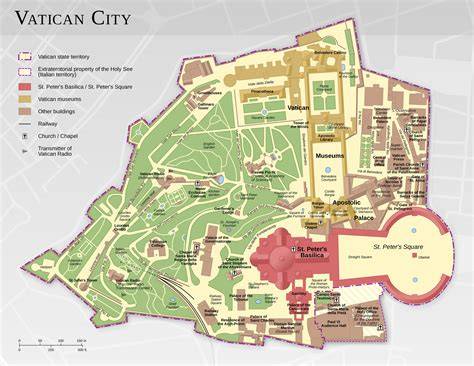
Located within the city of Rome, Vatican City is surrounded on all sides by Italy, and nearly encircled by a stone city wall except for in St. Peter’s Square, where it is separated from Italy only by a white line drawn on the ground.
Political status and government
Yes, technically, Vatican City is a country. Although it doesn't really have the kind of population and national cultural identity we would often expect from a “country”, it is recognized worldwide as a “sovereign state”, which means it rules itself and answers to no one else.
This makes it by far the world's smallest independent “country”, at less than a quarter the size of the runner-up, Monaco.
Vatican City is an ecclesiastical or sacerdotal-monarchical state ruled by the pope, who is the bishop of Rome and head of the Catholic Church. The highest state functionaries are all Catholic clergy of various origins.
Its form of government is a unitary theocratic elective absolute monarchy. Sovereignty is exercised by the pope upon his election as the head of the Roman Catholic Church, and he has absolute executive, legislative, and judicial powers within the city.
| Political feature | Information |
|---|---|
| Official name | State of the Vatican City |
| Capital | Vatican City |
| Form of government | Unitary theocratic elective absolute monarchy |
| Sovereign entity | Holy See |
| Head of state | Pope |
| Legislature | Pontifical Commission |
| Establishment | Lateran Treaty, 11 February 1929 |
Location, boundaries, and layout
Vatican City, landlocked ecclesiastical state, seat of the Roman Catholic Church, and an enclave surrounded by Rome, is situated on the west bank of the Tiber River. Vatican City is the world’s smallest fully independent nation-state.
Vatican City’s medieval and Renaissance walls form its boundaries, except on the southeast at St. Peter’s Square, or Piazza San Pietro.
Of the six entrances, only three-the piazza, the Arco delle Campane, or Arch of the Bells, in the facade of St. Peter’s Basilica, and the entrance to the Vatican Museums and Galleries in the north wall-are open to the public.
Various religious and administrative buildings are located within Vatican City's confines, but more than half of its area is taken up by the green space of the Vatican Gardens.
Population, languages, and institutions
In addition to the Pope, the state is said to have a population of about 800, most of whom are either clergy or members of the Swiss Guard.
While most of the inhabitants of Vatican City are priests or nuns, they also include several hundred laypersons engaged in secretarial, domestic, trade, and service occupations.
Vatican City’s official working language is Italian. The Holy See’s official language is Latin, with French as the international diplomatic language.
The Vatican's only military force, the Swiss Guard, gives orders in German and has been responsible for the personal safety of the pope since 1506.
| Feature | Information |
|---|---|
| Population, 2024 estimate | 882 |
| Total area | 0.49 km² (0.19 sq mi) |
| Official working language | Italian |
| Language of the Holy See | Latin |
| State religion | Catholicism |
| Currency | Euro (€) |
| Time zone | UTC+1 (CET) |
| ISO code | VA |
| Internet domain | .va |
Important buildings and attractions
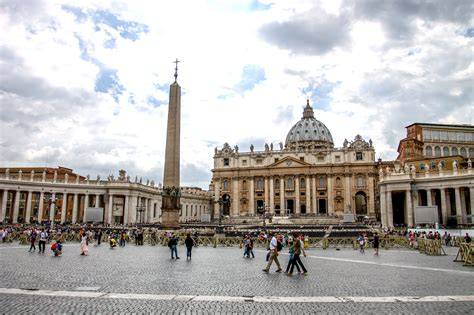
The most imposing building is St. Peter’s Basilica, built during the 4th century and rebuilt during the 16th century. Erected over the tomb of St. Peter the Apostle, it is the second largest religious building after Yamoussoukro Basilica in Christendom.
The Vatican Palace is the residence of the pope within the city walls. Vatican City contains religious and cultural sites such as St Peter's Basilica, the Sistine Chapel, the Vatican Apostolic Library, and the Vatican Museums.
They feature some of the world's most famous paintings and sculptures. The Vatican Museums and Galleries, the frescoes by Michelangelo in the Sistine Chapel, the frescoes by Pinturicchio in the Borgia Apartment, and Raphael’s Stanze, or “Rooms,” attract critics, artists, and flocks of tourists from throughout the world.
St. Peter’s Basilica
Site of the tomb of the Apostle Saint Peter, first of the uninterrupted succession of Roman Pontiffs, and therefore a main pilgrimage centre, the Vatican is directly and tangibly linked with the history of Christianity.
Beneath the basilica of Saint Peter, reconstructed in the 16th century under the guidance of the most brilliant architects of the Renaissance, remains of the first basilica founded by Constantine still exist, as well as ruins of the circus of Caligula and Nero, and a Roman necropolis of the 1st century AD, where Saint Peter’s tomb is located.
The Constantinian basilica was built in 326 over what was believed to be the tomb of Saint Peter, buried in that cemetery.
The Sistine Chapel
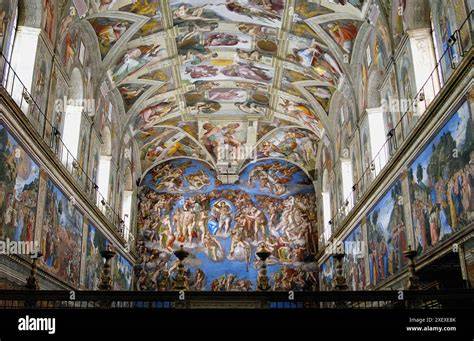
The Sistine Chapel is a vast chapel built inside the Vatican Palace in 1473. Under Julius II’s patronage in 1506, an extraordinary artistic era was inaugurated, leading to the decoration of Raphael’s Stanze and of the Sistine Chapel with frescoes by Michelangelo.
The mural decoration, begun by Perugino, Botticelli and other painters, was completed in the 16th century with the frescoes of the ceiling and the monumental Last Judgement by Michelangelo, who left his last murals in the Pauline Chapel.
Years of restoration work on the Sistine Chapel frescoes were completed in 1994, making it possible to view Michelangelo’s work in full vibrant colors.
The Vatican Apostolic Library
The Vatican Apostolic Library contains a priceless collection of some 150,000 manuscripts and 1.6 million printed books, many from pre-Christian and early Christian times.
In 1475, Sixtus IV founded the Vatican Library, which is the first open to the public in Europe; the collections of manuscripts and books, prints, drawings, coins and decorative arts, constantly increased through the centuries, making it an invaluable repository of human culture.
The Vatican Museums
From the mid-18th century, the popes’ efforts were also directed towards expanding the private collections of antiquities dating back to the Renaissance: their transformation into public museums accessible to scholars and connoisseurs marks the origin of the Vatican Museums.
New buildings were built specifically to house the classical sculptures, such as the Pio-Clementine Museum, which represents a milestone in the history of European culture.
History of Vatican City
Early Christian and Roman history
The city of Rome has been an important center of Christianity since the early days of the church. St. Peter, considered the first pope, is thought to have lived and died in Rome.
In 313 Emperor Constantine I issued the Edict of Milan, which ended official persecution of Christians and opened the door to the growth of the church in both spiritual and material terms.
By the 4th century the church had gained control of a great deal of territory, called the Patrimony of St. Peter, in and around Rome.
Papal influence in central Italy began to increase in the 5th century, as the Roman Empire fell apart and the people of the area began to rely on the pope for protection from invading armies. By about the year 600 the church was one of the largest landowners in the world.
The Vatican area in ancient Rome
The name “Vatican” was already in use in the time of the Roman Republic for the Ager Vaticanus, a marshy area on the west bank of the Tiber across from the city of Rome, located between the Janiculum, the Vatican Hill and Monte Mario, down to the Aventine Hill and up to the confluence of the Cremera creek.
During the Roman Empire, many villas were constructed there, after Agrippina the Elder drained the area and laid out her gardens in the early-1st century AD.
In AD 40 her son, the emperor Caligula, built in her gardens a circus for charioteers. It was later completed by the emperor Nero and named the Circus Gaii et Neronis, usually called, simply, the Circus of Nero.
The Vatican obelisk in St Peter's Square is the last visible remnant from the Circus of Nero. It was brought from Heliopolis in Roman Egypt by the emperor Caligula.
The circus became the site of martyrdom for many Christians after the Great Fire of Rome in AD 64. Tradition states that it was in this circus that Saint Peter was crucified upside-down.
Opposite the circus was a cemetery separated by the Via Cornelia. Funeral monuments, mausoleums, small tombs, and altars to pagan gods of all kinds of polytheistic religions were constructed before the construction of the Constantinian Basilica of St. Peter in the first half of the 4th century.
The Papal States and medieval development
The legal basis for the foundation of the Papal States was provided by the Donation of Pippin, which granted the pope the rights to large parts of central Italy in 754.
In the 9th century the first city walls, known as the Leonine Walls, were completed under Pope Leo IV. Between the 12th and 14th centuries the Vatican underwent something of a building boom as a new palace was built and the Leonine Walls were restored.
The Vatican fell into decay after 1309, when the office of the papacy was moved to Avignon in France. The pope’s return to Rome in 1377 marked the beginning of a revitalization.
Popes gradually came to have a secular role as governors of regions near Rome. They ruled the Papal States, which covered a large portion of the Italian Peninsula, for more than a thousand years until the mid-19th century, when all the territory belonging to the papacy was seized by the newly created Kingdom of Italy.
The Roman Question
Italy became a unified country in the 19th century, which led to major changes in the Vatican’s political status. Most immediately, the church lost its land to the new country.
Italy annexed the rest of the Papal States by 1870 and made Rome the Italian capital. To protest the incorporation into a unified Italy, each pope thereafter remained a voluntary “prisoner of the Vatican,” never leaving the small territory of the papal grounds.
This situation lasted nearly 60 years. The popes did not recognize the Italian king's right to rule in Rome, and they refused to leave the Vatican compound until the dispute was resolved in 1929.
Pope Pius IX, the last ruler of the Papal States, was referred to as a “prisoner in the Vatican.” Forced to give up secular power, the popes focused on spiritual issues.
The Lateran Treaty
In 1929 a solution to this ongoing problem was found. Vatican City’s independent sovereignty was recognized by the Fascist Italian government in the Lateran Treaty.
This situation was resolved on 11 February 1929, when the Lateran Treaty between the Holy See and the Kingdom of Italy was signed by Prime Minister and Head of Government Benito Mussolini on behalf of King Victor Emmanuel III and by Cardinal Secretary of State Pietro Gasparri for Pope Pius XI.
The treaty was ratified and took effect on 7 June 1929. It established the independent state of Vatican City and reaffirmed the special status of Catholic Christianity in Italy.
Vatican City and international relations
Vatican City is the only undisputed country in the world which is not a member of the United Nations. However, the Holy See does have status as a “permanent observer state” in the U.N. General Assembly.
Vatican diplomacy is conducted not in the name of Vatican City itself, but directly by the Catholic Church in the name of the Holy See.
Not only is its independence undisputed by the international community, but it actually maintains diplomatic relations with the U.N. and many countries.
Special extraterritorial privileges are extended to more than 10 other buildings in Rome and to Castel Gandolfo, the pope’s summer residence in the Alban Hills. In addition, Vatican City maintains embassies in numerous foreign nations.
World War II and neutrality
The Holy See, which governed Vatican City, pursued a policy of neutrality during World War II under the leadership of Pope Pius XII.
German troops occupied Rome after the September 1943 Armistice of Cassibile, with Allied forces pushing them out in 1944. Both sides respected the Vatican City's status as neutral territory.
One of the main diplomatic priorities of Pius XII was to prevent the bombing of Rome. A high level of sensitivity led him to protest even the dropping of pamphlets over Rome by the Royal Air Force, claiming that the few which landed within the Vatican City violated its neutrality.
In connection with the Allied invasion of Sicily, 500 United States Army Air Forces aircraft bombed Rome on 19 July 1943, targeting Rome's railway hub in particular. Approximately 1,500 people were killed.
Another Allied bombing raid took place on 13 August 1943, after Mussolini had been ousted from power. The following day, the new Italian government declared Rome an open city, after consulting the Holy See on the wording of the declaration.
Art, culture, and UNESCO status
Vatican City is both an ideal and an exemplary creation of the Renaissance and of Baroque art. It exerted an enduring influence on the development of the arts from the 16th century.
The Vatican enjoyed a cultural golden age during the Renaissance, when the popes were among Italy’s foremost patrons of the arts.
The Vatican is a continuous artistic creation whose progress spreads over centuries, representing a unique masterpiece of the modelling of a space and integrating creations which are among the most renowned of mankind.
Not only the world-famous icon of sacred architecture, the Basilica of Saint Peter, but also the chapel of Nicholas V decorated by Fra Angelico, the Borgia Apartment with frescoes by Pinturicchio, the Stanze of Raphael and his students, and the Sistine Chapel form part of this exceptional artistic ensemble.
The Vatican exerted a deep influence on the development of art from the 16th century. Architects have visited it to study the constructions of Bramante, Michelangelo, and Bernini.
Both within and outside Europe, the Vatican buildings have been abundantly copied and imitated, and the paintings and antiquities of the Museums have been copied and imitated no less so.
Vatican City was designated a UNESCO World Heritage site in 1984. The site is listed under cultural criteria i, ii, iv, and vi, with reference 286.
Services and economy
Vatican City has its own telephone system, post office, gardens, astronomical observatory, radio station, banking system, and pharmacy, as well as a contingent of Swiss Guards responsible for the personal safety of the pope since 1506.
Almost all supplies-including food, water, electricity, and gas-must be imported. There is no income tax and no restriction on the import or export of funds.
As the Holy See, it derives its income from the voluntary contributions of more than one billion Roman Catholics worldwide, as well as interest on investments and the sale of stamps, coins, and publications.
The economy of Vatican City is supported financially by donations from Catholic believers, by the sale of postage stamps and souvenirs, fees for admission to museums, and sales of publications.
Vatican City has no taxes, and items are duty-free. Banking operations and expenditures have been reported publicly since the early 1980s.
Useful Spanish phrases
- Where is Vatican City located? - ¿Dónde está situada la Ciudad del Vaticano?
- Why is Vatican City considered a country? - ¿Por qué se considera un país la Ciudad del Vaticano?
- Who lives in Vatican City? - ¿Quién vive en la Ciudad del Vaticano?
- What important buildings are found in Vatican City? - ¿Qué edificios importantes se encuentran en la Ciudad del Vaticano?
- How does Vatican City play a role in the Roman Catholic Church? - ¿Qué papel desempeña la Ciudad del Vaticano en la Iglesia católica romana?
- The new pope was announced in Vatican City. - El nuevo papa fue anunciado en la Ciudad del Vaticano.
- Vatican City is the smallest sovereign state in the world. - La Ciudad del Vaticano es el Estado soberano más pequeño del mundo.