At the Last Supper, Jesus says that the bread is His body, given for His disciples, and that the cup is the new covenant in His blood, poured out for many for the forgiveness of sins. He commands His followers to eat and drink in remembrance of Him.
He also announces that one of the disciples will betray Him, says that He will not eat or drink the Passover again until the kingdom of God comes, and teaches His disciples that true greatness is demonstrated through humble service.
The setting of the Last Supper
The Last Supper was Jesus’ final Passover meal with His disciples before His suffering, crucifixion, and resurrection. Jesus had made arrangements in advance to celebrate the Passover in Jerusalem.
Then came the day of Unleavened Bread on which the Passover lamb had to be sacrificed. Jesus sent Peter and John, saying, “Go and make preparations for us to eat the Passover.”
“Where do you want us to prepare for it?” they asked. He replied, “As you enter the city, a man carrying a jar of water will meet you. Follow him to the house that he enters, and say to the owner of the house, ‘The Teacher asks: Where is the guest room, where I may eat the Passover with my disciples?’ He will show you a large room upstairs, all furnished. Make preparations there.”
They left and found things just as Jesus had told them. So they prepared the Passover. When the hour came, Jesus and his apostles reclined at the table.
Jesus was born and brought up Jewish, so it is natural that he should want to remember this festival with his disciples. The Jewish Passover festival is celebrated annually during the month of Nisan in the spring. It remembers the Exodus-how God rescued the Jewish people from slavery in Egypt.
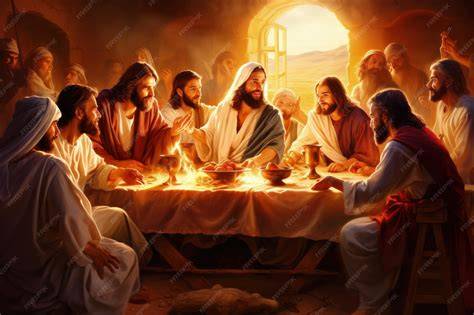
Why the Passover was important
The main focus of the festival is a special meal, where the whole family will gather to hear the story of their ancestors’ deliverance from slavery. There are a number of symbolic foods which are present on the table or tasted.
- Unleavened bread: this is flat bread baked without yeast. It reminds Jewish people that when their ancestors left Egypt they did so in a hurry and did not have time to prepare bread in the usual way.
- Wine: four glasses are drunk during the telling of the Exodus story to remind the Jews of God’s promises to his people.
- Bitter herbs: a reminder of the bitterness of slavery.
- Lamb bone: a reminder of the lamb that was sacrificed so that people’s door frames could be marked with blood.
- Haroset: a paste of apples, nuts and cinnamon. Its colour and texture are meant to recall mortar, and therefore to act as a reminder of the work of the Israelite slaves who made bricks out of mud.
The beginnings of the Passover go back to Exodus 12. In the book of Exodus, the nation of Israel has been in Egypt for over 400 years. They are no longer welcome guests as they were in the days of Joseph in Genesis. Now they are enslaved and oppressed.
God sent Moses to lead them out of their captivity into Canaan, the land God promised by covenant to Abraham, Isaac, and Israel. When Moses brought the word from God to Pharaoh, “Let My people go,” Pharaoh challenged Moses: “Who is the LORD, that I should obey His voice to let Israel go?”
The ten plagues were God’s answer to this question. The final plague was the death of the firstborn sons of the Egyptians, which resulted in the release of the Israelites.
The firstborn sons of the Israelites were spared by means of the first Passover celebration. The Passover lambs were slaughtered, and some of the blood was placed on the doorposts. When the death angel saw the blood on the doorposts, he “passed over” the house. This celebration was made an annual feast for the Israelite nation.
It is important to note that even the original Passover was not to protect Israel from the wrath of Pharaoh but from the judgment of God. The Passover was never solely about deliverance from Egypt, but rather about deliverance from sin and the judgment of God upon sin.
So, John the Baptist would declare that Jesus was “the Lamb of God who takes away the sin of the world.” It was always a picture of Jesus although the Jews had never really grasped that. But after this night and what Jesus would accomplish through his death and resurrection, we can see the true significance of the Passover.
Jesus announces the betrayal
During the meal, Jesus announced that one of His disciples would betray Him to the authorities. Judas had already made arrangements with the Jewish leaders to do this for 30 silver coins.
Jesus was celebrating the meal with his disciples. During the meal he said that one of them would betray him. The disciples were very upset and began to ask him, one after the other, “Surely, Lord, you don’t mean me?”
Jesus answered, “The one who dips his bread in the dish with me will betray me.” Judas asked if Jesus meant him, to which he replied “So you say.”
In Matthew’s account, Jesus says, “Truly I tell you, one of you will betray me.” They became greatly distressed and began to say to him one after another, “Surely not I, Lord?”
He answered, “The one who has dipped his hand into the bowl with me will betray me. The Son of Man goes as it is written of him, but woe to that one by whom the Son of Man is betrayed! It would have been better for that one not to have been born.”
Judas, who betrayed him, said, “Surely not I, Rabbi?” He replied, “You have said so.”
In Luke’s account, Jesus says, “But see, the one who betrays me is with me, and his hand is on the table. The Son of Man will go as it has been decreed. But woe to that man who betrays him!”
They began to question among themselves which of them it might be who would do this. This shows that Jesus is fully aware of what will happen to him-that he will be arrested and put to death. Jesus accepts this as he knows it is God’s plan for him.
Jesus’ words about the bread
While they were eating, Jesus took a piece of bread, gave a prayer of thanks, broke it, and gave it to his disciples. “Take and eat it,” he said, “this is my body.”
Matthew records the words this way: “Take, eat; this is my body.” Mark says: “Take; this is my body.” Luke writes: “This is my body, which is given for you; do this in remembrance of me.”
Jesus speaks of His body as an offering, a sacrifice given for them: “This is My body which is given for you.” With these few simple statements, Jesus ends the Old Covenant and launches the new.
Jesus wasn’t saying that the bread was literally His body; clearly, it was a symbol. At the time, He was still using His body.
The apostle Paul gives the same tradition in 1 Corinthians: “This is my body, which is for you. Do this in remembrance of me.”
What the bread signifies
The body is where Jesus satisfied the righteous requirements of God. God didn’t want a sheep or a goat or a bull, God wanted a holy life.
Jesus took on flesh and lived that holy life, obedient to His Father in all things. And here He tells the disciples, “I DID IT FOR YOU.” All of My obedience… All of My suffering… All of My resistance to temptation… IT WAS FOR YOU.
Jesus satisfied the righteous requirements for you. The bread points to His life, His obedience, His suffering, and His sacrificial death for His people.
It is symbolic of acceptance. It is symbolic of need. It is an act of worship. They were to eat showing that they needed this righteousness that Jesus alone had obtained.
Jesus’ words about the cup
Then Jesus took a cup, gave thanks to God, and gave it to them, saying, “This is my blood, which seals God’s covenant, my blood poured out for many for the forgiveness of sins.”
Matthew records: “Drink from it, all of you; for this is my blood of the covenant, which is poured out for many for the forgiveness of sins.”
Mark records: “This is my blood of the covenant, which is poured out for many.” Luke records: “This cup that is poured out for you is the new covenant in my blood.”
Paul writes: “This cup is the new covenant in my blood. Do this, as often as you drink it, in remembrance of me.”
Jesus’ blood is about to be spilt at the cross and the wine represents this. However, Christians believe that through Jesus’ blood a person is saved for eternity, not just for a short while.
The new covenant
Focus on the word “covenant.” The Lord’s Supper is meant to symbolize and remind us of a covenant. A covenant is an agreement between two parties.
Jesus is saying, “By this meal, by this bread, by this cup, I’m inaugurating a New Covenant. I’m inaugurating an agreement between myself and you and My disciples.” There’s a new understanding. There’s a new relationship based on this covenant.
This is officialized, this is signed by this drinking of cup and eating of the bread. Jesus has taken the bread and wine and given them a new significance for his followers, showing that a new covenant is about to be put in place between God and His people.
The old covenant at Sinai
Many years before the Last Supper, God made a covenant with the nation of Israel. He made an agreement with these people. He brought them out of Egypt into the land of wilderness, into Sinai. He gathered them at the foot of the Mountain, Sinai. And there, He made an agreement, a covenant with the people.
He said in Exodus 19:5, “Now therefore, if you will indeed obey My voice and keep My covenant, you shall be My treasured possession among all peoples.”
God said, “This is My covenant with you.” “You keep My commandment. You keep My covenant. You obey My voice. This is the part of your deal. And My part is that, I will be your God. You will be My treasured possession. So if you obey Me, I will be your God.” That’s the agreement. That’s the covenant.
In Exodus 20 and so on, God gave them the laws-His statutes-in particular, what we know today as “The 10 Commandments”. God is saying, “If you keep My word, if you keep My laws, I will be your God, you will be My people.”
It’s like a marriage. It’s like a wedding ceremony. And you know, on that day, the people of Israel say, “Yes, we will do it.” Exodus 24:3 says, “All the people answered with one voice and said, ‘All the words that the Lord has spoken we will do.’”
“We will sign the marriage register. We will make our vows. We will be with you, God.” Properly looked at, Mount Sinai was the place where they had a wedding ceremony. They had a covenant between God and the nation.
The failure of the old covenant
However, the Jewish people in the Old Testament repeatedly committed sin and adultery against their God. They did not follow God wholeheartedly.
They broke all His laws, and worst still, they flirted and they were engaged with other false gods and committed idolatry. God over the centuries are grieved with them.
They have broken the Old Covenant. They have broken their original covenant at Mount Sinai. Yes, they broke the end of their deal.
The promise of the new covenant
However, God did not give up on the people of Israel. In Jeremiah 31, hundreds of years later, after Sinai, when Israel just kept sinning and sinning and sinning, God then gave them a new agreement, a New Covenant, a wonderful New Covenant.
He said in Jeremiah 31:31-32, “Behold, the days are coming declares the Lord, when I will make a New Covenant with the house of Israel and the house of Judah…” “So let Me give you a new deal. Let Me give you a new way of relating with Me.”
He goes on to say, “…Not like the covenant that I made with their fathers on the day when I took them by the hand to bring them out of the land of Egypt, My covenant that they broke, though I was their husband, declares the Lord.”
Mount Sinai was a wedding ceremony. But even though they said they will keep the covenant, they did not. They broke the covenant. So God now graciously says, “Let Me give you a New Covenant.”
“And this is the covenant that I will make with the house of Israel after those days, declares the Lord. After the Old Covenant has failed, and has been broken, I will give you the New Covenant, whereby I will put My law within them, I’ll write it on their hearts, I will be their God and they shall be My people.”
“And no longer shall each one teach his neighbor, each his brother saying, ‘Know the Lord,’ for they shall all know Me, from the least of them to the greatest declares the Lord, for I will forgive their iniquity, and I will remember their sin no more.”
Likewise, in Ezekiel 11:19-20, “I will give them one heart, a new Spirit, heart of flesh that they may walk in My statutes and they shall be My people and I will be their God.”
The Old Covenant is: “I’ll be your God, if you obey My voice.” There’s something for them to do. Of course, they failed.
So what’s so special about the New Covenant? Nothing for them to do. It’s all God’s part! Man is so helpless and hopeless, that God’s way of relating with men in the New Covenant is, “It’s not about you, it’s Me! I will. I will. I will. I will. I will change your heart, I’ll write My laws, I will cleanse you from sin, I’ll forgive your iniquities, I’ll put My Spirit within you.”
“This is my blood of the covenant”
The expression “blood of the covenant” recalls the covenant that Moses ratified at Mount Sinai. The blood signifies sacrifice and the establishment of a relationship between God and His people.
Sacrifice was important in the old covenant. The Israelites frequently sacrificed animals in the temple to receive God’s blessing and to have their sins forgiven through the blood that was shed.
For the first Passover, a lamb or young goat was killed and its blood put on the door frames of the Israelites’ houses. If they all stayed indoors, then the blood would save their first born when the angel of death visited Egypt that night.
At the Last Supper, Jesus identifies His own blood with the blood of the covenant. His words point ahead to His suffering and death, through which the promised new covenant is inaugurated.
One sacrifice, not repeated sacrifices
The writer of Hebrews makes clear that Jesus’ sacrifice is once for all: “By that will we have been sanctified through the offering of the body of Jesus Christ once for all.”
Hebrews also says, “When Christ had offered for all time, a single sacrifice,” and then speaks of “a single offering.”
Jesus is not saying, “Crucify Me over and over again. Let My body be laid down for you over and over again. Let My blood be spilled over and over again.”
There is no longer any need to put a lamb to death for it has been fulfilled by the sacrifice of Christ. The Lord’s Supper recalls and proclaims Christ’s completed sacrifice rather than requiring Him to suffer and die repeatedly.
The bread and cup as symbols of remembrance
Jesus took bread and Jesus took a cup. These two items, the bread and the cup, are symbols for remembrance. They are meant to teach the disciples wonderful spiritual lessons.
Jesus makes it clear that they are tokens of remembrance when He said in Luke 22:19, “Do this in remembrance of Me.” The apostle Paul reinforced the symbols and the need of remembrance when he said in 1 Corinthians 11:24, “Do this in remembrance of Me.” And then in verse 25, again, “Do this as often as you drink it, in remembrance of Me.”
So, the bread and the cup in the Lord’s Supper are tokens and symbols of remembrance. They remind Christians of Jesus, His life, His obedience, His suffering, His death, and the forgiveness made possible through Him.
Different Christian understandings
Some religious traditions teach transubstantiation. This is a teaching that says, after some prayer by some religious leader, that bread and the cup is literally transformed into the body and the blood of Jesus Christ.
It might still look like bread and grape juice or wine, but they say, “It is now actually the body and the blood of Jesus.”
Others teach something quite similar, called consubstantiation. The idea is that, when someone prays over the bread and the cup, it still is bread and cup, but somehow the spiritual elements, the essence of Christ, is now invested into the bread and cup.
So it is a little bit different from transubstantiation, but they are also adding that idea of some mystical power and blessing and element into the tokens of the Lord’s Supper.
When it comes to defending the real presence of Christ in the Eucharist, Catholics turn to Jesus’ words at the Last Supper: “Take, eat; this is my body” of the bread; and of the cup, “Drink of it, all of you; for this is my blood of the covenant, which is poured out for many for the forgiveness of sins.”
The logic of this passage seems simple: if Jesus had meant for the bread and the wine to merely represent his body and blood, he would have said so: “This represents my body; this represents my blood.” But since he says, “This is my body; this is my blood,” we can conclude that he meant the bread and wine to be his body and blood.
Protestants aren’t so quick to accept this logic. Some Protestant interpretations understand the bread and cup primarily as symbols that point to Christ’s body and blood and call believers to remember His sacrifice.
“Fruit of the vine”
One question concerns Jesus’ words about drinking “the fruit of the vine” in the kingdom of God. This phrase appears in Matthew and Mark after the words about the bread and cup, while Luke places it before the words of institution.
Given the ambiguity as to the order in which Jesus spoke the words, the phrase cannot by itself establish that the contents of the chalice after the words of consecration were merely wine. In Luke, the order is reversed, weakening any argument based strictly on the order in Matthew and Mark.
Biblical authors often described things according to their appearance. Scholars call this phenomenological language. For example, the weatherman says the sun will rise at 6 a.m. and set at 7 p.m. This does not mean the weatherman believes the sun moves up and down above the Earth; he is simply describing the sun as it appears.
Similarly, the reference to “the fruit of the vine” does not by itself prove that the substance in the chalice is mere wine. It may describe what is seen or tasted, without resolving the theological question of the Eucharist.
“Blood of the covenant” and sacrifice
Another question concerns the phrase “blood of the covenant.” The blood of the covenant in Exodus was blood from a sacrificial victim. Since Jesus had not yet died on the cross, some argue that the contents of the cup could only have been symbols of the blood that would be shed the next day.
One response is that the issue of whether real blood is present is different than the issue of whether that blood has the status of being “blood of the covenant.” Before they were slain, the animal victims at Mount Sinai did not have the status of being the “blood of the covenant.” But that does not mean the blood present in the oxen was not real blood.
One can also challenge the assumption that Christ’s blood at the Last Supper was not the “blood of the covenant.” The sacrificial rituals consisted of many things that preceded death: bringing the animal into the sacred precincts, examining the animals for any blemish, placing hands on its head, the confession of sins by both the priest and the penitent, and other acts.
Moreover, the New Testament teaches us that there is such a thing as a living sacrifice. Paul tells the Romans, “Present your bodies as a living sacrifice, holy and acceptable to God, which is your spiritual worship.”
The New Testament also identifies Jesus’ sacrifice with His Passion as a whole, including the sufferings that immediately led up to the Crucifixion and were intentionally directed toward it. Jesus’ redemptive sacrifice may reasonably include the sufferings that immediately led up to it.
Thus, at the time of the Last Supper, Christ’s blood already had the status of “blood of the covenant” within the redemptive work that would culminate in His death the next day.
“Do this in remembrance of me”
Jesus says, “This is my body given for you; do this in remembrance of me.” He says, “This cup is the new covenant in my blood, which is poured out for you.”
The command “Do this in remembrance of me” is repeated in Paul’s account: “This is my body, which is for you. Do this in remembrance of me.” “This cup is the new covenant in my blood. Do this, as often as you drink it, in remembrance of me.”
For as often as you eat this bread and drink the cup, you proclaim the Lord’s death until he comes.
The Lord’s Supper therefore looks in three directions: back to Jesus’ death, inward to the believer’s dependence on Christ, and forward to His coming kingdom.
Jesus’ teaching about humble service
Luke’s account continues beyond the words over the bread and cup. A dispute also arose among the disciples as to which of them was considered to be greatest.
Jesus said to them, “The kings of the Gentiles lord it over them; and those who exercise authority over them call themselves Benefactors. But you are not to be like that.”
“Instead, the greatest among you should be like the youngest, and the one who rules like the one who serves. For who is greater, the one who is at the table or the one who serves? Is it not the one who is at the table? But I am among you as one who serves.”
“You are those who have stood by me in my trials. And I confer on you a kingdom, just as my Father conferred one on me, so that you may eat and drink at my table in my kingdom and sit on thrones, judging the twelve tribes of Israel.”
John’s Gospel presents this same setting through Jesus’ act of washing the disciples’ feet. During supper, Jesus, knowing that the Father had given all things into his hands, and that he had come from God and was going to God, got up from the table, took off his outer robe, and tied a towel around himself.
Then he poured water into a basin and began to wash the disciples’ feet and to wipe them with the towel that was tied around him.
After he had washed their feet, had put on his robe, and had returned to the table, he said, “Do you know what I have done to you? You call me Teacher and Lord-and you are right, for that is what I am.”
“So if I, your Lord and Teacher, have washed your feet, you also ought to wash one another’s feet. For I have set you an example that you also should do as I have done to you.”
“Very truly, I tell you, servants are not greater than their master, nor are messengers greater than the one who sent them. If you know these things, you are blessed if you do them.”
The Last Supper therefore includes both a sacrificial meal and a pattern for Christian conduct. Jesus gives Himself for His disciples and commands them to serve one another.
Jesus’ warning to Peter
Jesus also warns Simon Peter about the testing that is coming: “Simon, Simon, Satan has asked to sift all of you as wheat. But I have prayed for you, Simon, that your faith may not fail. And when you have turned back, strengthen your brothers.”
Peter replies, “Lord, I am ready to go with you to prison and to death.” Jesus answers, “I tell you, Peter, before the rooster crows today, you will deny three times that you know me.”
These words show that the disciples’ devotion will be tested, yet Jesus continues to prepare and care for them. The meal takes place in the shadow of betrayal, denial, suffering, and death, but Jesus speaks of remembrance, forgiveness, service, faith, and the coming kingdom.
The Last Supper in the four Gospels
| Gospel | Distinctive emphasis |
|---|---|
| Matthew | Jesus identifies the cup as His blood of the covenant, poured out for many for the forgiveness of sins. |
| Mark | Jesus says, “This is my blood of the covenant, which is poured out for many,” and the disciples all drink from the cup. |
| Luke | Jesus emphasizes His eager desire to eat the Passover with the disciples, the new covenant in His blood, remembrance, service, and the coming kingdom. |
| John | Jesus washes the disciples’ feet and commands them to serve one another as He has served them. |
Matthew, Mark, and Luke recount the words over the bread and cup directly. John’s account focuses on Jesus washing the disciples’ feet, while also recording His teaching about betrayal, service, love, and discipleship.
All four accounts contribute to the meaning of the night. The Synoptic Gospels emphasize the Passover meal and the institution of the Lord’s Supper. John emphasizes the humility and self-giving love that Jesus expects His followers to imitate.
The Lord’s Supper in the early church
Church Tradition teaches how the Eucharist began at the Last Supper and how the early community obeyed Jesus’ command to “break bread” in his name.
This memorial of the Last Supper became a central ritual for Christians when they gathered together. In the earliest times, the Eucharist was celebrated along with a shared meal in the homes of local Christians.
In his First Letter to the Corinthians, Paul describes a Eucharist celebrated in connection with a common supper shared in the homes of the early Christians. This supper included the blessing of the bread and wine, the breaking of the bread, and communion.
As the numbers of Christians grew, the Eucharist as a sacred meal separated from the common meal. Believers today still remember and celebrate the Last Supper on Holy Thursday.
The early church gathered for the breaking of bread, and Acts 20:7 describes believers gathering on the first day of the week to break bread. Paul also wrote to the church at Corinth, teaching and correcting them with regard to the Lord’s Supper.
Believers take part in the Eucharist to give thanks to God, and share this meal as a community. In community believers gain strength from everyone who has gathered.
What Christians remember at the Lord’s Supper
The bread and wine are symbols of nourishment and food for the Christian journey. They direct believers to Jesus Christ and to the work He accomplished through His body and blood.
- Christ’s body was given for His people.
- Christ’s blood was poured out for many.
- The new covenant was inaugurated through Jesus.
- Forgiveness of sins is connected with His sacrificial death.
- Believers are called to remember Jesus.
- Christians proclaim the Lord’s death until He comes.
- Followers of Jesus are called to serve one another humbly.
- The meal points forward to the coming kingdom of God.
We certainly enjoy the Lord’s Supper today. We celebrate with a warmth and gratitude that fills our hearts as we remember Christ and His sacrifice.
Jesus intensely desired to share this Passover with His disciples as He foresaw His suffering and death. But the expectation of His suffering was not with dread or dismay-instead, it was with eagerness for what He was about to accomplish.
Jesus saw this Passover as prophetic, as anticipatory of the coming of the kingdom, and in this, He could rejoice. The old covenant, being fulfilled in Christ, was to be set aside. The Kingdom, while still future, was certain to be established, because Messiah, at His first advent, had laid its foundation by His sacrificial death.
The eating of the first Passover involved the sacrifice of the Passover lamb to deliver the first-born sons of Israel from death. It was done as well as a preparatory step to the exodus, their release from Egypt by Pharaoh, their crossing of the Red Sea, and their entrance into the promised land.
Thus, the sacrifice of the Passover lamb was not focused only on the preservation of the lives of the Israelites, but on the possession of the promised kingdom. In the same way, Jesus rejoiced in the assurance that the kingdom would come in all its fullness.
Hebrews 12:2 speaks about Jesus, “who for the joy that was set before Him endured the cross, despising the shame, and has sat down at the right hand of the throne of God.”
What joy was set before Him? The joy of a purchased bride; the joy of a redeemed humanity; the joy of a consummated kingdom; the joy of His coming reign.
That is what Jesus is doing here on the night before He would die. He is looking forward to the kingdom He will purchase. He is looking forward to the kingdom He will redeem. He is eagerly anticipating the day when all the saints are redeemed and He returns and reigns on the earth and celebrates with His own.
Someday, in the consummated Kingdom, Jesus will eat and drink the Passover again-but not until then. The Bible teaches that the Kingdom of God has been inaugurated with the coming of Jesus Christ, the King of Israel.
All of us who believe in Jesus Christ are citizens of that Kingdom today. This is the spiritual reality of the Kingdom of God. But the consummation of God’s Kingdom will not come until Christ returns to earth.
So, although there is certainly a spiritual element of the Kingdom here today, we still look for more-a literal earthly kingdom in which all the kingdom promises and prophecies of both the Old Testament and New Testament will be fulfilled.
At the Last Supper, Jesus says that His body is given for His disciples, His blood establishes the new covenant, forgiveness is offered through His sacrificial death, His followers must remember Him, and His kingdom is still to come. His words and actions unite the Passover, the cross, the Lord’s Supper, humble service, and the hope of His coming kingdom.