The Aaronic Priesthood quorum theme was announced on November 17, 2019, during the worldwide Face to Face event for Children and Youth. Young men around the world stood and recited the new theme together during the event.
The theme was introduced to help young men understand who they are, why they are on earth, what God expects of them, and how they can follow the covenant path. It was also intended to strengthen unity among Aaronic Priesthood quorums throughout the world.
When the Aaronic Priesthood quorum theme was announced
The Aaronic Priesthood quorum theme was announced during a Face to Face event for Children and Youth on Nov. 17. We will never forget the remarkable feeling that came as we stood and recited the new theme with young men around the world during the Face to Face event for Children and Youth on Nov. 17.
This theme was introduced just before the world pandemic affected our ability to gather. However, pandemic restrictions do not need to stop young men from coming to realize what a blessing it is to know who we are, why we are here, and what God expects them to become.
Young Men General President Steven J. Lund has said: “We invite young men and their leaders to memorize the new theme. We also invite young boys in Primary to memorize it and missionaries and young single adult men to memorize it too.”
“Beyond that, we invite moms, dads, grandparents and everyone to talk about it and make it a focus in family gatherings. We know our young men will be blessed as a result.”
The complete Aaronic Priesthood quorum theme
The new theme is composed of five powerful paragraphs - and every young man may reflect upon these principles as he learns, ponders and internalizes its words:
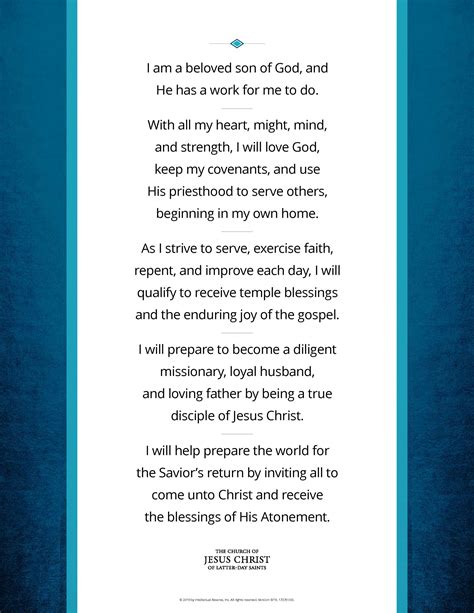
I am a beloved son of God, and He has a work for me to do.
With all my heart, might, mind, and strength, I will love God, keep my covenants, and use His priesthood to serve others, beginning in my own home.
As I strive to serve, exercise faith, repent, and improve each day, I will qualify to receive temple blessings and the enduring joy of the gospel.
I will prepare to become a diligent missionary, loyal husband, and loving father by being a true disciple of Jesus Christ.
I will help prepare the world for the Savior’s return by inviting all to come unto Christ and receive the blessings of His Atonement.
Why the theme was created
The words of the Aaronic Priesthood quorum theme can help us understand and remember who we are and why we are here and help us walk the covenant path. The words can also help us understand that each day is part of the journey of improving as we strive to do better and be better than ever before.
For truly, we are sons of a Father in Heaven who knows and loves us. The new theme helps young men to know who they are, that God has called them to a great work and to know and understand what He expects of them.
The wording in this theme was inspired. Our desire is that young men not only memorize the theme, but internalize it, ponder it and let the meaning go from their head to their heart.
The five principles in the Aaronic Priesthood theme
1. Identity: “I am a beloved son of God”
Identity: My Heavenly Father loves me, and He has a work for me to do. I was not sent to earth to simply fill time - the Lord is not just waiting to see if I might contribute at some point.
I am not here to be a spectator. He has sent me for a reason. The angel Moroni told Joseph Smith that “God had a work for [him] to do” (Joseph Smith-History 1:33), and like Joseph Smith, I have a mission, a purpose and a destiny, and God will help me to discover and fulfill that mission.
2. Commitment: Loving God and serving others
Commitment: When it comes to the gospel, I am “all in.” The Lord has given me everything, and He wants my everything in return. I am beloved of Him, and I love Him.
My covenants motivate me to be a light to the world, and my priesthood service - beginning in my own home - can expand into my circle of influence at church, at school and in my community.
3. Focus and fruits: Faith, repentance and improvement
Focus and fruits: As I practice the first principles of the gospel, I can face the future with confidence, always grateful for the chance to repent and improve. The fruits of the gospel lead me to the most heavenly place on earth, the house of the Lord.
The covenant path is a path of joy - the lasting joy that only the gospel can bring. As I strive to serve, exercise faith, repent, and improve each day, I will qualify to receive temple blessings and the enduring joy of the gospel.
4. My work: Preparing for future responsibilities
My work: Important roles and important goals are milestones along the covenant path, and although I cannot know exactly how my life will unfold, I can prepare to become all the Lord wants me to become.
I will prepare not only to go on a mission, but to become a diligent missionary; not only get married, but to become a loyal husband; not only to have a family, but to become a loving father; not only to learn about Jesus Christ, but to become a true disciple of Christ throughout my life.
5. His work: Inviting all to come unto Christ
His work: As one who holds the Aaronic Priesthood, and a member of The Church of Jesus Christ of Latter-day Saints, I have a role to play in the global work of salvation.
I will help gather Israel on both sides of the veil that others may find joy in Christ and choose to receive the blessings of His Atonement. I will help prepare the world for the Savior’s return by inviting all to come unto Christ and receive the blessings of His Atonement.
How the theme helps young men
During a general conference leadership meeting a few years ago, a question was asked about how to help members [young men] who struggle with personal challenges. Then Elder-Nelson gave a simple but profound answer: “Teach them their identity and purpose.”
When we find ourselves in a moment of temptation or we’re feeling down, we can take a step back and think of the words of this theme. These words are powerful, and they can lift us to a higher and holier place.
Whether we’re at home, at school, with our friends, or at work, we can draw on the words of this theme to help us make the right decisions and bring the Spirit into our lives.
What if every young man in the world could begin each day by affirming: “This is who I am, this is what I believe, this is what I will do, and this is what I will become”? With such knowledge and commitment, the world would change overnight.
A worldwide brotherhood
The Savior said, “If ye are not one ye are not mine” (Doctrine and Covenants 38:27). This theme helps bring together a worldwide brotherhood of those holding the Aaronic Priesthood and the strength that is found in a quorum.
Our desire is that this will help unite quorums in love and commitment to each other. This is one of the most important things we can do as we help each other walk the covenant path.
From our visits around the world, we have seen young men and their leaders recite passages such as the Standard of Truth and Doctrine and Covenants section 4 in their Aaronic Priesthood quorums. Missionaries worldwide gain strength from reciting the missionary purpose and Doctrine and Covenants section 4.
Now, young men around the world can increase their unity by reciting an Aaronic Priesthood quorum theme. As young men stand and recite the new Aaronic Priesthood quorum theme, they are virtually locking arms with each other in a worldwide brotherhood who is pledging their commitment to follow the Savior.
How families and quorums can use the theme
We encourage Church members to study the words of the theme in their families. Perhaps set aside a home evening to study each stanza.
Like a patriarchal blessing, different messages and promptings will come to us at different times. This theme can serve as a tool for parents to talk to their young men.
Start conversations about how to use the priesthood to bless your home and family and what it means to be a diligent missionary, loyal husband and loving father.
We invite young men to recite the theme at every quorum meeting. Consider displaying a copy in your bedroom or another place where it can be referenced often.
We also invite quorum presidencies to teach their quorums about the doctrine found within the theme. As we study the theme and allow the words to take root in our hearts and minds, the Spirit will testify to us of truly who we are and who Heavenly Father wants us to become.
The Aaronic Priesthood in historical context
The Aaronic Priesthood has its historical beginning in the Restoration of the gospel. In May 1829 the Prophet Joseph Smith and his scribe Oliver Cowdery were working on the translation of the Book of Mormon at Joseph’s home in then-Harmony Township, Pennsylvania, when they learned about the necessity of baptism.
Seeking divine guidance on May 15, 1829 - nearly 200 years ago - Joseph and Oliver walked into nearby woods to pray about baptism and the remission of sins. As they prayed, Oliver recorded that the voice of the Lord spoke peace to his heart as John the Baptist, a resurrected being, appeared.
The heavenly messenger placed his hands on their heads and conferred upon them the Aaronic Priesthood. That same day, Joseph and Oliver waded into the flooded Susquehanna River and baptized each other.
Afterward, they ordained each other to the Aaronic Priesthood. Oliver wrote that the day was one of joy, wonder and amazement.
When John the Baptist appeared, he called Joseph and Oliver his “fellow servants” (Doctrine and Covenants 13:1). As young men serve in the offices of the Aaronic Priesthood as deacons, teachers or priests, they act as fellow servants with John the Baptist in the work of the Lord.
Development of Aaronic Priesthood offices
This thesis traces the history of the restoration and development of the Aaronic Priesthood and its offices of priest, teacher, and deacon, from 1829 to the middle 1840s in The Church of Jesus Christ of Latter-day Saints.
The major areas of emphasis include the organizational structure of the Aaronic Priesthood, the responsibilities assigned to priests, teachers, and deacons, and the relationship of the functions of the Aaronic Priesthood which are first given in Section 13 of the Doctrine and Covenants, namely the ministering of angels, the preparatory gospel, and the offering of the sons of Levi.
Also included is the role of the Aaronic Priesthood in the temples during the formative period of the Church. Interesting finding of the study includes 1) the functioning of priests as presidents of priests quorums instead of bishops, 2) the guardianship or watchman role of teachers and priests and the quasi-legal position therein entailed, and 3) the ordinances of the Kirtland temple participated in by priests, teachers, and deacons in the temple.
When young men began receiving the Aaronic Priesthood
In the very early days of the Mormon Church all members were converts, principally adults. However, youth were also ordained to both the Melchizedek and the Aaronic Priesthood.
From the records of the Church, there seems to be no definite time when the Aaronic Priesthood was first given to boys. Some ordinations were given to very young men who showed aptitude as far back as the days of Kirtland.
Don Carlos Smith, youngest brother of the Prophet Joseph Smith, was ordained and labored as a missionary when only fifteen years of age. George A. Smith, father of John Henry Smith, was active in the ministry when about fifteen years of age, and also was a member of Zion’s Camp in 1834.
He was ordained a seventy when the first seventies were chosen in 1835 and was called into the Council of the Twelve when twenty-one years of age. Other young men who were worthy were ordained in those early days and sent out to preach the gospel.
President Joseph F. Smith was ordained an elder and sent on a mission when he was fifteen. So we see the conferring of the priesthood was not completely confined to men in the days of Kirtland, Nauvoo, or in the Salt Lake Valley.
The 1908 reorganization of Aaronic Priesthood age groups
New male converts were ordained first to offices in the Aaronic Priesthood, and then to offices in the Melchizedek Priesthood. Ordaining principally youth to the Aaronic Priesthood did not start until some time after the number of youth in the church, i.e. baptized children of members, became large enough to merit individual quorum consideration.
The definition of the current minimum ages for the Aaronic Priesthood offices was defined by the First Presidency of the Mormon Church in 1908.
| Year | Development |
|---|---|
| 1829 | The Aaronic Priesthood was restored through John the Baptist. |
| 1908 | The First Presidency restructured the Aaronic Priesthood to be a priesthood for boys. |
| Nov. 17, 2019 | The Aaronic Priesthood quorum theme was announced during a Face to Face event for Children and Youth. |
In 1908 the First Presidency restructured the Aaronic Priesthood to be a priesthood for boys. They approved that worthy boys be ordained at set ages and advance through each office: deacons at age 12, teachers at 15, priests at 18, and elders at 21.
Church headquarters produced lesson manuals and assigned duties geared to these age levels. For ward teaching, ordained teachers and priests served as junior companion-apprentices to Melchizedek Priesthood holders.
In the 1930s the Church began an adult Aaronic Priesthood program for converts and less-active adult men.
Why the date matters
The date November 17, 2019, identifies when the Aaronic Priesthood quorum theme was formally presented to young men worldwide. Its purpose was not merely to provide words for memorization, but to give young men a concise statement of identity, commitment, service, preparation and discipleship.
The theme connects the daily responsibilities of Aaronic Priesthood holders with the broader work of following Jesus Christ, serving others, strengthening families and inviting people to receive the blessings of His Atonement.