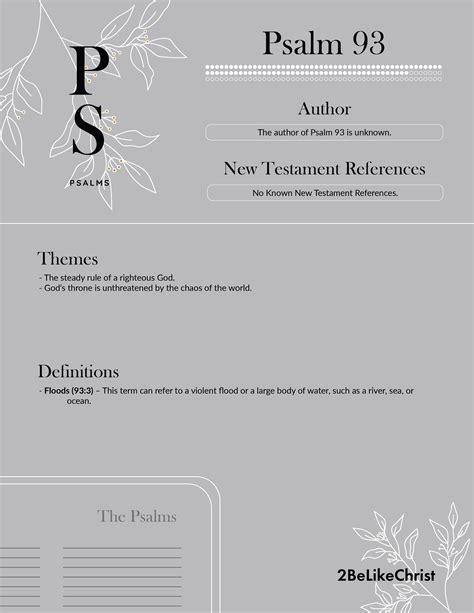
The author of Psalm 93 is unknown. The psalm has no Hebrew title naming its writer, and there is no reliable evidence by which its author, date, or original occasion can be determined.
Some later traditions and commentators have attributed Psalm 93 to Moses or David, but these suggestions are uncertain. The Septuagint, the Vulgate, and several Oriental versions associate it with David and describe it as a psalm for the day before the Sabbath, while the Hebrew text does not contain that title. The presumption from Psalm 93:5 that it refers to God’s house or sanctuary may suggest that it was composed after the temple was built, which would make Davidic authorship less certain.
Why the Author of Psalm 93 Is Considered Unknown
This brief psalm is without title or name of author, but its subject is obvious enough, being stated in the very first line.
The author of this psalm is unknown, and there is nothing by which we can determine this, or its date, or the occasion on which it was written.
This Psalm, as you will note at the top underneath the title of 'Psalm 93', which has not been ascribed a specific title as many of the other psalms have, and neither has it been ascribed an author.
Sometimes as you go through the book of Psalms you will see a Psalm of Asaph, or a Psalm of David, or the Sons of Korah - but there is no title nor author to this Psalm.
Indeed, the occasion is debated by commentators and teachers alike, but really it is conjecture.
None of us really know the reason why whoever wrote this Psalm wrote it in the first place.
Traditional Attributions to Moses and David
This psalm is by some ascribed to Moses, by others to David, which latter is more probable; with which agree the Septuagint, Vulgate Latin, and all the Oriental versions; all which, excepting the Syriac and Arabic versions, say it is a psalm that was made to be sung the day before the sabbath, and it was a custom with the Jews to sing it on the sixth day of the week.
The Septuagint and the Latin Vulgate give the title, “The praise of an ode by David, for the day preceding the sabbath, when the earth was founded.” The origin of this title is unknown, and it has no authority.
There is no evidence that it was composed by David, and the presumption from Psalm 93:5 is that it was composed after the temple was built, and consequently after the death of David.
Although Davidic authorship is considered more probable by some interpreters, probability is not proof. The Hebrew text itself does not identify David as the writer, and the traditional title supplied by later versions cannot establish authorship.
| Question | What can be established |
|---|---|
| Who wrote Psalm 93? | The author is unknown. |
| Was it written by David? | Some ancient versions and commentators say so, but there is no conclusive evidence. |
| Was it written by Moses? | Some commentators have attributed it to Moses, but the attribution is uncertain. |
| When was it written? | The date cannot be determined with certainty. |
| Why was it written? | The original occasion is unknown, though the psalm may reflect danger, opposition, or public worship. |
The Likely Historical Setting
It seems, from Psalm 93:5, to have been composed with some reference to the sanctuary, and to the service there: “Holiness becometh thine house,” O Lord, and it may have been designed, with the last psalm, to have been used in the place of public worship on the sabbath-day.
It would appear, also, from the structure of the psalm, that it was composed in view of some danger which may have threatened the nation from some hostile power, and that the design was to impart confidence in God, or to keep up the assurance in the mind of the people that God presided over all, and that his kingdom was safe.
The likelihood is, probably, the nation found themselves in political trouble.
Their enemies were about to attack them, I think that you can at least read that between the lines, and therefore - as often is the occasion when you are in trouble - they lifted their eyes from the earth to heaven, and asked God for help.
Even when circumstances may be adverse, not the way we would hope or like things to go, the Psalmist reminds us that the Lord still is King.
Possibly at the time this sacred ode was written, the nation was in danger from its enemies, and the hopes of the people of God were encouraged by remembering that the Lord was still King.
With this view, it is adapted to inspire confidence in God in all ages, and in all times of danger.
Psalm 93 and the Reign of God
This is the Psalm of Omnipotent Sovereignty: Jehovah, despite all opposition, reigns supreme.
The subject of the psalm is the kingdom of God; not of nature and providence, but of grace; the kingdom of the Messiah; of the certainty, firmness, and eternity of it, notwithstanding the opposition of mighty enemies; being established by the sure promises of God, which his faithfulness and holiness were engaged to make good.
Psalm 93 is a psalm of praise worshiping God for being an eternal king whose throne cannot be touched by the chaos of the earth.
The steady rule of a righteous God is the central theme. God’s throne is unthreatened by the chaos of the world.
Jehovah reigns is the first word and the main doctrine of the psalm, and holiness is the final result.
The whole psalm is most impressive, and is calculated to comfort the distressed, confirm the timorous, and assist the devout.
Structure and Content of the Five Verses
Psalm 93 is a brief psalm with only 5 verses moving through 3 stanzas.
The first stanza declares, “The LORD is king!” and then continues to declare the majesty and strength of God that has firmly established the world for eternity.
The second stanza leaves the realm of humans to remind us that there is more to God’s reign than human issues and concerns.
The final stanza, verse 5, places God’s decrees as part of God’s vast kingdom.
Psalm 93:1 - The Lord Reigns in Majesty and Strength
“The LORD reigneth, he is clothed with majesty; the LORD is clothed with strength, wherewith he hath girded himself: the world also is stablished, that it cannot be moved.”
Whatever opposition may arise, his throne is unmoved; he has reigned, does reign, and will reign for ever and ever.
Whatever turmoil and rebellion there may be beneath the clouds, the eternal King sits above all in supreme serenity; and everywhere he is really Master, let his foes rage as they may.
He is clothed with majesty. Not with emblems of majesty, but with majesty itself: everything which surrounds him is majestic.
His is not the semblance but the reality of sovereignty.
The LORD is clothed with strength. His garments of glory are not his only array, he wears strength also as his girdle.
He is always strong, but sometimes he displays his power in a special manner, and may therefore be said to be clothed with it; just as he is always majestic essentially, but yet there are seasons when he reveals his glory, and so wears his majesty, or shows himself in it.
Wherewith he hath girded himself. As men gird up their loins for running or working, so the Lord appears in the eyes of his people to be preparing for action, girt with his omnipotence.
Strength always dwells in the Lord Jehovah, but he hides his power full often, until, in answer to his children's cries, he puts on strength, assumes the throne, and defends his own.
Psalm 93:1 - The Stability of the World
The world also is stablished, that it cannot be moved.
Because Jehovah reigns terrestrial things for a while are stable.
We could not be sure of anything if we were not sure that he has dominion.
When he withdraws his manifest presence from among men all things are out of order; blasphemers rave, persecutors rage, the profane grow bold, and the licentious increase in wantonness; but when the divine power and glory are again manifested order is restored, and the poor distracted world is at peace again.
That there is any stability, either in the world or in the church, is the Lord's doings, and he is to be adored for it.
The psalmist described God as a majestic king robed with majesty and wearing a belt of strength.
His greatness is observable in the fact that He created and established the earth.
Psalm 93:2 - The Eternal Throne
“Thy throne is established of old: thou art from everlasting.”
Though thou mayest just now appear in more conspicuous sovereignty, yet thine is no upstart sovereignty: in the most ancient times thy dominion was secure, yea, before time was thy throne was set up.
Thy throne is established of old. Whatever might occur, the throne of God was firm.
That could not be moved.
It had been set up from all eternity.
It had stood through all the convulsions and changes which had occurred in the universe; and it would stand firm forever.
The Lord himself is eternal.
Let the believer rejoice that the government under which he dwells has an immortal ruler at its head, has existed from all eternity and will flourish when all created things shall have for ever passed away.
God did not begin to reign at earth’s creation, but has always been King.
Infinity, or as stated here, “eternity,” means that God never had a starting point and has no end.
Psalm 93:3-4 - The Floods and the Power of God
“The floods have lifted up, O LORD, the floods have lifted up their voice; the floods lift up their waves. The LORD on high is mightier than the noise of many waters, yea, than the mighty waves of the sea.”
Men have raged like angry waves of the sea, but vain has been their tumult.
Observe that the psalmist turns to the Lord when he sees the billows foam, and hears the breakers roar; he does not waste his breath by talking to the waves, or to violent men; but like Hezekiah he spreads the blasphemies of the wicked before the Lord.
These repetitions are needed for the sake both of the poetry and the music, but they also suggest the frequency and the violence of wicked assaults upon the government of God, and the repeated defeats which they sustain.
Sometimes men are furious in words-they lift up their voice, and at other times they rise to acts of violence-they lift up their waves; but the Lord has control over them in either case.
The ungodly are all foam and fury, noise and bluster, during their little hour, and then the tide turns or the storm is hushed, and we hear no more of them; while the kingdom of the Eternal abides in the grandeur of its power.
The image in the psalm is intense and frightening.
The churning waters were the very definition of chaos.
In a world gone crazy, it is comforting to realize that even the chaotic waters obey God.
Large bodies of water, especially during storms, can be chaotic, untamable, and extremely powerful.
But the chaos of these mighty “floods” does not threaten the stability of God’s throne.
The psalmist wrote, “mightier than the waves of the sea, the Lord on high is mighty” (93:4).
God’s throne is set on high above the waves and they cannot threaten it.
The LORD on high is mightier than the noise of many waters.
The utmost of their power is to him but a sound and he can readily master it, therefore he calls it a noise by way of contempt.
When men combine to overthrow the kingdom of Jesus, plot secretly, and by and by rage openly, the Lord thinks no more of it than of so much noise upon the sea beach.
Jehovah, the self existent and omnipotent, cares not for the opposition of dying men, however many or mighty they may be.
When the storm raises Atlantic billows, and drives them on with terrific force, the Lord is still able to restrain them, and so also when impious men are haughty and full of rage the Lord is able to subdue them and overrule their malice.
Kings or mobs, emperors or savages, all are in the Lord's hands, and he can forbid their touching a hair of the heads of his saints.
Psalm 93:5 - God’s Testimonies and Holiness
“Thy testimonies are very sure: holiness becometh thine house, O LORD, for ever.”
As in providence the throne of God is fixed beyond all risk, so in revelation his truth is beyond all question.
Other teachings are uncertain, but the revelations of heaven are infallible.
As the rocks remain unmoved amid the tumult of the sea, so does divine truth resist all the currents of man's opinion and the storms of human controversy; they are not only sure, but very sure.
Thy testimonies are very sure means all that thou hast borne witness to; all that thou hast affirmed or declared to be true.
This would embrace all that God has spoken, whether his law, his promises, his commands, his prophecies, or his statements of what has occurred and of what will occur.
Holiness becometh thine house, O LORD, for ever.
Truth changes not in its doctrines, which are very sure, nor holiness in its precepts, which are incorruptible.
The teaching and the character of God are both unaltered.
God has not admitted evil to dwell with him, he will not tolerate it in his house, he is eternally its enemy, and is for ever the sworn friend of holiness.
The church must remain unchanged, and for ever be holiness unto the Lord; yea, her King will preserve her undefiled by the intruder's foot.
Sacred unto the Lord is the church of Jesus Christ, and so shall she be kept evermore.
Divine sovereignty both confirms the promises as sure testimonies, and enforces the precepts as seemly and becoming in the presence of so great a Lord.
Proposed Occasions for Psalm 93
Because the psalm has no authorial title, proposed occasions remain uncertain.
Many scholars believe that this Psalm was also sung during the Feast of the Tabernacles.
The Feast of the Tabernacles in the Old Testament was a type or a picture of what we still await as God's people today in the millennial reign of Christ.
The Jewish Talmud, or what has been also called the Babylonian Talmud, says that it was the custom of the Jews to sing this 93rd Psalm on the sixth day of the week.
That would suit, when you think about it, when you think of the subject matter talking of waves and nature and so on, because on the sixth day of the creation week God finished His creation, it was the founding of the world in a new creation.
The psalm may have been intended for public worship, especially in connection with the Sabbath or the sanctuary.
It may also have been written to strengthen the people of God during a period of national danger, political uncertainty, or hostile opposition.
Psalm 93 and the Messiah
Kimchi says that all these psalms, this and the following to Psalm 101, are concerning the Messiah; and so say Kabvenaki and Ben Melech.
Even Jewish interpreters say of them: “these all treat of the things which will take place in the times of Messiah.”
Alfred Edersheim, who was a Jewish scholar himself, says that most Jewish interpreters believe that this Psalm and the next six form part of a section that looks forward to the times of Messiah.
The present state of things is connected with Christ's humiliation.
But when he puts on his royal mantle of majesty, and girds about him the sword of his might: “thus the world shall be established; it cannot be moved.”
And yet, though seemingly the enemy has long prevailed, “Thy throne is established of old: thou art from everlasting.”
The establishment of his throne is the ground and the pledge of the establishment of the world and of his kingdom.
“Jesus Christ, the same yesterday, and today, and for ever.”
It has been the song of the Lord's people right throughout the Old and the New Testament, and the book of the Revelation tells us that it will always, throughout eternity, be the song - Revelation 19: “The Lord God omnipotent reigneth”.
These interpretations concern the theological meaning and possible prophetic use of the psalm, not the identity of its human author.
The Complete Text of Psalm 93
Psalm 93 verse 1: “The LORD reigneth, he is clothed with majesty; the LORD is clothed with strength, wherewith he hath girded himself: the world also is stablished, that it cannot be moved. Thy throne is established of old: thou art from everlasting. The floods have lifted up, O LORD, the floods have lifted up their voice; the floods lift up their waves. The LORD on high is mightier than the noise of many waters, yea, than the mighty waves of the sea. Thy testimonies are very sure: holiness becometh thine house, O LORD, for ever”.
Why the Question of Authorship Matters
The absence of a named author directs attention away from the human writer and toward the psalm’s central confession: the Lord reigns.
The psalm does not depend on the reputation of David, Moses, Asaph, or any other named figure in order to make its theological claim.
Its message is that God’s throne is eternal, his power exceeds the raging forces of nature and the opposition of nations, his testimonies are reliable, and holiness belongs to his house forever.
As I’ve gotten older, I’ve realized that time, and people, and circumstances are not as stable as I believed them to be as a child.
Everything temporal can change, if you try to hold on to it it will slip through your fingers, but God doesn’t ever change.
He is the one thing that is fixed in life.
This psalm speaks of a king whose throne is fixed in place amidst the “floods.”
It doesn’t matter how chaotic the “floods” of your life become; God is never moving!