Yahweh Tzevaot is the Hebrew name commonly translated as “the LORD of Hosts,” “the LORD of Armies,” or “the LORD Almighty.” It combines Yahweh, the personal name of God represented by the four Hebrew letters יהוה, with Tzevaot, the plural of tzava, a word that can mean army, host, multitude, service, or organized forces.
The name presents God as the supreme ruler over every power: the armies of Israel, the angelic hosts, the forces of nature, and the whole created order. In biblical usage, Yahweh Tzevaot therefore expresses not only military authority but also God’s sovereignty, protection, judgment, creative power, and active presence in the world.
The Hebrew expression Yahweh Tzevaot
The Hebrew form is יהוה צְבָאוֹת, commonly transliterated as YHWH Tzevaot, Yahweh Tzevaot, Adonai Tzevaot, or Adonai Tsvaot. The first element, יהוה, is the Tetragrammaton, the four-letter name of God. The second element, צְבָאוֹת, is the plural form of צָבָא, tzava.
The phrase is usually translated as “the LORD of Hosts,” but a more literal rendering is “the LORD of Armies.” The word tzava means “army” and, with the plural ending -ot, Tzevaot means “of the armies” or “of the hosts.”
| Hebrew element | Meaning | Function in the name |
|---|---|---|
| יהוה | Yahweh, represented as YHWH | The personal name of God |
| צָבָא | Tzava: army, host, service, organized force | The singular form behind Tzevaot |
| צְבָאוֹת | Tzevaot: armies, hosts, multitudes | The plural designation of the forces under God’s authority |
Why Yahweh is God’s personal name
God cannot be named, because God cannot be described. Any description circumscribes the Uncircumscribable. The name of God given to the Jews, however, reveals something of the nature of God, and the relationship of God to people.
Indeed, Yahweh is the personal name of God, whereas the other words spoken of God are not names but titles, and these refer to the various roles he plays vis a vis people, the world, the creation.
- Elohim means God.
- El means mighty one.
- El Shaddai means almighty God.
- El Elyon means most high God.
- Adonai means lord or master.
- Avinu means our father.
In Judaism, the name of God is more than a distinguishing title. It represents the Jewish conception of the divine nature, and of the relation of God to the Jewish people.
The various names of God in Judaism represent God as he is known, as well as the divine aspects which are attributed to him. The different aspects of God have different names, depending on the role God is playing, the context in which he is referred to and the specific aspects which are emphasized.
The Tetragrammaton: YHWH
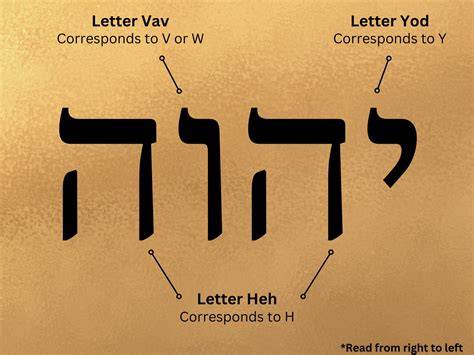
The “Tetragrammaton” is the 4 letter name of God, YHWH. This is just consonants, with vowels left out, so no one can actually say the name.
The Hebrew letters are named Yod-Heh-Vav-Heh: יהוה; note that Hebrew is written from right to left, rather than left to right as in English. In English it is written as YHWH, YHVH, or JHVH depending on the transliteration convention that is used.
The Tetragrammaton is the four-letter name of God. This name is first mentioned in the book of Genesis and is usually translated as “the LORD.” Because Judaism forbids pronouncing the name outside the Temple in Jerusalem, the correct pronunciation has been lost-the original Hebrew texts only included consonants.
Some scholars conjecture that it was pronounced “Yahweh,” but some suggest that it never had a pronunciation, which is extremely unlikely given that it is found as an element in numerous Hebrew names.
The Tetragrammaton appears in Genesis and occurs 6,828 times in total in the Biblia Hebraica Stuttgartensia edition of the Masoretic Text.
Yahweh and the meaning of “I am”
Yahweh contains the archaic third person singular imperfect of the verb to be. So it might mean, “He exists.”
In Exodus God speaks to Moses in the first person voice, Ehyeh, and so says, “I am,” or “I exist.” In English, this has been rendered as “I am who I am,” or “I am the Existing One,” but the best rendering is probably, “I am that I am.”
The phrase Ehyeh asher ehyeh is the first of three responses given to Moses when he asks for God’s name in the Book of Exodus. The King James Version of the Bible translates the Hebrew as “I Am that I Am” and uses it as a way to describe God.
The word ehyeh is the first-person singular imperfect form of hayah, “to be.” Biblical Hebrew does not distinguish between grammatical tenses. It has instead an aspectual system in which the imperfect denotes any actions that are not yet completed.
Accordingly, Ehyeh asher ehyeh can be rendered in English not only as “I am that I am” but also as “I will be what I will be,” “I will be who I will be,” “I shall prove to be whatsoever I shall prove to be,” or even “I will be because I will be.”
- “I am that I am”
- “I will be what I will be”
- “I will be who I will be”
- “I shall be what I shall be”
- “I will be because I will be”
- “I am the Existing One”
This translation captures that God stands on nothing, but stands in himself, leaning on nothing, but being self-subsistent and self-generating, rather than arising from anything extraneous.
I am, full stop. The beingness, the existing, needs no other support, ground, origin. It is. It is what is. Everything else that has being leans on, depends on, subsists in, needs, the existence that exists and needs nothing.
Yahweh as the living God
Closely associated with being or existing is “life.” Thus Yahweh is “the God of the living,” the bestower of life, the source of “aliveness” (1 Kings 18; Isaiah 41, 26-29; 44, 6-20; Jeremiah, 10, 10; 14; Genesis, 2,7).
The idea of “life” has been traditionally connected with the name YHWH from medieval times. God is presented as a living God, as contrasted with the lifeless gods of the heathen: God is presented as the source and author of life.
Life has vitality, strength, and health, or “well-being.” In God, people move from ill-being to well-being, and from well-being to eternal being.
Some Hasidic people also translate Yahweh in Exodus as “I exist, and I will exist.” Or, “I will be who I will be,” or even “I will be because I will be.”
The Hasidic tradition says of this, only God exists into the future, or has a future that is assured. Living beings have a past and present, but no assured future. This means there is no beginning and no ending in God. God persists, so to speak.
This name of the personal, living God is being, and existence, but it suggests, on-going being and existence with a future. This being cannot fail, cannot diminish, cannot recede like an outgoing tide; it is, and its isness will be.
The divine name and eternal life
Therefore, all the promises of God to the Jews, and via them to us, have this implication of being pledges that we too, in participating in the isness of God, will be, and will continue to be.
This is the Jewish origin for the later Christian preoccupation with “eternal life.” It is not a reward for being a good boy or good girl; it is what is, and so as we draw nearer to God, our fragile and precarious being is uprooted from its native soil and replanted in God, like a little green shoot grafted onto a large vine.
Incomplete existence, human, is immersed in complete existence, divine; thus does a being inherently without a secure future acquire a secure future. The latter gifts the former; and so by gift the human becomes something God is by nature.
Yahweh beyond titles and descriptions
The Hasids also say that the names, deeds, attributes, influences, energies, interventions, of God, especially the key 7, manifest Holiness. But Yahweh is beyond even Holiness.
Holy is kadosh in Hebrew, and means transcendent and apart. By contrast, eh-he-ye, or “I am,” is God as being, God as the essence of reality. Thus it is beyond Holiness.
If Holiness is God’s transcendence, then the beingness of God, signified by Yahweh, transcends Holiness, describing a divine reality that pervades every existence even as it transcends it, and thus relates equally to all realities, whether holy or mundane.
“The sun shines on the just and unjust alike” Christ says of his father, and this is built into the very name Yahweh.
Yahweh is reality, the reality not far off, but in all things, supporting them in existence-their true being, and calling them out-their true action, and relating to them personally-the Love that carries all being, all doing, and is available to humanity, face to face, and heart to heart.
The many names of God
Another Hasidic writer says that the “many” names of God-and though there are 7 main ones, in fact there are many more multiple ones-are adjectives or qualitative terms describing God’s many faceted involvement with his creation.
These names or qualities are like different rays of the sun, having different kinds of influence on our lives. These names are also, according to the Midrash, the different deeds of God.
In this text God says to Moses, “You want to know my name? I am called by my deeds. When I judge my creatures [as to whether they observe justice], I am called Elohim. When I wage war on the wicked, I am called Tzevakot; when I tolerate the sins of mankind, I am called E-l Shad-dai; when I have compassion on my world, I am called Ha-va-ya-h.”
These names are energies of God, active influences of God; each is some qualitative attribute by which God relates to his creation.
It is interesting that Elohim also means “the Mighty Forces of Nature.” Thus there is some link, often overlooked, between the giant powers of nature and the justice, or injustice, of human society.
A society living in injustice is more likely to be hit by natural disasters, in Jewish history. Both political and natural calamities are warnings to the Jews their society is unjust.
The many names are, then, a divine “intervention in reality”-God as ruler, God as judge, God as provider, God as saviour, and so on.
What does “Tzevaot” mean?
The word tzava can mean “a battle, a company, a host, a military, service, army, or war.” The meaning is broader than a reference to soldiers alone.
The word צבא is frequently translated as “host” rather than army, in most of our Bibles. “Host” could refer to either an army or a great number or multitude.
The word “army” can describe a large organized body of armed personnel trained for war especially on land, a great multitude, or a body of persons organized to advance a cause.
- A military army prepared for war.
- A multitude or great number of living beings.
- A body organized to advance a cause.
- A group working together toward a common purpose.
- A body carrying out a defined service.
We might speak of an army of ants, for example. We could say that such an army is a collective group ready to work together towards a common purpose. The meaning is flexible in English, as we shall explore below, and it’s the same way in Hebrew as well.
Creation as a host
The first time the word appears in the Bible is right at the beginning, in the creation account: “Thus the heavens and the earth were finished, and all the HOST of them.” (Genesis 2:1).
This could mean that all of the atoms, all of the molecules, the vast array of them, were working together, all assembled and acting towards a purpose. Like an army. Not like a machine, but like an army.
When we call our Heavenly Father the “Lord of Hosts,” there is so much in that name. Yes, there are the myriad armies of angels at his disposal, and yes, he is a warrior, mighty in battle, but he is also the conductor of the beautiful orchestra that is the entirety of all creation.
Every atom, every molecule, moves in accordance with his purposes and at his command. He sustains everything by his powerful word.
Yahweh Tzevaot and the armies of Israel
In the Book of Numbers, God commanded Moses and Aaron to arrange the armies of Israel by their families and tribes:
“Take a census of all the congregation of the sons of Israel, by their families, by their fathers’ households, according to the number of names, every male, head by head from twenty years old and upward, whoever is able to go out to war in Israel, you and Aaron shall number them by their armies.”
All of the males who were of the age of 20 years and older and who were able to go to war were to be counted as part of the army of Israel. They were to be counted by their families and their tribes.
God provided Moses and Aaron with a list of 12 individuals who were to be the head of each tribe, and then they organized the counting of all the eligible men of Israel for military service.
These eligible men were to be numbered “by their armies” or in Hebrew, le’tziotam.
The service of the Levites
In the same manner that the LORD set apart certain men from the Israelites to serve in the Israeli army, the LORD also gave specific requirements for the men who would serve from the tribe of Levi.
“Take a census of the descendants of Kohath from among the sons of Levi, by their families, by their fathers’ households, from thirty years and upward, even to fifty years old, all who enter the service to do the work in the tent of meeting.”
The minimum age for those who would serve from amongst the Levites was 30 years old and the maximum age was 50 years old.
The Levites would have a more specialized service with a more defined age bracket determining when they could serve. There were three different families among the Levites-the Kohathites, the Gershonites, and the Merarites-and each family would have different responsibilities in regard to the Tabernacle service.
We see a very interesting word usage in describing the service that the Levites were to carry out. In the phrase, “all who enter the service to do the work in the tent of meeting,” the word “service” is the Hebrew word la’tzava, the same word which is used for the military men who go out to war.
In other words, the same word tzava, which is used for “war” and “army,” is used to describe the “service” of the Levites.
Warriors and servants
The Levites also had a battle to fight and a war to wage in their service of the King of Kings, however, the battle of the Levites differed from the armies of Israel.
Whereas the armies of Israel engaged the enemy and sought to defeat them, the Levites drew close to the LORD and sought to worship Him through the Tabernacle service.
Both the Levites and the Armies of Israel were commissioned to serve the LORD but with separate responsibilities.
All of the Israelite men, both the men of war and the men called to serve the LORD in worship, were commissioned by God to enter into His service in order to maintain peace and protect the people.
Yahweh Tzevaot as “the LORD of Armies”
A common name of the LORD in the prophets is the name יהוה צבאות, “Adonai Tzevaot,” which is commonly translated as “The LORD of Hosts.”
This particular name of the LORD is usually translated as “The LORD of Hosts,” as mentioned above, however, the more literal translation is “The LORD of Armies.” “Tzevaot” is the plural form of “tzava,” which often carries the meaning of a military army.
The phrase “יהוה צבאות” is used approximately 250 times in the Bible. It is never used in the Torah but appears in the Prophets and Writings.
The tanna Jose ben Halafta considered “Tzevaot” a common name in the second century, and Rabbi Ishmael considered “Elohim” to be one.
Angelic armies and unseen forces
Some versions translate the phrase as “Lord of the Angel Armies.” One of the passages of Scripture that so well paints this picture of the unseen reality for us is found in 2 Kings chapter 6.
When the servant of the man of God got up and went out early the next morning, an army with horses and chariots had surrounded the city. “Oh no, my lord! What shall we do?” the servant asked.
“Don’t be afraid,” the prophet answered. “Those who are with us are more than those who are with them.” And Elisha prayed, “Open his eyes, LORD, so that he may see.”
Then the LORD opened the servant’s eyes, and he looked and saw the hills full of horses and chariots of fire all around Elisha.
In this passage we can see the numerical multitude of the resources at God’s disposal. The key verse is “Those who are with us are MORE than those who are with them.”
When we are in spiritual battle, this is ALWAYS going to be a true fact. Sight and blindness, faith and doubt are paralleled here. Elisha knew without seeing, his servant doubted and had to be shown.
The Syrian army seemed to be holding all the cards initially, but the cells in their body had to obey the command of their Creator, and they suddenly lost their God-given capacity of sight.
The commander of the LORD’s army
“Now when Joshua was near Jericho, he looked up and saw a man standing in front of him with a drawn sword in his hand. Joshua went up to him and asked, ‘Are you for us or for our enemies?’”
“‘Neither,’ he replied, ‘but as commander of the army of the LORD I have now come.’ Then Joshua fell facedown to the ground in reverence, and asked him, ‘What message does my Lord have for his servant?’ The commander of the LORD’s army replied, ‘Take off your sandals, for the place where you are standing is holy.’ And Joshua did so.”
Israel’s God is not satisfied with assisting Israel’s army, fighting on her side. He will lead Israel into battle Himself.
Joshua immediately understood to whom he was talking. He fell face down and quickly took off his shoes as Moses did before him at the sight of God in the burning bush, for the place upon which his feet stood was holy.
The exchange between Joshua and the commander also shows that Yahweh Tzevaot cannot be reduced to a tribal battle slogan. The divine commander does not simply accept the categories “our side” and “their side.” His authority is higher than the competing claims of human armies.
David and Goliath: the God of Israel’s armies
We see this name of the LORD explained in context during the exchange between David and Goliath in the Elah valley:
“You come to me with a sword, a spear, and a javelin, but I come to you in the name of the LORD of hosts, the God of the armies of Israel, whom you have taunted.”
“This day the LORD will deliver you up into my hands, and I will strike you down and remove your head from you. And I will give the dead bodies of the army of the Philistines this day to the birds of the sky and the wild beasts of the earth, that all the earth may know that there is a God in Israel.”
“And that all this assembly may know that the LORD does not deliver by sword or by spear; for the battle is the LORD’s and He will give you into our hands.”
David stated that he had come in the name of “Adonai Tzevaot” and he followed this declaration by explaining exactly what this means: “the God of the armies of Israel.”
David fought Goliath and the Philistine armies on that day in the name and the power of “Adonai Tzevaot”-“The LORD of Armies.”
There was a physical battle which David fought but David knew that he could only be victorious with the armies of the LORD. The LORD fought for David and the LORD gave David and the armies of Israel a great victory on that day.
“The battle belongs to the LORD”
David’s greatest weapon was the God of Israel. David told Goliath that he was not standing on that battlefield alone but rather in the name of his God.
David even went so far as to say that the weapons with which Goliath was coming against him were as nothing in the sight of his God.
The battle belongs to the LORD. The name Yahweh Tzevaot therefore emphasizes that victory does not ultimately depend on human weapons, numbers, or military strength.
We need to understand and proclaim the name and power of the God whom we claim to know. There is true victory in this life, physically and spiritually, in the LORD alone.
He alone is our victorious leader and He alone brings salvation to His people. The battles we face on this earth will take various forms and we need to know our God well in every situation and fight in the power and strength that He provides.
Hannah and the first use of Yahweh Tzevaot
The very first time that the name “Adonai Tzevaot” is used in the Bible is in the first chapter of the prophet Samuel.
It is the familiar story of Hannah who was married to her husband Elkanah, yet barren and constantly ridiculed by Elkanah’s other wife, Peninnah.
Year after year Elkanah would bring Hannah, Peninnah, and Peninnah’s children to worship the LORD at Shiloh and year after year Hannah would remember that she was barren and suffered the shame that accompanied barrenness.
In the midst of her desperate situation, Hannah remembered the God whom she knew and she poured out her heart to the LORD in prayer.
“O LORD of hosts, if You will indeed look on the affliction of Your maidservant and remember me, and not forget Your maidservant, but will give Your maidservant a son, then I will give him to the LORD all the days of his life, and a razor shall never come on his head.”
Hannah made a vow to God and promised the LORD that if He would give her a son, then she would give her son to the LORD all the days of his life; he would be a nazirite unto the LORD.
Why Hannah called God “the LORD of Hosts”
Hannah was absolutely powerless to change her situation. She had suffered for years in her powerless state and her position of societal shame.
Hannah believed in God but surely had to wonder where was God in the midst of her years of loneliness and shame.
When Hannah prayed this particular prayer, the very first words which came out of her mouth were “Adonai Tzevaot,” “The LORD of Armies!”
Hannah called upon the LORD of all creation and the Commander-in-Chief of the spiritual armies in heaven to hear her prayer and answer her plea.
The LORD heard Hannah’s prayer, accepted her vow, and granted her request. God remembered Hannah and allowed her to conceive.
A son was born to her and this son of her vows was the prophet Samuel. After Hannah weaned Samuel, she dedicated him to the LORD and left him at the Temple.
The LORD then blessed Hannah and granted her five more children. The LORD heard Hannah’s prayer, removed her shame, and blessed her beyond what she had even hoped for.
Yahweh Tzevaot and divine protection
The name Yahweh Tzevaot conveys supreme authority over all other powers, even nature itself.
There is not magic in using this name but there is supernatural power in the God who bears this name.
We all face various battles in life, whether against a real enemy or an impossible situation. We must know our God intimately and call upon Him to help us in the midst of our battles.
There will be times when we will have to stand up to the enemy as David did in full faith to see the victory of the LORD.
There will be other times when all we can do is to pour our hearts out to God in prayer because we are too ashamed to even talk about our pain to others, as Hannah did.
In either case, we need to remember that one of the names of God is “Adonai Tzevaot,” “The LORD of Armies.”
Yahweh Tzevaot and God’s relationship with the nations
How quick we are to desire harsh judgement on those who come against us. How slow we are to believe that there is no real threat when we are safe in God’s hands.
How confused and uncompassionate we become, when we forget that the battle belongs to the Lord.
Not only does the battle belong to him, but our enemies also belong to him, and he loves them very much.
“The Commander of the Angel Armies” is not exclusively “pro-Israel.” He is Creator and Father of all, and seeks to bless, to save and to redeem.
He has more than enough love to go around. He refuses to be drawn into choosing sides. He insists, rather, that we join his side and his purposes.
Just look at how God refers to Egypt-a nation that has oppressed, opposed, and attempted to annihilate Israel-and to Assyria, another fierce enemy of Israel:
“In that day there will be a highway from Egypt to Assyria. The Assyrians will go to Egypt and the Egyptians to Assyria. The Egyptians and Assyrians will worship together.”
“In that day Israel will be the third, along with Egypt and Assyria, a blessing on the earth. The LORD Almighty will bless them, saying, ‘Blessed be Egypt my people, Assyria my handiwork, and Israel my inheritance.’”
Justice, compassion, and the many divine energies
If you assert one manifestation of God, say compassion, and down play another, say fighting the wicked, then your vision of God’s rich relating to the creation is skewed, imbalanced, narrowed.
Yahweh is the only real name permissible to the God beyond all names. Only this name is an acceptable positive affirmation of the unknown and unknowable Essence of God.
The other and basically “plural” names of God do not describe God qua God, or presume to affirm anything about God in Essence, but they do describe, and richly, the Manifestations of God in relation to his creation, and to his people.
Hasidism uses the Greek Orthodox Christian distinction between the Essence and the Energies of God: when we call God provider or ruler, these are “mere names,” describing not God’s Essence, or what God is as God, but rather, describing a certain vision of God he grants us to have of him by affecting our reality in a certain manner.
The Energies of God, as Eastern Christianity calls them, or the Many Divine Names, as Jewish tradition calls them, are bridges between God and creation, relational inter-active fields connecting, in a dynamic and evolving way, Uncreated and created.
Related names of God
El
El means the deity and can mean “power” or “might,” hence “Mighty One.” It is used mostly in poetry and prophetic discourse, always with some attribute of God attached.
- El Elyon - Most High God.
- El Olam - Everlasting God.
- El Shaddai - Almighty God.
- El Hai - Living God.
- El Ro’i - God of Seeing.
- El Gibbor - God of Strength.
El appears in Ugaritic, Phoenician and other late Bronze and Iron Age Levant texts both as generic “god” and as the head of the divine pantheon.
In theophoric names such as Gabriel, Michael, Raphael, Ariel, Daniel, Ezekiel, Israel, Immanuel, and Ishmael, it is usually interpreted and translated as “God.”
Elohim
Elohim is a common name of God in the Hebrew Bible. Despite the -im ending common to many plural nouns in Hebrew, the word Elohim, when referring to God, is grammatically singular and regularly takes a singular verb in the Hebrew Bible.
Elohim can be understood as “the power over powers,” “God has many powers,” or “the all-powerful One.” It is also associated with “the Mighty Forces of Nature.”
The God doing the creating in the Genesis story is called Elohim. This name is Shamanic, without doubt. “He is lord over all the things that are lordly.” The lords of Nature, all the spirits, have a lord, a Great Spirit, who is their source.
Thus Elohim is singular and plural at once, One and Many. God uses the plural of himself in Genesis 1:26 and 11:7; this has led to tremendous debate among scholars.
Self-deliberation within God can be singular but the “majesties” of divine presence and action in nature can be plural.
The plural form ending in -im can also be understood as denoting abstraction, as in the Hebrew words chayyim, “life,” or betulim, “virginity.” If understood this way Elohim means “divinity” or “deity.”
Elyon
Elyon means “the Most High” or “supreme.”
Ro’i
Ro’i means “seeing.” It can refer to the God who sees or is seen. This term is used of the prophet who is a seer or visionary.
El Shaddai
El Shaddai is one of the names of God in Judaism and is conventionally translated as “God Almighty.” While the translation of El as “god” is straightforward, the literal meaning of Shaddai is the subject of debate.
The word means “almighty,” even “to overpower” or “to destroy.” Thus “the Destroyer” is an aspect of God, from an early time.
Another root for this word might be “mountain,” or “mountain dweller.” Paradoxically, the word has by different routes also been associated with God’s “fertility and blessings,” connected with “fruitfulness.”
Yet another line of interpretation claims that the word means “setting a limit” on God’s acts; the things he does stop at a certain point, but are “enough, sufficient, a sufficiency.”
This could be nuanced somewhat differently to mean, “the God who is sufficient to supply all one’s needs.” This word perhaps is a direct precursor of the Mosaic God, in that Yahweh is sufficient in himself, a self-determined being.
Shekhinah
Shekhinah means the “dwelling” of God, the presence of God which has descended to “dwell among” humanity.
Adonai
Adonai is Hebrew for “Lord.” Formally, this is plural, “my Lords,” but the plural is usually construed as a respectful, and not a syntactic plural.
Since pronouncing YHWH is considered sinful, Jews use Adonai instead in prayers, and colloquially would use Hashem, “The Name.”
As the pronunciation of the Tetragrammaton came to be avoided, Jews may have begun to drop the Tetragrammaton when presented alongside Adonai and subsequently to expand it to cover for the Tetragrammaton in the forms of spoken prayer and written scripture.
Why Jews say “Adonai” instead of “Yahweh”
In prayers, Jews speak Adonai, even though they leave YHWH in the text. This practice only arose after the Exile in Babylon.
All modern denominations of Judaism teach that the four-letter name of God, YHWH, is forbidden to be uttered except by the High Priest in the Temple.
Since the Temple in Jerusalem no longer exists, this name is never said in religious rituals by Jews. Orthodox and Conservative Jews never pronounce it for any reason.
Instead of pronouncing YHWH during prayer, Jews say Adonai. In conversation, many Jewish people will call God “Hashem,” which is Hebrew for “the Name.”
Jewish law requires that secondary rules be placed around the primary law, to reduce the chance that the main law will be broken. As such, it is common Jewish practice to restrict the use of the word Adonai to prayer only.
When the Masoretes added vowel pointings to the text of the Hebrew Bible, they gave the word YHWH the vowels of Adonai, to remind the reader to say Adonai in place of the Tetragrammaton.
Hashem and other substitutes
Many Jews extend the prohibition against pronouncing YHWH to some of the other names listed below, and will add additional sounds to alter the pronunciation of a name when using it outside of a liturgical context.
Hashem is used by Orthodox Jews so as to avoid saying Adonai outside of a ritual context. For example, when Orthodox Jews make audio recordings of prayer services, they generally substitute Hashem for Adonai.
Up until the mid twentieth century, another convention was quite common: the use of the word Adoshem, combining the first syllable of Adonai with the last syllable of Hashem.
This convention was discouraged by Rabbi David HaLevi Segal in his commentary to the Shulchan Aruch. The rationale was that it is disrespectful to combine a Name of God with another word.
Yahweh, Jehovah, and “the LORD” in English
In English, Yahweh was always translated as “the Lord.” This is a big error, because it substitutes the formality of a title for the personalness, even intimacy, of God’s only name.
This happened through William Tyndale, who also introduced the speculative, and inaccurate, “Jehovah.”
English translations of the Bible generally render YHWH as “the LORD” in small capitals, while replacing the name altogether as “the LORD” and Adonai as “Lord” in normal case.
Most English translations of the Bible write “the LORD” for YHWH, and “the LORD God” or “the Lord GOD” for Adonai YHWH instead of transcribing the name.
The name Yahweh is often reconstructed as Yahweh or oftentimes Jehovah in the English language.
Yahweh Tzevaot in Isaiah
In Isaiah 6 we read that the great prophet heard angels call out to each other: “Holy, Holy, Holy is Adonai Tzevaot!”
The last two words make up a phrase “Adonai Tzevaot”-“Lord God Almighty, the Lord of Hosts or Lord Sabaoth” as it is sometimes translated.
The Hebrew Adonai Tsvaot has been used differently in different contexts. In Isaiah, the phrase appears in the heavenly worship of the angels and connects God’s holiness with the authority of the hosts.
“Lord Sabaoth” and translation history
In “A Mighty Fortress is our God” hymn in old, but still comprehensible English, the translator of the original German version in referring to the same idea has: “Lord Sabaoth, His name, from age to age the same, And He must win the battle.”
“Lord Sabaoth” is a transliteration of the Greek form of Tzevaot. The Hebrew word Tzevaot was also absorbed in Ancient Greek as sabaōth and Latin as Sabaoth.
Tertullian and other Fathers of the Church used it with the meaning of “Army of angels of God.”
The phrase does not refer to the Lord of the Sabbath. “Sabaoth” comes from the Hebrew word for hosts or armies, not from the Hebrew word for Sabbath.
Yahweh Tzevaot and the Messiah
Yahweh is existence, Yahweh is reality; thus Yahweh is with us, in all that is, in all that happens.
A modern Hasid has Yahweh say, “Certain things must be, no matter how painful and incomprehensible to your human selves, in order that great things, and infinitely blissful things, should be.”
“But I do not orchestrate these things from some distant heaven, holy and removed from your existential pain. I am with you, suffering with you, praying for redemption together with you.”
“If you cannot experience me, it is not because I am ethereal; it is because I am so real.”
This is moving closer to the Messiah, the God who pours himself out, and empties himself, for love, and who bears the crimes we cannot repay or make reparation for, one human to another, but accepts these harms as wounds to his being.
The Messiah’s ultimate deed is hidden, as a secret, in Yahweh’s name. “I uphold all, unconditionally” comes to mean, “I will redeem all, unconditionally, for I will pay for those who cannot pay.”
Yahweh will take the hit for what he has risked. This is justice, as well as a generosity going way beyond justice.
Love is beyond what is fair. It is passionate, it is excessive, it goes all the way. Yahweh’s name says, Love comes through.
The future is with Love. All else passes away, save Love. “I will be” is changing to “I will be with you.”
This has existential implications for us, for it also means, “our fate is with the God who joins with us in existence’s pain and absurdity.”
Yahweh Tzevaot as divine action
Only in so far as we seek to love, as Yahweh is Love, do we receive the power inherent to each and every one of the divine names.
The “I am that I am” is the beingness of Love, the Love that bestows existence, and relates with it personally; the Love that upholds it in being, and calls every being out to doing.
In this way we participate in, and deploy, the deeds and energies of Yahweh, in our deeds and energies. We become co-Actors with him, which means, co-Lovers of the creation he has made.
Yahweh is reality, the reality not far off, but in all things, supporting them in existence-their true being, and calling them out-their true action, and relating to them personally.
If you depart from true being, you enter a shadowy and limited being, you become sick. This affects your soul. If you depart from true action, you enter a twisted and harmful action, you become unrighteous. This affects your heart.
Soul: eyes: face. A light in your soul shines from your face. Heart: ears: voice. A fire in your heart burns from your voice.
What Yahweh Tzevaot means in one phrase
Yahweh Tzevaot means that the personal, living God is the supreme Lord over every army, host, multitude, power, and organized force, whether visible or invisible.
The name includes the armies of Israel, the angelic hosts, the forces of nature, the whole created order, and every power that acts within reality.
It also means that God is not merely a distant military ruler. Yahweh Tzevaot is the God who creates, sustains, judges, protects, hears prayer, leads his people, confronts injustice, and remains personally present within the struggles of creation.