Archbishop Salvatore J. Cordileone is a Catholic archbishop, canon lawyer, and the Archbishop of San Francisco. He was appointed the Archbishop of San Francisco on July 27, 2012, by Pope Benedict XVI and was installed on October 4, 2012, the Feast of St. Francis of Assisi, at the Cathedral of St. Mary of the Assumption.
His ministry combines pastoral leadership, expertise in canon law, advocacy for marriage and family life, defense of unborn human life, and a strong emphasis on the reverence and beauty of Catholic worship. He is also known for his clear and uncompromising articulation of Church teaching in the public sphere.
Early life and family background
Archbishop Salvatore Joseph Cordileone was born in San Diego, California, on June 5, 1956, the second of Leon and Mary Cordileone’s two sons and third of their four children. Salvatore J. Cordileone was born in San Diego on June 5, 1956 to Leon and Mary Cordileone, who raised their family in Blessed Sacrament Parish.
Archbishop Cordileone’s grandparents were from Sicily; his paternal grandfather was a fisherman and his maternal grandfather, Salvatore, a farmer. His paternal uncle, Joe, died in World War II. Following Sicilian tradition, his name reflects his family.
His paternal grandfather was a fisherman in Sicily; his maternal grandfather, Salvatore, came from a farming family in Sicily; and his paternal uncle Joseph was killed in World War II. Archbishop Cordileone’s father Leon was born in San Francisco and the family moved to San Diego when he was four years old.
He worked with his three brothers in the family commercial fishing business and later bought his own albacore fishing boat. He also served in the Navy during the Second World War. Mary, the Archbishop’s mother, was born and raised in Buffalo, New York, the oldest of four sisters.
She came to San Diego in March of 1947, and the rest of her family moved there in October of the same year. In 1947 she and her family moved to San Diego where she met Leon. His parents met in San Diego and married on November 13, 1949.
Education and call to the priesthood
The family grew up in Blessed Sacrament Parish in San Diego. Cordileone attended public grammar and high school and was an active participant in parish after-school religion classes and his high school music program, playing in the concert band, marching band and stage band.
Salvatore attended public grammar and high schools and was an active participant in after-school religion classes and high school music programs, including the concert band, marching band and stage band. He graduated from San Diego’s Crawford High School in June 1974.
In December of 1974, during his first year of college and with encouragement from a young parish priest he respected, Cordileone attended a seminary vocation retreat. It was during this first year at San Diego State that Cordileone discerned his call to the Priesthood and entered St. Francis Seminary, transferring as a sophomore to the University of San Diego.
The following December, during his first year of college at San Diego State University, he was encouraged by a young parish priest he respected to attend a seminary vocation retreat. It was during this first year that the Archbishop discerned his call to the priesthood, entering St. Francis Seminary and transferring as a sophomore to the University of San Diego.
Cordileone graduated three years later in 1978 with a B.A. in Philosophy. Salvatore Cordileone graduated in 1978 with a B.A. in Philosophy. He was accepted to study in Rome and continued in the seminary at the Pontifical North American College.
He received the Bachelors Degree in Sacred Theology in 1981 from the Pontifical Gregorian University and then chose to return to be ordained a priest in San Diego and begin his first pastoral assignment. He received an undergraduate degree in Sacred Theology in 1981 from the Pontifical Gregorian University and the following year returned to San Diego to be ordained and begin his first pastoral assignment.
Ordination and early priestly ministry
On July 9, 1982, Bishop Leo T. Maher ordained the Reverend Salvatore Cordileone. On July 9, 1982, Bishop Leo T. Maher ordained the Reverend Salvatore J. Cordileone.
Soon thereafter he took up his assignment as associate pastor at St. Martin of Tours Parish in La Mesa, where he remained for three years. Soon thereafter, he became associate pastor at St. Martin of Tours Parish in La Mesa, where he remained for three years.
In 1985 he was again sent to Rome, this time to study the new Code of Canon Law. He spent the next four years again at the Gregorian University, completing his doctorate.
Upon Father Cordileone’s return to San Diego in 1989, he became secretary to Coadjutor Bishop Robert Brom and a year later became adjutant judicial vicar. Upon Father Cordileone’s return to San Diego in 1989, he became secretary to Coadjutor Bishop Robert Brom, and a year later became adjunct judicial vicar.
Pastoral work called to him again in 1991 and Father Cordileone accepted appointment as pastor of Calexico’s Our Lady of Guadalupe Parish, four blocks from the Mexican border. Pastoral work called to him again in 1991 and he became pastor of Calexico’s Our Lady of Guadalupe Parish, four blocks from the Mexican border.
Canon law and service in Rome
In 1985 he was again sent to Rome to study the new Code of Canon Law. He spent the next four years at the Gregorian University, earning a doctorate in canon law.
The Archbishop was appointed Judicial Vicar for the Diocese of San Diego in 1990 and served as an assistant to the Supreme Tribunal of the Apostolic Signatura from 1995-2002. In 1995 he was called to Rome and for the next seven years served as assistant at the Supreme Tribunal of the Apostolic Signatura, the Church’s highest canonical court.
His experience in canon law later became an important part of his episcopal ministry, particularly through his service on the United States Conference of Catholic Bishops Committee for Canonical Affairs and Church Governance.
Episcopal ministry in San Diego and Oakland
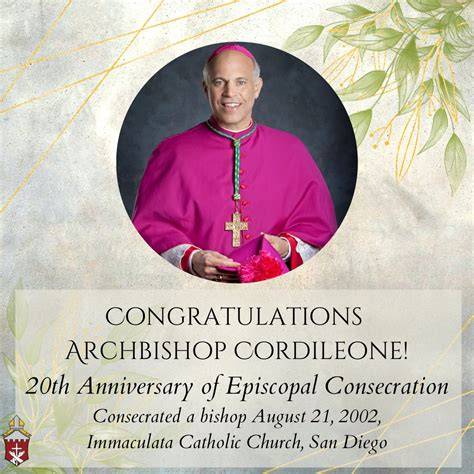
On July 5, 2002, Pope John Paul II appointed him the Auxiliary Bishop of the Diocese of San Diego, where he served until his appointment as Bishop of Oakland on March 23, 2009. On July 5, 2002 Pope John Paul II appointed then-Monsignor Cordileone as Auxiliary Bishop of the Diocese of San Diego.
He was ordained bishop on August 21, 2002 by Bishop Brom. He was ordained a bishop on August 21, 2002 by Bishop Brom.
In addition to serving on the various consultative bodies of the Diocese during his years as auxiliary of San Diego, Bishop Cordileone also chaired the Corporate Board of Catholic Charities and was a member of the University of San Diego Board of Trustees, serving on its Academic Affairs and Mission and Vision Committees.
On March 23, 2009, Pope Benedict XVI appointed Bishop Cordileone as the fourth Bishop of Oakland. His Mass of Installation was celebrated on May 5, 2009 at the Cathedral of Christ the Light, Oakland.
Archbishop of San Francisco
On July 27, 2012, Pope Benedict XVI appointed him as the ninth Archbishop of San Francisco. He was installed on October 4, 2012.
Three years later, on July 27, 2012, he was appointed the Archbishop of San Francisco and was installed on October 4, 2012, the Feast of St. Francis of Assisi, at the Cathedral of St. Mary of the Assumption.
As the new Metropolitan Archbishop of the Province of San Francisco, Archbishop Cordileone received the pallium from Pope Francis in Rome on June 29, 2013.
| Milestone | Date |
|---|---|
| Birth in San Diego | June 5, 1956 |
| Ordination to the priesthood | July 9, 1982 |
| Appointment as Auxiliary Bishop of San Diego | July 5, 2002 |
| Ordination as bishop | August 21, 2002 |
| Appointment as Bishop of Oakland | March 23, 2009 |
| Installation in Oakland | May 5, 2009 |
| Appointment as Archbishop of San Francisco | July 27, 2012 |
| Installation in San Francisco | October 4, 2012 |
| Reception of the pallium | June 29, 2013 |
Current ecclesial responsibilities
Archbishop Cordileone serves as Chairman of the United States Conference of Catholic Bishops (USCCB) Committee on Laity, Marriage, Family Life and Youth and is also a member of the Administrative Committee of the USCCB and a member of the USCCB Committee for Canonical Affairs and Church Governance.
Archbishop Cordileone is a member of the United States Conference of Catholic Bishops (USCCB) Committee on Laity, Marriage, Family Life and Youth and also of its Committee for Canonical Affairs and Church Governance. He currently serves as well on the USCCB Ad Hoc Committee Against Racism, Subcommittee on the Catechism, and Eucharistic Revival Bishops’ Advisory Group.
In addition, the Archbishop serves on a number of boards to support Church efforts beyond the USCCB, including the Catholic Benefits Association/Catholic Insurance Company, Cross Catholic Outreach Board of Directors, the Courage Apostolate Episcopal Board, the Governing Board of the International Theological Institute in Trumau, Austria, and is a founding member of the Episcopal Advisory Board of the Catholic Healthcare Leaders Association.
Archbishop Cordileone is a member of the Board of Trustees, Catholic University of America; the Governing Board of the International Theological Institute; and the Subcommission on the Liturgy for the Anglican Ordinariates.
In 2021, he was named prior of the U.S. delegation of the Sacred Military Constantinian Order of St. George. The Archbishop also serves as the Prior of the American Delegation of the Sacred Military Constantinian Order of Saint George.
Teachings on the liturgy
Archbishop Cordileone regards Catholic worship as a central expression of the Church’s faith and patrimony. He has emphasized the importance of preserving the Church’s liturgical heritage while ensuring that the celebration of Mass is marked by reverence, attention, and fidelity.
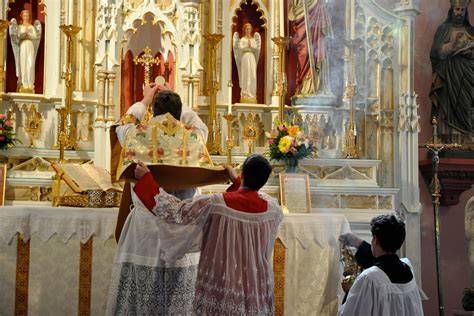
It is difficult to state anything about the extraordinary form of the Roman rite that Pope Benedict XVI has not already expressed. Yet I see in this form of worship a part of the Church’s patrimony developed since ancient times; a treasure that still speaks to many in our time.
Moreover, it is a value in and of itself, a value that needs preservation and cherishing, along with other forms of Catholic worship.
The need to “repair the Mass”
Reflecting on the importance of worship in your lecture before the Pontifical Mass in Saint Blaise, you mentioned the urgency to »repair the Mass.« What did you mean by that?
I am not familiar with the way Mass is celebrated in Croatian parishes, but I know that in the United States and other parts of the world in the years immediately following the Second Vatican Council there was a period of very severe and intentional liturgical abuses.
I have heard complaints from many devout Catholics about the way Mass is celebrated in our own time; perhaps they are not old enough to remember, or they have simply forgotten, how deplorable the situation was after the Second Vatican Council. The situation was far worse then than now, and those abuses are best described as horror stories.
Today it is more a matter of sloppiness, inattentiveness, and banality. But even when these are to blame, bad liturgy whittles down the faith, just as good liturgy builds it up, as stated in Sacrosanctum Concilium.
In that sense, a repair of the Mass is necessary: the Church needs to reclaim the sense that it is dealing with the sacred, so every detail has its importance. A different mindset will dismiss - sometimes even mock - the idea of attention to every little detail of the liturgy.
But one can see what happens when there is little oversight and all is subject to the whims of the celebrant. There is a natural tendency - especially for priests who are extroverted - to celebrate Mass without being confined to tightly scripted rubrics, all the more so when Mass is celebrated facing the people.
The sanctuary thus becomes a kind of stage, the faithful an audience, and the meaning of the Mass quickly vanishes. As Cardinal Sarah once said, it takes greater discipline to celebrate the Novus Ordo Mass than the Old Mass, precisely because the priest must keep this tendency in check.
Of course, one may become overly focused on the details; but details instill a deeper sense of reverence. Just as detail is the language of love in a friendship or marriage, the same is true for the liturgy.
Tradition, beauty, and young people
I am old enough to remember the years when the traditional Latin Mass was decried as no longer speaking to the times because it belongs to a past era, reflecting a period when Christian liturgy mirrored court ceremonies. This is a superficial, yet partially truthful, remark: liturgy does mirror a ceremony, but the court in question is not earthly, but heavenly.
At the time, there was another, less benign attitude towards the Old Mass: »The Church made a mistake. It distorted the liturgy after Constantine, with priests becoming somewhat of a higher caste and separating themselves from the laity.«
The Novus Ordo was supposed to return the liturgical clock to the time of the Church Fathers. In both cases, it was claimed that a new Mass was necessary. The problem is that what is new today becomes old tomorrow. And many people do not realize that tomorrow is now.
The current form of the Mass still feels new to me and everyone else of my generation and older, although I was just a child when things changed; but this change occurred sixty years ago.
Sixty years before the time I was a university student World War I was raging. To young people today, the Second Vatican Council seems as distant as World War I seems to people of my age, yet the traditional Mass does not seem old to them: they find that it takes them out of an earthly realm.
Certainly, youth have a natural attraction to the esoteric, the otherworldly - especially if it distinguishes them from their parents. Unlike people of my generation, the traditional way of worshipping seems to them precisely as such.
But there is more to it. When young people discover this ancient patrimony and its beauty, their minds and hearts open to the truth. It becomes a door leading to moral conversion.
Therefore, this natural tendency of the youth is an opportunity for the Church to evangelize them, providing them with solid catechesis and a worshipping community.
Perhaps surprisingly to some, it is precisely the teachings of the Church at and after Vatican II that can guide this process, because the Council Fathers envisioned the preservation of earlier traditions and the formation of the faithful in accordance with them.
It is impossible to go back to a make-believe golden era - whenever one thinks it occurred: in the 1950’s, the 1970’s, or the era of the early Church Fathers. But the Church can discern what it has lost and what it needs to reclaim.
Dialogue, obedience, and Church unity
Archbishop Cordileone has also addressed tensions involving the Catholic Church and the traditionalist Priestly Fraternity of St Pius X. He has stressed the importance of understanding opposing arguments and maintaining dialogue even amid serious disagreements.
A peculiar way of reclaiming tradition also seems to be at the heart of the ongoing tensions between the Catholic Church and the traditionalist Priestly Fraternity of St Pius X, which has announced it will consecrate new bishops without a papal mandate despite imminent schism.
It would certainly slow things down. I think each side needs to understand the other side better. The Church has always had the ability to achieve this.
The scholastic method - as applied by Saint Thomas of Aquinas in his Summa Theologiae - always presents the best possible arguments for the other side of a debate. This seems a necessary step now.
I am of the impression that there are differences of opinion within the Vatican itself, which thwarted Pope Benedict XVI’s efforts towards reconciliation. I think the Church needs to understand what the concerns of the SSPX are.
We dialogue with Christians who are further away from our doctrine than the Fraternity - we even have interfaith dialogue. Why should dialogue be a problem with the SSPX?
Even if there are differences in belief that are not doctrinal divides, only dialogue can bring that to light. Yet the crux of the issue is a doctrinal divide - a renouncement of the Second Vatican Council.
It is also difficult to see how one can truly adhere to tradition while denying obedience… I do not think there is a unity of opinion on all issues.
For instance, religious liberty as conveyed in Dignitatis Humanae is a doctrinal point of dissent. But we need clarity on that. Is there an interpretation of Dignitatis Humanae that accords with the basic view of the Fraternity?
Dialogue is necessary to point this out. The consecrations would be an act of disobedience, but the Church needs to understand where this disobedience comes from.
Marriage, family life, and the protection of children
Archbishop Cordileone has consistently connected marriage and family life with the well-being of children and society. He argues that the weakening of marriage has consequences that extend beyond individual couples and affect poverty, homelessness, incarceration, violence, and other social problems.
It is common sense, but it is also backed by social science data, which indicate that the greatest contributor to poverty is broken families - especially fatherlessness. And the greatest solution not just to poverty, but also to homelessness, incarceration, violence in our families and neighborhoods, and so many other social ills, is good fathers.
But this has become rarer in a culture that has forgotten that marriage is a fruitful, lifelong committed relationship. In my state of California, it all started in the 1960s with the advent of »no-fault divorce,« which allows any spouse to leave the marriage for any reason whatsoever.
This has caused tremendous damage not just to spouses, but also to children, who carry deep scars well into adulthood - despite what supposed experts were saying at the time about the resilience of children.
We have witnessed this many times within our Healing Wounds Ministry, dedicated to adult children of divorced parents.
Sometimes there is a need for a couple to separate - for instance, when violence is present. But no-fault divorce allows adults to pursue their own interests at the expense of their children.
Abortion and the culture of life
Archbishop Cordileone presents abortion within the same moral framework as other questions involving the relationship between adult interests and the protection of children. He argues that society must recover the principle that adults should sacrifice for the good of children rather than sacrifice children for adult interests.
Abortion is driven by the very same logic. For decades, children have been sacrificed for the interests of adults. It is time that adults return to sacrificing themselves for the good of children.
He has also emphasized prayer and fasting as essential responses to abortion and as means of cultivating respect for human life.
We need prayer and fasting to build a culture of life and to understand what is truly at stake in abortion - the killing of innocent human life
Western civilization and the Christian mission
Archbishop Cordileone has described the renewal of Western civilization in connection with the kingship of Christ, the preservation of Christian faith, and the formation of communities capable of serving the wider world.
Looking to Christ our King, let us renew Western civilization
The last time civilization collapsed, the Benedictine monasteries were the ones that preserved faith, learning, and even social care. We seem to be entering a similar era.
Rod Dreher’s idea of a similar Benedict Option as a solution for today has been criticized for separating the Christian community from the world outside. But that is not what it means at its best.
God set ancient Israel apart as a people »peculiarly His own«: He gave them the Law as a sign of this setting apart and promised to protect them if they obeyed Him. But they were also given the Law to serve as a light to the nations.
Christ follows the same logic: He calls His followers to come aside before sending them forth to make disciples of all nations.
I think this is already beginning to happen. Certain parishes are attracting people serious about their faith who are not being fed elsewhere.
Other types of communities - for instance, faithful Catholic colleges and seminaries - are building communities around them. It will take generations - possibly even centuries - for the fruits of this process to become visible; but eventually the world will recognize that this is the way toward human flourishing.
As Archbishop Fulton Sheen famously noticed, when Western civilization has destroyed all the pictures of what that civilization is supposed to look like, it will discover that the Church has kept the negatives.
The Mass: Essence and Foundation of Western Civilization - Abp Cordileone Lecture CISM
Sacred music and liturgical renewal
Archbishop Cordileone has sought to advance liturgical renewal not only through public discussion but also through concrete artistic and pastoral initiatives. Within the Archdiocese of San Francisco, the Benedict XVI Institute for Sacred Music and Divine Worship was created to reclaim the Church’s artistic patrimony and encourage reverence in the celebration of the Mass.
Although there has been a lot of talk in the Church about correcting liturgical abuses and instilling a greater sense of reverence in the celebration of the Mass - including by all popes from Paul VI onward - very little has been done on the practical, concrete level in this regard.
Within our Institute, we tried to reclaim the artistic patrimony of the Church by commissioning new compositions of sacred music with contemporary themes.
The first was the »Mass of the Americas,« composed as a twin tribute to Our Lady of Guadalupe, patroness of Mexico, and Our Lady of the Immaculate Conception, patroness of the United States.
Our composer-in-residence, Frank La Rocca, incorporated the sounds and melodies of popular folk hymns the Mexican people sing to honor Our Lady of Guadalupe, elevating them to the timeless beauty of classical polyphony.
The second was a Requiem Mass for people who died homeless, which used musical elements conveying the chaos, fear, and instability of life on the streets.
These and similar initiatives have restored the role of the Church as patroness of the arts, and they have begun to change the cultural mindset among active Catholics.
In the future, through our »Reverent Liturgy Project«, we intend to provide practical resources to priests, deacons, seminarians, and parish music directors that can enhance the reverence and dignity of the Mass with sacred music, along with other traditional practices.
Many pastors have already returned to ad orientem worship and easier reception of Communion while kneeling for people who wish to do so. But it is not a matter of forcing.
The authorities in the Church must apply what I call »bi-directional leadership« avoiding both imposing initiatives from above and leaving grassroots initiatives without any oversight.
That is the only way to preserve communion while at the same time fostering positive development.
Peace, war, and public responsibility
Archbishop Cordileone has maintained that the Church must speak for peace when war breaks out and should encourage diplomatic solutions. His approach places public engagement within the moral responsibilities of the Church rather than treating faith as separate from social and political questions.
The Church must always be a voice for peace whenever a war breaks out. We must urge peace and advocate for diplomatic solutions. Even in a just war, there are too many losers. We need to be very outspoken about this.
Personal interests
Archbishop Cordileone’s avocations include a life-long interest in jazz music. He also enjoys swimming, hiking and badminton, as well as spectator sports, especially professional baseball and football.
tags: #archbishop #salvatore #cordileone