Yes. JD Vance publicly said that he hopes his wife, Usha Vance, will one day become a Christian and come to believe in the Christian Gospel as he does. However, he also said that Usha is not a Christian, has no plans to convert, and is free to make her own decision.
Vance described his position as a personal hope rooted in his Christian faith rather than a demand or ultimatum. He said he would continue to love and support his wife regardless of whether she converts, while critics argued that publicly expressing a wish for her conversion was disrespectful toward her Hindu background.
What Did JD Vance Say About His Wife’s Conversion?
At a Turning Point USA event at the University of Mississippi, Vance was asked how he and Usha raise their three children in an interfaith marriage without placing his religion above hers. The question also addressed why some conservatives appeared to treat Christianity as a requirement for being regarded as a patriotic American.
Vance said that he and his wife had discussed their religious differences and had decided to raise their children as Christians. He explained that their two older children attend a Christian school and that their eight-year-old son had received his First Communion.
He then directly addressed whether he hoped Usha would eventually convert. “Do I hope eventually that she is somehow moved by the same thing that I was moved by in church? Yeah, I honestly do wish that, because I believe in the Christian Gospel, and I hope eventually my wife comes to see it the same way,” Vance said.
“But if she doesn’t,” Vance continued, “God says that everybody has free will, so that doesn’t cause a problem with me.” He added that religious questions are something people work out with their friends, their families, and the person they love.
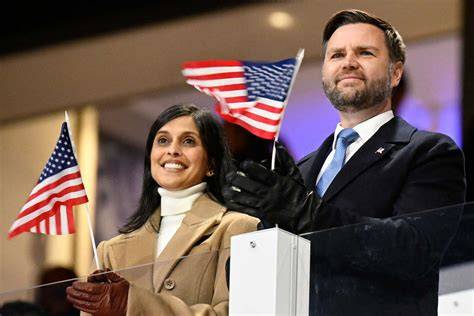
Did Vance Say That Usha Must Convert?
No. Vance did not say that Usha must convert to Christianity, and he did not claim that their marriage depended on her conversion. His comments distinguished between hoping that she will share his faith and forcing her to adopt it.
In a subsequent post on X, Vance wrote that Usha “is not a Christian and has no plans to convert,” but said that, like many people in an interfaith marriage, he hopes she may one day see things as he does.
“Regardless, I’ll continue to love and support her and talk to her about faith and life and everything else, because she’s my wife,” Vance wrote.
Vance also said that his Christian faith tells him that the Gospel is true and good for human beings. He argued that Christians naturally want to share their beliefs with other people, especially those closest to them.
How Did Vance Respond to the Criticism?
Vance responded to a social-media post accusing him of throwing his wife’s religion “under the bus” in public for acceptance from far-right extremists. He called that criticism “disgusting” and described it as an example of “anti-Christian bigotry.”
“Yes, Christians have beliefs,” he said. “And yes, those beliefs have many consequences, one of which is that we want to share them with other people. That is a completely normal thing, and anyone who’s telling you otherwise has an agenda.”
Vance said he had answered the question because he is a public figure and people were curious about his faith and family life. He also emphasized that Usha had encouraged him to reconnect with his own faith many years earlier.
“She herself encouraged me to re-engage with my faith many years ago,” Vance wrote. He described her as “the most amazing blessing” in his life and said that her support was important to his religious journey.
What Is Usha Vance’s Position?
Usha Vance has publicly said that she is not Catholic and does not intend to convert. In an interview with Meghan McCain, she said that the family has made church “a family experience,” but that the children know she is not Catholic.
“I’m not Catholic and I’m not intending to convert or anything like that,” Usha Vance said. She added that the children attend Catholic school but can choose whether they want to be baptized Catholic.
Usha also said that the children have access to Hindu traditions through books, family practices, and visits to India. She described her grandmother as a particularly devout Hindu who prays every day, visits the temple regularly, and performs puja prayer rituals.
Her comments indicate that Usha has accepted a family arrangement in which the children are raised with substantial exposure to Christianity while remaining connected to Hindu traditions through her side of the family.
How Are the Vances Raising Their Children?
Vance said that he and Usha decided to raise their children as Christians. Their two older children attend a Christian school, and the family participates in Catholic religious practices.
The couple’s eight-year-old son received his First Communion. Vance also said that Usha usually attends church with him on Sundays and that she is close to the priest who baptized him.
In another account of the family’s arrangement, Vance said that Usha sometimes goes with him to church and that their children participate in Christian education and Catholic sacraments. Usha has also said that the children are exposed to Hindu religious traditions through her family.
| Question | Answer |
|---|---|
| Does JD Vance want Usha to convert? | Yes, he has publicly said that he hopes she will one day become a Christian. |
| Has Usha Vance converted? | No, she has said that she is not Catholic and has no plans to convert. |
| Does Vance say she must convert? | No, he says that she has free will and that he will support her regardless. |
| How are the children being raised? | They are being raised as Christians and are also exposed to Hindu traditions. |
| Was their wedding interfaith? | Yes, they married in 2014 in a ceremony involving Hindu and Christian elements. |
When Did JD Vance Become a Catholic?
Vance was raised in a loosely evangelical or Protestant family and later identified as agnostic or atheist. He said that when he met Usha at Yale Law School, both of them would have considered themselves agnostic or atheist.
Vance converted to Catholicism in 2019, five years after the couple married. He was baptized into the Catholic Church as he became increasingly prominent in conservative politics.
At the time of his baptism, Vance said that his views on public policy and the ideal structure of society were closely aligned with Catholic social teaching. “I saw a real overlap between what I would like to see and what the Catholic church would like to see,” he said.
Vance has also said that Usha played an important role in his return to religious belief. In discussing his memoir, he said that he probably would not be a Christian if it were not for his wife, even though she is not herself a Christian.
How Did JD and Usha Vance Meet and Marry?
JD and Usha Vance met at Yale Law School, where they joined a discussion group focused on social decline in white America. They married in 2014, four years after meeting.
Their wedding was an interfaith Christian-Hindu ceremony in Kentucky. A Hindu pandit and a Christian officiant took part in the ceremony, reflecting the religious backgrounds of both families.
Usha Vance was raised in a Hindu immigrant family in Southern California. Vance has described her family as Hindu but not particularly religious, while critics have objected to descriptions that they believe minimize her Hindu identity.
Why Did the Comments Cause a Backlash?
Critics said that Vance’s remarks presented Hinduism as an incomplete or inadequate faith that needed to be replaced by Christianity. Some argued that publicly describing his wife’s religion as something he hoped would change reduced an important part of her identity to a problem awaiting correction.
The Hindu American Foundation criticized Vance’s comments and said they reflected the belief that there is only one true path to salvation and that this path runs through Christ. The organization also cited a history of Christian efforts to convert Hindus and concerns about increasing anti-Hindu rhetoric online.
Suhag Shukla, the executive director of the Hindu American Foundation, said that Vance appeared to be suggesting that this aspect of Usha’s identity was “just not enough.” She also said that the remarks added to uncertainty and fear within the Hindu American community.
Ajay Jain Bhutoria, an Indian American and former adviser to Joe Biden, wrote that Vance was publicly casting Usha’s Hindu faith as a problem to be fixed and as a soul to be moved to Christianity.
Other critics described Vance’s comments as “Hindu-phobic” and accused him of hypocrisy because of his stated support for religious freedom. Former Indian Foreign Secretary Kanwal Sibal asked where the discussion of religious freedom had gone and said that charity should begin at home.
Why Did Some People Defend Vance?
Vance’s supporters argued that Christians are generally expected to regard the Christian Gospel as true and to want the people they love to share that belief. From this perspective, Vance’s statement was an expression of his religious convictions rather than an announcement of pressure or coercion.
Vance himself said that wanting to share one’s beliefs with others is a normal consequence of being a committed Christian. He also repeatedly emphasized that Usha has free will and that he would not force her to convert.
Some observers noted that interfaith couples often negotiate religious differences by choosing one tradition for the children while allowing both traditions to remain present in family life. The Vances’ arrangement follows that pattern: the children are raised as Christians while also receiving exposure to Hindu customs and family practices.
What Does the Catholic Church Say About Interfaith Marriage?
The Catholic Church requires Catholics in interfaith marriages to commit to raising their children Catholic. This is a commitment Catholics must make in order to receive permission to marry outside the faith.
John Grabowski, a theology professor who helps prepare interfaith couples for marriage, said that if faith is the most important thing in a person’s life, wanting to share it with a spouse can be a natural expression of love.
At the same time, Grabowski said that the Catholic Church insists that a spouse should not be coerced or pressured into the faith. He described this as a delicate line.
Grabowski believed that Vance handled the sensitive question fairly well by acknowledging the challenges of his interfaith marriage, although he did not explain in detail how the couple manages their religious differences.
What Do Experts Say About Hoping for a Spouse’s Conversion?
Experts who counsel interfaith couples generally say that respect, honesty, and clear discussions about family life are essential. Susan Katz Miller, author of Being Both: Embracing Two Religions in One Interfaith Family, said that respecting a partner and every part of the partner’s identity is integral to the honesty needed in a marriage.
Miller also warned that secret agendas are unlikely to lead to a successful marriage. She said that pressuring a spouse to convert, or even hoping that the spouse will convert, is not a good basis for a successful marriage.
Interfaith couples can choose one religion, both religions, a new religion, or no religion. The important issue is that the couple reaches an arrangement through open discussion rather than allowing an institution or an outside authority to dictate the relationship.
Dilip Amin, founder of an online forum for interfaith couples, said that conversion can damage a relationship when it happens because of constant pressure or proselytizing. He said that conversion is different when it results from an authentic change of heart.
Ani Zonneveld, founder and president of Muslims for Progressive Values, said that tension can arise when one spouse becomes significantly more religious after the marriage, particularly after the couple has children. She described it as unfair when one partner changes the religious expectations of the family without adequately considering the other partner.
The Rev. J. Dana Trent, who is married to a man initiated into Hinduism, said that the goal of an interfaith marriage is not to convert each other but to support and deepen each other’s religious traditions and spiritual paths.
Surprising Data on Interfaith Marriages
How Common Are Interfaith Marriages?
A Pew Research Center survey conducted in 2015 found that 39% of Americans who had married since 2010 had a spouse from a different religious group. By comparison, only 19% of people who married before 1960 reported being in an interfaith marriage.
The growing number of interfaith couples means that questions about religious conversion, children’s religious education, worship, holidays, and extended-family traditions are increasingly common in American family life.
Interfaith couples have several possible arrangements. They may raise children in one religion, expose them to both religions, choose no formal religious identity, or allow children to make their own decisions later.
What Role Does Free Will Play in Vance’s Explanation?
Vance repeatedly invoked free will as the reason he said Usha’s lack of conversion did not create a problem for him. He said that God gives people free will and that he would not force anyone to believe anything.
At the same event, Vance said that one of the most important Christian principles is respecting free will. He said that families must work through religious questions themselves, trust that God has a plan, and try to follow it as best they can.
Vance also said that he makes no apologies for believing Christianity is the pathway to God or for thinking that Christian values are an important foundation of the United States. At the same time, he said that he would not force anyone to believe because he does not think that is what God wants.
Why Did the Public Setting Matter?
Vance’s comments were made in a packed university arena in front of a politically conservative audience. The event was sponsored by Turning Point USA and held to honor the organization’s late founder, Charlie Kirk.
The statement received enthusiastic applause from many Christian conservatives in attendance. However, the public setting also made the comments more consequential because Vance was speaking about his wife’s religious identity before thousands of people while serving as vice president.
Critics argued that a private hope for a spouse’s conversion becomes more complicated when it is presented publicly by a powerful political figure. Supporters responded that Vance was answering a direct question about his family, faith, and approach to raising his children.
What Is the Most Accurate Answer?
JD Vance did ask, in the sense of publicly expressing a hope, that his wife would one day convert to Christianity. He said that he wants Usha to see the Christian Gospel as he does and to be moved by the same religious experience that led him to the Catholic Church.
He did not say that Usha is required to convert, and he acknowledged that she has no plans to do so. He also said that he would continue to love and support her regardless of her decision.
The dispute is therefore not about whether Vance expressed a desire for Usha’s conversion; he clearly did. The disagreement concerns whether expressing that desire publicly is a normal and sincere part of Christian belief or whether it diminishes Usha’s Hindu identity and places inappropriate pressure on her.