Goliath is described in 1 Samuel 17 as a Philistine warrior from Gath who challenges the Israelites to single combat. The biblical account presents him as an exceptionally large and heavily armed champion, but the surviving textual traditions disagree about his exact height.
The Masoretic Text gives his height as six cubits and a span, approximately 9 feet 9 inches or 2.97 meters, while the Septuagint and Dead Sea Scrolls preserve a shorter reading of four cubits and a span. Depending on which textual tradition is followed, Goliath was either an extraordinary giant by ancient standards or a very tall man standing approximately 6 feet 6 inches to 6 feet 9 inches.
Who Was Goliath?
Goliath appears in the Hebrew Bible, specifically in 1 Samuel 17, where he is described as a Philistine warrior from Gath who challenges the Israelites to single combat. According to the text, he is an enormous man, standing at a height of “six cubits and a span” (roughly 9 feet, 9 inches, or 2.97 meters). He wears an imposing suit of armor, including a bronze helmet, a coat of mail, and greaves on his legs.
His primary weapon is a massive spear with a shaft like a weaver’s beam, along with a sword and a shield-bearer accompanying him. For forty days, Goliath taunts the Israelites, demanding a champion to face him in single combat. The Israelites, including their king, Saul, are terrified of him.
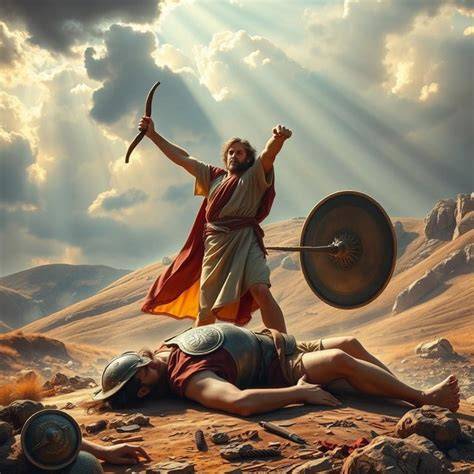
Then, David, a young shepherd boy, volunteers to fight. Armed with only a sling and five smooth stones, David faces Goliath, striking him in the forehead with a single stone. Goliath falls, and David beheads him, securing victory for the Israelites.
The story is often interpreted as a metaphor for faith, courage, and divine intervention. Goliath has come to symbolize overwhelming odds, brute force, and arrogance, while his defeat by David represents the triumph of faith and intellect over brute strength.
Goliath’s Biblical Description
His Size
The most famous feature of Goliath’s description is his exceptional height. The Masoretic text describes Goliath as being six cubits and a span (9’ 9”) tall. The Septuagint is a Greek copy of the original Hebrew text that was translated in the second or third century BC.
In most points, the Septuagint agrees with the Masoretic text, but there are some differences. One of these is the height of Goliath. According to the Septuagint, Goliath was four cubits and a span (6’ 6”) tall.
The Dead Sea Scrolls agree with the Septuagint regarding Goliath’s height. Thus, the weight of textual evidence seems to point to Goliath being four cubits and a span tall.
| Textual tradition | Reported height | Approximate modern equivalent |
|---|---|---|
| Masoretic Text | six cubits and a span | 9 feet, 9 inches or 2.97 meters |
| Septuagint | four cubits and a span | 6 feet, 6 inches |
| Dead Sea Scrolls | four cubits and a span | four cubits and a span |
His Armor
Goliath wears an imposing suit of armor, including a bronze helmet, a coat of mail, and greaves on his legs. His weapons and armor, detailed in 1 Samuel 17, align with Philistine military practices influenced by Aegean cultures.
Bronze armor and large spears were common among warriors of that era. His primary weapon is a massive spear with a shaft like a weaver’s beam, along with a sword and a shield-bearer accompanying him.
His Role as a Champion
Goliath is described as a “champion” (Hebrew: Ish ha-benayim), meaning he was likely a warrior who fought single combat on behalf of his people. Single combat was a known practice in ancient warfare, often used to determine the outcome of battles with minimal bloodshed.
For forty days, Goliath taunts the Israelites, demanding a champion to face him in single combat. The Israelites, including their king, Saul, are terrified of him. Only David ventured to respond and, armed with a sling and pebbles, overcame Goliath.
His reliance on melee combat was ultimately his downfall against David’s long-range slingshot technique. David did not attempt to match Goliath’s armor, spear, or physical strength; instead, he used a weapon that allowed him to attack from a distance.
What Does “Giant” Mean in the Biblical Context?
In order to determine if Goliath was a giant, we must first define the word giant. According to the Merriam-Webster dictionary, the word giant can refer to either “a legendary humanlike being of great stature and strength” or a “living being of great size.”
The word giant does not appear in the Hebrew Old Testament. But that is not surprising, because giant is not a Hebrew word! The English word giant comes from the Greek word gigantas.
In ancient Greek poems, giants were half god and half earth. They were powerful, fearsome mythical creatures. Some were exceptionally tall, others were not.
Goliath does not fit the first definition because he was a real historical person, not a “legendary humanlike being.” However, Goliath does fit the second definition of “a living being of great size.”
Nephilim, Rephaim, and Anakim
The biblical language surrounding unusually large or powerful people includes several different terms. In the third and second centuries BC, the Hebrew Old Testament was translated into Greek. This Greek text is known as the Septuagint.
There are two different Hebrew words that were translated as gigantas in the Septuagint. These are Nephalim and Rephaim. Many English Bibles translate both these words as giant.
Using one English word to describe two different Hebrew terms can be confusing. There is one Hebrew term that is also of interest in a study of giants, and that is Anakim.
The Nephilim
According to Genesis 6:4, there were Nephalim on the earth before the Flood. This passage seems to indicate that the Nephalim were the mixed offspring of the sons of God and the daughters of men, although there is some ambiguity in the text.
Some biblical scholars believe that the sons of God refer to the descendants of Seth who married into the family line of Cain. Other biblical scholars believe that the sons of God were fallen angels who mated with human women.
The meaning of the Hebrew word Nephilim is uncertain, but it seems to have a connotation of falling, perhaps meaning, “the fallen ones.” During Noah’s Flood, the Nephilim were presumably wiped out.
However, there is one post-Flood reference to the Nephilim. In Numbers 13:33, ten spies reported back to Moses that they had seen the Nephilim. According to Numbers 13:22 and Numbers 13:28, the spies saw the Anakim, and in Numbers 13:33, they equated the Anakim with the descendants of the Nephilim.
So, it seems that the spies saw Anakim, and reported seeing Nephilim. Based on the biblical description of the Nephilim, it is unlikely that they were particularly tall. Genesis 6:4 simply describes them as being mighty men and men of renown.
The Rephaim
The Rephaim appear in both biblical texts and other texts from the Ancient Near East. Extrabiblical texts describe the Rephaim as heroes of old who had died and gone to the underworld.
Biblically, the Rephaim were originally a people group living in the trans-Jordan region (Genesis 14:5; 15:20; Deuteronomy 2:20). By the time of the Conquest, there were very few Rephaim left alive.
Og, king of Bashan, was one of the few remaining Rephaim (Deuteronomy 3:11; Joshua 12:4; 13:12). Yet, some descendants of the Rephaim survived all the way until the time of David, when David’s mighty men killed four descendants of the Rephaim: Ishbi-Benob, Saph, Lahmi, and an unnamed man with six fingers on each hand and six toes on each foot (2 Samuel 21:16-22; 1 Chronicles 20:4-8).
Lahmi is described as the brother of Goliath, which suggests that Goliath was also a descendant of the Rephaim. The biblical text indicates that Rephaim were unusually tall.
Moses reported in Deuteronomy 3:11 that King Og had an iron bed that was 9 cubits (approx. 13 feet) long. However, it is unclear whether that means that Og was unnaturally tall, or if it simply means that he was wealthy enough to have an extravagant bed.
The extravagance of his bed is apparent in the fact that it was made of iron. Iron had just been invented and was a rare metal at that time in history. So, its large size might be another indicator of its extravagance, or it might relate to Og’s height.
Scripture contains other hints, though, of the size and nature of the Rephaim. The Rephaim that David’s mighty men killed carried unusually large weapons (2 Samuel 21:16, 19; 1 Chronicles 20:5).
One of them was a man of great stature who had extra fingers and toes (1 Chronicles 20:6). Additionally, there is a connection between the Rephaim and the Anakim, who were also tall people (Deuteronomy 2:11).
The Anakim
Although Bible translators did not translate the word Anakim as giant, the Anakim are also of interest in a study of biblical giants. Numbers 13:33 describes the Anakim as being descendants of the Nephilim, but it is unclear whether they truly were descended from the Nephilim or whether this was a falsehood reported by the spies.
Anak appears to have been a person who lived around the time of the Conquest. Anak’s father’s or perhaps ancestor’s name was Arba, and Anak had at least three sons or perhaps descendants named Sheshai, Ahiman, and Talmai.
Joshua and Caleb, with God’s help, drove the Anakim out of the central hill country, leaving them only in Philistine cities (Joshua 11:21-22; 15:14; Judges 1:20). Multiple Bible passages describe the Anakim as being tall people (Deuteronomy 2:10, 21; 9:2).
However, their exact height is unknown. Egyptian texts may also reference the Anakim. An Egyptian execration text, now in the Berlin Museum, references a people group known as the ly Anaq, very likely the Anakim.
Another text, the Papyrus Anastasi I, dates to around 1300 BC. It describes the Egyptian army encountering nomadic people in Canaan who were very large: four to five cubits (6’ 8” to 8’ 6”) tall.
An Egyptian stone carving from the time of Ramses II shows captured slaves who are larger than their captors. This is unusual, since Egyptian art typically portrays captives as smaller than Egyptians, indicating the superiority of the Egyptians over their enemies.
Thus, it seems likely that the Egyptians encountered very tall people, likely the Anakim, in Canaan, corroborating the biblical assertion that the Anakim were unusually tall people.
Was Goliath a Rephaim or an Anakim?
Biblical texts do not directly associate Goliath with any of the three groups discussed above. However, they do provide an indirect link with the Rephaim, since Goliath’s brother, Lahmi, was a descendant of the Rephaim (1 Chronicles 20:5-8).
Thus, Goliath was likely descended from the Rephaim. Goliath may have also been one of the Anakim, since according to Deuteronomy 2:11, the Anakim were counted as Rephaim.
Also, Joshua 11:22 notes the presence of Anakim in Gath, which is Goliath’s hometown. However, this connection is tentative at best since Goliath may have belonged to a different group of Rephaim from the Anakim.
The presence of Anakim in Gath centuries before the time of Goliath may be coincidental.
Goliath’s Height: Textual and Archaeological Evidence
The Four-Cubit Reading
The Masoretic Text is the Hebrew version of the Old Testament that was carefully copied by scribes. The oldest known copy of the Masoretic Text dates to the 10th century AD, but it reflects a much older text.
The Masoretic Text describes Goliath as being six cubits and a span (9’ 9”) tall. Typically, scholars consider the Masoretic Text to be more reliable than the Septuagint.
However, in this case, there is another text to consider. The Dead Sea Scrolls are Jewish manuscripts including biblical books. They date to the second century BC through the first century AD.
The vast majority of the Dead Sea Scrolls were written in Hebrew. The Dead Sea Scrolls agree with the Septuagint regarding Goliath’s height. Thus, the weight of textual evidence seems to point to Goliath being four cubits and a span tall.
Ancient Measurement Systems
Early versions of the Bible describe Goliath as an ancient Philistine warrior whose height in ancient terms reached four cubits and a span. Archaeological findings at biblical-era sites including Goliath’s home city, a prominent Philistine settlement called Gath, indicate that those ancient measurements work out to 2.38 meters, or 7 feet, 10 inches.
That’s equal to the width of walls forming a gateway into Gath that were unearthed in 2019, according to archaeologist Jeffrey Chadwick of Brigham Young University in Provo, Utah.
Archaeologists have long known that in ancient Egypt a cubit corresponded to 52.5 centimeters and assumed that the same measure was used at Gath and elsewhere in and around ancient Israel.
But careful evaluations of many excavated structures over the last several years have revealed that standard measures differed slightly between the two regions. Buildings at Gath and several dozen other cities from ancient Israel and nearby kingdoms of Judah and Philistia were constructed based on three primary measurements.
| Ancient measurement | Length |
|---|---|
| cubit used at Gath and nearby sites | 54-centimeter cubit |
| short cubit | 38-centimeter short cubit |
| span | 22-centimeter span |
Those include a 54-centimeter cubit (versus the 52.5-centimeter Egyptian cubit), a 38-centimeter short cubit and a 22-centimeter span that corresponds to the distance across an adult’s outstretched hand.
Dimensions of masonry at these sites display various combinations of the three measurements. At a settlement called et-Tell in northern Israel, for instance, two pillars at the front of the city gate are each 2.7 meters wide, or five 54-centimeter cubits.
Each of four inner pillars at the city gate measure 2.38 meters wide, or four 54-centimeter cubits and a 22-centimeter span. Excavators of et-Tell regard it as the site of a biblical city called Bethsaida.
Chadwick’s 2019 excavations found one of presumably several gateways that allowed access to Gath through the city’s defensive walls. Like the inner pillars of et-Tell’s city gate, Gath’s gate walls measured 2.38 meters wide, or four cubits and a span, the same as Goliath’s biblical stature.
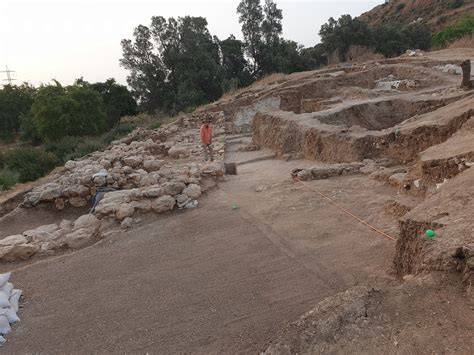
“The ancient writer used a real architectural metric from that time to describe Goliath’s height, likely to indicate that he was as big and strong as his city’s walls,” Chadwick said.
The width of his home city’s walls were possibly used to metaphorically represent the champion’s height. Rather than standing taller than any NBA player ever, Goliath was probably described metaphorically by an Old Testament writer as a warrior who matched the size and strength of Gath’s defensive barrier.
Although the research raises the possibility that Goliath’s recorded size referred to the width of a city wall, Chadwick “will need to do more research to move this beyond an intriguing idea,” says archaeologist and Old Testament scholar Gary Arbino of Gateway Seminary in Mill Valley, Calif.
For one thing, Arbino suggests, it needs to be established that the measure applied to Goliath, four cubits and a span, was commonly used at the time as a phrase that figuratively meant “big and strong.”
Gath and the Philistines
The Philistines were a well-documented ancient people, originating from the Aegean region before settling in the land of Canaan around the 12th century BCE.
Archaeological findings confirm their presence in cities like Gath, Ashkelon, Ashdod, Ekron, and Gaza. Gath reached its peak during the Iron Age around 3,000 years ago, the time of biblical references to Goliath.
People known as Canaanites first occupied Gath in the early Bronze Age, roughly 4,700 to 4,500 years ago. The city was rebuilt more than a millennium later by the Philistines, known from the Old Testament as enemies of the Israelites.
The remains of Gath are found at a site called Tell es-Safi in Israel. A team led by archaeologist Aren Maeir of Bar-Ilan University in Ramat-Gan, Israel, has investigated Tell es-Safi since 1996.
Other discoveries at Gath include a pottery fragment inscribed with two names possibly related to the name Goliath. Evidence of Gath’s destruction about 2,850 years ago by an invading army has also been recovered.
The Tel es-Safi Inscription
One of the most compelling pieces of evidence regarding Goliath’s possible existence is the Tel es-Safi inscription, discovered in the ancient Philistine city of Gath.
The inscription, dated to the 10th or 9th century BCE, features names similar to “Goliath,” suggesting that such a name was in use among the Philistines at the time.
While it does not confirm the existence of the biblical Goliath, it lends some credibility to the story’s historical basis.
The shard found this week dates to 950 B.C., making it the oldest Philistine inscription yet found. That's roughly 70 years after Goliath was reportedly killed by the Hebrew shepherd boy with a sling.
“This is evidence that non-Semitic names that are remarkably similar to Goliath were used within the time frame of this Philistine warrior in his reputed hometown of Gath,” says Lawrence Mykytiuk.
“It provides well-grounded cultural background that supports the biblical narrative.”
Mykytiuk says the find indicates an accurate cultural knowledge by the author of the biblical book of 1 Samuel. This knowledge runs counter to some scholarly criticism that holds the David vs. Goliath story is merely a legend written down many centuries later.
The inscription probably does not refer to the biblical Goliath but does lend credence to the story surrounding him. It supports the narrative not with a direct identification of Goliath, but in its historical and linguistic background.
Was Goliath a Historical Person?
The historical accuracy of Goliath’s existence has been debated by scholars for centuries. Scholars continue to debate whether David and Goliath were real people who met in battle around that time.
The Philistines were a well-documented ancient people, and Gath was a prominent Philistine settlement. The existence of the Philistines, the antiquity of Gath, the use of names similar to Goliath, and the presence of unusually tall people in Canaan provide historical context for the biblical account.
None of these discoveries confirms that the specific warrior described in 1 Samuel 17 existed. The Tel es-Safi inscription does not identify the biblical Goliath, and the archaeological evidence does not establish that David and Goliath personally met in combat.
At the same time, the evidence does not require the story to be understood as a culturally impossible invention. A Philistine warrior bearing a similar name, associated with Gath and remembered for exceptional size, remains historically possible.
An Internal Biblical Difficulty: Goliath and Elhanan
In another passage it is said that Goliath of Gath was slain by a certain Elhanan of Bethlehem in one of David’s later conflicts with the Philistines (II Samuel 21:18-22).
This may be a transcriptural error as the parallel account in I Chronicles 20:5 avoids the contradiction by reading “Elhanan . slew Lahmi the brother of Goliath.”
The passage has therefore contributed to discussions about how the biblical traditions concerning Goliath were transmitted and edited. The parallel account identifies Lahmi as the person killed by Elhanan, while preserving Goliath as a separate figure.
How Tall Was Goliath Compared with Other People?
Considering that the average height of a full-grown man in the Ancient Near East was around 5’ 6”, Goliath would have been abnormally tall even at 6’ 6”.
This matches well with the Papyrus Anastasi I, in which the Egyptians encountered people in Canaan ranging in height from four to five cubits tall.
If Goliath was closer to 6’9″, he would still have been significantly taller than the average man of the time, who stood around 5’5″.
Under the Masoretic reading, Goliath would have been an extraordinary figure whose reported height approached 9 feet 9 inches. Under the Septuagint and Dead Sea Scrolls reading, he would have stood approximately 6 feet 6 inches to 7 feet 10 inches depending on the measurement system used.
Goliath might not have been as large as we might have imagined when, as children, we went “round and round and round and round and round and round and round,” and finally came tumbling down. Yet, he was a giant of a man.
Goliath’s Defeat and Military Meaning
Goliath’s challenge reflects the ancient practice of single combat, in which a champion represented an entire army or people. The Israelites’ fear is presented as a response not only to his physical size but also to his armor, weapons, experience, and status as a professional warrior.
David, a young shepherd boy, trusts in God and takes down a giant Philistine warrior using nothing but his sling and one of five smooth stones. The unlikely hero of the story, a mere shepherd boy, faces a warrior equipped for close combat.
Goliath’s defeat does not result from a stronger sword, heavier armor, or a larger army. David strikes him in the forehead with a single stone, Goliath falls, and David beheads him, securing victory for the Israelites.
The account presents the sling as an effective long-range weapon rather than a harmless toy. David’s method contrasts with Goliath’s expectations and turns the warrior’s confidence in close combat into a disadvantage.
Religious and Literary Symbolism
The story of David and Goliath is one of the most well-known and enduring tales in history, symbolizing the triumph of the underdog against overwhelming odds.
The story is one that easily impresses itself on young minds. It is the triumph of good over evil and weakness over strength. It showcases God’s ability to triumph over anyone, no matter how big.
The Philistines trusted in their champion, Goliath, while David, representing the Israelites, trusted in God. The moral of the story is that God is greater than any human champion, no matter how tall.
Goliath has come to symbolize overwhelming odds, brute force, and arrogance. His defeat by David represents the triumph of faith and intellect over brute strength.
The story resonates across cultures as a universal metaphor for underdog victories. Whether he was a real warrior, a mythological exaggeration, or a symbol of Philistine might, his legend endures as a powerful story of courage and resilience.
Goliath in Popular Culture
The legend of Goliath has inspired countless references in literature, movies, and sports metaphors. Shakespeare refers to Goliath in Henry VI, Part 1.
Malcolm Gladwell’s book David and Goliath explores how disadvantages can become advantages. Films like Rocky and Braveheart draw on the underdog theme of David vs. Goliath.
Sports often use “David vs. Goliath” to describe a smaller, weaker team defeating a powerful opponent. The biblical image has therefore become a widely recognized expression for an unexpected victory against a stronger rival.
The Story of David and Goliath Isn't What You Think
tags: #biblically #accurate #goliath