Books about Isaiah help readers understand one of the Old Testament’s most complex prophetic books, whose message moves from judgment on Jerusalem, Israel, and the nations to hope, restoration, the coming Messiah, and new creation. The most useful choice depends on whether the reader wants a broad overview, a detailed commentary, a literary and theological study, a Christian interpretation, or material for preaching and teaching.
Isaiah addresses the problem of sin, showing the need for salvation. Isaiah is called by God to speak to the people of Judah and call attention to their wrongdoings-and the resulting judgment. But judgment is not the end of the story; the book also prophesies salvation and restoration.
What the Book of Isaiah Is About
Isaiah lived in Jerusalem during the latter half of Israel’s kingdom period and spoke to the leaders of Jerusalem and Judah on God’s behalf. Isaiah brought with him a warning about God’s judgment, telling Israel’s corrupt leaders that their rebellion against the covenant with God would come at a cost.
Isaiah also said that God would use the great empires of Assyria and later Babylon to judge Jerusalem if they persisted in idolatry and oppression of the poor. However, that dire announcement was also combined with a message of hope, as Isaiah believed deeply that God would one day fulfill all his covenant promises.
He trusted that God would send a king from David’s line to establish his Kingdom on Earth (2 Sam. 7; Ps. 2; Ps. 72) and lead Israel in obedience to the laws of the covenant made at Mount Sinai (Exod. 19). This was how God’s blessing and salvation would flow outward to all nations, just as God promised to Abraham (Gen. 12).
It’s this messianic hope that compelled Isaiah to speak out against the corruption and idolatry of Israel and its leaders. The book’s central movement can be summarized as judgment followed by purification, restoration, salvation, and the establishment of God’s universal kingdom.
How Isaiah Is Organized
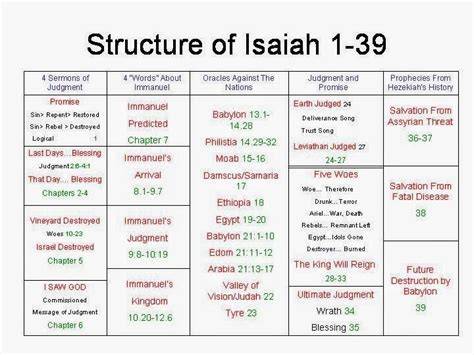
The book has a complex literary design, but there is one simple way to see how it all fits together. Chapters 1-39 contain three large sections that develop Isaiah’s warning of judgment on Israel, culminating in an event pointed to at the end of chapter 39, the fall of Jerusalem and the exile of its people to Babylon.
But chapters 1-39 also present a message of hope, that after the exile, God’s covenant promises would be fulfilled. Chapters 40-66 pick up that promise and develop it further.
| Passage | Main emphasis |
|---|---|
| Isaiah 1-12 | Judgment and hope for Jerusalem |
| Isaiah 13-27 | Judgment and hope for the nations |
| Isaiah 28-39 | The fall of Jerusalem predicted |
| Isaiah 40-48 | Hope after exile |
| Isaiah 49-55 | The suffering servant king |
| Isaiah 56-66 | The hope of new creation |
Books for a Broad Overview of Isaiah
Readers beginning a study of Isaiah should look for books that explain the prophecy’s historical setting, literary structure, major themes, and theological development before turning to highly technical commentaries. An overview makes it easier to follow the relationship between Jerusalem’s judgment, the Babylonian exile, the servant, the Messiah, and the new creation.
Old Testament Overviews: Isaiah 1-39
The first 12 chapters of the book of Isaiah focus on the prophet’s vision of judgment and hope for Jerusalem. It all begins as Isaiah accuses the city’s leaders of covenant rebellion, idolatry, and injustice, especially towards the poor.
God will judge the city by sending other nations to conquer Israel. Isaiah says this will be like a purifying fire that burns away all that is worthless among his people. But this fire doesn’t only destroy. It will also create a new Jerusalem populated by a remnant of Israel that has repented and turned back to God.
Isaiah goes on to say that, through these events, God’s Kingdom will come and all nations will gather at the temple in Jerusalem to learn of God’s justice. This will bring about an age of universal peace and harmony.
Now, this basic storyline of the old Jerusalem changing over to the new will get repeated over and over throughout the book, and it will get filled in with increasing detail.
Isaiah 1-12: Judgment and Hope for Jerusalem
At the center of this section, in chapter 6, is Isaiah’s grand vision of God sitting on his throne in the temple. He’s surrounded by heavenly creatures, all shouting that God is “holy, holy, holy.” Isaiah suddenly realizes just how corrupt he and his people are, and he’s certain that he’ll be destroyed by God’s holiness.
Instead, God’s holiness, in the form of a burning coal, comes and burns Isaiah, not to destroy him but to purify him of his sin. As Isaiah ponders this strange experience, God commissions him with a difficult task.
Isaiah is to continue announcing the coming judgment, but since Israel has already reached a point of no return, his warnings will have the paradoxical effect of hardening their hearts. However, Isaiah is to trust in God’s plan-Israel will undergo its own purification like Isaiah.
It will be chopped down like a tree with its stump scorched and burned. But God says that this smoldering stump is a “holy seed” that will survive on into the future. It’s a small sign of hope, but who or what is the holy seed? The rest of this section offers up an answer.
Isaiah 7-12: Immanuel and the Messianic King
Isaiah confronts Ahaz, a descendant of David and king of Jerusalem, and announces his downfall. God says that the great empire of Assyria will chop Israel down and devastate the land, but there’s hope!
Because of God’s promise to David, he will send a new king named Immanuel, or “God with us” (ch. 7). Immanuel’s kingdom will free God’s people from violent, oppressive empires.
Then Isaiah goes on to describe this coming king as a small shoot of new growth emerging from the old stump of David’s family, the holy seed. This king will be empowered by God’s Spirit to rule over a new Jerusalem and bring forth justice for the poor.
All nations will look to this messianic king for guidance, and his kingdom will transform all creation, bringing peace.
Isaiah 13-27: Judgment and Hope for the Nations
This brings us to the next sections of the book of Isaiah, first opening with a large collection of poems in chapters 13-27 that explore God’s judgment and hope for the nations.
It is in these poems that we learn about the coming fall of Babylon and other nations around Israel. Isaiah could see that Assyria’s world power would one day be replaced by the empire of Babylon, a nation that was even more destructive and arrogant.
Babylon’s kings would claim that they were higher than all other gods, and so God vows to bring Babylon down. Isaiah continues down a list of Israel’s neighbors-Philistia in chapter 14, Moab in 15-16, Damascus in 17, Egypt and Cush in 18-20, and Tyre in 23-accusing them all of the same kind of pride and injustice and predicting their ultimate ruin.
Remember, however, that for Isaiah, divine judgment isn’t the final word for either Israel or these other nations.
Isaiah 28-39: The Fall of Jerusalem Predicted
Chapters 28-39 return the focus to the rise and fall of Jerusalem. We first read poems where Isaiah rebukes Jerusalem’s leaders for turning to Egypt for military protection against Assyria.
He knows that their plan will backfire, and he tells the leaders that only trust in their God and repentance can save Israel now. This is illustrated well in the following story of the rise of King Hezekiah in chapters 36-38.
Just as Isaiah had predicted, the Assyrian armies attack the city. Hezekiah humbles himself before God and prays for divine deliverance, and the city is miraculously saved overnight.
Hezekiah’s initial rise and success, however, is immediately followed by his fall. He attempts to make another political alliance for protection and hosts a delegation from Babylon.
Hezekiah tries to impress the Babylonians by showing off everything in Jerusalem’s treasury and palaces. Isaiah hears about this and confronts Hezekiah’s foolishness, predicting that this “ally” will one day betray him and return as an enemy to conquer Jerusalem.
As we know from 2 Kings 24-25, Isaiah was right. Over 100 years later, Babylon turned on Jerusalem, destroyed the city and its temple, and carried away the Israelites into exile in Babylon.
All of Isaiah’s warnings of divine judgment led up to this very moment, and Isaiah was shown to be a true prophet. It all came to pass, just like he said it would.
Remember, though, that the purpose of God’s judgment was to purify Jerusalem and bring forth the holy seed and the messianic Kingdom over all the nations. It’s this hope that gets explored in the book’s second half.
Books on Isaiah 40-66
Isaiah 40-48: Hope After Exile
Isaiah chapter 40 opens up the book’s second half, which explores the future fulfillment of God’s covenant promises after the exile. The first main section, chapters 40-48, opens with an announcement of hope and comfort for Israel.
The people are told that the Babylonian exile is over. Israel’s sin has been dealt with, and a new era is beginning. They should return home, where God himself will bring his Kingdom to Jerusalem and allow all nations to see his glory.
Unfortunately, that’s not what happens. Israel, instead of bearing witness to all nations, starts complaining and accusing God. “The Lord doesn’t pay attention to our trouble, he ignores our cause” (Isa. 40:27).
The Babylonian exile has caused Israel to lose faith in their God. They start to think that maybe he’s not all that powerful; maybe the gods of Babylon are greater.
Chapters 41-47 are set up like a trial scene as God responds to these doubts and accusations with the following arguments. First of all, the exile into Babylon was not divine neglect but a divinely orchestrated judgment for Israel’s sin.
Secondly, it was for the sake of Israel’s return home that God raised up Persia to conquer Babylon and fulfill Isaiah’s prophetic word (Isa. 13:17). The right conclusion that Israel should draw is that their God is the King of history, not their idols.
In the fall of Babylon and the rise of the Persian king Cyrus, Israel should see God’s hand at work and become his servant who will bear witness to the other nations.
Questions of Authorship and Composition
Now, a question most readers ask at this point is, “Who’s saying all this? Whose voice are we hearing with these words of hope?”
The perspective of the author of these chapters is someone living after the exile during the time period described in the book of Ezra-Nehemiah. But Isaiah died over 150 years before any of that. What exactly are we to make of this?
Many think that these chapters were composed by Isaiah himself, but that he had been prophetically transported nearly 200 years into the future to speak to later generations as if the exile had already passed.
However, the book of Isaiah itself offers us clues that something else is probably going on. In chapters 8, 29, and 30, we are told that after Isaiah was rejected by Israel’s leaders, he wrote and sealed in a scroll his message of judgment and hope, passing it on to his “disciples” (Isa. 8:16) “as a witness for days to come” (Isa. 30:8).
Isaiah eventually died, waiting for God to vindicate his words. Chapters 1-39 were designed to show us that Isaiah’s predictions of judgment were fulfilled in the Babylonian exile, proving him to be a true prophet.
So after the exile was over, Isaiah’s disciples, who had long treasured his words, opened up the scroll and began developing his message about the future hope of God’s salvation.
According to this view, the book of Isaiah consists of both the original collection of Isaiah’s words, as well as the writings of his later disciples who God used to extend Isaiah’s message of hope to future generations.
Whichever view you take, everyone agrees that these chapters announce that the day of future hope has come and God is fulfilling his prophetic promises.
Isaiah 49-55: The Suffering Servant King
In chapters 49-55, we are introduced to a new figure called God’s “servant,” who will fulfill God’s mission and do what Israel has failed to do.
God gives this servant the title “Israel,” and sends him on a dual mission to restore the people of Israel back to their God and become God’s “light to the nations.”
We’re told that this servant is empowered by God’s Spirit (Isa. 42:1; Isa. 48:16) to announce the good news and bring God’s Kingdom over all nations, just like Isaiah’s messianic king in chapters 9 and 11.
We continue to learn how this servant will bring about God’s Kingdom by being rejected, beaten, and ultimately killed by his own people (Isa. 49:7; Isa. 50:4-9, and 53).
In reality, he’s going to be accused and sentenced to death on behalf of the sins of his people-his death will be a sacrifice of atonement for the people’s evil and rebellion.
The servant does die, but then suddenly he comes back to life (Isa. 53:10-12). We’re told that by his sacrificial death, he provided a way to make people “righteous,” that is, to put them back into a right relationship with God.
The section concludes by describing two different ways that people will respond to God’s servant. Some will respond with humility, turn from their sins, and accept what the servant did on their behalf.
These people are also called “servants” or “the seed,” calling back to the “holy seed” from chapter 6. These people are the ones who will experience the blessing of the messianic Kingdom (ch. 55).
Others, however, will reject both the servant and his servants and are simply called “the wicked.”
Isaiah 56-66: The Hope of New Creation
We come now to the final section of this book with chapters 56-66, in which the servants, who follow the servant, inherit God’s Kingdom.
These chapters are artistically designed as a symmetry that brings together all the themes in the book. At the center are three beautiful poems that describe how the Spirit-empowered servant announces the good news of God’s Kingdom to the poor by reaffirming all the promises of hope from earlier in the book.
The new Jerusalem, inhabited by God’s servants, will be the place from which God’s justice and mercy flow out into the world.
Surrounding these poems are two long prayers of repentance (chs. 59 and 63-64). The servants confess Israel’s sin and grieve over all the evil that they see in the world around them, asking for God’s Kingdom to come here on Earth as it is in Heaven.
Christian Books About Isaiah
Reading Isaiah with Luther
Reading Isaiah with Luther explains Luther's view of the conscience and applies it to your life. Read Isaiah alongside Martin Luther and discover how God’s Word comforts the conscience and directs sinners to Christ.
Isaiah’s prophecy unfolds amid fear, false worship, political uncertainty, and spiritual confusion. Yet throughout the book, God continues to speak His promises.
Through Isaiah’s warnings and consolation, readers encounter the Holy One who judges sin, preserves His people, and brings salvation through the coming Messiah.
In Reading Isaiah with Luther, Brian L. Kachelmeier guides readers through key passages of Isaiah while drawing on Luther’s lectures and commentaries.
Scripture, selected insights from Luther, and pastoral reflection work together to illuminate Isaiah’s proclamation of Christ and its enduring comfort for the Church.
Along the way, readers will explore themes that stand at the heart of Luther’s theology: the distinction between Law and Gospel, the formation of the conscience by God’s external Word, the danger of false assurances, the comfort of Christ’s forgiveness, and the certainty of God’s promises amid suffering and temptation.
- Examine Isaiah’s major themes alongside Luther’s interpretation
- See how Scripture shapes and governs the Christian conscience
- Explore Isaiah’s promises concerning Immanuel, the Suffering Servant, and the new creation
- Reflect on Baptism, forgiveness, vocation, and life under God’s grace
- Gain pastoral insight into spiritual warfare, doubt, and the Christian life
Pairing Isaiah’s prophetic proclamation with Luther’s pastoral wisdom, Reading Isaiah with Luther helps readers see how God addresses troubled consciences through His living Word.
Whether used for personal study, group discussion, or theological reflection, this volume invites readers to hear Isaiah’s promises anew and to find confidence in the Christ who still speaks comfort to His people: “Fear not.”
Isaiah: An Introduction and Commentary
Isaiah: An Introduction and Commentary appears among resources designed to explain the prophecy’s historical, literary, and theological dimensions. It is included in the Tyndale Old Testament Commentary and in a broader collection of resources for studying and teaching Isaiah.
The Book of Isaiah and God’s Kingdom
The Book of Isaiah and God’s Kingdom: A Thematic-Theological Approach is presented as a study of Isaiah’s central theological themes, especially the relationship between judgment, restoration, God’s kingdom, the servant, and the hope extended to all nations.
Reading Isaiah: A Literary and Theological Commentary
Reading Isaiah: A Literary and Theological Commentary belongs to a group of resources that treat the book as a unified literary and theological work rather than merely a collection of isolated predictions.
Major Commentaries on Isaiah
J. Alec Motyer’s Commentary
Drawing on a lifetime of study and teaching the book, J. Alec Motyer presents a landmark, single-volume commentary on the prophecy of Isaiah.
He emphasizes the grammatical, historical, structural, literary, and theological dimensions of the text, and pays particular attention to three central and re.
The book of Isaiah is perhaps the most compelling of all Old Testament prophecy. No other prophet rivals Isaiah's brilliance of style, powerful imagery and clear vision of the messianic hope.
Unlike many commentators who divide Isaiah between chapters 1 - 39 and 40 - 66, J. Alec Motyer instead identifies three messianic portraits: the King (1 - 37), the Servant (38 - 55), and the Anointed Conqueror (56 - 66).
These three portraits are expounded in Motyer's lucid, insightful and probing commentary.
Barry Webb’s Study of Isaiah
Ever since Jesus read from the scroll of Isaiah in the synagogue of Nazareth, Christians have gravitated to this great prophecy as the interpretive center of the Old Testament.
Here the story of Israel, scourged by judgment and exile yet hopeful of restoration, is framed by its witnesses, heaven and earth.
How will Israel be brought through its school of suffering and be propelled toward its divine destiny as the vanguard of a new heaven and earth?
In the visionary world of Isaiah, the varied themes and imagery of the Old Testament converge and blend to transcend their plainest meanings as they project an extraordinary climax of the story of Israel and of the world.
Barry Webb calls Isaiah the “Romans” of the Old Testament, where all the threads come together and the big picture of God’s purposes for His people and for His world are most clearly set forth.
Commentaries and the Christian Reading of Isaiah
The book of Isaiah's imagery sparkles as it inspires. It draws us in to meditate and extends our vision toward the future.
But what should we make of this sprawling and puzzling book-so layered and complex in its composition-as a whole?
The book of Isaiah has nourished the church throughout the centuries. However, its massive size can be intimidating; its historical setting can seem distant, opaque, varied; its organization and composition can seem disjointed and fragmented; its abundance of terse, poetic language can make its message seem veiled-and where are those explicit prophecies about Christ?
These are typical experiences for many who try to read, let alone teach or preach, through Isaiah.
Books on Isaiah’s Servant and Isaiah 52-53
The servant in Isaiah 52 and 53 is one of the most intriguing figures in the prophetic Scriptures. The questions are many, the interpretations are diverse, and the answers always seem to be different.
Some have looked to this text in search of Jesus, others to reclaim Israel’s role in the world, and some to find a historical explanation for this prophetic text that seems to have no precedence.
Brevard Childs and the History of Interpretation
A key emphasis of Brevard Childs’ distinguished career has been to show not only that the canon of Scripture comprises both Old and New Testaments but also that the concept of “canon” includes the way the Christian church continues to wrestle in every age with the meaning of its sacred texts.
In this new volume Childs uses the book of Isaiah as a case study of the church’ s endeavor throughout history to understand its Scriptures.
In each chapter Childs focuses on a different Christian age, using the work of key figures to illustrate the church’s changing views of Isaiah.
After looking at the Septuagint translation, Childs examines commentaries and tractates from the patristic, Reformation, and modern periods.
His review shows that despite an enormous diversity in time, culture, nationality, and audience, these works nevertheless display a “family resemblance” in their theological understandings of this central Old Testament text.
Childs also reveals how the church struggled to a.
Books on Isaiah’s Structure, Rhetoric, and Composition
This monograph explores the structure and rhetoric of the book of Isaiah. Its thesis is twofold.
First, the book of Isaiah best manifests its structural unity, thematic coherence, and rhetorical emphasis when read as an exemplar of prophetic covenant disputation.
A study of Isaiah’s structure is especially useful for readers who find the book disjointed or fragmented. It helps connect its courtroom imagery, prophetic warnings, poetic sections, historical narratives, servant passages, and visions of restoration.
Study Resources for Teaching Isaiah
Isaiah Expository Preaching Resources
Planning for an expositional sermon series on a book of the Bible typically involves hours of reading and studying the Bible and other resources before fleshing everything out.
Often, preachers amass a small library for each book of the Bible they preach on.
The Isaiah Expository Preaching Kit (S) does this for you. It curates the best Bible study materials (commentaries, Bible dictionaries, and expositional books) on the book of Isaiah along with the Bible study tools you need to streamline your sermon prep and presentation-all at an affordable price.
The Isaiah Expository Preaching Kit (S) includes Carta's New Century Handbook and Atlas of the Bible; Introduction and Biographic Information; Expository Sermon Preparation Workflow; and more.
The Isaiah Expository Preaching Kit (M) does this for you. It curates the best Bible study materials (commentaries, Bible dictionaries, and expositional books) on the book of Isaiah along with the Bible study tools you need to streamline your sermon prep and presentation-all at an affordable price.
The Isaiah Expository Preaching Kit (M) includes everything in Isaiah Expository Preaching Kit (S), plus other resources like Isaiah: An Introduction and Commentary (TOTC); Isaiah Old and New: Exegesis, Intertextuality, and Hermeneutics; Reading Isaiah: A Literary and Theological Commentary (Reading the Old Testament | RtOT); Isaiah (Holman Old Testament Commentary | HOTC); and more.
The Isaiah Expository Preaching Kit (L) includes everything in Isaiah Expository Preaching Kit (S) and Isaiah Expository Preaching Kit (M), plus other resources like Isaiah: An Introduction and Commentary (Tyndale Old Testament Commentary | TOTC); The Book of Isaiah and God’s Kingdom: A Thematic-Theological Approach (New Studies in Biblical Theology); Commentary on Isaiah (Ancient Christian Texts Collection); and more.
Courses and Exegetical Study
This course explores the main themes presented in the book of the prophet Isaiah. Israel’s unfaithfulness to her faithful God in the areas of worship, idolatry, and covenant obedience is central in Isaiah, and this theme is explored reflectively for self-examination of our own obedience in these areas.
Another key theme is the supremacy of God not only over Israel, but also over every other nation of the world and any other presumed god; Israel’s God, Yahweh, is presented by Isaiah as being greater than anything else anyone can conceive of.
The course also explores God’s redemptive program and his ability to carry it out in light of his supremacy and undoubtable power. This redemptive program includes God’s description of the character of, and future hope for, his people.
The prophets of the Old Testament conveyed the words of God to ancient Israel, promised the advent of Jesus the Messiah, and are still relevant to our modern setting.
Paul Ferris educates viewers on the office of prophet, provides detailed character studies of prophets like Isaiah and Jeremiah, and outlines his methodology for teaching powerful lessons drawn from their lives and teaching.
This course allows modern students and teachers of the Bible to identify themes in the ministries of Old Testament prophets and to relate them to their church, their classroom, and in a devotional sense.
Embark on a journey of OT Hebrew exegesis with Jason DeRouchie. The books of the OT were the only Scriptures Jesus had.
It was books like Genesis and Deuteronomy, Isaiah and Psalms that shaped Jesus’ upbringing and that guided His life in ministry as the Jewish Messiah.
It was these Scriptures that Jesus identified as God’s Word and that He considered to be authoritative; it was these Scriptures that He believed called people to know and believe in God and guarded them against doctrinal error and hell.
This course will give you the tools you need to access meaning in the OT and then apply it to your life. It will help you to grow in reading God’s living Word for depth and not just distance.
A Thematic Reading Plan for Isaiah
A chapter-by-chapter reading plan can help readers connect the book’s major movements with its central theological themes.
| Reading | Theme |
|---|---|
| Isaiah 1 | No More Rotten Religion! |
| Isaiah 2 | Longing Living For That Day |
| Isaiah 5 | A Song of Injustice |
| Isaiah 6 | Responding to God's Call |
| Isaiah 8:19--9:7 | To Us a Child Is Born |
| Isaiah 11--12 | A Hope to Live By |
| Isaiah 24 | Our Spoiled World |
| Isaiah 25 | Free at Last! |
| Isaiah 30:1-18 | Why Can Trust You? |
| Isaiah 36--37 | The Source of Confidence |
| Isaiah 38--39 | How Quick We Are to Forget |
| Isaiah 40 | A Hope That Never Tires |
| Isaiah 42 | “Here Is My Servant” |
| Isaiah 43:1--44:5 | You Are Precious |
| Isaiah 45 | Turning to God |
| Isaiah 49:1-18 | Strong Foundations for Service |
| Isaiah 52:13--53:12 | The Burning Heart of Scripture |
| Isaiah 54--55 | Shout for Joy |
| Isaiah 61 | Jeans of Joy Shirts of Praise |
| Isaiah 62 | The Exhilaration of God's Love |
| Isaiah 63:7--64:12 | A Cry for Forgiveness Revival |
| Isaiah 65:17--66:24 | The Terror the Glory |
Visually Designed Books of Isaiah
The Book of Isaiah: A poetic, prophetic book on finding hope in God amidst failure, injustice, and suffering.
In many ways, the thematic focus of Isaiah can be categorized twofold. First, there is a theme of judgment-used to describe the wrongdoings and injustice of the people of Israel against God.
And second, there is a theme of hope and salvation-God's promises that in the midst of Israel's rebellion, he would still fulfill his covenant promises through a new king, named “Immanuel.”
The complete text of each Bible book, with visual imagery and thoughtful design. NLT translation.
Reading the Bible can feel intimidating. In common Bibles, the text is small and condensed, the pages are thin.
Alabaster Bibles combines imagery, design, and craftsmanship into the full text of each book of the Bible-to create a visually beautiful reading experience.
Original artwork from around the world, typography, layout design and negative space are thoughtfully weaved into each book of the Bible.