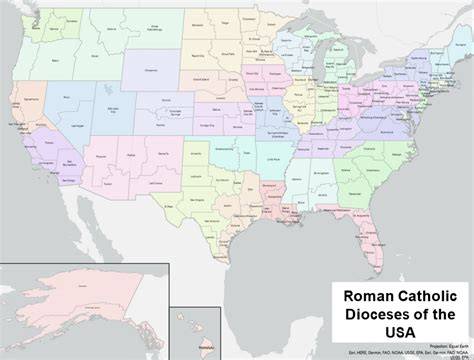
The Catholic Diocese of Oakland is a Roman Catholic diocese in California covering Alameda and Contra Costa counties in the United States of America. It was erected on 13 January 1962 and is part of the ecclesiastical province of the Archdiocese of San Francisco.
The diocese is led by Bishop Michael Charles Barber, S.J., follows the Latin, or Roman, Rite, and serves a Catholic population estimated at 582,600 people within a total population of 2,931,900, according to the 2023 statistics.
General information
| Category | Information |
|---|---|
| Type of jurisdiction | Diocese |
| Date erected | 13 January 1962 |
| Metropolitan | Archdiocese of San Francisco |
| Depends on | Dicastery for Bishops |
| Rite | Latin (or Roman) |
| State | California |
| Country | United States of America |
| Territory | Alameda and Contra Costa counties |
| Area | 3,798 square kilometers (1,466 square miles) |
| Conference region | XI (CA, HI) |
| Catholic Directory abbreviation | OAK |
| Headquarters | Oakland, California |
| Type of organization | Nonprofit |
| Founded | 1962 |
| Specialties | Catholic Mass, Social Services, Religious Vocation, and Education |
The headquarters is located at 2121 Harrison Street, Suite 100, Oakland, California 94612, United States. The diocese also has locations at 433 Jefferson Street, Oakland, California 94607, and throughout the diocese.
Geographic territory and Catholic population
The Diocese of Oakland serves Alameda and Contra Costa counties in the East Bay region of California. Within its 1,467 square miles, the current estimated population of Alameda and Contra Costa counties is over 2.7 million people with a Catholic population projected 590,000.
At the time of its creation in 1962, there were an estimated 329,000 Catholics among the East Bay’s population of 1.3 million people. The diocese therefore began its history in a rapidly growing urban and suburban region with a substantial Catholic community.
Leadership
Current bishop
Michael Charles Barber, S.J., has served as Bishop of Oakland since his appointment on 3 May 2013. The diocese is under the leadership of Bishop Michael C. Barber, SJ.
Past and present ordinaries
- Floyd Lawrence Begin † - appointed 27 January 1962; died 26 April 1977.
- John Stephen Cummins † - appointed 3 May 1977; retired 1 October 2003.
- Allen Henry Vigneron - succeeded on 1 October 2003; appointed Archbishop of Detroit, Michigan, on 5 January 2009.
- Salvatore Joseph Cordileone - appointed 23 March 2009; appointed Archbishop of San Francisco, California, on 27 July 2012.
- Michael Charles Barber, S.J. - appointed 3 May 2013 and serving as bishop.
Other affiliated people
- Michael Charles Barber, S.J. - Bishop from 3 May 2013.
- Salvatore Joseph Cordileone - Bishop from 23 March 2009 to 27 July 2012.
- Steven Joseph Lopes.
- Clarence Richard Silva - deacon from 17 May 1974; priest from 2 May 1975 to 17 May 2005.
- Allen Henry Vigneron - coadjutor bishop from 10 January 2003; bishop from 1 October 2003 to 5 January 2009.
Parishes, clergy, religious life, and education
As of 2015, serving the needs of the faithful, are 349 priests, 114 deacons and 481 religious brothers and sisters in 84 parishes, 16 pastoral centers and other diocesan offices.
Including religious education programs, there are nearly 50,000 students under Catholic instruction in the Diocese at 46 elementary schools, nine high schools, two Catholic colleges and several schools of religious formation.
The diocese’s parish and educational network includes Catholic Mass, religious education, religious vocation programs, Catholic schools, pastoral centers, and schools of religious formation. The number of parishes and the available clergy have changed over time, reflecting broader changes in participation and diocesan organization.
Social services and community ministry
The Catholic Church throughout the diocese offers a range of service ministries assisting the elderly, the young, the poor, and the oppressed. As such the Church is the largest provider of social services in the East Bay, delivering shelter, meals, counseling, education and other critical services free of charge to over 500,000 people of all faiths each year.
These ministries extend beyond regular parish life and include assistance for people of different ages, economic circumstances, and religious backgrounds. The diocese describes its work as serving people in the East Bay and beyond.
Statistical development
The available statistics show changes in the Catholic population, total population, clergy, religious communities, deacons, and parishes between 1962 and 2023. The figures also show that the relationship between the Catholic population and the number of priests has varied considerably over time.
| Year | Catholics | Total population | Percent Catholic | Diocesan priests | Religious priests | Total priests | Catholics per priest | Permanent deacons | Male religious | Female religious | Parishes |
|---|---|---|---|---|---|---|---|---|---|---|---|
| 1962 | 329,040 | 1,314,700 | 25.0% | 148 | 137 | 285 | 1,154 | 170 | 736 | 87 | |
| 1970 | 342,000 | 1,710,000 | 20.0% | 181 | 12 | 193 | 1,772 | 82 | |||
| 1976 | 345,965 | 1,724,829 | 20.1% | 155 | 200 | 355 | 974 | 532 | 662 | 84 | |
| 1980 | 390,099 | 1,718,500 | 22.7% | 164 | 229 | 393 | 992 | 30 | 577 | 607 | 87 |
| 1990 | 423,037 | 1,909,875 | 22.1% | 155 | 169 | 324 | 1,305 | 58 | 390 | 458 | 90 |
| 1999 | 496,122 | 2,255,100 | 22.0% | 167 | 100 | 267 | 1,858 | 76 | 20 | 320 | 89 |
| 2000 | 510,175 | 2,318,522 | 22.0% | 187 | 98 | 285 | 1,790 | 78 | 247 | 258 | 89 |
| 2001 | 429,477 | 2,348,723 | 18.3% | 199 | 90 | 289 | 1,486 | 90 | 232 | 325 | 89 |
| 2002 | 429,477 | 2,348,723 | 18.3% | 203 | 110 | 313 | 1,372 | 99 | 218 | 340 | 87 |
| 2003 | 432,890 | 2,433,952 | 17.8% | 187 | 99 | 286 | 1,513 | 92 | 229 | 354 | 87 |
| 2004 | 527,566 | 2,453,766 | 21.5% | 211 | 146 | 357 | 1,477 | 109 | 309 | 399 | 87 |
| 2006 | 529,841 | 2,464,379 | 21.5% | 177 | 100 | 277 | 1,912 | 102 | 295 | 460 | 86 |
| 2011 | 555,000 | 2,589,322 | 21.4% | 187 | 187 | 374 | 1,483 | 108 | 944 | 84 | |
| 2013 | 563,000 | 2,625,000 | 21.4% | 180 | 175 | 355 | 1,585 | 101 | 523 | 342 | 83 |
| 2016 | 575,029 | 2,895,761 | 19.9% | 183 | 181 | 364 | 1,579 | 110 | 372 | 332 | 82 |
| 2019 | 575,500 | 2,896,939 | 19.9% | 173 | 180 | 353 | 1,630 | 103 | 365 | 372 | 82 |
| 2021 | 581,390 | 2,926,535 | 19.9% | 194 | 184 | 378 | 1,538 | 122 | 384 | 285 | 82 |
| 2023 | 582,600 | 2,931,900 | 19.9% | 184 | 174 | 358 | 1,627 | 99 | 312 | 366 | 85 |
The statistics indicate that the reported Catholic population increased from 329,040 in 1962 to 582,600 in 2023, while the total population increased from 1,314,700 to 2,931,900. The reported percentage of Catholics was 25.0% in 1962 and 19.9% in 2023.
The number of total priests was 285 in 1962, reached 393 in 1980, stood at 374 in 2011, and was 358 in 2023. The number of parishes was 87 in 1962, reached 90 in 1990 and 89 in 2000, and was 85 in 2023.
Any changes in boundaries over time are not indicated in the above table.
Mission Alignment Process
The Mission Alignment Process, or MAP, began in 2021 to address a growing gap between the mission of the Church and the operational realities of the parishes.
The challenges of declining participation in parish life, sacramentally, financially and ministerially, are not unique to the Diocese of Oakland. Dioceses throughout the United States are impacted with similar challenges.
The Diocese put together a “Mission Alignment Process”, which looked at data to identify which parishes were struggling the most.
Parish closures and reorganization
The Oakland Diocese of the Catholic Church will close 13 churches - 7 in Oakland - due to declining participation and an ongoing financial crisis linked to sexual abuse cases dating between 1960 and 1990, some of which resulted in lawsuits and multi-million dollar jury verdicts.
The closures follow years of financial struggles for the Oakland Diocese. In 2023, the diocese filed for bankruptcy, and last week it was ordered to pay $16 million in a clergy abuse case.
Diocesan leaders said those developments did not factor into the decision to close churches. The diocese attributes this decision to a lack of priests, low Catholic school enrollment and a decline in Mass attendance.
In a letter dated April 28, released to its parishioners and the media, Oakland Bishop Michael C. Barber wrote that attendance at masses across the diocese’s region - Alameda and Contra Costa counties - has fallen since the early 2010s, meaning less participation in the sacraments and lower Catholic school enrollment.
“We are also at an all-time low of priests assigned to our 80 parishes, and the average age of our priests continues to climb,” he wrote.
In a statement, the Oakland bishop wrote in part, “We are currently seeking bankruptcy court approval of our proposed plan of reorganization. Regardless of that outcome we must face the realities described above and proceed with these closures.”
Parishes and sites listed for closure
- Mary Help of Christians, Oakland.
- Our Lady of Lourdes, Oakland.
- Sacred Heart, Oakland.
- St. Andrew Kim Korean Pastoral Center, Oakland.
- St. Augustine, Oakland.
- St. Paschal Baylon, Oakland.
- St. Patrick, Oakland.
- Our Lady of Guadalupe Site at Blacow Road, Fremont.
- St. Albert the Great, Alameda.
- St. Barnabas, Alameda.
- St. Rose of Lima, Crockett.
- St. Stephen, Walnut Creek.
- Transfiguration, Castro Valley.
Seven of the churches are in Oakland, with six others outside the city, including Transfiguration Church in Castro Valley and Saint Stephen Church in Walnut Creek.
Effects on parishioners and neighborhoods
The announcement stunned parishioners, neighbors and employees at affected churches, including Saint Barnabas in Alameda.
“It was a friend who texted me at first, so I thought, no, it’s not closing, but then she sent me the letter from the Bishop,” said Agatha Leong, a lifelong member of Saint Barnabas.
Leong said the church has been a second home to her. She has attended Mass there since birth, received every sacrament and had all five of her children baptized at the parish.
“It’s really hard for me to take it, I’m in a shock,” she said.
She did say though the signs were there. After COVID-19 she said she saw attendance decline, and it hasn’t been the same.
“It’s been slowly creeping up, but only in the hundreds, like about 100 something for mass. So I don’t think that was sustainable to keep it open,” Leong said.
The potential loss is also affecting residents who do not attend services. Alameda resident Marilyn Alwan said she values the church’s presence in the neighborhood.
“I wish it would stay. I like the idea of having having the building that fit the space. And there’s a lot of open space behind it. And they’ve been good neighbors as far as I’m concerned,” Alwan said.
Parishes whose status remained part of an open process
Not everyone believes the decision is final. Father Leo Edgerly of Our Lady of Lourdes said his parish remains active, even though it appears on a list of parishes that may close.
“We don’t know exactly what the change is going to be. I know our name is on the list of parishes that may close, but the process is still open,” Edgerly said.
He added, “our responsibility, which is to be church here. And the way we do that is by showing up and not giving up.”
Property decisions and accommodation for parishioners
Decisions about what comes next for the church properties will be left to individual pastors, according to the diocese. Diocesan officials declined to answer our specific questions Wednesday.
The diocese said displaced parishioners will be welcomed at nearby churches. Barber said in the letter that he will “provide welcoming accommodation of all affected parishioners at another convenient location.”
The diocese has a Frequently Asked Questions section addressing how the sale of the churches, and subsequent release of funds will be addressed.
The FAQ says that the sale of the properties will be “unique to each site,” that there’s no exact timeline yet, and “Bishop Barber will work in collaboration with the “receiving” pastor(s) on the disposition of the sale of church property.”
Bankruptcy and abuse litigation
The Diocese has faced hundreds of lawsuits in recent years, filed by the survivors of clergy sexual abuse.
In 2023, Bishop Barber announced a bankruptcy plan that involved paying $165 million to survivors while looking at potentially closing churches with declining attendance. The plan also included a survivors’ fund worth up to $198 million.
A survivor’s group called the plan a “sham of an offer.” In his letter issued on Tuesday, Barber explained that the diocese is still currently seeking approval of its bankruptcy plan from a federal judge.
“Regardless of that outcome, we must face the realities described above and proceed with these closures.”
Religious and cultural events
The Cathedral of Christ the Light in Oakland will host an evening of sacred choral music presented by the Bartolucci Foundation, featuring Sacred Voices, with singers from the Roman and Vatican.
Faithful from the Diocese of Oakland are invited to a day of deep spiritual reflection in celebration of the 800th anniversary of the transitus, or passing into eternal life, of Saint Francis of Assisi.
Sources and official designation
The diocesan record identifies the jurisdiction as a diocese under the Archdiocese of San Francisco and the Dicastery for Bishops. The cited ecclesiastical source is Acta Apostolicæ Sedis, Volume 54, pages 839 to 841.