In biblical interpretation, the question of whether Yahweh has horns must be distinguished from the question of why Moses is sometimes depicted with horns. Exodus 34:29-35 describes Moses’s face after his encounter with God on Mount Sinai. The Hebrew verb qaran can be associated with “horns,” but the immediate context, ancient translations, and most modern English translations understand the passage to mean that Moses’s face radiated light.
The Bible does contain passages in which “horn” is connected symbolically with divine strength and power, and some scholars have argued that Israel’s God was represented in ancient Near Eastern tradition with horns. However, the claim that the biblical text straightforwardly teaches that Yahweh is a literal horned being is not the dominant interpretation of the relevant passages. In Exodus 34, the strongest contextual reading is that Moses’s face shone with reflected divine glory.
Why Is Moses Sometimes Depicted with Horns?
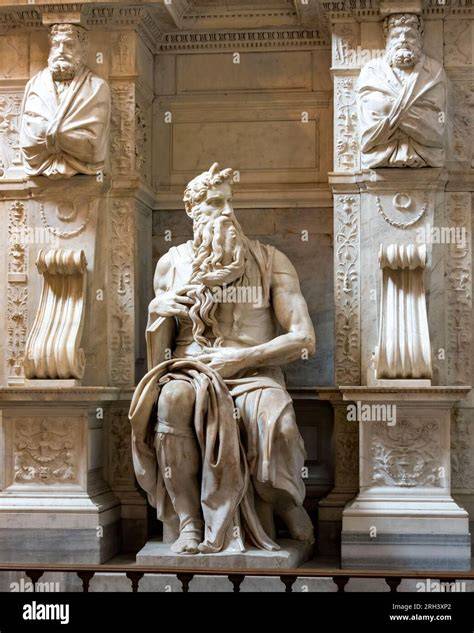
Various artistic depictions portray Moses as having two protruding horns on his head. Among the numerous statues, paintings, drawings and woodcuts are Michelangelo’s famous marble statue and the relief of Moses in the United States Capitol.
This artwork stems from an interpretation of a very curious passage of scripture in Exodus 34. This passage describes Moses ascending Mount Sinai to receive instructions from God. Upon his descent, it was recognized that his visage had changed, following his close contact with the divine.
Verses 29-35 are often interpreted as meaning that Moses’s face radiated light; the Hebrew verb used, however, can literally mean to become horned. The answer to this question has proved more historically consequential than you might think.
The Hebrew Text of Exodus 34
Your NRSV translation has used a different word in the English, but the Hebrew at the end of verse 29 reads: קרַ֛ן עֹור פָּנָיו בְּדַבְּרוֹ אִתֹּו (“Karan yor panav b’dabor”) which literally means “[Moses’] face had grown horns in conversation” with God.
The following are the pertinent snippets from Exodus 34 in Hebrew with the English translations:
- Verse 29: וּמֹשֶׁה לֹא־יָדַע כִּי קָרַן עוֹר פָּנָיו “and Moses knew not that qaran [was the] skin of his face.”
- Verse 30: וְהִנֵּה קָרַן עוֹר פָּנָיו “and behold, qaran [was the] skin of his face.”
- Verse 35: כִּי קָרַן עוֹר פְּנֵי מֹשֶׁה “for qaran [was the] skin of Moses’s face.”
As Professor Rendsburg pointed out, the associated noun, qeren, can refer to both horns and rays (although in most cases referring to the former). Of the related verb form, qaran-a form only found in this precise manner in these three verses-the Gesenius’ Hebrew-Chaldee Lexicon renders it as meaning “to radiate, to emit beams, to shine (used of the face of Moses).”
The Hebrew text does clearly refer to something projecting from Moses’s face. But the question remains: Was Moses adorned with literal horns or rays of light?
How Different Bible Translations Render the Passage
This passage of scripture is handled differently by various translations.
The King James Version
The King James Version renders it:
And it came to pass … when he came down from the mount, that Moses wist not that the skin of his face shone …. And when Aaron and all the children of Israel saw Moses, behold, the skin of his face shone; and they were afraid to come nigh him. … And the children of Israel saw the face of Moses, that the skin of Moses’ face shone: and Moses put a veil upon his face … (Exodus 34:29-30, 35).
The Jewish Publication Society Translation
The Jewish Publication Society writes: “Moses knew not that the skin of his face sent forth beams … behold, the skin of his face sent forth beams …. [T]he skin of Moses’ face sent forth beams.”
A footnote states: “Heb. Horns.”
The Douay-Rheims Translation
The Douay-Rheims translation, a popular Catholic Bible, reads: “… he knew not that his face was horned from the conversation of the Lord. And Aaron and the children of Israel seeing the face of Moses horned, were afraid to come near. …. [T]he face of Moses when he came out was horned, but he covered his face.”
This rendering comes directly from the fourth-century c.e. Jerome’s famous Latin Vulgate translation. In the opinion of Egyptologist Prof. Gary Rendsburg, Jerome “was guided by his fine sense of the Hebrew language. Thus he rendered qaran ‘or panaw (‘the skin of his face was horned’) from Exodus 34:29-30 quite literally-and to my mind accurately-as cornuta esset facies sua (‘his face was horned’).”
The Septuagint
Ancient translations can be extremely helpful for understanding certain uncommon words or phrases that, over time, have fallen out of use. And the earliest known translation of the Hebrew scriptures is the Septuagint (LXX)-a Greek translation, initially of the Torah, by Jewish scribes of the third century b.c.e.
The following is how the passage was understood by these ancient Hebrew speakers:
And when Moses went down from the mountain … Moses knew not that the appearance of the skin of his face was glorified, when God spoke to him. And Aaron and all the elders of Israel saw Moses, and the appearance of the skin of his face was made glorious, and they feared to approach him. … And the children of Israel saw the face of Moses, that it was glorified; and Moses put the veil over his face.
| Translation or tradition | Rendering of Moses’s face |
|---|---|
| King James Version | The skin of his face shone |
| Jewish Publication Society | The skin of his face sent forth beams |
| Douay-Rheims | His face was horned |
| Septuagint | The appearance of the skin of his face was glorified |
| Latin Vulgate | His face was horned |
Jerome, the Latin Vulgate, and Western Art
When the scholar Jerome translated this into the “vulgar tongue,” the Latin Vulgate, he used the literal Latin for “horn” here and so that’s how all Western Christians read it from about the 4th century until the 16th.
Those horns of Moses appear in many forms in Western culture. Michelangelo’s stunningly beautiful sculpture of Moses has a long flowing beard, rippling muscles…and two cute little droopy horns.
There’s a fresco in St. Andrew’s church in Westhall, Suffolk that depicts Moses with great bull horns. In Bern, Switzerland, the Moses Fountain has great multi-shafted horns, and the Moses Well in a Carthusian monetary in Djion, France, has horns reminiscent of Hellboy’s cutoff nubs.
The Latin Vulgate was used throughout the Middle Ages and Renaissance periods, making the emergence of contemporary artistry depicting Moses with horns “as an indication of the ancient prophet’s honor and prestige” unsurprising.
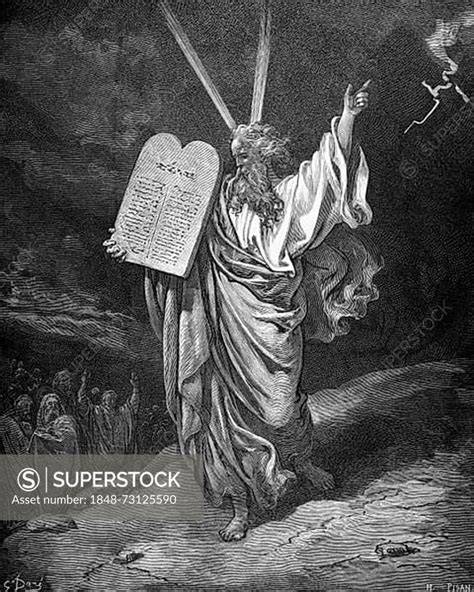
Certain artists met the subject somewhere in the middle-here is Gustave Doré’s Moses. He is emitting rays of light, albeit in the position of “horns.”
Is “Horned” the Best Interpretation of Exodus 34?
The Hebrew verb qaran can be translated in relation to horns, but the surrounding details create significant difficulties for a literal-horns interpretation.
All three verses mention qaran in direct association with the skin and the face. Identifying these passages as referring to literal horns requires saying, not that his head was horned-not even that “his face was horned”-but that the “skin of his face was horned.”
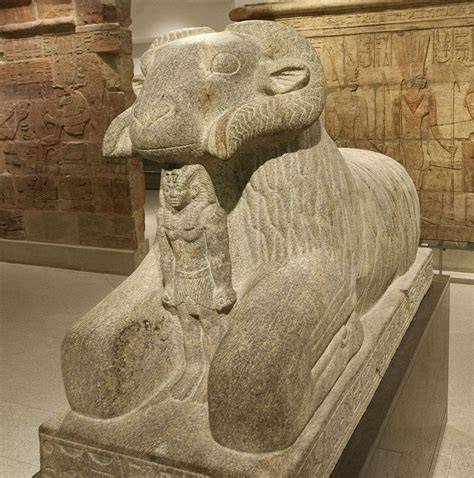
Yet literal horns come out of the head, the separate word ראש, rosh. Why would the face, פנים, panim, be described as being horned? Even the aforementioned Egyptian artwork depicts horns growing out of the head, not out of the face.
Certainly, in the case of pharaohs occasionally depicted with ram’s horns-“Horns of Ammon,” the symbol of the deity Ammon/Amun-these are shown to somewhat curl around in front of the cheeks. But these are hardly facial horns.
Further, it is the skin that is the focal point of the verses: “the skin of his face was horned/rayed.” This word is completely omitted in the Vulgate.
Why would skin be the key feature defined as being horned? Horns emerge from the head and are rooted to the bone-not the skin of the face. This implicit connection between the words קָרַן עוֹר has even led to all-the-more outlandish interpretations that these were horns of skin.
The Case for Rays of Light
Each of these state that this passage of scripture denotes projecting or radiating light. Part of the claim of “absurdity” for the Vulgate rendering is because it is not a directly accurate translation of the sentence in full.
Rendsburg himself wrote, “cornuta esset facies sua (‘his face was horned’), notwithstanding the slight change of ‘the skin of his face’ to the simpler ‘his face.’” It’s a slight change, but consequential-and part of a broader series of logical questions mandated by the scriptural context.
Moses’s face shone. It emitted light so bright that those around him were terrified, and begged him to drape cloth over it to dim the light.
This event occurs specifically in the context of Moses’s close contact with God, including his request that he would be able to see God’s glory.
And He said: “Thou canst not see My face, for man shall not see Me and live.” And the Lord said: “Behold, there is a place by Me, and thou shalt stand upon the rock. And it shall come to pass, while My glory passeth by, that I will put thee in a cleft of the rock, and will cover thee with My hand until I have passed by. And I will take away My hand, and thou shalt see My back; but My face shall not be seen.”
Contact with such radiant glory would be the only logical reason for why the exposed skin of the face would be highlighted as being affected-reflecting and radiating such brilliance with which it had come into contact.
It would also explain why the descending Moses, after his communion with God atop the mountain, could have been seen by “all the children of Israel”-not just those close enough to make out some kind of horn-like protrusions on his face.
It would further explain the necessity for Moses’s face to be veiled, which could hardly hide the shape of horns for those close enough to see, and would also explain why such veiling was only temporary, worn long enough for the light post-exposure to “fade.”
It would also explain why Moses sought to hide his appearance-not because it was something God necessarily wanted to demonstrate to the Israelites, but rather, as the by-product of Moses’s own personal interactions with His glory.
Habakkuk and the Meaning of “Horns”
Horns in Hebrew literature are always used as symbols of might and power. Just as horns emerge from the head of an animal, so also does light emerge from the presence of God: it radiates out!
In Habakkuk 3:3-4 the King James Version reads: “God came from Teman, and the Holy One from mount Paran. Selah. His glory covered the heavens, and the earth was full of his praise. And his brightness was as the light; he had horns coming out of his hand: and there was the hiding of his power.”
Clearly the context defines these horns as rays of light and glory!
“The noun qeren, from which the verb is derived, means both ‘horn’ and ‘ray,’ as in the rays of the sun,” wrote Rendsburg.
Given this dual possible meaning, we are not mandated to interpret the term as referring to literal horns in Exodus 34 but must consider the context in order to understand which of the options best fits the situation at Mount Sinai-a situation we already know to be one unequivocally of brightness and light.
Certainly, the related noun to qaran refers most often in the Bible to literal horns-but this is not always necessarily the case, as in the example of Habakkuk 3, using the plural word קרנים, in the JPS and most other translations, “rays,” in the context of brightness and light.
“God cometh from Teman, and the Holy One from Mount Paran. Selah. His glory covereth the heavens … a brightness appeareth as the light; Rays hath He at His side …. The sun and moon stand still in their habitation; At the light …”
Why Moses’s Veil Matters
Why, exactly, were “all the children of Israel” able to see this peculiarity in Moses’s visage? Why was this condition of being “horned”-thus requiring his face to be covered with some sort of veil-apparently only temporary?
And why, if this was God’s doing in order to present Moses in such a “prestigious” manner, did Moses keep himself veiled in public?
These issues are more naturally resolved if the passage describes radiance rather than physical horns. A bright face would be visible from a distance, would frighten those who encountered it, and would require a veil to reduce the intensity of the light.
The story brings the mystery back to the Christian story of the Transfiguration, which we have in our Gospel reading today, because while so many of us in the church are used to thinking of Jesus as a purely divine being who could light up the glow anytime he wanted to, we don’t think of Moses that way.
Moses is fully human, and humans don’t glow. I mean, that’s one thing we can count on, that when you see a glowing being it’s got to be angel or alien or something out of a comic book, right?
Divine Radiance in Biblical and Christian Tradition
Yet, that motif of “glow” appears in many different testimonies of Christian mystics and saints, from the Old Testament to Marcus Borg.
Notes from the Jewish Study Bible on the Exodus reading state: According to passages such as Ezek. 1.27-28; Hab. 3.4; Ps. 104.2, the divine Presence is surrounded by a radiant luminosity, a concept also found in Mesopotamian literature, where it is called “fearsome radiance.”
Thus, from his lengthy and intense encounter with God, Moses’ face came to reflect the divine radiance.
In this way, the golden calf episode ends with the theme with which it began: Moses’ role as Israel’s conduit to God, which the people feared they had lost, is reaffirmed and he is shown to be more than a common “man.”
This story brings the mystery back to the Christian story of the Transfiguration. The Gospel account presents Jesus’s appearance as transformed by divine glory, while Moses’s radiance shows that a fully human person can reflect the presence of God.
Moses as Pharaoh’s Equal
A 2023 Biblical Archaeology Review article titled “Moses as Pharaoh’s Equal-Horns and All” made the case that the passage does describe Moses as having literal “horns” and that this was another case of the Torah utilizing Egyptian motifs among an Egypt-familiar populace.
It’s a controversial stance that was met with a degree of pushback from readers.
One of the astonishing, often overlooked aspects of the Torah is the number of Egyptianisms it contains specific to the chronological period in which Moses was on the scene-the New Kingdom Period.
This can be seen in the terminology, symbolism, perspective, understanding of particular contemporary customs-attesting to the genuine period of composition reflected in the Bible: during the latter part of the second millennium b.c.e. at the hand of a skilled, Egypt-educated scribe.
Against this backdrop, Professor Rendsburg sees another Egyptian motif in Exodus 34. In his article, he points out certain artistic depictions of pharaohs having horns, representing their divine status.
He then compares this to two particular passages of scripture in which God informs Moses that he will take on a divine status in relation to Aaron and the pharaoh.
“And he [Aaron] shall be thy spokesman unto the people: and … he shall be to thee instead of a mouth, and thou shalt be to him instead of God” (Exodus 4:16; KJV).
“And the Lord said unto Moses, See, I have made thee a god to Pharaoh: and Aaron thy brother shall be thy prophet” (Exodus 7:1; KJV).
Rendsburg wrote: In these two passages, Moses, the prophet par excellence, is elevated to the level of deity, while Aaron, the first high priest, is elevated to the level of prophet.
This serves as the foreground for our analysis of qaran ‘or panaw, “the skin of his face was horned,” in Exodus 34:29-30.
The noun qeren, from which the verb is derived, means both “horn” and “ray,” as in the rays of the sun. But the former meaning clearly predominates in the Bible, with only one possible instance of “ray” attested, Habakkuk 3:4.
When we look at the verbal forms of qaran, we note that in the only other instance of this verb in the Bible, namely, maqren in Psalms 69:31, the meaning is clearly “be horned,” or “have horns.”
Egyptian Images of Horned Pharaohs
Support for understanding Exodus 34:29-30 as “the skin of his face was horned” derives from ancient Egyptian artwork.
Wall reliefs at Luxor Temple and Karnak Temple depict two different pharaohs with rams’ horns on the skin of their cheeks-or more accurately, given the Egyptian penchant for profiles, a single ram’s horn on the one visible cheek.
Both Amenhotep III and Ramesses II are portrayed in such fashion, with the rams’ horns no doubt representative of the power of the god Amun, who was associated with the ram in Egyptian iconography.
Once again, the Bible wishes to portray Moses as Pharaoh’s equal. Just as the facial skin of Egyptian kings was horned, so was the facial skin of the leader of the people of Israel. So Pharaoh, so Moses.
Rendsburg makes an interesting case. And certainly, the appeal to cultural background can be appreciated. But given the broader scriptural context, is it the most logical?
Do Other Biblical Passages Say Yahweh Has Horns?
One interpretation connects the biblical language of horns with passages in Numbers:
God brought them out of Egypt; He has, as it were, the [horn] of a unicorn. - Numbers 23:22
God brings him out of Egypt; He has [horns] like a wild ox. - Numbers 24:8
One prominent Biblical scholar believes that these passages can only lead to one possible conclusion. He states without hesitation that, “The horns belong to God, who is…called El.”
These verses use animal imagery to express strength and power. They do not by themselves provide a simple physical description of Yahweh’s body.
Horns in biblical poetry can signify authority, military power, royal status, victory, or the strength of a deity. The metaphor does not necessarily mean that the person or deity being described possesses literal animal horns.
Horns, Altars, and Divine Power
Just as the horns of Moses imply his presence as the very horns of the altar in the temple sanctuary, just as Jesus promised to “tear down and rebuild the temple in three days” in the form of his body, so also we each of us are temples of the Holy Spirit.
Horns, in Moses’ time, were a symbol of authority and power. Many gods, including YHVH have been depicted as having them.
The Canaanite gods Baal and El were horned bull gods as was, originally, Yahveh, which is why horns decorate the altar described in Exodus 27.
These claims belong to a broader discussion of ancient Near Eastern religious imagery and the relationship between Israelite religion and surrounding cultures. They should not be confused with the specific statement in Exodus 34 that Moses’s face shone after encountering God.
Yahweh, El, and Canaanite Religious Imagery
Historically speaking, it is entirely accurate to insist that YHVH, or Yahweh, the father God of both Jews and Christians, has horns.
Canaanite legend states this explicitly. The Hebrews were directly related to the Canaanites because both were Semitic tribes descended from Shem.
This god…was seen in two basic ways; as a solar sky deity and, particularly as he expressed himself in nature, as a horned god of the woodlands and forests. A great being who was lord of all nature. He also has many names: Cernunnos, Merlin, Lugh, Pan, Osiris and many others including YHVH, or Jehovah of the Hebrews.
Such statements combine biblical interpretation with claims about comparative mythology and religious history. The biblical texts themselves frequently use horns symbolically, but they do not present a consistent, explicit portrait of Yahweh as a literal horned man.
Michelangelo and the Confusion Between Moses and Yahweh
The modern confusion over the appearance of God the Father comes mostly from the artwork of Michelangelo. In his various paintings and sculptures, God is portrayed without horns, like Zeus, or Jupiter, the sexually degenerate god of the Greeks and the Romans.
This has caused generations upon generations of believers to picture the Christian father God as human and without horns. For whatever reason, Michelangelo did make a sculpture of the prophet Moses with horns.
Sadly, many Christians have taken this to mean that the God of Moses, the God of the Old Testament, the God of the Jews, was the Devil with horns, while the God of Jesus Christ, the God of the New Testament, the God of Christianity did not have horns and was an entirely different God.
This is completely contrary to Church teachings and is, in fact, blasphemy and heresy. The God of the Old Testament and the God of the New Testament was, and is, the exact same God. Scores of Christian scholars have confirmed this throughout the centuries.
Christians certainly do not worship Zeus, a sexually perverted human god without horns. They never did. They worship the God of the Holy Bible.
Horns and Anti-Semitic Misinterpretation
In the saddest development, the emerging connection between horns and Satan in the late Middle Ages paired with growing anti-semitism led to a viral belief still existing in some parts of the world that all Jews have the horns of the devil under their hair, as their founder Moses did.
This last example is a clear case of ignorance taking the original clear poetry and metaphorical symbolism as physical literalism.
The modern association of horns with Satan should not be projected backward onto the biblical description of Moses. A symbol can carry different meanings in different cultural settings, and the medieval association of horns with demonic imagery created a harmful interpretation that was not a valid description of Jewish people.
Does the Bible Forbid Images of Yahweh?
In the past, this line of thought has led to some highly anti-Semitic conclusions. Jew-haters spewing nonsense have time and again attempted to claim that the horned God of the Jews was, and is, the Devil and that the God of Christianity does not have horns.
In fact, the proper Biblical tradition is to never, ever create an image of God whether it be a painting or a sculpture. The Ten Commandments completely forbids any portrayal of what God actually looks like:
You shall not make unto thee any graven image, or any likeness of any thing that is in heaven above, or that is in the earth below, or that is in the water under the earth. - Exodus 20:4
For this reason, the image of God having horns has remained somewhat of a secret over the centuries. It has been passed down from generation to generation, from father to son, by word of mouth commonly known as the oral tradition.
The biblical prohibition concerns the making and worshiping of images, while artistic representations of biblical scenes have existed in many Jewish and Christian settings. The existence of an image therefore does not establish that the biblical text teaches a literal physical appearance for Yahweh.
Is Yahweh Described as Having a Human Form?
The passages are as follows: “The LORD our God is a series of articles concerning the God of Israel, the God of the Holy Bible.”
They forget what the Bible clearly states numerous times in many languages-that God has a face, hands, and feet just like a man. He also has a name and that is YHVH which in Hebrew means, “I will be what I will be.”
Exodus 24:9-11 describes an encounter involving Moses, Aaron, Nadab, Abihu, and seventy of the elders of Israel:
Then Moses went up with Aaron, Nadab, and Abihu, and seventy of the elders of Israel, and they saw the God of Israel; and under His feet there appeared to be a pavement of sapphire, as clear as the sky itself. Yet He did not stretch out His hand against the nobles of the sons of Israel; and they saw God, and they ate and drank.
These passages use human bodily language and visionary imagery to speak about divine encounters. They do not provide a complete anatomical description of Yahweh, nor do they explicitly say that the divine being has horns.
“God Hides His Face” and Divine Hiddenness
Some believers may become confused or even angry that the God of the Holy Bible has hidden the fact that He has horns from so many of His loyal and devout followers throughout the centuries.
The hiding of God’s horns is not a conspiracy. It is merely one small part of the Biblical tradition, predicted several different times in Scriptures.
- “[God] said, I will hide my face from them, I will see what their end shall be.” - Deuteronomy 32:20
- “How long will you forget me, O LORD? For ever? How long will you hide your face from me?” - Psalm 13:1
- “Hide not your face far from me; put not your servant away in anger. You have been my help; leave me not, neither forsake me, O God of my salvation.” - Psalm 27:9
- “LORD, by your favor you have made my mountain to stand strong: you did hide your face, and I was troubled.” - Psalm 30:7
- “Why do you hide your face, and forget our affliction and our oppression?” - Psalm 44:24
- “Truly you are a God that hides yourself, O God of Israel, the Savior.” - Isaiah 45:15
- “Neither will I hide my face any more from them: for I have poured out my spirit upon the house of Israel, says the Lord GOD.” - Ezekiel 39:29
These passages use the language of God’s hidden face to express divine absence, judgment, mystery, or the limits of human access to God. They do not function as evidence that a concealed physical feature such as horns is being deliberately kept secret.
Moses, Jesus, and the Transfiguration
This story brings the mystery back to the Christian story of the Transfiguration, which we have in our Gospel reading today, because while so many of us in the church are used to thinking of Jesus as a purely divine being who could light up the glow anytime he wanted to, we don’t think of Moses that way.
Moses is fully human, and humans don’t glow. Yet, that motif of “glow” appears in many different testimonies of Christian mystics and saints, from the Old Testament to Marcus Borg.
It’s too easy to fall into the trap of thinking that this is unattainable for us average humans, that both Moses and Jesus are a different order of creature entirely, but Saint Paul reminds us in his second letter to the Corinthians that every one of us has this connection if we would but have the boldness and confidence to unveil it.
The great truth is that we are all horned with light but we have not developed the eyes to see it and our calluses have grown too thick over the surface to reveal it.
Thomas Merton and the Experience of Radiance
Fifteen days from now, on March 18th of this year, it will be the 61st anniversary of the famous life-changing epiphany of the great Catholic Trappist monk and contemplative author Thomas Merton.
In Conjectures of a Guilty Bystander, in which he writes of his sorrow over the racism, war, and abuses of the 1960s and his inner conflict about his decision to remain apart from it as a monastic, he describes this event:
“In Louisville, at the corner of Fourth and Walnut, in the center of the shopping district, I was suddenly overwhelmed with the realization that I loved all those people [walking around me], that they were mine and I theirs, that we could not be alien to one another even though we were total strangers. It was like waking from a dream of separateness, of spurious self-isolation in a special world, the world of renunciation and supposed holiness.
The whole illusion of a separate holy existence is a dream. There is no way of telling people that they are all walking around shining like the sun. I suddenly saw the secret beauty of their hearts, the depths of their hearts where neither sin nor desire nor self-knowledge can reach, the core of their reality, the person that each one is in God’s eyes.
If only they could all see themselves as they really are. If only we could see each other that way all of the time.”
The biographer William H. Shannon writes of this experience that occurred 17 years after Merton had entered the monastery: “One of the things going on in [Merton] was the maturing realization, born of this contemplation, that it is not possible to leave the world in any real sense.
There is simply no place else to go…The experience challenged the concept of a separate ‘holy’ existence lived in a monastery. He experienced the glorious destiny that comes simply from being a human person and from being united with, not separated from, the rest of the human race.”
Christian Theosis and the Image of Divine Light
Jesus descended to the human so that we might understand the human to be divine, as 4th century church father Athanasius wrote in On the Incarnation, “God became Man that Man might become God.”
Eastern Orthodox theologians call this theosis: “a transformative process whose aim is likeness to or union with God, as taught by the Eastern Orthodox Church and Eastern Catholic Churches.
As a process of transformation, theosis is brought about by the effects of catharsis, purification of mind and body, and theoria, illumination with the vision of God.
According to Eastern Christian teaching, theosis is very much the purpose of human life. It is considered achievable only through a synergy, or cooperation, between human activity and God’s uncreated energies, or operations.
This language does not mean that human beings become identical with God in essence. It describes transformation, participation, likeness, or union with God through divine grace and illumination.
Humanity as a Temple of the Holy Spirit
The tragedy of modern understandings of Jesus is how the polarity of divisions have lost the unitive truth. Conservatives tend to emphasize the divinity of Christ while diminishing the humanity. Liberals tend to emphasize the humanity of Jesus without appreciating divinity.
In truth, orthodox Christian teaching is both/and rather than either/or. Since the Council of Chalcedon in 451, official Christology, the doctrine of Christ’s nature, as quoted on page 841 of the Book of Common Prayer under the seat in front of you, is: Jesus is both fully God and fully Man in a way that does not diminish the fullness of each reality.
Sadly, even those who affirm that sometimes miss the final implication for us. Just as the horns of Moses imply his presence as the very horns of the altar in the temple sanctuary, just as Jesus promised to “tear down and rebuild the temple in three days” in the form of his body, so also we each of us are temples of the Holy Spirit.
When we realize this, when we see the full implications of the glory of God, we may be just as terrified as those three disciples on the mountain, just as lost for words as James and John or as thoughtlessly babbling as Peter.
When we see every body around us as glowing with the radiance of God, when we recognize that our own bodies contain that same radiance, we can no longer respect the divisions of the world.
We can no longer hold onto hatred or fear of others, we can no longer resent or begrudge, or envy people in our lives. That’s a hard thing to do. Enlightenment isn’t always easy: but it’s joyful.
And it is the fate Jesus calls us to. May you be aware of your own horns today, as you also see the horns on your neighbor, as we celebrate the light of the world in each and every one of us.