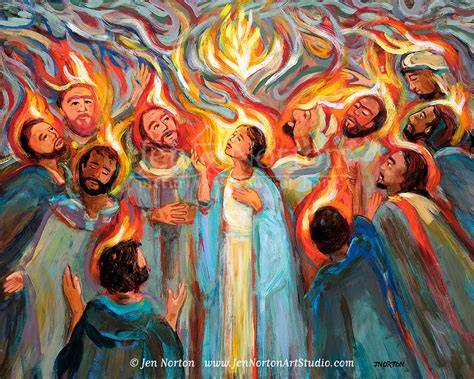
Flames are one of the central symbols of Pentecost because Acts 2 describes “cloven tongues like as of fire” resting upon the disciples, who were then filled with the Holy Spirit and began to speak in other languages. The image represents the presence and power of the Holy Spirit, divine illumination, spiritual transformation, passionate witness, and the commissioning of the Church.
Pentecost also includes the symbol of wind: “And suddenly there came a sound from heaven as of a rushing mighty wind, and it filled all the house where they were sitting.” Together, wind and flame portray the Spirit as the breath of God who gives life, the power of God who moves freely, and the fire of God that enlightens, purifies, strengthens, and sends believers into the world.
The biblical origin of the flames of Pentecost
“And suddenly there came a sound from heaven as of a rushing mighty wind, and it filled all the house where they were sitting. And there appeared unto them cloven tongues like as of fire, and it sat upon each of them. And they were all filled with the Holy Ghost, and began to speak with other tongues, as the Spirit gave them utterance.”- Acts ii. 2 - 4.
On Pentecost Sunday we celebrate the Birthday of the Church, the Day the Holy Ghost, the Spirit of Truth, descended on the fearful Apostles and changed hesitant men into roaring lions for Christ. “And suddenly there came a sound from heaven, as of a mighty wind coming, and it filled the whole house where they were sitting. And there appeared to them parted tongues as it were of fire, and it sat upon every one of them: And they were all filled with the Holy Ghost, and they began to speak with divers tongues, according as the Holy Ghost gave them to speak” (Acts 2:2).
The Holy Spirit, who is everywhere, made His presence known in this place, in this city of Jerusalem, in this house of the family of Saint Mark, in this Upper Room of the house where the Holy Eucharist was instituted, by way of a “mighty wind” and “fire.”
Although the account describes tongues “as of fire,” the flames are not presented as ordinary destructive fire. Tongues of flame sitting on each man’s head betoken a personal visitation to the mind and heart of each one of the chosen company. Not to consume them came the fires, for no one was injured by the flaming tongue; to men whom the Lord has prepared for his approach there is no danger in his visitations.
What the flames symbolize
Presence and power of the Holy Spirit
At the heart of Pentecost symbolism are the flames of fire that descended upon the disciples, symbolizing the presence and power of the Holy Spirit. In art and iconography, flames often hover above the heads of the apostles, depicting the transformative moment of Pentecost.
Fire, again, is a frequent symbol of Deity. Abraham saw a burning lamp, and Moses beheld a burning bush. When Solomon had builded his holy and beautiful house, its consecration lay in the fire of God descending upon the sacrifice to mark that the Lord was there; for when the Lord had dwelt aforetime in the tabernacle, which was superseded by the temple, he revealed himself in a pillar of cloud by day and a pillar of fire by night. “Our God is a consuming fire.” Hence the symbol of fire is a fit emblem of God the Holy Spirit.
The image therefore calls the congregation to adore and worship the Holy Spirit. The flame is not merely a decorative representation of an ancient event; it expresses the continuing presence and activity of God among the people.
Illumination and understanding
The intention of the symbol was to show them that the Holy Spirit would illuminate them, as fire gives light. “He shall lead you into all truth.” Henceforth they were to be no more children untrained, but to be teachers in Israel, instructors of the nations whom they were to disciple unto Christ: hence the Spirit of light was upon them.
Fire makes things visible, and the Pentecostal flame therefore signifies understanding, discernment, and the ability to recognize and proclaim divine truth. The disciples are changed from fearful followers into witnesses who can teach, speak, and bear the message of Christ.
Zeal, love, and spiritual fervor
But fire doth more than give light: it inflames; and the flames which sat upon each showed them that they were to be ablaze with love, intense with zeal, burning with self-sacrifice; and that they were to go forth among men to speak not with the chill tongue of deliberate logic, but with burning tongues of passionate pleading; persuading and entreating men to come unto Christ that they might live.
These flames are a reminder of divine illumination, igniting hearts with passion, zeal, and spiritual fervor. The Pentecostal fire represents an inward energy that moves believers from hesitation to action and from private faith to public witness.
May a fire burn steadily within to destroy our sin, a holy sacrificial flame to make us whole burnt offerings unto God, a never-dying flame of zeal for God, and devotion to the cross.
Inspiration and proclamation
The fire signified inspiration. God was about to make them speak under a divine influence, to speak as the Spirit of God should give them utterance. Oh! blessed symbol, would God that all of us experienced its meaning to the full and that the tongue of fire did sit upon every servant of the Lord.
Note that the emblem was not only fire, but a tongue of fire; for God meant to have a speaking church: not a church that would fight with the sword - with that weapon we have nought to do- but a church that should have a sword proceeding out of its mouth, whose one weapon should be the proclamation of the gospel of Jesus Christ.
The style of the Holy Ghost is one which conveys the truth to the mind in the most forcible manner, - it is plain but flaming, simple but consuming. The Holy Spirit has never written a cold period throughout the whole Bible, and never did he speak by a man a lifeless word, but evermore he gives and blesses the tongue of fire.
Purification and transformation
Fire changes things. When Jesus calls us to penance, and fills the world with the grace for all men to amend their lives, He likens it to casting fire upon the earth. We need the fire of grace from the Spirit of Christ to do penance and “change our minds” as the Greek word for penance, metanoia, implies.
The sacrament of baptism does even more. The baptized become members of the Mystical Body of Christ and are “washed” (baptizein, in Greek, means “to wash”) from all sin by the fire of the Holy Ghost. That is why John the Baptist was so excited about Jesus’ baptism, which was far greater than his.
Fire can purify. An angel from heaven took a burning coal from heaven’s thurible and purified the lips of Isaias the prophet with it. This fire did no harm, but purified him.
The Pentecostal flame therefore signifies not only warmth and energy but also the refining work of the Spirit. The fire of the Holy Spirit burns away sin, purifies the heart, and makes believers ready for faithful service.
Fire as a biblical symbol of divine revelation
The descent of fire at Pentecost belongs to a wider biblical pattern. God sometimes manifested His presence in the Old Testament by fire. God spoke to Moses in a burning bush, and that fire, although material with flames and all, did not consume the bush.
The laws of nature were suspended by the Author of nature, so that Moses would realize who it was who was speaking to him. A pillar of fire led Moses and the Israelites through the desert nights on their way to the Promised Land.
When Solomon had builded his holy and beautiful house, its consecration lay in the fire of God descending upon the sacrifice to mark that the Lord was there. The fire indicated that God was present, active, and revealing himself to his people.
| Biblical image | Meaning associated with fire |
|---|---|
| Burning bush | God’s presence and revelation |
| Pillar of fire | Guidance through the desert |
| Burning coal | Purification and prophetic commissioning |
| Tongues of fire | Illumination, inspiration, proclamation, and mission |
Pentecost, Sinai, and the Jewish background
Pentecost, according to the belief of the Jews, was the time of the giving of the law; and if when the law was given there was a marvellous display of power on Sinai, it was to be expected that when the gospel was given, whose ministration is far more glorious, there should be some special unveiling of the divine presence.
One thing I’ve discovered as I learn about Jesus’ Jewishness is that once one mystery gets solved, the fog starts lifting elsewhere. For instance, what was the significance of the wind and the tongues of flame that floated over the heads of the believers? You can find several clues in Jewish traditions regarding Pentecost.
For one, the day was a celebration of God’s appearance on Mt. Sinai in Exodus 19-20. God’s presence on the mountain was signified by wind and fire.
One traditional Jewish story (which I assume is a legend, personally,) is that when God came down to Mount Sinai, angels brought “crowns of fire” for every Israelite. And, when God spoke, “The Divine voice divided itself into the seventy tongues of men, so that all might understand it… All heard indeed the same words, but the same voice, corresponding to the individuality of each, was God’s way of speaking with them. And as the same voice sounded differently to each one, so did the Divine vision appear differently to each.” (from Legends of the Jews, Louis Ginsberg)
This is a very ancient story, even if it isn’t biblical or even historical. I wonder, though, how God was using it to broadcast the significance of this scene to the first-century Jews who saw it being played out before their very eyes.
Wind and flame as signs of a theophany
These passages in Exodus, Isaiah and Ezekiel are all theophanies - manifestations of God’s divine presence before humans. In Exodus, God commissions Israel to represent him as his people, and he gives them his Law so that they can reflect his holiness.
In Ezekiel and Isaiah, God commissions these prophets to proclaim his Word to his wayward people. These accounts shed new light on the scene in Pentecost.
God was publicly commissioning Jesus’ disciples to take the Gospel to the world. The Holy Spirit filled them with the ability to proclaim God’s praises in every language. And the very first thing that Peter does is to preach to the masses, and thousands of people become believers that day.
Wow, when we read the New Testament in its Jewish context, it brims over with new meaning. We can see how God was replaying glorious scenes from Israel’s history to announce the mission that he had given believers in Christ - to share his message with the world.
Ezekiel’s wind and fire
Another fascinating clue comes from a text that is still read today on Shavuot - Ezekiel 1-3. This is the dazzling, technicolor vision of Ezekiel. Have you ever looked at the details?
“I looked, and I saw a windstorm coming out of the north - an immense cloud with flashing lightning and surrounded by brilliant light… The appearance of the living creatures was like burning coals of fire or like torches. Fire moved back and forth among the creatures; it was bright, and lightning flashed out of it.” (Ezekiel 1:4, 13)
Hmm…a great wind and fire that floats in the air. Sound familiar?
Isaiah’s coal and prophetic commission
We find a similar scene is Isaiah 6:6, where Isaiah sees a vision of angels worshiping God, and one angel brings a “coal” to his mouth to purify his lips. He is commissioned to take God’s word to Israel.
Both Isaiah and Ezekiel experienced these visions for a purpose. God was appointing them to speak as prophets to Israel.
Very interestingly, God tells Ezekiel, “Son of man, go now to the house of Israel and speak my words to them. You are not being sent to a people of obscure speech and difficult language, but to the house of Israel - not to many peoples of obscure speech and difficult language, whose words you cannot understand.” (Ezekiel 3:4-5)
Hmm…God was sending Ezekiel to Israel, who speaks his language. In Acts, the Spirit gives the believers the ability to speak in every language. They weren’t just being sent to Israel, they were being sent out to the world.
The flame, languages, and unity
One of the most profound aspects of Pentecost is the gift of tongues, where the disciples spoke in diverse languages, yet everyone understood them. This symbolizes the universality of the Gospel message, transcending cultural and linguistic barriers to unite believers from every nation, tribe, and tongue.
Pentecost is a celebration of unity in diversity, emphasizing the inclusive nature of God's kingdom. The individual flames rest upon the disciples separately, yet the Spirit forms them into one witnessing community.
The tongues of fire therefore connect the physical sign to the missionary purpose of Pentecost. The disciples do not receive fire merely for personal spiritual experience; they receive it so that they can speak, proclaim, and be understood by people from many nations.
The wind as the companion symbol of the flame
Take the symbols separately. The first is wind- an emblem of Deity, and therefore a proper symbol of the Holy Spirit. Often under the Old Testament God revealed himself under the emblem of breath or wind: indeed, as most of you know, the Hebrew word for “wind” and “spirit” is the same.
So, with the Greek word, when Christ talked to Nicodemus, it is not very easy for translators to tell us when he said “spirit” and when he said “wind;” indeed, some most correctly render the original all the way through by the word “wind,” while others with much reason have also used the word “spirit” in their translation. The original word signified either the one or the other, or both.
Wind is, of all material things, one of the most spiritual in appearance; it is invisible, ethereal, mysterious; hence, men have fixed upon it as being nearest akin to spirit.
Observe that this wind was on the day of Pentecost accompanied with a sound - a sound as of a rushing mighty wind; for albeit the Spirit of God can work in silence, yet in saving operations he frequently uses sound.
Breath, life, and renewal
The meaning of the symbol is that as breath, air, wind, is the very life of man, so is the Spirit of God the life of the spiritual man. By him are we quickened at the first; by him are we kept alive afterwards; by him is the inner life nurtured, and increased, and perfected. The breath of the nostrils of the man of God is the Spirit of God.
This holy breath was not only intended to quicken them, but to invigorate them. That rushing mighty wind soon cleared away all earth-engendered damps and vapours; it aroused the disciples and left them braced up for the further work of the Lord.
They took in great draughts of heavenly life; they felt animated, aroused, and bestirred. A sacred enthusiasm came upon them, because they were filled with the Holy Ghost; and, girt with that strength, they rose into a nobler form of life than they had known before.
Movement and irresistible power
No doubt this wind was intended to show the irresistible power of the Holy Ghost; for simple as the air is, and mobile and apparently feeble, yet set it in motion, and you feel that a thing of life is among you; make that motion more rapid, and who knows the power of the restless giant who has been awakened.
See, it becomes a storm, a tempest, a hurricane, a tornado, a cyclone. Nothing can be more potent than the wind when it is thoroughly roused, and so, though the Spirit of God be despised among men, so much so that they do not even believe in his existence, yet let him work with the fulness of his power, and you will see what he can do.
He comes softly, breathing like a gentle zephyr, which fans the flowers, but does not dislodge the insect of most gauzy wing, and our hearts are comforted. He comes like a stirring breeze, and we are quickened to a livelier diligence: our sails are hoisted and we fly before the gale.
He comes with yet greater strength, and we prostrate ourselves in the dust as we hear the thunder of his power, bringing down with a crash false confidences and refuges of lies!
How the flames relate to the mission of the Church
This morning my object is not to talk of the descent of the Holy Spirit as a piece of history, but to view it as a fact bearing upon us at this hour, even upon us who are called in these latter days to bear our testimony for the truth.
The Father hath sent us the Comforter that he may dwell in us till the coming of the Lord. The Holy Ghost has never returned, for he came in accordance with the Saviour’s prayer, to abide with us for ever.
The gift of the Comforter was not temporary, and the display of his power was not to be once seen and no more. The Holy Ghost is here, and we ought to expect his divine working among us.
The Pentecostal flame therefore points beyond the first-century event. It represents the continuing work of the Spirit in the Church: giving life, teaching truth, strengthening witness, purifying believers, and sending the community into God’s mission.
Flames in Christian art and worship
In art and iconography, flames often hover above the heads of the apostles, depicting the transformative moment of Pentecost. This visual arrangement makes the individual nature of the visitation clear: the Spirit rests upon each disciple.
As Pentecost approaches, we are drawn into a sacred season rich in symbols and spiritual depth. This pivotal feast in the Christian calendar commemorates the outpouring of the Holy Spirit upon the disciples, marking the birth of the Church and the empowerment of believers.
Our liturgical arts committee aims to include color, music, motion, and symbolism in worship. For Pentecost, we wanted to symbolize how the Holy Spirit came upon the disciples with wind and flame.
There are many ways to depict a flame, but depicting wind is more difficult. To capture the motion of both and remind us of the motion of the Holy Spirit, we used wind to blow the flames of an 8-foot-tall fabric fire.
A fabric flame installation for Pentecost
We decided to hang the flame at the front of the sanctuary where worship is focused (though not directly over the pastor’s head). The flame could also be hung above the congregation to reflect how the Holy Spirit is moving among them, or at the sanctuary exit to symbolize how the Holy Spirit goes forth with God’s people.
Materials for the flames
- Flames Organza, 2.5 yards (2 m) of each of the following colors: red, orange, gold (not metallic), yellow
- Contrasting colored thread
- Serger sewing machine
Making the fabric flames
Cut fabric on the bias (diagonal to the weave) into strips 4 inches (10 cm) wide. The strips (flames) should vary in length from 3-6 feet (1-2 m).
Finish each strip off with a rolled hem on a serger in a contrasting color. Stretch the fabric while you sew to create a wave along the edges (a little like lasagna noodles).
Finish one end of each flame to a point, leaving a string of serged threads 3-4 inches (8-10 cm) on the tip. Fold the other end of each flame over about 1" (2.5 cm) and sew it into a sleeve.
Materials for the support structure
- Copper and bronze wire
- Fishing line (6-lb and 20-lb)
- Needle for fishing line
- Hot glue gun
- Fan
- Metal ring (made of twisted brass wire, or use a sturdy key ring)
Constructing the tiers
There are three nested tiers of flames. Each tier starts with copper wire; we used electrical wire bendable by hand but stiff enough not to bend under its own weight.
For the largest tier, cut a 5-foot (2.5 m) length of wire, and thread approximately 22 flames of varying length and color on through their sleeves. Twist the ends of the wire to form a hoop 28" (70 cm) in diameter. Adjust the flames to cover where the wire is joined.
Twist a finer piece of copper or bronze wire (we used jewelry wire) into a circle 8" (20 cm) in diameter. (Depending on the gauge of the wire you may want to twist additional wire around the circle for strength.)
Suspend the large hoop from the small hoop at four points using fishing line. It doesn’t matter if it hangs a little crooked. Use a dab of hot glue to keep the tied ends of the fishing line in place on the top hoop.
The distance between the hoops should be approximately an inch (2.5 cm) longer than the longest flame. Use a needle and thread to secure fishing line to the pointed tip of each flame.
These lines are also tied to the upper hoop (and dabbed with hot glue)-leave a little slack so each flame has a slight sag to it. Suspend the upper hoop 4" (10 cm) from a metal ring using fishing wire.
Construct two other tiers using the same technique, one with a lower hoop diameter of 20" (50 cm) and sixteen flames and a maximum height of 5' 10" (1.8 m) and the other with a hoop diameter of 16" (40 cm) and thirteen flames with a maximum height of 4' 7" (1.4 m).
| Tier | Hoop diameter | Number of flames | Maximum height |
|---|---|---|---|
| Largest tier | 28" (70 cm) | approximately 22 flames | 3-6 feet (1-2 m) |
| Middle tier | 20" (50 cm) | sixteen flames | 5' 10" (1.8 m) |
| Smallest tier | 16" (40 cm) | thirteen flames | 4' 7" (1.4 m) |
The tiers are then nested (with the largest hoop on the outside) and tied to the top ring.
Installing the flame
Suspend the finished flame from the ceiling so the bottom hoop is approximately 8' (2.5 m) above the floor.
Our sanctuary ceiling is too high so we suspended it from four points high on the walls, two on the front wall and two on the side walls about 8' back from the front wall. Four points allows a significant degree of adjustment in location.
Although the flame is not heavy, this kind of suspension puts significant tension on the lines. We used double stranded 20 lb. fishing line.
Lay a fan on the floor so that it will blow directly up under the flame (if necessary, set it on bricks or blocks so it can draw air from underneath). The wind from the fan will cause the flames to flutter.
How to Make Fire Fan Covers
Time and materials estimate
| Item | Estimate |
|---|---|
| Fabric and thread | Approximate cost: $83 US ($100 CDN) |
| Wire and fishing line | $25 US ($30.00 CDN) |
| Cutting fabric | 4 hours |
| Sewing and assembly | 10 hours |
Estimated time is for one person: more help is needed to install the finished flame in the sanctuary.
Wind and flame in Pentecost worship
To capture the motion of both and remind us of the motion of the Holy Spirit, we used wind to blow the flames of an 8-foot-tall fabric fire.
The movement is part of the meaning. A static flame can represent fire, but a moving flame can suggest the Spirit’s living activity. The fluttering fabric recalls the rushing wind, the restless movement of divine power, and the continuing action of the Holy Spirit among the gathered people.
The flame could also be hung above the congregation to reflect how the Holy Spirit is moving among them, or at the sanctuary exit to symbolize how the Holy Spirit goes forth with God’s people.
The Cross and Flame
The insignia of The United Methodist Church is a cross linked with a dual flame, a powerful reminder of who we are in Christ. It relates the United Methodist church to God through Christ-the cross-and the Holy Spirit-the flame, a reminder of Pentecost when witnesses were unified by the power of the Holy Spirit and saw "tongues, as of fire" in Acts 2:3.
The elements of the emblem also remind us of a transforming moment in the life of Methodism's founder, John Wesley, when he sensed God's presence and felt his heart "strangely warmed."
The two tongues of a single flame may also be understood to represent the union of two denominations.
History of the emblem
The Cross and Flame was birthed following the formation of the United Methodist Church by the union of the Methodist Church and the Evangelical United Brethren Church in 1968.
After considering more than two dozen other designs, the cross and flame was chosen as the official emblem. The symbol, one with lettering and one without, was formally adopted by the General Conference in 1968.
Since 1996, the General Council on Finance and Administration (GCFA) of The United Methodist church has supervised the emblem's use.
Flames, light, and the season of Pentecost
Fire The sun in the summer is high in the sky and gives off its greatest light and heat during the season of Pentecost. The sun is fire, and without fire there is no light and no heat.
There is a trinity in all created things. Light proceeds from the fire, as the Son from the Father, and heat proceeds from the fire and light, as the Holy Spirit proceeds from Father and Son as Love.
Why did the Third Person of the Trinity appear as tongues of fire upon the heads of the Apostles? What is it about this material element, or rather, its manifestation as light and heat, which makes it so spiritual that indeed, although invisible itself, all material things must be seen by means of it and, although unfelt itself, makes all things warm that are touched by it.
Fire, by its nature, is material, but it is the closest of all material things to immaterial realities.
Fire as change and new life
Heraclitus, an ancient Greek philosopher, who lived around the fifth century B.C., was convinced that fire was cause of everything in the cosmos.
The Greeks, among others, believed that there were four ultimate elements: earth, air, water, and fire. Thales thought that water was the ultimate element from which all things arise and participate in. Anaxamenes thought that air was the basic element. Heraclitus considered it to be fire, because, he said all things are in flux and always changing and fire underlies all change.
If we understand by “fire,” in Heraclitus’ thought, the reality of “change,” then that element takes on a deeper significance that mere flames, light, and heat.
Physical fire is not limited to what we are familiar with everyday; lightning is fire; and the sun and stars are fire, but much hotter than the flames that end up as carbon gas in our ordinary experience.
Fire changes things. The Pentecostal flame can therefore be read as a sign of the change brought by the Spirit: fearful disciples become bold witnesses, divided languages become an occasion for understanding, and a gathered group becomes the Church sent into the world.
Fire in the life of faith
When Jesus said, “I am come to cast fire on the earth; and what will I, but that it be kindled? (Luke 12:49), He was, of course, speaking analogously of spiritual fire.
As was His Precursor, John the Baptist, when he told the penitents who had come to his baptism: “I indeed baptize you in the water unto penance, but he that shall come after me, is mightier than I, whose shoes I am not worthy to bear; he shall baptize you in the Holy Ghost and fire” (Matt. 3:11).
The fire of grace from the Spirit of Christ enables believers to do penance and “change our minds” as the Greek word for penance, metanoia, implies.
The flame thus carries a double meaning: it comforts and empowers, but it also calls for repentance, purification, and a transformed way of life.
Fire, purification, and discernment
So fire, material fire, can purify. This is what the fire in purgatory does. It purifies the souls waiting there to be taken as perfect vessels to heaven.
Even here on earth fire purifies, as you know. Pure iron is extracted from impurities in iron ore by fire, and iron is purified by fire again to make steel.
This imagery helps explain why Pentecostal fire can represent spiritual refinement. The Spirit does not merely produce excitement; the Spirit exposes what must be changed and forms believers for holiness and service.
For other foundation no man can lay, but that which is laid; which is Christ Jesus. Now if any man build upon this foundation, gold, silver, precious stones, wood, hay, stubble: Every man’s work shall be manifest; for the day of the Lord shall declare it, because it shall be revealed in fire, and the fire shall try every man’s work, of what sort it is.
If any man’s work abide, which he hath built thereupon, he shall receive a reward. If any man’s work burn, he shall suffer loss; but he himself shall be saved, yet so as by fire” (3: 12-15).
The continuing meaning of Pentecostal fire
Although we may not expect, and need not desire, the miracles which came with the gift of the Holy Spirit, so far as they were physical, yet we may both desire and expect that which was intended and symbolized by them, and we may reckon to see the like spiritual wonders performed among us at this day.
If at the commencement of the gospel we behold the Holy Spirit working great signs and wonders may we not expect a continuance- nay, if anything, an increased display - of his power as the ages roll on?
It ought not to be forgotten that Pentecost was the feast of first fruits; it was the time when the first ears of ripe corn were offered unto God.
If, then, at the commencement of the gospel harvest we see so plainly the power of the Holy Spirit, may we not most properly expect infinitely more as the harvest advances, and most of all when the most numerous sheaves shall be ingathered?
As we prepare to celebrate Pentecost, let us embrace these symbols not merely as historical artifacts but as living expressions of God's ongoing work in our lives and communities.
May the flames of Pentecost's fire ignite our hearts with love and zeal, may the dove of peace fill us with divine comfort and guidance, and may the wind of the Spirit propel us into transformative action for God's kingdom.
Pentecost is a reminder that the Spirit continues to move and breathe among us, inviting us into deeper communion with God and one another.
As we meditate on these symbols, may Pentecost's timeless truths resonate within us, inspiring us to live as bold witnesses of Christ's love and grace.