James the Apostle, also known as James the Greater or James the son of Zebedee, was beheaded by order of King Herod Agrippa I of Judaea in approximately AD 44. His execution is recorded in the New Testament in Acts 12:1-2, which states that Herod “killed James the brother of John with the sword.”
James was the first of the Twelve Apostles to be martyred for the Christian faith and the only apostle whose martyrdom is explicitly recorded in the New Testament. After his death in Jerusalem, Christian tradition holds that his followers transported his remains to Galicia in northwestern Spain, where they are believed to rest in the Cathedral of Santiago de Compostela.
The biblical account of James’s death
The Acts of the Apostles records that “Herod the king” had James executed “by the sword.” The king is usually identified with Herod Agrippa I, the ruler of Judaea. James was beheaded by order of King Herod Agrippa I of Judaea.
This account appears in Acts 12:1-3: “King Herod extended his hands to harm certain ones from the church. 2 He killed James the brother of John with the sword. 3 Seeing that it pleased the Jews, he proceeded further to arrest Peter also.”
The passage presents James’s execution as part of a wider persecution of the early Christian community. Herod’s action was politically motivated, since the account says that James’s death pleased certain Jewish leaders and that Herod then proceeded to arrest Peter.
The site of martyrdom is located within the Armenian Apostolic Cathedral of St. James in the Armenian Quarter of Jerusalem. The Chapel of Saint James the Great, located to the left of the sanctuary, is the traditional place where he was martyred when King Agrippa ordered him to be beheaded (Acts 12:1-2). His head is believed to be buried under the altar, marked by a piece of red marble and surrounded by six votive lamps.
When did James the Apostle die?
James died in AD 44, during the reign of Herod Agrippa I. The year is also given as approximately 44, because the New Testament provides the historical event but does not specify an exact day.
The traditional reason why St. James’s feast day is held on the 25th of July is the belief that he was martyred on this date in the year 44 AD. However, some historians argue that July 25th was chosen so as to coincide with the feast day of Saint Christopher.
| Detail | Information |
|---|---|
| Name | James the Apostle, James the Greater, James the son of Zebedee |
| Death | AD 44 |
| Place of death | Jerusalem, Judea |
| Method of execution | Beheading by the sword |
| Person who ordered the execution | King Herod Agrippa I |
| Biblical record | Acts 12:1-2 |
| Feast day | 25 July in Western Christianity |
Was James the first apostle to be martyred?
James was the first of the Apostles to be martyred for the faith. James was the first apostle to suffer death after the martyrdom of Stephen.
James the Great was one of the Twelve Apostles of Jesus. According to the New Testament, he was the second of the apostles to die, after Judas Iscariot, and the first to be martyred.
There is an apparent difference between describing James as the “first apostle to be martyred” and the “second apostle to die.” Judas Iscariot died before James, but James is identified as the first of the Twelve to die specifically as a martyr for the Christian faith.
What does “James the Greater” mean?
James was the son of Zebedee and Salome, born into a long line of Jewish fisherman on the Sea of Galilee. He was the brother of John the Apostle.
James is styled “the Greater” to distinguish him from the other apostle James “the Lesser,” with “greater” meaning older or taller, rather than more important. His name of “James, the Greater” is meant to distinguish him from his fellow Apostle, “James, the Lesser” because of him being older and taller.
There was another disciple called James, the son of Alphaeus, who was also one of the twelve apostles. James the son of Zebedee is known as “James the Greater,” while James the son of Alphaeus is known as “James the Lesser” (Mark 15:40).
James’s family and life before becoming an apostle
James was born into a family of Jewish fishermen on the Sea of Galilee. His parents were Zebedee and Salome. Salome was a sister of Mary, the mother of Jesus, which made James the Great a cousin of Jesus according to this tradition.
He worked as a fisherman with his brother, John, his father, Zebedee, and his partner, Simon. James and his brother John were fishermen by trade and partners with the disciples Andrew and Simon Peter.
James was one of the first disciples called by Jesus, alongside his brother John and their friend and fellow fisherman, Simon Peter. The Synoptic Gospels state that James and John were preparing to fish with their father by the seashore when Jesus called them to follow him.
James and John were followers of John the Baptist and later, Jesus. James, along with his brother John, left life as a fisherman when Jesus called him to be a “fisher of men”.
After an entire night of fishing with no results, they were dubious when Jesus told them to lower their nets into the water once more. Yet they complied and were astonished to watch as they caught more fish than they could keep in their boat (Luke 5:1-11).
After this miracle, Jesus asked them to follow him, saying he would make them fishers of men (Matthew 4:18-22). Immediately, they cast aside their nets to follow him, and did not look back.
James and the “Sons of Thunder”
James and his younger brother, St. John the Apostle, are designated Boanerges, translated in Mark 3:17 as “Sons of Thunder,” perhaps referring to their characteristic fiery zeal (Mark 9:38 and Luke 9:54), though the etymology and meaning are uncertain.
James is one of two disciples given a nickname by Jesus. Although Jesus changed the name of Simon to Peter, James and John were the only disciples he gave nicknames.
The fiery evangelical zeal and extreme reactions often displayed by these two inspired Jesus to-rather humorously-dub them “the Sons of Thunder” (Mark 3:17).
James and his brother wanted to call down fire on a Samaritan town, but were rebuked by Jesus. This episode is commonly associated with the brothers’ intense temperament and helps explain why the nickname “Sons of Thunder” became connected with them.
James’s place among Jesus’s closest disciples
With Saints Peter and Andrew, James and John were the first four disciples whom Jesus called (Mark 1:16-19). James, along with his brother John, and Peter, formed an informal triumvirate among the Twelve Apostles.
As the “inaugural three,” they would go on to be present at key moments throughout Jesus’ life and ministry that the other nine apostles were not privy to.
Jesus allowed them to be the only apostles present at three particular occasions during his public ministry: the raising of Jairus’ daughter, the Transfiguration, and Jesus’ agony in the Garden of Gethsemane.
As a member of the inner circle, James witnessed the raising of Jairus’s daughter from the dead (Mark 5:37 and Luke 8:51), the Transfiguration (Mark 9:2), and Jesus’ agony in the Garden of Gethsemane (Mark 14:33 and Matthew 26:37).
They were present when Jesus brought Jairus’ daughter back from the dead, and when He healed Peter’s mother-in-law. Perhaps their greatest honor was to be the only three disciples to witness the transfiguration (Matthew 17:1).
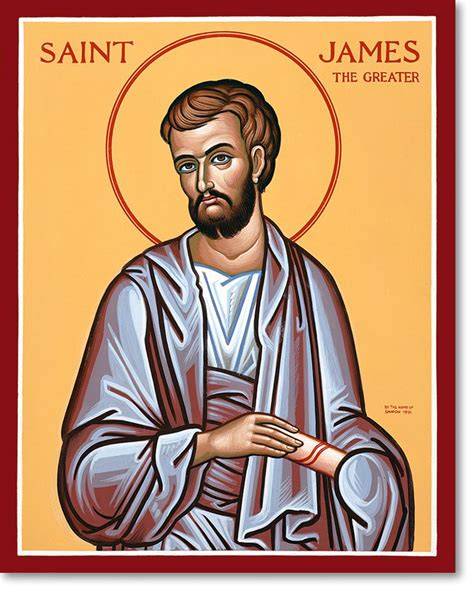
James’s request for a place beside Jesus
James and John asked Jesus to let them sit, one at his right and one at his left, in his future glory (Mark 10:35-40). In another tradition, their mother made the request on their behalf (Matthew 20:20-28).
Jesus rebuked them, asking if they were ready to drink from the cup he was going to drink from and saying the honor was not even for him to grant. The other apostles were annoyed with them.
Both he and John were rebuked by Jesus and the other Apostles in Mark 10:35-45 after asking to be seated at Jesus’ right and left hand in the kingdom.
James’s later martyrdom gave a profound meaning to Jesus’s question about drinking from the cup of suffering. Pope Benedict XVI observed that James, who had initially requested a place beside Jesus in his Kingdom, became precisely the first apostle to share the martyr’s cup.
The traditional story of James’s final days
According to tradition, James traveled to Spain to preach the gospel before returning to Judaea and becoming a martyr. Following the crucifixion of Jesus Christ, James made a pilgrimage to the Iberian Peninsula to spread the word of Jesus.
According to tradition, St. James passed through various towns in Tarraconensis, including Bracara Augusta, where he preached to the local populace and later elevated a fellow Jew by the name of Peter as their local preacher before leaving to continue traveling.
According to local tradition, on 2 January AD 40, the Virgin Mary appeared to James on the bank of the Ebro River at Caesaraugusta, while he was preaching the Gospel in Hispania. She appeared upon a pillar, and that pillar is conserved and venerated within the present Basilica of Our Lady of the Pillar in Zaragoza, Spain.
Following that apparition, St. James returned to Judaea, where he was beheaded by Herod Agrippa I in AD 44.
The New Testament does not describe James’s missionary journey to Spain. The tradition concerning his preaching in Hispania and the later transport of his remains developed in Christian sources and local traditions associated with Santiago de Compostela.
The story of James’s execution in later tradition
From Acts 12:2 we know that Herod beheaded the apostle James, brother of John, but do you know the rest of this story?
Although Herod was the authority that took his head, James’s fate started when an individual brought charges against him before the tribunal. When the case was over and James had been condemned to death, the man who had instigated the trial was deeply moved by the behavior and continence of the apostle.
James was so filled with the Spirit of God that on the way to the place of execution the one who had initiated the charges against him made a confession of faith in Christ.
When he asked James to forgive him, the apostle said, “Peace be to thee, brother.” James then kissed him and both men were beheaded for their faith in 36 A.D.
This account comes from Foxe’s Book of Martyrs and differs from the usual date of James’s death given in the biblical and historical tradition. The New Testament account identifies James’s death during the reign of Herod Agrippa I, generally dated to AD 44.
Why is James considered a martyr?
There are two categories of saints-martyrs and confessors. A Christian martyr is regarded as one who is put to death for his Christian faith or convictions. Confessors are people who died natural deaths.
St. James the Greater died in AD 44 after being beheaded by King Herod, making him a martyr. St. James is also widely recognised as the first apostle to be martyred.
He followed Jesus as one of his disciples until Jesus was crucified by the Romans. Still, his love for Jesus endured, even after His death, resurrection, and ascension into heaven, preaching to the Jews like the rest of the Apostles.
That is, until his death in 44 AD, when he was beheaded on the order of King Herod in the Acts of the Apostles 12:1-3.
James’s martyrdom as an example of Christian devotion
James the Apostle stands as a testament of evangelical fervor. He is remembered as a man who responded to Jesus’ call without hesitation.
“We can learn much from St James: promptness in accepting the Lord's call even when he asks us to leave the ‘boat’ of our human securities, enthusiasm in following him on the paths that he indicates to us over and above any deceptive presumption of our own, readiness to witness to him with courage, if necessary to the point of making the supreme sacrifice of life,” said Pope Benedict XVI in his general audience on June 21, 2006.
“Thus, James the Greater stands before us as an eloquent example of generous adherence to Christ. He, who initially had requested, through his mother, to be seated with his brother next to the Master in his Kingdom, was precisely the first to drink the chalice of the passion and to share martyrdom with the Apostles.”
“And, in the end, summarizing everything, we can say that the journey, not only exterior but above all interior, from the mount of the Transfiguration to the mount of the Agony, symbolizes the entire pilgrimage of Christian life, among the persecutions of the world and the consolations of God, as the Second Vatican Council says,” he concluded.
“In following Jesus, like St James, we know that even in difficulties we are on the right path.”
What happened to James’s body after his death?
The remains, or relics, of St. James the Greater were then transported by his followers to the Iberian Peninsula, today’s Galicia in Spain, and are said to be buried in Santiago de Compostela. This is why St. James the Greater is now the patron saint of Spain.
The tradition also claims that his body was taken by boat to Galicia, a region in northwestern Spain, and buried there. The translation of his relics from Judaea to Galicia in the northwest of Hispania was, in legend, accomplished by a series of miraculous events.
His decapitated body was taken up by angels and sailed in a rudderless, unattended boat to Iria Flavia in Hispania, where a massive rock closed around his body.
According to legend, his body, along with his followers, sailed to the Iberian Peninsula on a rudderless ship with no sail. Landing on the northwest coast of the peninsula, they proceeded up the River Ulla to land at Iria Flavia, modern-day Padrón.
The legend of Queen Lupa
Tradition has it that when the disciples of James, Theodore and Athanasius, arrived in Iria Flavia, they approached Queen Lupa about giving them a place to bury his body.
The Celtic Queen Lupia ruled these lands, and when asked by James’s followers if they could bury his body, she refused and sent troops after them.
Lupa appears in the Codex Calixtinus, which further relates that she decides to trick the disciples and sends them to the governor of Duio with the intent of having them killed. Sensing a trap, they escape the governor and return to the queen.
Once again Lupa tries to deceive them and sends them to Pico Sacro, the Sacred Peak, to collect two of her oxen to carry the necessary material to build the tomb.
She does not tell them that the mountain has a cave which is the entrance to hell and is guarded by a dragon. However, the presence of the holy cross protects the disciples from harm and tames the bulls.
While chasing the followers of James with his body across a bridge, it collapsed, killing her troops. Queen Lupia then converted to Christianity and provided an ox and cart for the followers of James to transport the body.
Unsure of where they should bury the sacred remains, his followers prayed on this and decided to let the ox continue until it chose a place to rest. After pausing at a stream, the ox finally came to rest under an oak tree at the top of a hill.
Upon witnessing the miraculous events, Lupa converts to Christianity and helps build the apostle’s tomb in Libredon.
The discovery of the tomb at Santiago de Compostela
The tradition at Compostela placed the discovery of the relics of the saint in the 9th century, by Pelayo in the Libredon forest in the time of Bishop Theodemir and King Alfonso II.
In the early 9th century his tomb was purportedly discovered in what is now Santiago de Compostela, and a church was built on the site of his tomb.
These traditions were the basis for the pilgrimage route that began to be established in the 9th century, and the shrine dedicated to James at Santiago de Compostela became a famous pilgrimage site within the Christian world.
How James’s death is connected with the Camino de Santiago
St. James is the patron saint of Spain and the namesake of the Camino de Santiago. Saint James the Greater is the patron saint of both pilgrims and the nation of Spain.
The Camino de Santiago is Spanish for “Way of St. James.” It is a network of routes that cross Western Europe and arrive at Santiago de Compostela through northern Spain.
After centuries of decline, beginning in the 14th-16th centuries with the Renaissance and the Protestant Reformation, the pilgrimage tradition to Santiago de Compostela was revitalized toward the end of the 20th century and became known as the Camino de Santiago.
In the 21st century the tradition has continued to grow, and the shrine of St. James has attracted thousands of pilgrims annually from all over the world.
The scallop shell and the symbolism of pilgrimage
James’s emblem was the scallop shell, or “cockle shell,” and pilgrims to his shrine often wore that symbol on their hats or clothes.
The scallop shell then became the recognized symbol of all pilgrims on the Camino, as it is found on the shores of Galicia. When returning to their own countries, pilgrims displayed the scallop shell on their hats to show they had carried out their pious intentions.
St. James the Greater is represented in Christian art in the garb of a pilgrim, with staff, gourd, and scallop shell. Saint James the Elder was painted by Rembrandt in 1661, depicted clothed as a pilgrim, with a scallop shell on his shoulder, and his staff and pilgrim’s hat beside him.
The feast day of James the Greater
The Feast Day of St. James the Greater is July 25th and is widely celebrated in Spain, especially in Santiago de Compostela. The feast day of St. James is celebrated on 25 July on the liturgical calendars of the Catholic, Eastern Orthodox, True Orthodox, Anglican, Lutheran and certain other Protestant churches.
He is additionally commemorated on 30 April in the Orthodox Christian liturgical calendar, and on 30 June as part of the Synaxis of the Apostles. The National Day of Galicia is also celebrated on 25 July because St. James is its patron saint.
When the Feast of St. James falls on a Sunday, that year becomes a Camino Holy Year, also known as a Year of Compostela or Jacobean Year. During these years, visitors to the Cathedral in Santiago can receive a plenary indulgence.
Jubilee years follow a 6-5-6-11 pattern, except when the last year of a century is not a leap year, which can yield a gap of 7 or 12 years. The most recent of such Holy Years was 2021; the next will be 2027.
How James is represented in Christian art
It is helpful to be able to recognise iconic saints in paintings, stained glass windows, illuminated manuscripts, architecture, and other forms of Christian art. The artistic representations reflect the life or death of saints or an aspect of life with which the person is most closely associated.
St. James the Greater is represented in Christian art in the garb of a pilgrim, with staff, gourd, and scallop shell. St. James is often also depicted riding a white horse into battle.
A common representation of St. James that emerged during the Crusades, when Spain was a stronghold of Moorish rule, was that of Santiago Matamoros, Spanish for “St. James the Moor-Slayer.” He was depicted on horseback and brandishing a sword-iconography that served to inspire Christian knights in battle against the Muslim Moors.
Similar depictions of Santiago Matamoros were used during the Spanish conquest of the Americas in the 15th and 16th centuries.
The later legend of Santiago Matamoros
St James, also known as St Iago, the Spanish form of his name, is also the military patron of Spain. His mission to defend the Christian Church against invaders actually occurred after his death.
According to legend, during the celebrated battle of Clavijo, he suddenly appeared on a milk-white charger, waving aloft a white standard, and leading the Christians to victory.
This manifestation was a response to the soldiers’ invocation of his name, “Sant Iago!”, as the battle-cry of the day. Hence, the name of the ancient city, Santiago, where the cathedral was founded in his honour.
An even later tradition states that he miraculously appeared to fight for the Christian army during the legendary battle of Clavijo, and was henceforth called Santiago Matamoros, “Saint James the Moor-slayer.” “¡Santiago, y cierra, España!”-“St. James and strike for Spain!”-was the traditional battle cry of medieval Spanish Christian armies.
James’s patronage
In Roman Catholicism, St. James is the patron saint of pilgrims, soldiers, veterinarians, pharmacists, and people with arthritis. He is also the patron saint of Spain, Galicia, Nicaragua, Guatemala, and Seattle.
St. James is the patron of Spain, veterinarians, oyster fishers, and more. He is also associated with equestrians, furriers, tanners, woodcarvers, and pharmacists.
Saint James the Greater is the patron saint of pilgrims and Spain. His feast day is on the 25th of July, and he was named by Jesus as one of the Sons of Thunder. He was executed in AD 44 by beheading.
Where James is remembered today
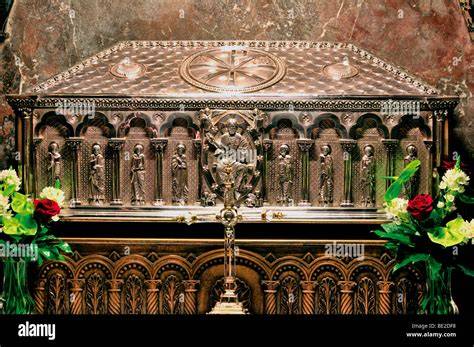
Today, James is particularly associated with the Cathedral of Santiago de Compostela, which is believed to contain his relics. The tomb of St. James the Great is located in the crypt of the Santiago de Compostela Cathedral in Spain.
To learn more about Saint James, visit Santiago. Here you will find many tributes to him, especially in the Cathedral of Santiago de Compostela-the cathedral of Saint James of the Field of Stars.
St. James the Apostle is also depicted in stained glass in the St. John the Evangelist Chapel, on the side of the Mary Memorial Altar in the Crypt Church, and in the southern entrance of the Basilica.
Why James’s death remains significant
James’s death is significant because it is the earliest recorded martyrdom among the Twelve Apostles. His execution connects the apostolic mission of the early Church with the cost of public witness to Jesus.
He was a “son of Thunder”-a man of eager disposition. And perhaps most importantly, he was a man who responded to Jesus’ call without hesitation.
His life is remembered as a journey from the fishing boat to Jesus’ inner circle, from the mount of the Transfiguration to the Garden of Gethsemane, and finally to martyrdom in Jerusalem.
As Pope Benedict XVI concluded, “In following Jesus, like St James, we know that even in difficulties we are on the right path.”