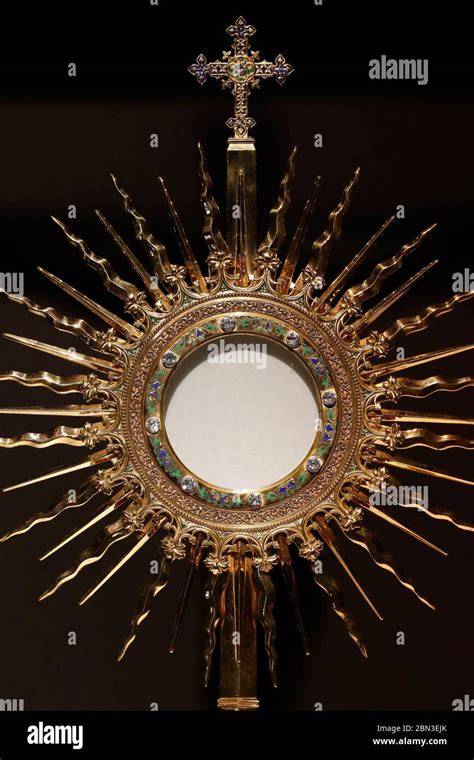
The Forty Hours Devotion is a Roman Catholic practice involving continuous prayer and adoration before the Blessed Sacrament, solemnly exposed in a monstrance for forty hours, usually across three days. Its central purpose is to honor Jesus Christ’s real presence in the Holy Eucharist while encouraging repentance, reparation, intercession, confession, and deeper sacramental communion.
The devotion is traditionally associated with the approximately forty hours between Christ’s death and His resurrection, and it is commonly celebrated during Lent or Advent. It begins with a Solemn Mass of Exposition and ends with a Mass of Reposition, procession, benediction, and the return of the Blessed Sacrament to the tabernacle.
What the Forty Hours Devotion Is
The Forty Hours Devotion is a special forty-hour period of continuous prayer made before the Blessed Sacrament in solemn exposition. Of course, the focus of this devotion is on the Holy Eucharist. Affirming our belief in the real presence of our Lord in the Blessed Sacrament, the Vatican Council II taught that the Holy Eucharist is “the source and summit of the Christian life” (Lumen Gentium, #11).
While the Mass is the central act of worship for us Catholics, an act which participates in the eternal reality of our Lord’s passion, death, and resurrection, Vatican Council II upheld and encouraged the adoration of the Blessed Sacrament outside of Mass. Of course such devotion derives from the sacrifice of the Mass and moves the faithful to both sacramental and spiritual communion with our Lord (Eucharisticum Mysterium, #50).
As Pope Pius XII taught in Mediator Dei, “This practice of adoration has a valid and firm foundation.” Our Holy Father, Pope John Paul II has repeatedly “highly recommended” public and private devotion of the Blessed Sacrament, including processions on the Feast of Corpus Christi and the 40 Hours Devotion (cf. Dominicae Cecae, #3, and Inaestimabile Donum, #20-22).
As Catholics, the words of our Lord burn in our hearts: “I myself am the living bread come down from Heaven. If anyone eats this bread, He shall live forever; the bread I will give is my flesh for the life of the world” (John 6:51).
Why the Devotion Lasts Forty Hours
Why 40 Hours? 40 Hours Devotion comes from the 40 hours that Christ’s body traditionally rested in the tomb. The Forty Hours Devotion remembers that traditional “forty-hour period” from our Lord’s burial until the resurrection.
Second, the number forty has always signified a sacred period of time: the rains during the time of Noah lasted 40 days and nights; the Jews wandered through the desert for 40 years, our Lord fasted and prayed for 40 days before beginning His public ministry.
“Forty: is a significant number. Noah was on the ark for forty days. The Israelites spent forty years in the desert. Jesus fasted for forty days, and it could be said that Jesus lay in the tomb for approximately forty hours from Good Friday to Easter Sunday.
The number 40 is mentioned many times in Scripture, and often in relation to an encounter with God.
- The rain of the Deluge lasted 40 days and 40 nights (Genesis 7:4, 12, 17).
- At the end of 10 months of the Deluge, the waters began to recede and after 40 days Noah opened the window he had made in the ark (Genesis 8:6).
- Isaac (Genesis 25:20) and Esau (Genesis 26:34) were married at the age of 40.
- Moses stayed 40 days and 40 nights on Mount Sinai in the presence of God without food or drink, and at the end of this period he received the tables of the Law (Exodus 24:18; 34:28; Deuteronomy 9:9,11, 18, 25; 10:10).
- Moses’ messengers explored the land of Canaan in 40 days (Numbers 13:26), then Israel was condemned to wander in the desert for 40 years (Numbers 14:33-34; 32:13; Exodus 16:35; Deuteronomy 8:2-4; Joshua 5:6).
In the Middle Ages, the Blessed Sacrament was transferred to the repository, “the Easter Sepulcher,” for this period of time to signify our Lord’s time in the tomb. During Holy Week, the faithful used to keep vigil in the churches before a representation of Christ’s sepulchre from the time of his death-at None of Good Friday-until His resurrection, which is celebrated by the Paschal procession in the early morning of Easter: a period of around 40 hours in total.
In many places, the clergy lay the Body of Christ to rest in a tomb along with a host after the Mass of the Presanctified on Good Friday, and it was this host that was taken from the tomb and led in solemn procession to be placed triumphantly on the altar on the morning of Easter.
This symbolic number of 40 hours spent by Christ in death harkens back to an old tradition already reported by St. Augustine (De Trinitate IV, 6): From the hour, then, of His death to the dawn of the resurrection are forty hours, counting in also the ninth hour itself. And with this number agrees also His life upon earth of forty days after His resurrection. (Ab hora ergo mortis usque ad diluculum resurrectionis horae sunt quadraginta, ut etiam ipsa hora nona connumeretur. Cui numero congruit etiam vita eius super terram post resurrectionem in quadraginta diebus.
We should keep in mind that the ancient form of reckoning the hours does not correspond to our current practice of having hours of a fixed 60-minute duration.
Origins in Sixteenth-Century Italy
The exact origin of the Forty Hours Devotion is not completely known. The first clear attestation for its celebration comes from Milan in 1527. In its inception it was celebrated as reparation for the sins of the community and was motivated to offer prayers to God for protection during the crisis of war.
The practice of celebrating Forty Hours Devotion spread rapidly from this point. The practice of Forty Hours Devotion originated in Milan about the year 1530. Granted, prior to this time, the Church did have exposition and benediction, Eucharistic processions, and devotions to the Blessed Sacrament reserved in the tabernacle.
The Forty Hours-at first considered an exceptional devotion-appeared in Milan in 1527 amidst wars and calamity, the sack of Rome and the French invasion of the Duchy of Milan. They were instituted by Giovanni Antonio Bellotti for the beginning of each trimester until 1529.
In 1537, the Milanese Capuchin Giuseppe da Ferno took up the practice and made of it a series of solemn prayers with a Eucharistic procession: when one parish ended its Forty Hours, another took its place, such that the Holy Sacrament was adored perpetually.
Saint Anthony Mary Zaccaria (1502 † 1539), the founder, also at Milan, of the Clerks Regular of St. Paul (the Barnabites) promoted them with great zeal. The Capuchins and Barnabites rapidly diffused the Forty Hours beyond Milan.
Giuseppe da Ferno introduced the devotion to Pavia, Siena, and Arezzo during his missions there in 1537-1539, and his confrere Francesco di Soriano established the custom in Umbria.
Early Expansion Through Religious Orders
In 1550, St. Philip Neri introduced them in Rome and had the custom of organising them at the beginning of each month in the various churches of the Confraternities he directed, among which was the Santissima Trinità dei Pellegrini.
At Messina, besieged by the Turks in 1552, it was the Jesuits who organized them to beg for and obtain the liberation of the city. Beginning in 1556, the Jesuit order was used to making the Forty Hours prayer from Quinquagesima Sunday to the Tuesday before Ash Wednesday, in order to expiate the faults committed during Carnival.
By 1550, both St. Philip Neri and St. Ignatius Loyola had also instituted this practice, especially for the reparation of sin. The practice gained popularity during the Counter-Reformation as a way to combat heresy and to encourage devotion to the Eucharist.
Official Ecclesiastical Approval
When the Archdiocese of Milan asked for an indulgence for 40 Hours Devotion in 1539, Pope Paul III replied:
“Since our beloved son the Vicar General of the Archbishop of Milan, at the prayer of the inhabitants of the said city, in order to appease the anger of God provoked by the offenses of Christians, and in order to bring to nought the efforts and machinations of the Turks who are pressing forward to the destruction of Christendom, amongst other pious practices, has established a round of prayers and supplications to be offered by day and night by all the faithful of Christ, before our Lord’s Most Sacred Body, in all the churches of the said city, in such a manner that these prayers and supplication are made by the faithful themselves relieving each other in relays for forty hours continuously in each church in succession, according to the order determined by the Vicar… We approving in our Lord so pious an institution, grant and remit.”
While this pronouncement seems to be the earliest official approval by the Church of this devotion, the Forty Hours Devotion spread rapidly. Pope Clement VIII in his 1592 letter “Graves et diuturnae,” proclaimed:
“We have determined to establish publicly in this Mother City of Rome an uninterrupted course of prayer in such ways that in the different churches, on appointed days, there be observed the pious and salutary devotion of the Forty Hours, with such an arrangement of churches and times that, at every hour of the day and night, the whole year round the incense of prayer shall ascend without intermission before the face of the Lord.”
Recognizing the tremendous graces offered through this devotion as well as the dangers threatening the Church, Pope Clement VIII in his letter Graves et diuturnae (November 25, 1592) proclaimed, “We have determined to establish publicly in this Mother City of Rome an uninterrupted course of prayer in such ways that in the different churches, on appointed days, there be observed the pious and salutary devotion of the Forty Hours, with such an arrangement of churches and times that, at every hour of the day and night, the whole year round the incense of prayer shall ascend without intermission before the face of the Lord.”
He also issued regulations for the devotions, which were later collected and promulgated by Pope Clement XI in 1705, and known as the Instructio Clementina. Pope Clement XI (1700 † 1721) published, on January 21st 1705, several directives for the maintenance of this observance in the churches of Rome.
But it was Pope Clement XII (1730 † 1740) who published them on 1st September 1731, in the form of an instruction in Italian, the Clementine Instruction, which fixed the liturgical order of the Forty Hours devotion in Roman churches.
The Clementine Instruction was not, strictly speaking, rigorously obligatory anywhere but in the Eternal City, but the general rules that it established gained currency everywhere through the rubrics and decisions of the Sacred Congregation of Rites (n°2403). Stercky calls it “an excellent treatise on the exposition of the Holy Sacrament” to which one ought to refer and conform in all the dioceses of the Roman Rite.
The Forty Hours Devotion in Rome
In Rome, this period of forty hours of Solemn Exposition of the Eucharist was scheduled so that the forty hours devotion in each church formed a continuous time of adoration from church to church. On the 25th of November 1592, Pope Clement VIII, in the Constitution Graves et diurturnae, organized the Forty Hours in the city of Rome in the form in which it had been done previously by Giuseppe da Ferno: in a continuous manner, the prayers would begin in one Roman Church just as they ended in another.
The Pope asked that the prayer of Forty Hours be made for three intentions: For the salvation of the Kingdom of France, at that time rent by the succession of Henry III, for the victory of Christianity against the Turks, for the unity of the Church.
The pope began this series of prayers on the 30th of November 1592 at the Sistine Chapel.
The Forty Hours in France
France was not to be outdone by Italy, for from 1574 a Jesuit, Father Auger, had received the permission of the Archbishop of Paris to organize the Forty Hours in all the churches of our capital, despite the strong opposition of the Curé of Saint-Eustache.
From Paris, the Forty Hours devotion spread rapidly throughout all France. We find them at Rouen in 1584 and 1589, at Isle-sur-Sorgue and at Lyon in 1593, at Avignon in 1596, at Annemasse in 1597, at Thonon in 1598, at Marseille in 1599, at Gap in 1604, etc…
The Forty Hours were celebrated with great solemnity in the context of preaching missions, at the initiative of the Capuchins to encourage the faithful who had been seduced by Protestantism to return to the Church, and to strengthen the faith of the neophytes.
The Forty Hours in our country become a veritable “war machine” of the Catholic Counter-Reformation, drawing huge crowds (100,000 persons at Gap in 1618 for example) and inspiring numerous conversions, by bringing together all the arts (extraordinary decorations and majestic musical pieces were employed on every occasion) to magnify the Holy Eucharist.
In his brief Sacri apostolatus ministerio, Pope Gregory XV (who reigned 1621 to 1623) exhorts the archbishops and bishops of France to organize the Forty Hours devotion throughout the realm, for “the success of the royal enterprise against the heretics of the realm, the extirpation of heresies and the exaltation and peace of our Holy Mother the Church.”
This brief granted a plenary indulgence to French faithful who, after having confessed and received communion, prayed for the intentions of the Sovereign Pontiff (this indulgence was made general for the whole Catholic world by Pius XI in 1931).
Shortly afterwards, in 1625, Pope Urban VIII gave French Capuchins who heard confessions during the Forty Hours (and afterwards to other missionary orders) wide powers of absolution reserved ordinarily to bishops, something that contributed not a little to the success of many Capuchin missions-always accompanied by a magnificent Forty Hours-all throughout the 17th century in our country.
In 1617 at Cahors, the crowds of people desiring to assist at the Forty Hours celebrated in the church of the Jesuits were so numerous that it led to riots.
At Gap in 1628-where the Forty Hours led to the recanting of 1,500 Protestants-“heretics who came from the highest mountain reaches of the Dauphiné, upon entering the church and seeing the great pomp and magnificence, illuminated with so many lights in honor of the Most Holy Sacrament that was exposed, cast themselves to their knees, believing themselves to be in paradise and crying aloud: Praised be the Roman Church which is so wonderful, and not the temple of those ministers which by comparison are like the stables of beasts!”
The Forty Hours were celebrated throughout the year in Capuchin missions, as in Italy, and the custom very rapidly grew of having them in Quinquagesima for the three final days before Lent.
At Paris, the church of Saint-Nicolas-du-Chardonnet had an annual celebration of Forty Hours during Quinquagesima starting in 1616. Several of the parish’s acts between 1628 and 1637 indicate that the Forty Hours there were a grandiose prelude to Lent, coupled with an invitation to confession and communion.
The acts describe in great detail how these solemn devotions were carried out at Saint-Nicolas-du-Chardonnet: the bell-towers rang out as on first class feasts, the main altar was decorated with reliquaries, paintings, a great number of candles, “and other pious and sacred ornaments,” “all with the dress, ornaments, ceremonies, and solemnity of a solemn feast as on the day of Corpus Christi itself, and even beyond, were it possible.”
The Paris Province of the Capuchins decided to organize the Forty Hours during Quinquagesima of 1621-1622. But it was the French Jesuits-and St. Jean-François Régis (1597 † 1640) in particular-who generalized the Italian custom of their Society of making the Forty Hours in Quadragesima as a prelude to Lent.
The Forty Hours Machines
In order to heighten the solemnity of the exposition of the Blessed Sacrament during the Forty Hours, the piety of the faithful, allied with the whole decorative genius of the Baroque age, invented marvelous temporary constructions to form an elevated throne for the monstrance and decorated it with a great many candles.
These temporary constructions for the three days of the exposition earned the name “Forty Hours Machines” (Macchine della Quarantore in Italian). The first machine seems to have been conceived by the Jesuits in Rome.
The greatest architects and artists collaborated in their construction, which testifies to the extraordinary piety of our fathers. In 1633 Nicolas Poussin received the commission for the Rest on the Flight into Egypt and the Adoration of the Magi to beautify the Forty Hours of a Roman oratory.
Here we can see the machine designed in 1650 for the Jesuits’ Forty Hours devotion in the church of the Gesù in Rome. Here we have an engraving representing Pope Pius VI in adoration of the Blessed Sacrament placed on the extraordinary Forty Hours machine designed by Bernini himself for the Vatican.
This is a video of the Forty Hours machine belonging to the Church of Santa Maria dell’Orto in Rome, still in use today, but only for the Altar of Repose on Good Friday. Built in 1848, it boasts 231 candles.
Decline and Continuity in Europe
The French Revolution dealt a heavy blow to the Forty Hours in our country, and it seems that the custom of making them became less usual in the course of the 19th century.
One indication of this disaffection is found in the various ceremonials and manuals of liturgy published in the course of that century in France, where it is unusual to find a description of the ceremonies of the Forty Hours.
The Religious Week of the diocese of Lyon notes in 1911 that “in our diocese, it is never possible to observe the Clementine Instruction to the letter, and to make the Forty Hours without interruption either in the day or the night” (p. 218).
It is probable that the Second World War dealt an even more serious blow to this tradition, which has nevertheless remained lively in the United Kingdom and Italy up to our times, including in the new rite.
The Forty Hours Devotion is now observed in many Catholic parishes around the world, often as an annual or bi-annual event. It remains an important spiritual practice for Catholics as a way to deepen their faith and to honor the presence of Christ in the Eucharist.
Saint John Neumann and the United States
Saint John Neumann was the first church leader in America to practice the devotion. In our own country, St. John Neumann (1811-60), the fourth bishop of Philadelphia, was a strong promoter of the Forty Hours Devotion.
While the practice had already existed in individual churches throughout the city, as well as in other places in the country, no organized, cohesive diocesan schedule for it had ever before been attempted.
Devotion to the Blessed Sacrament was very close to the heart of Saint John - as it would be to any Redemptorist. Their founder, Saint Alfonso de Liguori, told his confreres: “Where your treasure is, there will your heart be also.”
These saints valued and loved one treasure only - and their treasure was Jesus Christ; hence their hearts and all of their love went out to the Most Blessed Sacrament.
The sixteenth century devotion of the Forty Hours adoration of the Blessed Sacrament went deep into the European roots of Neumann’s piety. From the beginning of his tenure as Bishop of Philadelphia, he wanted to bring this treasure of Eucharistic devotion into the American Church.
The Forty Hours had been celebrated intermittently and locally in Philadelphia and other dioceses. Neumann would organize the Forty Hours as a diocesan program and eventually a national act of parish spirituality.
Opposition During the Philadelphia Riots
At the time, Catholics faced great opposition in his home city of Philadelphia during the Know-Nothing Riots of 1844. Anti-Catholic protesters burned two churches and continued to foster animosity towards the Catholics in the city.
The Nativist riots of 1844, during which several churches in Philadelphia were destroyed or damaged, were still a green wound in local Catholic memory. Some priests, therefore, advised St. John that the introduction of 40 Hours Devotion would only flame the hatred against the Catholics and expose the Blessed Sacrament to desecration.
Neumann broached the matter informally with his priests early in 1853, and was met with a surprising amount of resistance. The priests feared that so lengthy and so public an exhibition of Catholic piety would provoke further desecration.
Neumann was left in a quandary. Neumann tabled the matter for the time being.
The Candle Incident
Then, late one night, while pondering and praying over the response of the priests, he fell asleep at his desk. He awoke to find that his candle had ignited the papers on which he had been working.
He extinguished the blaze, and found that amid the charred remains of his correspondence, his papers concerning the Forty Hours had remained undamaged.
As he fell to his knees in prayer, he tells us that he heard a voice saying within him: “As the flames are burning here without consuming or injuring the writing, so I pour out my work in the Blessed Sacrament without prejudice to my honor. Fear no profanation, therefore. Hesitate no longer to carry out your design for my glory.”
He awoke, surprised and thankful that a fire had not ignited. He fell on his knees to give thanks to God for protection, and heard His voice saying, “As the flames are burning here without consuming or injuring the writing, so shall I pour out my grace in the Blessed Sacrament without prejudice to My honor. Fear no profanation, therefore; hesitate no longer to carry out your design for my glory.”
The First Diocesan Celebration in Philadelphia
In April of 1853, Saint John convened a synod of the Church of Philadelphia. He later wrote: “Last month I assembled all the priests of my diocese and gave them the spiritual exercises; then followed a synod; and I have reason to rejoice over the success of both… Besides several statutes enacted upon various points of discipline, it was also proposed to introduce into the larger churches of the diocese the Devotion of the Forty Hours so that there might be no week in the year in which the Blessed Sacrament would not be exposed for the adoration of the faithful.”
He introduced the practice of 40 Hours Devotion at the first diocesan synod in April, 1853, and the first devotions began at St. Philip Neri Parish, an appropriate place since that saint had initiated the devotion in the city of Rome.
It was surely no accident that Neumann chose Saint Philip Neri Parish in Southwark as the inaugural site for his program of Forty Hours Devotions. Saint Philip Neri is often credited as the founder of the Forty Hours in sixteenth century Rome.
Also, St. Philip’s was the last of the churches to be desecrated during the tragic summer of 1844. So, with something between a prayer and a dare, Neumann launched a movement of piety that still lies very close to the heart of the American Church.
“Thursday, the 26th is the Feast of Corpus Christi, a holy day of obligation. We understand that on this day the devotion of the Forty Hours will commence in Saint Philip Church, Southwark. It will begin at six o’clock in the morning and will be continued through the remaining days of the week. The faithful are advised to visit that church to join in the devotions some time during its continuance.”
Those few sentences from the Catholic Herald, on 26 May 1853, mark an epoch in the history of a young American church. They signal one of the chief glories of the heroic career of Saint John Neumann, C.SS.R., fourth bishop of Philadelphia.
How the Devotion Spread in America
Saint John composed the manual for the celebrations himself. He spent the entire forty hours in the church rapt in prayer. There were no disturbances, and the devotions spread from parish to parish.
A year later he wrote to his sister: “In the nearby church of Saint Paul, the Forty Hours were held on Sunday, Monday and Tuesday. The church was always crowded. Fourteen priests heard confessions, and about three thousand people received Holy Communion… and so it goes the whole year, almost without interruption.”
St. John himself, spent most of the three days in the Church praying. No trouble ensued. St. John then introduced the program for the whole diocese, so that each parish would have Forty Hours Devotion during the course of the year.
He composed a special booklet for the devotions and obtained special indulgences for the faithful attending them. The Forty Hours Devotion was so successful it spread to other dioceses.
At the Plenary Council of Baltimore in 1866, the Forty Hours Devotion was approved for all Dioceses of the United States.
Neumann is somewhat slighted in the traditional annals of American Church history. The sagas of the missionaries, the wrangling of the theologians, the jovian thunders of the Irelands, the Corrigans, and the Gibbonses tend to get star billing from the academicians.
A sublimely, apostolically, simple pastor like Saint John does not always get his due. But when the tumult and the shouting dies, we are left to this day with the enduring legacy of a saint in his introduction of the Forty Hours Devotion into the life of the American Church.
Structure of the Celebration
The Forty Hours Devotion begins with a Solemn Mass of Exposition, which concludes with the exposition of the Blessed Sacrament and a procession. The Blessed Sacrament remains on the altar in a monstrance.
During the next 40 hours, the faithful gather for personal or public prayer in adoration of our Lord. The Blessed Sacrament is reposed in the tabernacle for the daily Mass, and then returned for exposition after Mass.
At the end of the devotions, the Mass of Reposition is offered, again concluding with a procession, benediction and final reposition of the Blessed Sacrament.
As practiced at the Basilica, the devotion is often broken up over a period of three days, with an opening Mass and closing Mass on the first and third days. The tradition is tied to repentance, and usually observed during Lent or Advent.
Typical Three-Day Pattern
| Stage | Practice |
|---|---|
| Opening | Solemn Mass of Exposition, exposition of the Blessed Sacrament, and procession |
| Adoration | Personal or public prayer before the Blessed Sacrament during the forty-hour period |
| Daily Mass | The Blessed Sacrament is reposed in the tabernacle for the daily Mass and then returned for exposition after Mass |
| Closing | Mass of Reposition, procession, benediction, and final reposition of the Blessed Sacrament |
While the forty-hour period should be continuous, some Churches break-up the time, reposing the Blessed Sacrament at night because of security reasons. The Blessed Sacrament must never be left alone while exposed.
Prayer and Parish Practices
The Forty Hours Devotion can be seen almost like a parish mini-retreat or mission. A guest priest may be invited to give a series of homilies.
Confessions should be offered and encouraged. Consequently, an appropriate time to schedule Forty Hours is either Advent or Lent.
Parishes may organize periods of adoration so that people pray in relays throughout the day and night. This arrangement helps preserve continuous prayer while ensuring that the exposed Blessed Sacrament is never left without adorers.
The devotion may include solemn processions, preaching, communal prayer, periods of silence, Eucharistic hymns, benediction, and opportunities for sacramental confession and Holy Communion.
Spiritual Meaning and Intentions
While the Forty Hours Devotion nurtures the love of the faithful for our Lord in the Blessed Sacrament, three special dimensions have also surrounded this devotion: the protection from evil and temptation; reparation for our own sins and for the Poor Souls in Purgatory; and deliverance from political, material, or spiritual calamities.
Here the faithful implore our Lord to pour forth His abundant graces not only for themselves, but their neighbors, not only for their own personal needs, but for those of the world. Such practices are evidenced in the history of this devotion.
In its inception it was celebrated as reparation for the sins of the community and was motivated to offer prayers to God for protection during the crisis of war. In Rome, the pope asked that the prayer of Forty Hours be made for the salvation of the Kingdom of France, the victory of Christianity against the Turks, and the unity of the Church.
In France, the devotion was connected with the success of the royal enterprise against heretics, the extirpation of heresies, and the exaltation and peace of the Church.
In parish life, these historical intentions can be expressed through prayer for personal conversion, the protection of families and communities, the restoration of faith, peace in the Church, and the needs of the wider world.
The Forty Hours as a Prelude to Lent
Traditionally, this form of prayer takes place in the hours that precede the beginning of Lent, from Quinquagesima Sunday to the Tuesday before Ash Wednesday, but it may be arranged at other times of the year as well.
Beginning in 1556, the Jesuit order was used to making the Forty Hours prayer from Quinquagesima Sunday to the Tuesday before Ash Wednesday, in order to expiate the faults committed during Carnival.
At Paris, the church of Saint-Nicolas-du-Chardonnet had an annual celebration of Forty Hours during Quinquagesima starting in 1616. Several of the parish’s acts between 1628 and 1637 indicate that the Forty Hours there were a grandiose prelude to Lent, coupled with an invitation to confession and communion.
As the Basilica observes Lent, an important practice of the season is the custom of 40 Hours Devotion. The tradition is tied to repentance, and usually observed during Lent or Advent.
Why the Practice Remains Significant
The Forty Hours Devotion provides a wonderful opportunity for the spiritual growth of each person and the parish as a whole. In a world where temptation and evil abound, where devotion to the Mass and our Lord in the Holy Eucharist have declined, where the practice of penance and confession have been forgotten, we need the Forty Hours Devotion more than ever.
The Basilica is honored to carry on the tradition of 40 Hours Devotion, providing the faithful an opportunity to draw close to the Lord in prayer during Lent, honoring the Lamb who takes away the sins of the world and enables us to have communion with God.
In the Eucharist, we live and move and have our being. In the Forty Hours Devotion, the heart of Saint John Neumann still speaks to the Church of Philadelphia.
The Forty Hours Devotion is now observed in many Catholic parishes around the world, often as an annual or bi-annual event. It remains an important spiritual practice for Catholics as a way to deepen their faith and to honor the presence of Christ in the Eucharist.