The full Shema prayer consists of three biblical passages: Deuteronomy 6:4-9, Deuteronomy 11:13-21, and Numbers 15:37-41. Its central declaration is: “Hear, O Israel: the Lord is our God, the Lord is One.” The prayer continues with the command to love God with all one’s heart, soul, and might, to teach His words to one’s children, and to remember His commandments throughout daily life.
The Shema is the oldest and most central of Jewish prayers, with the first line taken directly from Deuteronomy 6:4. It is recited twice daily-“when you lie down and when you rise.” It is the ultimate declaration of belief in the One and True God.
The Complete Shema Prayer in English
Opening declaration
Hear, O Israel: the Lord is our God, the Lord is One.
Recite the following verse in an undertone:
Blessed be the Name of His glorious kingdom forever and ever.
First passage: Deuteronomy 6:4-9
You shall love the Lord your God with all your heart, with all your soul, and with all your might. And these words which I command you today shall be upon your heart. You shall teach them thoroughly to your children, and you shall speak of them when you sit in your house and when you walk on the road, when you lie down and when you rise.
You shall bind them as a sign upon your hand, and they shall be for a reminder between your eyes. And you shall write them upon the doorposts of your house and upon your gates.
Second passage: Deuteronomy 11:13-21
And it will come to pass that if you continually hearken to My mitzvot that I command you today, to love the Lord your God, and to serve Him, with all your heart and with all your soul - then I will provide rain for your land in its proper time, the early and late rains, that you may gather in your grain, your wine, and your oil.
I will provide grass in your field for your cattle and you will eat and be satisfied. Beware lest your heart be seduced and you turn astray and serve gods of others and bow to them. Then the wrath of God will blaze against you.
He will restrain the heaven so there will be no rain and the ground will not yield its produce. And you will swiftly be banished from the goodly land which God gives you.
Place these words of Mine upon your heart and upon your soul; bind them for a sign upon your arm and let them be tefillin between your eyes. Teach them to your children, to discuss them, while you sit in your home, while you walk on your way, when you retire and when you arise.
And write them on the doorposts of your house and upon your gates. In order to prolong your days and the days of your children upon the ground that God has sworn to your ancestors to give them, like the days of the heaven on the earth.
Third passage: Numbers 15:37-41
And God said to Moses saying: Speak to the Children of Israel and say to them that they are to make themselves tzitzit on the corners of their garments, throughout their generations.
And they are to place upon the tzitzit of each corner a thread of blue (techelet). And it shall constitute tzitzit for you, that you may see it and remember all the mitzvot of God and perform them; and not explore after your heart and after your eyes after which you stray.
So that you may remember and perform all My mitzvot; and be holy to your God. I am God, your God, Who has removed you from the land of Egypt to be a God to you. I am God your God. it is true.
Shema Prayer in a More Literal English Translation
Hear, O Israel: the Lord our God, the Lord is one.
You shall love the Lord your God with all your heart and with all your soul and with all your might.
And these words that I command you today shall be on your heart. You shall teach them diligently to your children, and shall talk of them when you sit in your house, and when you walk by the way, and when you lie down, and when you rise.
You shall bind them as a sign on your hand, and they shall be as frontlets between your eyes. You shall write them on the doorposts of your house and on your gates.
And if you will indeed obey my commandments that I command you today, to love the Lord your God, and to serve him with all your heart and with all your soul, he will give the rain for your land in its season, the early rain and the later rain, that you may gather in your grain and your wine and your oil.
And he will give grass in your fields for your livestock, and you shall eat and be full. Take care lest your heart be deceived, and you turn aside and serve other gods and worship them.
Then the anger of the Lord will be kindled against you, and he will shut up the heavens, so that there will be no rain, and the land will yield no fruit, and you will perish quickly off the good land that the Lord is giving you.
You shall therefore lay up these words of mine in your heart and in your soul, and you shall bind them as a sign on your hand, and they shall be as frontlets between your eyes.
You shall teach them to your children, talking of them when you are sitting in your house, and when you are walking by the way, and when you lie down, and when you rise.
You shall write them on the doorposts of your house and on your gates, that your days and the days of your children may be multiplied in the land that the Lord swore to your fathers to give them, as long as the heavens are above the earth.
The Lord said to Moses, “Speak to the people of Israel, and tell them to make tassels on the corners of their garments throughout their generations, and to put a cord of blue on the tassel of each corner.
And it shall be a tassel for you to look at and remember all the commandments of the Lord, to do them, not to follow after your own heart and your own eyes, which you are inclined to whore after.
So you shall remember and do all my commandments, and be holy to your God. I am the Lord your God, who brought you out of the land of Egypt to be your God: I am the Lord your God.
Shema Prayer Transliteration
Opening declaration
Shema Yisrael, Ado-nai Elo-heinu, Ado-nai Echad.
Recite the following verse in an undertone:
Baruch sheim kavod mal-chuso li-olam va-ed.
First passage
Vi-ahav-ta ase Ado-noi Elo-hecha bi-chol li-vav-cha oo-vi-chol naf-shecha oo-vi-chol mi-odecha.
Vi-hayoo had-varim ha-ele asher ano-chi mi-tzvaecha ha-yomal li-vavecha. Vi-shee-nantam li-vanecha vi-dee-barta bam bi-sheev-techa bi-vey-techa oo-vi-lech-techa va-derech oo-vi-shach-bicha oo-vi-koo-mecha.
Ook-shartam li-ose al ya-decha. Vi-hayoo li-to-ta-fose bain ai-necha. Ooch-sav-tam al mi-zoo-zose bai-secha oo-vee-sharecha.
Second passage
Vi-haya eem sha-moah teesh-mi-oo el meetz-vo-sai asher anochi mi-tzaveh es-chem ha-yom li-ahava es Ado-noi Elo-hechem oo-lavdo bi-chol li-vav-chem, oo-vi-chol nafshechem.
Vi-nasa-tee mi-tar artz-chem bi-ee-toe yoreh oo-mal-koshe vi-asaf-ta di-ganecha vi-seer-shecha vi-yeetz-harecha.
Vi-na-satee aisev bi-sadicha leev-hem-techa vi-achalta vi-savata. Hee-sham-iroo lachem pen yeef-teh li-vav-chem vi-sartem va-avad-tem Eloheem achai-reem viheesh-tacha-veesem la-hem.
Vi-chara af Ado-noi ba-chem vi-atzar es ha-sha-mayim vi-loe yee-yeh matar vi-ha-adamah loe see-tain es yi-voolah. Va-avad-tem mi-hayra may-al ha-aretz ha-tova asher Ado-noi noe-sain la-chem.
Vi-sam-tem es di-va-rai ai-leh al li-vav-chem, vi-al naf-shechem. Ook-shartem o-sam li-ose al yed-chem. Vi-hayoo li-to-ta-fose bain ai-nai-chem.
Vi-leemad-tem o-sam es bi-naichem li-daber bam bi-sheev-ticha bi-vay-secha oo-vi-lech-ticha va-derech oo-vi-shach-bicha oo-vi-koomecha.
Ooch-sav-tam al mi-zoo-zose bai-secha oo-vee-sharecha. Li-man yeer-boo yi-may-chem vee-may vi-nay-chem al ha-adama asher neesh-ba Ado-noi la-avo-saychem la-sase la-hem kee-may ha-sha-mayim al ha-aretz.
Third passage
Va-yomer Ado-noi el Moshe lay-more. Da-ber el bi-nay Yisrael vi-amarta alay-hem.
Vi-asoo la-hem tzee-tzees al kan-fey beeg-day-hem li-doro-sam. Vi-nasi-noo al tzee-tzees ha-kanaf pi-seel ti-chay-les.
Vi-haya la-chem li-tzee-tzees. Oo-ree-sem oto. Ooz-char-tem es kol meetz-vose Ado-noi va-a-see-sem o-sam.
Vi-lo sa-soo-roo acha-ray li-vav-chem vi-acha-ray ay-nay-chem asher atem zo-neem acha-ray-hem.
Li-man teez-ki-roo va-a-see-sem es kol meetz-vo-sai. Vee-yee-sem ki-doshim lay-lo-hay-chem.
A-nee Ado-noi Elo-hay-chem asher ho-tzay-see es-chem may-eretz meetz-rye-eem lee-yose lachem lay-lo-heem. A-nee Ado-noi Elo-hay-chem emes.
What the Shema Means
Shema Yisrael - “Hear O Israel, the Lord our God, the Lord is One” - is perhaps the most famous of all Jewish sayings. The Shema is a declaration of faith, a pledge of allegiance to One God.
The Hebrew term shema means “listen,” and reciting it is an act of faithful listening-to the voice that created the universe, formed us in love, and guides our lives.
The Shema contains no requests, praise, or pleas. It is a direct reading from the Torah-a biblical proclamation rather than a conventional prayer. In conventional prayer, we speak to God; in the Shema, God speaks to us through His Word.
It is the ultimate declaration of belief in the One and True God. The Jewish confession, however, is not so much a “we believe” statement but a divine command to hear, to listen to the voice of God regarding who He is - the one true God.
The Three Parts of the Full Shema
| Part | Biblical passage | Main emphasis |
|---|---|---|
| First passage | Deuteronomy 6:4-9 | God’s oneness, love for God, teaching the Torah, tefillin, and mezuzah |
| Second passage | Deuteronomy 11:13-21 | Acceptance of the commandments, blessing through obedience, and consequences of disobedience |
| Third passage | Numbers 15:37-41 | Tzitzit, remembering the commandments, holiness, and the Exodus from Egypt |
The first passage: love and daily remembrance
The first paragraph, Deut. 6:4-9, contains the concepts of loving God, learning Torah, and passing on Jewish tradition to our children. These verses also refer specifically to the mitzvot of tefillin and mezuzah.
The first part of the Shema begins with one of the best-known, most fundamental expressions of Jewish belief, and the one from which this prayer gets its name: Shema Yisra'el. (Hear, Israel).
The end of that line, The Lord is One, expresses some core ideas about Judaism: monotheism (there is only one god) and that God is a single, unified whole.
Later in this paragraph, it commands two important symbols of Judaism: tefillin and mezuzot. Mezuzot are cases containing passages of scripture that are attached to the doorposts of the house.
Tefillin are strapped to the arm and the forehead between the eyes during weekday morning services. Most Jews today don't attend weekday services, so this is a less common observance.
The second passage: commandments and covenant responsibility
The second paragraph, Deut. 11:13-21, speaks about the positive consequences of fulfilling the mitzvot, and the negative consequences of not.
The second part of the Shema repeats many of the themes from the first part, but adds promises of rewards and punishments. This second paragraph represents “the acceptance of the commandments.”
While the first speaks to us as individuals, this one addresses us as a people, bound by the covenant and its commandments.
The third passage: tzitzit and the Exodus
The third paragraph, Numbers 15:37-41, speaks specifically about the mitzvah to wear tzitzit, and the Exodus from Egypt.
The third part of the Shema concerns the use of the tallit, a rectangular prayer shawl with four fringes called tzitzit. One tzitzit is attached to each corner of the tallit.
The reason for wearing the tzitzit is to remind oneself to observe all of the commandments of the Lord.
The Shema concludes with a call to remember the Exodus from Egypt, “all the days of your life,” tying our identity to the story of redemption.
When the Shema Is Said
Every Jew is supposed to pray the Shema at least twice a day, in accordance with the above passage from Deuteronomy 6 that you should say it “when you lie down” and “when you rise up.”
We are commanded to say the Shema twice each day: once in the morning and again in the evening. This requirement is derived from the verse: “And you should speak about them when you lie down and when you get up” (Deut. 6:7).
The Talmud explains that when you “lie down and when you get up” does not refer to the literal position of one's body, but rather designates the time of day to say the Shema (Brachot 10b).
This commandment is fulfilled by including the Shema in the liturgy for Ma'ariv (evening services) and Shacharit (morning services).
Traditional prayerbooks also include a Bedtime Shema, a series of passages including the Shema to be read at home before going to bed at night.
In addition to daily mornings and evenings, we recite Shema when preparing to read the Torah on Sabbaths and festivals. We also recite Shema at the end of the holiest day of Yom Kippur when we reach the level of angels.
Note that, as in most Jewish texts, it puts evening before morning, expressing once again the idea that the day starts at night.
Symbols Associated with the Shema
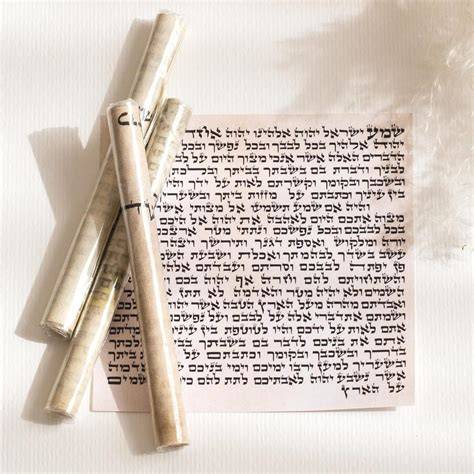
Shema is contained in the mezuzah we affix to the doorpost of our home, and in the tefillin that we bind to our arm and head.
While praying, we wear tefillin as a visible sign of God close to our hearts and close to our brains, to show that our every thought and emotions are directed toward God.
The mezuzah scroll is affixed to our doorposts to show that we are secure in God's presence.
Part 3 introduces an third important symbol: tzitzit. Tzitzit are a physical reminder of the 613 commandments in the Torah.
This is derived from the numerical value of the word tzitzit (600), plus the five knots and eight strings on each corner, totaling 613.
The Central Themes of the Shema
The oneness of God
A primary theme of the first verse is the Oneness of God: “Hear O Israel, the Lord our God, the Lord is One” (Deut. 6:4).
Further, as written in a Torah scroll, the letters “Ayin” and “Daled” of the first verse are enlarged - encoded to spell out the Hebrew word Aid - “witness.” When we say the Shema, we are testifying to the Oneness of God.
The Shema is a declaration that all events are from the One, the only One. The confusion stems from our limited perception of reality.
One way of understanding God's oneness is to imagine light shining through a prism. Even though we see many colors of the spectrum, they really emanate from one light.
So too, even though it seems that certain events are not caused by God, rather by some other force or bad luck, they in fact all come from the One God. In the grand eternal plan, all is “good,” for God knows best.
This runs contrary to the Zoroastrian doctrine of dualism, which propounds the idea of two conflicting powers - good and evil.
When a Jew says Shema, it is customary to close and cover one's eyes. The other time in Jewish tradition that one's eyes are specifically closed is upon death.
Just as at the end of days we will come to understood how even the “bad” was actually for the “good,” so too while saying the Shema we strive for that level of belief and understanding.
Love with all the heart, soul, and might
The second verse in the Shema is: “And you shall love the Lord your God, with all your heart, with all your soul, and with all your resources” (Deut. 6:5).
What does it mean to love God with all your heart? The Talmud explains that the word “heart” is metaphorical for “desires.”
When the Shema says to “love God with all your heart,” it means to use not only your “good traits” like kindness and compassion to do God's will, but also to use your more challenging traits to serve Him.
What does it mean to “love God with all your soul”? The great Talmudic scholar, Rabbi Akiva (second century) loved God so much, that he taught Torah despite the Roman law forbidding it.
When the Romans found out, they sentenced him to a painful death. They took a large iron comb and began to scrape off his flesh.
As he was being tortured, Rabbi Akiva joyously recited the Shema - “Hear O Israel, the Lord our God, the Lord is One.”
Hearing and doing
The Shema means for us not just to hear and but also to act. Our hearing needs to result in practical changes in how we deal with our neighbours, our spouses and children, or how we spend our time and money.
“Hear, O Israel” means that all our being, our strength, our heart and mind is directed in a loving way to God.
Remember that for Jews, Shema Yisrael means to accept the yoke of the Kingdom of God upon oneself.
It therefore places us under a higher authority: the Lord is God, the Lord is one! He is the Creator of heaven and earth, He is my and your Creator.
He is the King of Kings and Lord of Lords, and thus demands to be the ultimate authority over our lives - right to the smallest detail.
But He does so as a loving Father who wants and knows what is best for every one of us.
The Shema as a Daily Act of Listening
The Jewish confession, however, is not so much a “we believe” statement but a divine command to hear, to listen to the voice of God regarding who He is - the one true God.
For Christians, it is therefore noteworthy that God defines His relationship to His people most clearly through the means of hearing - “Hear, O Israel!”
Jesus himself repeatedly called his disciples to “come and see”. Or he could have chosen even Psalm 34:9 as the defining verse of our relationship to him: “Taste and see that the Lord is good!”
But the hearing part fell woefully short, as the sermons back then were delivered in Latin, a language which very few understood.
Even today, our emotions are well served by spectacular new church buildings and holistic experiences in our services, but we often forget that the kingdom of God should be less ‘show-business’ and much more ‘hear-business’.
The Shema in Jewish and Christian Scripture
The question we need to ask ourselves is: Does the Shema bear any significance for us as Christians and for the Church? The answer comes directly from Jesus.
When asked to identify the most important commandment of the Bible, Jesus replied:
“The first of all the commandments is: ‘Hear, O Israel, the Lord our God, the Lord is one. And you shall love the Lord your God with all your heart, with all your soul, with all your mind, and with all your strength.’ This is the first commandment.” (Mark 12:29-30)
According to Jesus, it carried the highest relevance as the most prominent biblical commandment for his disciples and all who would follow him.
The Shema in Jewish Memory
The Shema is the very first prayer taught to a Jewish child when they start speaking, and it is the very last prayer a Jew is taught to say on their death bed.
It also became especially noted for its dramatic usage during the Holocaust.
The cry of Shema symbolizes the ultimate faith in the gravest situations. Throughout the ages, the cry of Shema has always symbolized the ultimate manifestation of faith in the gravest situations.
With the Shema on their lips, Jews accepted martyrdom at the Inquisitor's stake and in the Nazi gas chambers.
In 1945, Rabbi Eliezer Silver was sent to Europe to help reclaim Jewish children who had been hidden during the Holocaust with non-Jewish families.
How was he able to discover the Jewish children? He would go to gatherings of children and loudly proclaim Shema Yisrael - “Hear O Israel, the Lord our God, the Lord is One.”
Then he would look at the faces of the children for those with tears in their eyes - those children whose distant memory of being Jewish was their mothers putting them to bed each night and saying the Shema with them.
Former Chief Rabbi Yisrael Meir Lau has repeatedly told the story of how many Jewish children were hidden in Christian orphanages during the Holocaust.
When they searched for the Jewish children after the war, it often was difficult to find and separate the Jewish youths among the Christian orphans.
But Rabbi Lau said it was enough just to start proclaiming “Shema Israel”, and the Jewish children would instinctively reply with “Adonai Eloheinu, Adonai Ehad.”
How the Shema Fits into Daily Prayer
The entire daily prayer is composed of three biblical passages. The first is from Deuteronomy 6:4-9, which is the commandment to love the Lord with all your heart, all your soul and all your strength.
The second passage included in the traditional Shema prayer is taken from Deuteronomy 11:13-21, which underlines the prayer’s spiritual significance: Blessing comes with obedience, but if Israel should turn aside from Adonai they would “perish from the good Land” the Lord had given them.
Finally, the third passage comes from Numbers 15:15-41, where the command is given to undertake practical steps to incorporate the Shema into daily customs and rituals.
This includes the command to place the fringes (tsizit) on one’s garment, the mezuzot at every door post, and the binding of phylacteries (tfillin) on the arm and forehead - all of which contain the above-mentioned Bible passages.
This ancient tradition to combine these passages in the Shema prayer dates back well over 2,000 years and is already mentioned in the Qumran scrolls.
Jewish rabbis teach that with every recital of the Shema prayer, every Jew accepts the yoke of the Kingdom of God upon his shoulders.
In services, the Shema is normally followed one of two other prayers: in the evening, Emet ve'Emunah (True and Faithful), which emphasizes His powerful deeds for Israel; in the morning, Emet v'Yatziv (True and Certain), which emphasizes His characteristics.
The prayers are tied together when the chazzan loudly proclaims the last two words of the Shema with the first word of the next prayer: Adonai Eloheikhem Emes! (The Lord, Your God, is True! or It is True that the Lord is our God!)
The Shema as a Call to Action
Interestingly, it was exactly the ‘hearing’ part that Israel also often struggled with. The prophet Jeremiah repeatedly challenged Israel for not hearing what God had spoken.
“Hear this now, O foolish people, … who have ears and hear not…” (Jeremiah 5:21); “… Indeed their ear is uncircumcised, and they cannot give heed …” (Jeremiah 6:10); “… I spoke to you, rising up early and speaking, but you did not hear, and I called you, but you did not answer,… ” (Jeremiah 7:13).
As a consequence, Jeremiah saw Israel being judged by God and exiled to Babylon. And if we are honest with ourselves, this was not just Israel’s problem but so often it also is our very own problem today.
Even the disciples struggled with hearing and understanding the message of Jesus (Mark 8:17ff; 16:14). And this means we all need to be watchful over how we hear.
Thus, Jesus admonishes his disciples: “Therefore take heed how you hear!” (Luke 8:18).
That means in the eyes of Jesus there is hearing, and then there is truly hearing. You can hear and yet not really listen to God’s voice.
It is this perpetual struggle to hear Him which presents possibly our biggest challenge as believers.
Too often, we select between what we want to hear and what we deem as not relevant for us.
Already in Paul’s time, Christians were drawn to teachers who “tickled their ears”, who taught what the people wanted to hear rather than what they needed to hear.
And even more, we often are sincerely touched by God’s voice in a sermon or daily reading, but our busy lifestyles distract us immediately and we become what the Apostle James calls “forgetful hearers” (James 1:24ff).
God speaks to us in many ways. Of course, primarily it is through the Word of God, the Bible, and through the preaching of the Word.
But often He also talks to us through circumstances or even in our very own daily lives. But do we hear?
Let us be hearers of the word of God, and doers as well! Shema Yisrael!