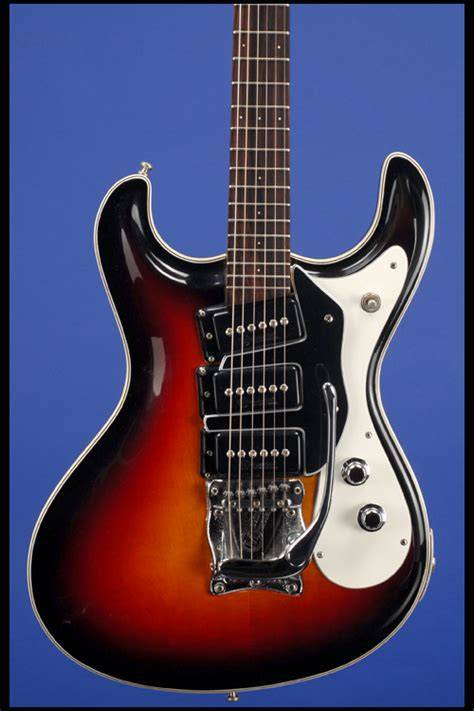
Mosrite Gospel guitars were instruments associated with Semie Moseley’s religious background and his intention to create a line specifically for gospel performers. The Gospel designation was used on both lower-priced solid-body instruments and scarce hollowbody models, and it identified a particular market and identity rather than a completely separate approach to guitar construction.
The best-known Gospel instrument is the Mark V, a lower-priced model positioned below the Mark I. Early examples were branded “Mosrite Ventures Model” like the Mark I instruments, while the Gospel versions were made to market to gospel performers. Kurt Cobain’s use of a Gospel-branded Mark V later brought exceptional attention to a model that otherwise might have remained a small footnote in Mosrite history.
Semie Moseley and the Origins of Mosrite
Luthier/designer Semie Moseley (1935-1992) was born in Durant, Oklahoma. The family moved to Bakersfield, California when Moseley was 9 years old, and Semie left school in the seventh grade to travel with an evangelistic group playing guitar.
Moseley, 18, was hired by Paul Barth to work at Rickenbacker in 1953. While at Rickenbacker, Moseley worked with Roger Rossmeisl. Rossmeisl´s "German carve" technique was later featured on Moseley´s guitar models as well.
Moseley was later fired from Rickenbacker in 1955 for building his own guitar at their facilities. In the later years, Moseley always credited Barth and Rossmeisl (and the Rickenbacker company) for his beginning knowledge in guitar building.
With the help of Reverend Ray Boatright, who cosigned for guitar building tools at Sears, Moseley began building his original designs. The Mosrite trademark is named after Moseley and Boatright ("-rite").
After leaving Rickenbacker, Moseley built custom instruments for various people around southern California, most notably Joe Maphis (of "Town Hall Party" fame). Moseley freelanced some work with Paul Barth´s "Barth" guitars, as well as some neck work for Paul Bigsby.
After traveling for several months with another gospel group, Moseley returned to Bakersfield and again set up shop. Moseley built around 20 guitars for Bob Crooks (Standel).
The Development of the Mosrite Body Shape
When Crooks asked for a Fender-styled guitar model, Moseley flipped a Stratocaster over, traced the rough outline, and built the forerunner to the Ventures model!
As best as myself or anybody else has been able to ascertain, the body shape that is most often known as the "Mark 1" or the "Ventures-style" body was developed around 1961 or 1962 when Bob Crooks of Standel wanted Semie Moseley to build some Standel guitars for him.
Now, Semie had already built some guitars for Standel around 1959 or 1960. They are basically like the Mosrite guitar I posted on the list a couple days ago, but you can tell they are slightly later because Semie learned he had to put the jack on a separate plate or the whole pickguard would break!
A year or two later, as the legend goes, Bob Crooks of Standel wanted a different kind of guitar. He suggested to Semie that he take the shape of a Fender Stratocaster, flip it over and trace it. Semie supposedly did just that, and then he added a little Salvador Dali fairy dust, and the famous shape that we know was born.
The only problem with this fairy tale story? There have never been any guitars from this era 1961-1962 with the Standel logo on them turn up. ever. It's possible that the first one was made as a Standel prototype, but that has yet to surface.
What have turned up are a couple of these, which may be Standel prototypes, but I have also heard that these were "mistake" guitars where a young kid working for Semie accidentally sawed the "M" off the top of the headstock.
Nonetheless, we can probably surmise that if a Standel prototype existed, it looked something like this.
Are you confused yet? Well, to make it even more convoluted, these 1961-1962 prototypes are not to be confused with a production model Standel guitar from about 1965-1966 that was a direct COPY of a Mosrite.
Around 1961 or 1962, the "Mosrite Joe Maphis Model" single-neck and double-neck guitars made their debut. This is really where the "mark 1-Ventures style" guitar came from. it is not a "Ventures prototype" as they have been called, and it was not a side line to the Ventures model.
Joe Maphis, the famous country picker, was promised his own signature model guitar, and these guitars were the "Joe Maphis Model" guitar.
From the Joe Maphis Model to the Ventures Model
I have seen the Joe Maphis model guitars with wood pickup covers, "dog-ear" handmade pickup covers, and the well-known pickup with the rectangular surround as found on all Ventures models.
What happened next is that Nokie Edwards, guitarist for the hit recording group The Ventures, played a Joe Maphis-style model that belonged to Gene Moles, a buddy of his in Bakersfield. Nokie borrowed the guitar and the group liked the design and how it sounded.
The group had been wanting to market a signature guitar and bass of their own, and they decided to ask Semie Moseley if this guitar could be the Ventures model guitar.
Semie Moseley jumped at the chance to have a hit rock & roll group endorsing his guitars. The group had a ton of capital to infuse the company with, and so for the time being Joe Maphis got shafted--his signature model was put on hold.
As many of us know the Joe Maphis model name was ressurected in 1966 for a completely redesigned singleneck, doubleneck, and bass.
The next thing you know the "Joe Maphis model" guitar is now "The Ventures" model guitar. The first few guitars shipped in late 1963. They were exactly the same as the Joe Maphis guitar, but the headstock now said "The Ventures".
After Nokie Edwards (Ventures) borrowed a guitar for a recording session, Stan Wagner (Ventures Manager) called Moseley to propose a business collaboration. Mosrite would produce the instruments, and use the Venture´s organization as the main distributor.
The heyday of the Mosrite company was the years between 1963 and 1969. When the demand set in, the company went from producing 35 guitars a month to 50 and later 300.
The Mosrite facility had 105 employees at one point, and offered several different models in addition to the Ventures model, such as the semi-hollowbody Celebrity series, the Combo, and the Joe Maphis series.
Why the “Mark I” Name Can Be Misleading
The first time the Ventures model guitar was called the "Mark 1" was in the 1966 Mosrite literature. Shortly thereafter, the Ventures and Semie Moseley parted ways and the same guitar was still called the "Mark 1" in the catalog and advertising (1967-1968) but there was no reference to the Ventures.
So maybe I'm just being a nerd about this, but it seems weird to keep calling the guitar the Mark 1 when it was only known as that towards the tail end of its original production run.
The body style is therefore connected to several stages of Mosrite history: early Standel-related experiments, the Joe Maphis instruments, the first Ventures guitars, and later Mark I catalog designations.
Why Mosrite Made Gospel Models
The "Gospel" versions were made to market to gospel performers--Semie Moseley was a gospel musician and preacher, and he wanted to have a line specifically for players in that genre.
The Gospel name consequently reflected Moseley’s personal background as well as a deliberate attempt to reach musicians in gospel performance. It was not simply a casual label added after production.
The Mark V was a lower-priced model, below the Mark I. The early ones were branded "Mosrite Ventures Model" like the Mark I's.
If it hadn't been for Kurt Cobain's use of that Gospel-branded Mark V, they'd be a footnote in Mosrite history, but his guitar was for all intents and purposes a Mark V, as the two models were identical except for the name.
In fact, until I saw Kurt's, I'd never seen a Gospel-branded Mark V.
Most of the Gospel guitars were hollowbodies like the Celebrity, but they're scarce too--it appears that regular Mosrite production far outnumbered Gospel production.
There are some Gospel Mark I's out there with different body contours and finishes than the Mosrite versions, but they seem to date from a later period--'70's or '80's.
The Mosrite Gospel Mark I
The cataloged Mosrite Gospel model was the Gospel (Mark I, Model 600), produced in 1967-69. It used a bound arched top, arched back, 2.75 in. body width, and a semi-hollowbody construction.
Its construction included a select maple top, maple back/sides, and maple neck. The body had 2 bound f-holes, a 24.5 in. scale, and a 22-fret bound rosewood fingerboard.
The headstock carried the "Mosrite of California/Gospel Guitar" logos. The instrument used a roller bridge/vibrato tailpiece, 3-per-side tuners, a raised black pickguard, and chrome hardware.
Electronics consisted of 2 black single coil pickups with exposed pole pieces, 2 volume/2 tone controls, and a 3-way selector switch. A black "apostrophe" plastic controls plate was mounted on the lower bout.
The listed finish was Natural finish with tinted Golden Brown headstock, giving the model a restrained appearance compared with some of the more colorful solid-body Mosrite finishes.
Gospel Bass
The Gospel Bass (Mark X, 601) was produced in 1967-69. It used a bound arched top, arched back, 2.75 in. body width, and a semi-hollow body.
The bass had a select maple top, maple back/sides, and maple neck. It featured 2 bound f-holes, a 30.25" scale, and a 20-fret bound rosewood fingerboard.
The headstock carried the "Mosrite of California/Gospel Guitar" logos. Other features included an adjustable bridge, 2-per-side tuners, a raised black pickguard, and chrome hardware.
Its electronics included 2 black pickups with exposed pole pieces, 2 volume/2 tone controls, and a 3-way selector switch. The lower bout used a black "apostrophe" plastic controls plate.
The listed finish was Natural finish with tinted Golden Brown headstock.
The Mark I: The Main Solid-Body Reference Point
The Mosrite Mark I was produced in 1967-69. It used an offset double cutaway solid body, a bolt-on maple neck, a 24.5 in. scale, and a 22-fret bound Indian rosewood fingerboard.
The hardware included a roller bridge/vibrato bridge, chrome hardware, and a white pickguard. The electronics consisted of 2 black single coil pickups, volume/tone controls, and a 3-position switch.
Available finishes included Cherryburst, Deep Black, Metallic Blue, Metallic Red, Pearl White, Trans. Cherry Red, or Trans. Sunburst.
The Mark V occupied a lower-priced position below this model. Its early examples were branded "Mosrite Ventures Model," while its Gospel counterpart retained the Gospel identity.
Other Important Mosrite Models
Ventures Models and Basses
The Mosrite Ventures Model Bass from 1963-65 used a bound offset double cutaway hardwood body, a set-in maple neck, a 20-fret bound fingerboard, and an adjustable bridge.
It had chrome hardware, 2-per-side tuners, a white pickguard, 2 black pickups, volume/tone controls, and a 3-position switch. It was available in Sunburst or White Pearl finish.
The Ventures Bass (Model Mark X, # 103) was produced in 1963-66. It used an offset double cutaway hardwood body, a bolt-on maple neck, a 30.25" scale, and a 20-fret bound rosewood fingerboard with dot inlay.
Its headstock carried the "Mosrite of California/The Ventures" logo. The bass had a fixed bridge, chrome hardware, a white pickguard, 2 black single coil pickups, volume/tone controls, and a 3-position switch.
Available finishes were Metallic Blue, Metallic Red, or Sunburst.
Celebrity Series
The Celebrity I (Mark I, CE I, # 202) was a semi-hollow double cutaway model produced in 1966-69. It had an arched top and back, 2.75 in. body depth, a spruce top, maple back/sides, double body binding, and 2 bound f-holes.
The model used a maple neck, a 24.5 in. scale, a zero fret, and a 22-fret bound rosewood fingerboard. Its hardware included a roller bridge/vibrato tailpiece, 3-per-side deluxe chrome tuners, and chrome hardware.
Electronics included 2 black single coil pickups with exposed pole pieces, volume/tone controls, and a white "apostrophe" plastic controls plate on the lower bout. It was available in Transparent Cherry Red or Transparent Sunburst finish.
The Celebrity I Bass (Mark X, Model CE I, # 203) used an arched top and back, 2.75 in. body depth, a semi-hollow double cutaway body, a spruce top, maple back/sides, bound top and back, and 2 bound f-holes.
It had a maple neck, a 30.25" scale, a 20-fret bound rosewood fingerboard, a fixed bridge, a chrome bridge cover, and 2-per-side tuners. The instrument used 2 black pickups with exposed pole pieces, volume/tone controls, and a 3-way selector switch.
Available finishes were Trans. Cherry Red or Trans. Sunburst.
The Celebrity Bass (Mark X, Model CE II, # 212) was a semi-hollowbody model with a spruce top, maple back/sides, double body binding, a maple neck, one bound f-hole, and a bound rosewood fingerboard.
It used 2-per-side tuners, an adjustable bridge/metal tailpiece, a chrome bridge cover, chrome hardware, 2 adjustable pickups, volume/tone controls, and a 3-way selector switch. Available finishes were Trans. Cherry Red or Trans. Sunburst.
The Celebrity Bass (Mark X, Model CE III, # 221) was similar to the Combo (Mark I) (Model CE II), except features maple top, curly maple back/sides, white body purfling, Indian rosewood fretboard, 2 black pickups, and 2-per-side enclosed tuners with white buttons.
It was available in Trans. Cherry Red or Trans. Sunburst finish.
Combo Series
The Mosrite Combo I (Mark I, Model 300) was a hollow body produced in 1966-69. It had a 1.5 in. body depth, a spruce top, maple back/sides, double body binding, a hard rock maple neck, and one bound f-hole.
The model featured a zero fret, a 24.5 in. scale, and a 22-fret bound Indian rosewood fingerboard with dot inlay. Its hardware included a roller bridge/Mosrite vibrato tailpiece and 3-per-side Kluson deluxe chrome tuners.
It used a white pickguard, chrome hardware, 2 adjustable pickups, volume/tone controls, and a 3-way selector switch. Available finishes were Trans. Cherry Red or Trans. Sunburst.
The Combo 1 Bass (Mark X, 301) was a hollow-body model with a spruce top, maple back/sides, double body binding, a hard rock maple neck, and one bound f-hole.
It used a 30.25" scale, a 20-fret bound rosewood fingerboard, 2-per-side Kluson deluxe chrome tuners, an adjustable bridge, and a chrome bridge cover.
Other features included chrome hardware, 2 adjustable pickups, volume/tone controls, and a 3-way selector switch. Available finishes were Trans. Cherry Red or Trans. Sunburst.
Joe Maphis Models
The Joe Maphis Model Mark I, # 501 was a slightly offset double semi-hollow body with a 1.5 in. body depth, a bound spruce top, and a walnut back.
It used a hard rock maple neck, a 24.5 in. scale, and a 22-fret celluloid bound rosewood fingerboard. The instrument had a laminated black or white shell pickguard, a deluxe adjustable roller bridge/vibrato tailpiece, 3-per-side tuners, and chrome hardware.
Its electronics included 2 adjustable pickups, volume/tone controls, and the listed finishes were Natural or Transparent Sunburst.
The Joe Maphis Bass (Model Mark X, 502) was a semi-hollowbody with a bound spruce top, 1.5 in. body depth, walnut back, maple neck, and a 30.25" scale.
It used a 20-fret rosewood fingerboard, a fixed bridge, a laminated black or white shell pickguard, a chrome bridge cover, 2-per-side tuners, and chrome hardware.
The bass had 2 adjustable pickups, volume/tone controls, and a 3-way selector switch. Available finishes were Natural or Trans. Sunburst.
V-I and V-II Models
The Mosrite V-I Standard, produced circa 1972-75, used an offset double cutaway solid body, a bolt-on maple neck, and a 22-fret bound rosewood fingerboard with dot inlay.
It had a roller bridge/vibrato bridge, 3-per-side tuners, a natural finish headstock, a white pickguard, and chrome hardware. Its electronics included 2 black single coil pickups with exposed pole pieces, 2 volume/1 tone controls, and a 3-position switch.
Available finishes were Red or Sunburst.
The Mosrite V-I Bass, also identified as the V I Standard Bass, was manufactured circa 1972-75. It used an offset double cutaway solid body, a bolt-on maple neck, and a 20-fret bound rosewood fingerboard with double dot inlay.
The bass had an adjustable bridge/stop tailpiece, a chrome bridge cover, 2-per-side tuners, a natural finish headstock, a white pickguard, chrome hardware, and 2 black pickups with exposed pole pieces.
Its controls included volume/tone controls and a 3-position switch. It was available in Red or Sunburst finish.
The Mosrite V-II was produced from 1973-75. It used an offset double cutaway solid body, a bolt-on maple neck, and a 22-fret bound rosewood fingerboard.
Its hardware included a roller bridge/vibrato bridge, 2-per-side tuners, a natural finish headstock, a white pickguard, and chrome hardware.
The electronics included 2 black humbucker pickups with exposed pole pieces, 2 volume/2 tone controls, a 3-position switch, and 2 bypass switches. Available finishes were Red or Sunburst.
Mosrite 1988
The Mosrite 1988 Guitar (M-88), produced circa 1988, used an offset double cutaway basswood body without a German carve body ridge, a 3-piece laminated maple neck, a zero fret, and a 22-fret laminated curly maple/rosewood fingerboard.
The headstock carried the "Mosrite 1988" logo. The model was available with a vibrato or fixed bridge, 3-per-side tuners, chrome hardware, and 2 creme-colored Alnico single coil pickups.
It used volume/tone controls, a 3-position switch, and a side-mounted 1/4 in. jack. Available finishes included Banana, Diamondized Ebony Black, Diamondized Money Green, Diamondized Ruby Red, or Sunburst.
The Mosrite 1988 Bass (M-88 Bass) used an offset double cutaway basswood body without a German carve body ridge, a 3-piece laminated maple neck, a zero fret, and a 20-fret laminated curly maple/rosewood fingerboard.
It carried the "Mosrite 1988" logo on the headstock and was available with a vibrato or fixed bridge. Other features included 2-per-side tuners, chrome hardware, and 2 creme colored Alnico pickups.
The controls included volume/tone controls and a 3-position switch, while the instrument used a side-mounted 1/4 in. jack. Available finishes included Banana, Diamondized Ebony Black, Diamondized Money Green, Diamondized Ruby Red, or Sunburst.
Later Reissues and Signature Models
The Ventures Early 1960s Reissue with bolt-on neck was produced circa 1987-1990. It used an offset double cutaway basswood or alder body, a bolt-on maple neck, and a 22-fret rosewood fingerboard.
It was available with a vibrato bridge or tailpiece, 3-per-side tuners, chrome hardware, a white pickguard, and 2 black Alnico single coil pickups. Its electronics included volume/tone controls and a 3-position switch.
The Ventures Early 1960s Reissue, identified as Ventures Reissue ´63, used a bound offset double cutaway alder body, a glued-in maple neck, and a bound rosewood fingerboard.
It featured an original-style sand cast Vibramute vibrato bridge, 3-per-side tuners, chrome hardware, a white pickguard, 2 black Alnico single coil pickups, volume/tone controls, and a 3-position switch.
It also used a side-mounted jack and was available in Black, Sunburst, or White finish. It was manufactured circa 1987-1990.
The Ventures Vintage Bass with set-neck was produced circa 1990. It used a bound offset double cutaway alder body, a glued-in maple neck, a 20-fret bound rosewood fingerboard, and a fixed bridge.
Other features included 2-per-side tuners, chrome hardware, a white pickguard, and 2 black Alnico single coil pickups. It used volume/tone controls, a 3-position switch, and a side-mounted jack.
Available finishes were Black, Sunburst, or White.
The Mosrite Ramones Model was produced circa 1992. It used an offset double cutaway basswood or alder body, a maple neck, and a 22-fret rosewood fingerboard with double dot inlay.
The headstock had a natural wood finish with the Mosrite/Ramones logo. The guitar used 3-per-side tuners, a tune-o-matic bridge/stop tailpiece, a black pickguard, chrome hardware, and a black covered Mosrite pickup.
Its controls consisted of a volume control, and the jack was top-mounted. The listed finish was Gold.
Construction Features and Their Effect on Sound
Mosrite’s solid-body instruments were commonly built around offset double cutaway shapes, maple necks, rosewood fingerboards, white pickguards, chrome hardware, and two pickups. The Mark I used a bolt-on maple neck, a 24.5 in. scale, a roller bridge/vibrato bridge, and 2 black single coil pickups.
The Gospel Mark I differed structurally from that solid-body formula by using a bound arched top, an arched back, a 2.75 in. body width, and a semi-hollowbody construction. It also used 2 bound f-holes and a roller bridge/vibrato tailpiece.
The Gospel model’s 2 black single coil pickups with exposed pole pieces, 2 volume/2 tone controls, and 3-way selector switch provided a broader control layout than the basic Mark I’s volume/tone controls.
Hollow and semi-hollow Mosrite designs included the Celebrity, Combo, Joe Maphis, and Gospel families. Their spruce tops, maple backs and sides, arched construction, and f-holes distinguished them from the sharper solid-body response of the offset Mark models.
The Joe Maphis-style instruments were especially important because the later Ventures model inherited their essential design and hardware. The first few Ventures guitars were exactly the same as the Joe Maphis guitar, but the headstock now said "The Ventures".
What Mosrite Gospel Guitars Sound Like
The available descriptions show that Mosrite Gospel guitars were not defined by a unique pickup technology separate from the rest of the company’s instruments. Their sound was shaped by the combination of Mosrite single-coil pickups, the individual body construction, the short 24.5 in. guitar scale, the vibrato system, and the amplifier used.
The Gospel Mark I’s semi-hollow maple construction and arched body point to a different acoustic foundation from the solid-body Mark I or Mark V. The two black single coil pickups with exposed pole pieces provide the direct, articulate electrical character associated with Mosrite’s classic pickup layout, while the semi-hollow body adds a more resonant platform.
The Gospel Mark V was essentially a Mark V apart from the name. Its sound should therefore be understood through the lower-priced solid-body Mosrite design rather than through the semi-hollow Gospel Mark I alone.
The contrast between the Gospel Mark I and Gospel Mark V is important: the Gospel name could appear on instruments with different construction concepts, so the designation did not guarantee one single voice.
The Mosrite instruments were also closely connected with the sounds of country, gospel, and instrumental rock. Moseley’s work for Joe Maphis placed his designs in a country-picking environment, while the Ventures partnership connected the offset solid body to a sharp, immediate instrumental-rock aesthetic.
Nokie borrowed the guitar and the group liked the design and how it sounded. This response helped turn the Joe Maphis-style instrument into the Ventures model and gave the Mosrite design a prominent place in electric-guitar history.
Gospel Models Compared with Other Mosrite Designs
| Model | Production period | Construction | Pickups and controls |
|---|---|---|---|
| Gospel Mark I, Model 600 | 1967-69 | Semi-hollowbody, bound arched top and back, maple construction, 2 bound f-holes | 2 black single coil pickups with exposed pole pieces, 2 volume/2 tone controls, 3-way selector |
| Gospel Bass, Mark X, 601 | 1967-69 | Semi-hollow body, bound arched top and back, maple construction, 2 bound f-holes | 2 black pickups with exposed pole pieces, 2 volume/2 tone controls, 3-way selector |
| Mark I | 1967-69 | Offset double cutaway solid body, bolt-on maple neck | 2 black single coil pickups, volume/tone controls, 3-position switch |
| Celebrity I | 1966-69 | Semi-hollow double cutaway, spruce top, maple back/sides, 2 bound f-holes | 2 black single coil pickups with exposed pole pieces, volume/tone controls |
| Combo I | 1966-69 | Hollow body, spruce top, maple back/sides, one bound f-hole | 2 adjustable pickups, volume/tone controls, 3-way selector |
| V-I Standard | Circa 1972-75 | Offset double cutaway solid body, bolt-on maple neck | 2 black single coil pickups with exposed pole pieces, 2 volume/1 tone controls |
| V-II | 1973-75 | Offset double cutaway solid body, bolt-on maple neck | 2 black humbucker pickups with exposed pole pieces, 2 volume/2 tone controls, 2 bypass switches |
Production, Distribution, and Decline
In 1963, investors sold the Dobro trademark to Moseley, who built the first 100 or 150 out of parts left over from the Dobro plant in Gardenia.
Later Bakersfield Dobros can be identified by the serial number imprinted on the end of the fingerboard.
The Mosrite company did not build the amplifiers which bear the Mosrite trademark; another facility built the Mosrite amplifiers and fuzz pedals, and paid for the rights to use the Mosrite name.
The amplifier line proved to be the undoing of Mosrite. While some of the larger amplifiers are fine, one entry level model featured a poor design and a high failure rate.
While covering for returns, the Ventures organization used up their line of credit at their bank, and the bank shut down the organization. In doing so, the Mosrite distribution was shut down as well.
Moseley tried a deal with Vox (Thomas Organ) but the company was shut down in 1969. Moseley returned to the Gospel music circuit, and transferred the Dobro name to OMI in a series of negotiations.
Instruments previously produced in Bakersfield, CA during the 1960s; earlier models built in Los Angeles, CA during the mid to late 1950s.
There were other factory sites around the U.S. during the 1970s and 1980s: other notable locations include Carson City, NV; Jonas Ridge, NC; and Booneville, AR, previous home of Baldwin-operated Gretsch production during the 1970s.
Distribution in the 1990s was handled by Unified Sound Association, Inc. Production of Mosrite guitars ceased in 1994.
How to Identify a Mosrite Gospel Guitar
- Look for the "Mosrite of California/Gospel Guitar" headstock logos on the Gospel Mark I and Gospel Bass.
- Check whether the instrument has a semi-hollow body, bound arched top and back, and 2 bound f-holes.
- The Gospel Mark I uses a 24.5 in. scale and a 22-fret bound rosewood fingerboard.
- The Gospel Bass uses a 30.25" scale and a 20-fret bound rosewood fingerboard.
- Inspect the raised black pickguard and the black "apostrophe" plastic controls plate on the lower bout.
- Look for black pickups with exposed pole pieces and chrome hardware.
- Do not assume that every Gospel-branded Mosrite is the same model, because the Gospel designation appeared on both solid-body and hollowbody instruments.
- Gospel Mark I's with different body contours and finishes than the Mosrite versions seem to date from a later period--'70's or '80's.
Why the Gospel Models Matter
Mosrite Gospel guitars occupy a distinctive place in the company’s history because they connect Semie Moseley’s personal religious life with a deliberate product direction. Moseley was a gospel musician and preacher, and he wanted to have a line specifically for players in that genre.
They also show how widely Mosrite’s designs ranged. The company is often associated with the offset solid-body Ventures silhouette, but its catalog included semi-hollowbody Celebrity models, hollow Combo instruments, Joe Maphis designs, basses, and Gospel versions.
The Gospel Mark V is historically significant because its close relationship to the Mark V demonstrates that the Gospel name could identify branding and intended audience as much as construction. The Gospel Mark I, by contrast, is notable for its semi-hollowbody architecture, arched maple body, f-holes, and expanded control layout.
Most of the Gospel guitars were hollowbodies like the Celebrity, but they're scarce too--it appears that regular Mosrite production far outnumbered Gospel production.
That scarcity, combined with the later visibility of Kurt Cobain’s Gospel-branded Mark V, has made the Gospel name unusually memorable relative to the apparently small number of instruments produced.