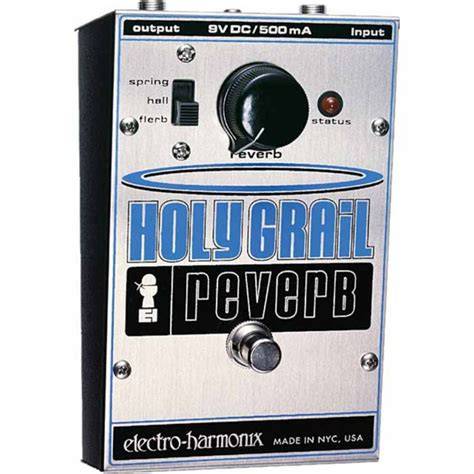
The Electro-Harmonix Holy Grail is a simple digital reverb pedal for guitar and other instrument-level sources, offering Spring, Hall and Flerb modes, a wet/dry control, and bypass switching. Its strongest feature is the convincing Spring setting, which closely approaches the character of classic guitar-amp spring reverb.
The Holy Grail Plus expands the basic design with four settings-Spring, Hall, Room and Flerb-and separate Blend and Amount controls. The larger Holier Grail goes further with Room reverb, selectable long and short decays, and several gate functions, making it more versatile but also more complicated as a floor pedal.
Electro-Harmonix Holy Grail features
The Electro-Harmonix Holy Grail is probably the simplest digital reverb unit on the planet. Designed for guitar, the pedal will work with any instrument-level source, including -10dBu line signals. It has a high input impedance to suit electric guitars, but only a single, unbalanced mono output.
By way of controls, there's a three-way slide switch and a wet/dry mix knob, plus a bypass footswitch. Power comes from an included 9V adaptor. Three reverb options are available via the slide switch: Spring, Hall and Flerb.
| Feature | Holy Grail | Holy Grail Plus | Holier Grail |
|---|---|---|---|
| Reverb modes | Spring, Hall and Flerb | Spring, Hall, Room and Flerb | Spring, Hall, Room and Flerb |
| Controls | Wet/dry mix knob and three-way slide switch | Blend and Amount knobs | Reverb controls, decay switch and gate controls |
| Output | Single, unbalanced mono output | Not specified | Not specified |
| Power | Included 9V adaptor | Not specified | Not specified |
Spring reverb sound
The first, Spring, is modelled on the spring reverbs found in typical guitar combos, right down to the rhythmic flutter, though there's no 'sproing' when you kick the unit! As with the real thing, the only variable is how much you dial in, but I thought it was actually pretty good.
I had tried a friend's EH Holy Grail pedal and was surprised at how realistic the spring reverb setting sounded through a guitar amp. Great pedal to have, especially if you're using a reverb-less amp.
The Holier Grail's best attribute is the quality of its spring reverb sound. I A-B'd it with a reissue Fender tube spring reverb unit, which in my mind is the archetype of how classic guitar reverb should sound.
I plugged a Telecaster into each unit and ran them into an old Fender Bassman amp. Carefully (and of course, subjectively) comparing the two, I was astonished at how close the Holier Grail sounded to the Fender unit, especially at "dryer" settings.
It had that nice subtle "boing" that other digital reverbs can't quite get right. At one point-and I'm not joking-I picked up the Holier Grail very gingerly, subliminally thinking that if I handled it roughly, the spring would clang and make an awful racket through the amp.
At "wetter" settings I found the Holier Grail sounded ever-so-slightly tinnier than the Fender, and lacked some of the Fender's richness. Still, this is a very handy effect for someone who might not want to lug a Fender reverb tank to gigs (not to mention deal with stage-vibration problems inherent to the Fender units).
Hall, Room and Flerb modes
Hall
Next is 'Hall', and though it may be a little on the generous side for some types of music, it's absolutely perfect for doing cover versions of Peter Green's 'Albatross' or that type of blues that sounds as though it was recorded at a large venue when nobody turned up!
The Holy Grail Plus has a warm, lush reverb, and the Hall setting can create the impression of hearing a guitar in a large acoustic space. The blend control makes it possible to move from a mostly direct guitar sound toward a more distant, reverberant presentation.
Room
Upping the ante, the Holier Grail adds a pretty nice "room" reverb sound, a switch which lets you choose between long and short decays, and a gate function.
There are four settings: Spring, Hall, Room, and Flerb. Now, it stumps me, because it would make sense for the hall setting to be after room, because that is the order for how much reverb you can get, from smallest to largest, but whatever, no big deal.
The room and spring settings are nothing to shake a stick at. They will also blow your mind as well. It doesn’t sound processed at all, in my opinion, and is some of the best reverb I’ve heard (at least, a reverb that comes in pedal form).
Flerb
As for Flerb, the manual (actually a piece of blue paper) says that it is 'a beautiful reverb like nothing you have heard before and may help you to play your instrument in new ways'.
To me, though, it sounds like a flanged reverb, a bit like the guitar effect on the intro to 'Shine On' by Pink Floyd, though the modulation was preset a little too deep for my taste.
The flerb setting is very different. It is still a reverb, however, it adds a flange to it, and makes it very space like, and I could see being useful for ambient sounds.
The Holier Grail provides great-sounding spring reverb, okay-sounding hall reverb, and a weird effect called "flerb" which is sort of a flanged reverb that most folks probably won't use very much.
Controls and sound shaping
There are two knobs (from left to right), blend and amount. The blend knob changes how your raw sound blends in with the reverb. The more blend you add, the more your sound gets put into the reverb sound.
So, for instance, if you put it all the way to the right, it sounds like you’re listening to your guitar from the back of the hall (at least, in the hall setting). Turn back the knob, and you find yourself listening to the perfect blend of guitar tone and reverb.
The amount is how much reverb is being put on your sound. The first three settings for the reverb are what you would expect, while Flerb provides a more pronounced modulated effect.
You’re probably wondering how the sound is on the reverb. Well, it’s a very warm, lush reverb, and if you close your eyes, you will feel like you are in a hall with the hall setting, and the room and spring settings are nothing to shake a stick at.
Holier Grail gate functions
The gate is kind of interesting. You can choose to gate just the reverb, '80s-style, or you can gate the direct and reverb signal. There is also a gate reverse switch which makes the gate work in reverse.
In other words, as the input signal gets louder and louder, normally it would reach a threshold and open the gate. But in this case, the signal is present until it reaches a set threshold, then when it gets loud enough, it shuts the signal off.
Kind of counter-intuitive, eh? The Holier Grail's manual suggests using this function to achieve swelling, backwards guitar effects. I'm sure this can be done, but I definitely had trouble mastering the necessary subtlety.
Overall, I felt the various gate functions were cool, but a bit much for a floor pedal. Even though the Holier Grail is very quiet and would work well in a studio situation (i.e., used through a board's effects bus), I couldn't help thinking that it has too much tweakability for a stompbox.
The Holier Grail is capable of some very cool things, but most of them would require a live performer to hover over the box twiddling knobs. Perhaps EH should consider developing a stereo rackmount version of it.
Electro-Harmonix - Holier Grail - Demo by Peter Stroud - Reverb- Gate
Using the pedal in a guitar signal chain
Of course, the weakness of any pedal reverb is that you're not actually adding reverb at the best place in the signal chain, unless you're playing clean guitar. Ideally it should come after the preamp (where most of the distortion happens in a modern guitar amp) so that clean reverb can be added to the distorted sound.
Placed at the front of the signal chain, anything more than mild overdrive will mess up the reverb, so the main beneficiaries are clean players or those who get their distortion from a pedal before the reverb unit.
Noise, connectivity and practical limitations
The quality is good though, other than a hint of background hiss which, after all, is an Electro-Harmonix tradition. Even so, I'm not sure the title Holy Grail can be honestly applied, though Damned Fine Coffee Mug wouldn't be stretching things too far.
- Pros: No learning curve at all! Two more reverbs than most guitar amps provide.
- Cons: A little noisy. Mono output limits usefulness in recording.
- Summary: A no-frills digital reverb in stomp-box format.
The single, unbalanced mono output keeps the basic Holy Grail straightforward, but it limits its usefulness in stereo recording setups. The pedal's high input impedance suits electric guitars, and its support for instrument-level sources also includes -10dBu line signals.
Which version suits which player?
If you're only looking for a convincing spring reverb sound in a stomp box, you'd probably want to just go for the original Holy Grail. Its main advantage is the direct, simple approach: select a reverb type, set the mix, and play.
But if you're an experimenter looking for some new sounds for the stage and the studio, for a few dollars more, the Holier Grail might fit the bill.
Overall, I'd recommend this pedal to anyone that’s looking for a reverb pedal to expand their sound. Like I said at the beginning, there’s not much to talk about, but what there is, it’s worth noting.
Reliability consideration
An endnote: For this review, EH initially sent me a defective unit, followed by a second defective one (the second one had a completely different problem than the first). Finally, the third one they sent worked like a charm.
If there is some sort of quality-control problem at Electro-Harmonix (and it sure seems like that may be the case; see Larry Crane's review of the Holy Grail in the Tape Op #31), I'd recommend not purchasing a Holier Grail through mail order. Instead, get it at a shop where you can audition it first.