Vatican City covers approximately 0.19 square miles. Its officially listed area is 0.49 square kilometers, equivalent to about 49 hectares or 121 acres.
Some references give a slightly smaller figure of 0.17 square miles, based on an area of 44 hectares. The commonly cited modern measurement, however, is 0.49 square kilometers, or approximately 0.19 square miles. With a population of about 882 people in 2024, Vatican City is the smallest sovereign state in the world by both area and population.
| Measurement | Vatican City |
|---|---|
| Area in square miles | 0.19 square miles |
| Area in square kilometers | 0.49 km2 |
| Area in hectares | 49 hectares |
| Area in acres | 121 acres |
| Population | 882 (2024 estimate) |
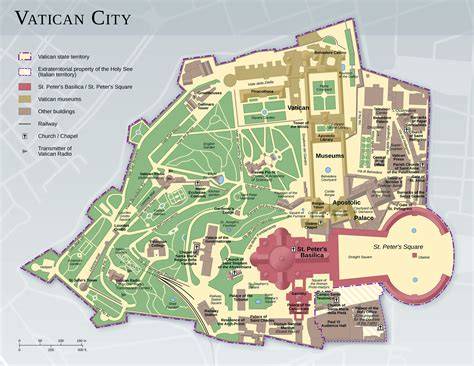
Where Vatican City Is Located
Vatican City, officially the Vatican City State, is a landlocked sovereign city-state in Southern Europe. It is an enclave within the city of Rome, Italy, and serves as the administrative centre of the Catholic Church.
Vatican City is situated on the west bank of the Tiber River and is surrounded by Rome. The territory is a tiny fragment when compared with the extensive Papal States of central Italy, which were conquered by the forces of Italian unification in the mid-19th century.
Vatican City is the world’s smallest fully independent nation-state. The Vatican City State, also known as The Vatican, became independent from Italy with the Lateran Treaty in 1929.
What 0.19 Square Miles Includes
Although Vatican City occupies only 0.19 square miles, it contains several of the most important religious, cultural, and administrative institutions of the Roman Catholic Church. The Vatican City itself packs many imposing buildings into its small area.
These include St Peter’s Basilica, a pilgrimage site. The Vatican Museums and Art Galleries house the priceless art collections of the popes.
Vatican City contains religious and cultural sites such as St Peter’s Basilica, the Sistine Chapel, the Vatican Apostolic Library, and the Vatican Museums. They feature some of the world’s most famous paintings and sculptures.
The medieval and Renaissance walls of Vatican City form its boundaries, except on the southeast at St. Peter’s Square. Of the six entrances, only three-the piazza, the Arco delle Campane, or Arch of the Bells, in the facade of St. Peter’s Basilica, and the entrance to the Vatican Museums and Galleries in the north wall-are open to the public.
The most imposing building is St. Peter’s Basilica, built during the 4th century and rebuilt during the 16th century. Erected over the tomb of St. Peter the Apostle, it is the second largest religious building in Christendom.
How Vatican City Compares with Other Places
Vatican City is smaller than many individual landmarks, parks, and urban sites. The area of Vatican City is 44 square kilometers or 0.17031 square miles.
| Place or area | Relative size compared with Vatican City |
|---|---|
| Fortnite map | 4.27 times as big |
| Hans Island | 2.95 times as big |
| London Eye | 0.10 times as big |
| Monaco | 4.55 times as big |
| Square Mile | 5.89 times as big |
Monaco is 4.55 times as big as Vatican City, while the area known as the Square Mile is 5.89 times as big. These comparisons show how compact Vatican City is even when compared with other famously small places.
Why Vatican City Is a Country
Vatican City is considered a country because it is an independent sovereign state with its own territory, government, head of state, legal system, institutions, and international status.
Ruled by the pope, it is an enclave within the city of Rome, Italy, and serves as the administrative centre of the Catholic Church. Vatican City is governed by the See of Rome, commonly known as the Holy See, itself a sovereign entity under international law, which maintains its temporal power, governance, diplomacy, and spiritual independence.
As governed by the Holy See, Vatican City State is an ecclesiastical or sacerdotal-monarchical state ruled by the pope, who is the bishop of Rome and head of the Catholic Church. The highest state functionaries are all Catholic clergy of various origins.
Vatican City is a unitary theocratic elective absolute monarchy. The pope is its sovereign, while the Pontifical Commission exercises legislative authority under powers delegated by the sovereign.
| Characteristic | Information |
|---|---|
| Official name | State of the Vatican City |
| Italian name | Stato della Città del Vaticano |
| Government | Unitary theocratic elective absolute monarchy |
| Sovereign entity | Holy See |
| Head of state | Pope |
| Official working language | Italian |
| State religion | Catholicism |
| Currency | Euro |
| Establishment | Lateran Treaty, 11 February 1929 |
Vatican City and the Holy See
The Holy See is the name given to the government of the Roman Catholic Church, which is led by the pope as the bishop of Rome. As such, the Holy See’s authority extends over Catholics throughout the world.
Since 1929 it has resided in Vatican City, which was established as an independent state to enable the pope to exercise his universal authority. Vatican is also used as a metonym for the Holy See, which is the central governing body of the Catholic Church and Vatican City, comprising the pope and the Roman Curia.
The independent state of Vatican City came into existence in 1929 via the Lateran Treaty between the Holy See and the Kingdom of Italy. The treaty spoke of it as a creation, not as a vestige of the much larger Papal States, which had previously encompassed much of central Italy.
Population and Density
Vatican City has a population of about 882 people according to the 2024 estimate. Today, the population is multinational and consists of about 900 people.
Priests and nuns of many nationalities make up almost all of the population. The inhabitants also include several hundred laypersons engaged in secretarial, domestic, trade, and service occupations.
With an area of 0.49 square kilometers and a population of about 882, Vatican City has a population density of approximately 2,205 people per square kilometer, or 5,710.9 people per square mile.
It is the only country in the world with a population of fewer than 1,000 people. It is also among the least populated capitals in the world.
Buildings and Services Within the Small Territory
Vatican City has its own telephone system, post office, gardens, astronomical observatory, radio station, banking system, and pharmacy, as well as a contingent of Swiss Guards responsible for the personal safety of the pope since 1506.
Almost all supplies-including food, water, electricity, and gas-must be imported. There is no income tax and no restriction on the import or export of funds.
Special extraterritorial privileges are extended to more than 10 other buildings in Rome and to Castel Gandolfo, the pope’s summer residence in the Alban Hills. In addition, Vatican City maintains embassies in numerous foreign nations.
The Vatican publishes its own influential daily newspaper, L’Osservatore Romano, and its press can print books and pamphlets in any of 30 languages, from old Ecclesiastical Georgian to Tamil. Since 1983 the Vatican has produced its own television programming. Its radio broadcasts are heard in some 40 languages in many parts of the world.
The History Behind the Modern City-State
The city of Rome has been an important center of Christianity since the early days of the church. St. Peter, considered the first pope, is thought to have lived and died in Rome.
In 313 Emperor Constantine I issued the Edict of Milan, which ended official persecution of Christians and opened the door to the growth of the church in both spiritual and material terms. By the 4th century the church had gained control of a great deal of territory, called the Patrimony of St. Peter, in and around Rome.
Papal influence in central Italy began to increase in the 5th century, as the Roman Empire fell apart and the people of the area began to rely on the pope for protection from invading armies. By about the year 600 the church was one of the largest landowners in the world.
The legal basis for the foundation of the Papal States was provided by the Donation of Pippin, which granted the pope the rights to large parts of central Italy in 754. The Papal States were a series of territories in the Italian Peninsula under the direct sovereign rule of the pope.
During the Renaissance, the papal territory expanded and popes became key secular rulers in Italy, as well as the heads of the Church. At their zenith, the Papal States covered most of central Italy, including Rome.
The Vatican Area in Ancient Rome
The name “Vatican” was already in use during the Roman Republic for the Ager Vaticanus, a marshy area on the west bank of the Tiber across from the city of Rome.
Vatican itself is derived from the name of an Etruscan settlement, Vatica or Vaticum, located in the general area the Romans called Ager Vaticanus, meaning “Vatican territory.”
Because of its vicinity to Rome’s archenemy, the Etruscan city of Veii, and for being subjected to the floods of the Tiber, the Romans considered this originally uninhabited part of Rome dismal and ominous.
During the Roman Empire, many villas were constructed there, after Agrippina the Elder drained the area and laid out her gardens in the early 1st century AD. In AD 40 her son, the emperor Caligula, built in her gardens a circus for charioteers.
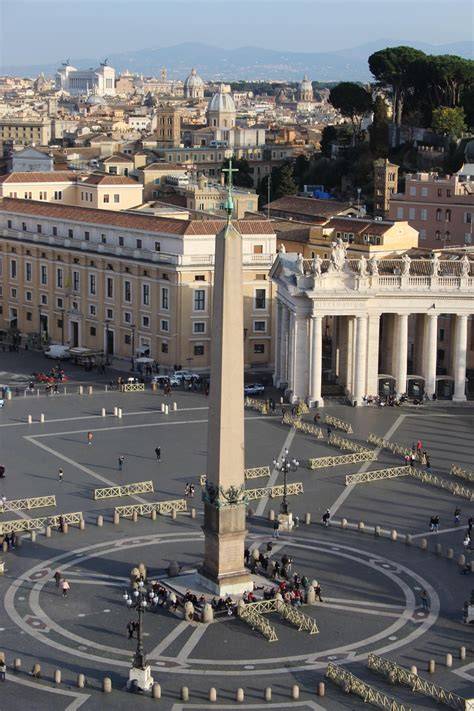
It was later completed by the emperor Nero and named the Circus Gaii et Neronis, usually called, simply, the Circus of Nero. The Vatican obelisk in St Peter’s Square is the last visible remnant from the Circus of Nero.
It was brought from Heliopolis in Roman Egypt by the emperor Caligula. The obelisk originally stood at the centre of the spina, or median, of the Roman circus.
The circus became the site of martyrdom for many Christians after the Great Fire of Rome in AD 64. Tradition states that it was in this circus that Saint Peter was crucified upside-down.
In 1586, the obelisk was moved to its current position by Pope Sixtus V, using a method devised by the Italian architect Domenico Fontana.
St. Peter’s Basilica and the First Vatican Structures
Opposite the circus was a cemetery separated by the Via Cornelia. Funeral monuments, mausoleums, small tombs, and altars to pagan gods of all kinds of polytheistic religions were constructed before the construction of the Constantinian Basilica of St. Peter in the first half of the 4th century.
A shrine dedicated to the Phrygian goddess Cybele and her consort Attis remained active long after the ancient Basilica of St. Peter was built nearby. Remains of this ancient necropolis were discovered during renovations by popes throughout the centuries, increasing in frequency during the Renaissance until it was systematically excavated from 1939 to 1941 on the order of Pope Pius XII.
The Constantinian basilica was built in 326 over what was believed to be the tomb of Saint Peter, buried in that cemetery. From then on, the land mass became more populated in connection with activity at the basilica.
A palace was constructed nearby as early as the 5th century during the pontificate of Pope Symmachus. The Leonine Wall was constructed by Pope Leo IV following the sacking by Muslim raiders of Old St. Peter’s Basilica in 846.
The original St. Peter’s Basilica was eventually replaced. St Peter’s Basilica was built from 1506 to 1626 and is one of the most renowned works of Italian Renaissance and Baroque architecture.
From the Papal States to Vatican City
Popes gradually came to have a secular role as governors of regions near Rome. They ruled the Papal States, which covered a large portion of the Italian Peninsula, for more than a thousand years until the mid-19th century, when all the territory belonging to the papacy was seized by the newly created Kingdom of Italy.
According to the historical sequence, the pope used to rule the Papal States, which included most of Italy. Catholic popes tried to stop Italy from becoming one country because they feared losing control of at least one of the Papal States.
In 1861, Italy was unified under the King of Savoy, but Rome and Latium remained unconquered. Much of the Papal States’ territory was conquered by the newly unified Kingdom of Italy, and only Lazio, including Rome, remained under the pope’s control.
Finally, on September 20, 1870, Italian troops invaded, and Rome became the capital of the new kingdom. Italy offered to create a city-state for the Catholic Church in the area, but popes from Pius IX and his successors refused to accept this and described themselves as prisoners of the new Italian state.
In 1870, the pope’s holdings were left in an uncertain situation when Rome was annexed by Italian forces, bringing to completion the Italian unification after a nominal resistance by the papal forces.
The popes then became “prisoners in the Vatican,” unwilling to leave the confines of the Apostolic Palace until 1929. The popes did not recognize the Italian king’s right to rule in Rome, and they refused to leave the Vatican compound until the dispute was resolved.
The Lateran Treaty and the Creation of the State
This situation was resolved on 11 February 1929, when the Lateran Treaty between the Holy See and the Kingdom of Italy was signed by Prime Minister and Head of Government Benito Mussolini on behalf of King Victor Emmanuel III and by Cardinal Secretary of State Pietro Gasparri for Pope Pius XI.
In 1929, Benito Mussolini decided to sign an agreement with the Holy See, called the Lateran Treaty, which established the Vatican State. The treaty created the current mini-state.
The treaty was ratified and took effect on 7 June 1929. It established the independent state of Vatican City and reaffirmed the special status of Catholic Christianity in Italy.
The name Vatican City was first used in the Lateran Treaty, signed on 11 February 1929, which established the modern city-state named after Vatican Hill, the geographic location of the state within the city of Rome.
Vatican City in the Modern Era
The Holy See, which governed Vatican City, pursued a policy of neutrality during World War Two under the leadership of Pope Pius XII. Both sides respected Vatican City’s status as neutral territory.
The Second Ecumenical Vatican Council was called by John XXIII in 1962. It oversaw extensive reform of the liturgy and new approaches to relations between the Church and the world, other Christian churches, non-Christian religions, and religious freedom.
Vatican City was designated a UNESCO World Heritage site in 1984. The Vatican enjoyed a cultural golden age during the Renaissance, when the popes were among Italy’s foremost patrons of the arts.
The Vatican Museums and Galleries, the frescoes by Michelangelo in the Sistine Chapel, the frescoes by Pinturicchio in the Borgia Apartment, and Raphael’s Stanze, or “Rooms,” attract critics, artists, and flocks of tourists from throughout the world.
Years of restoration work on the Sistine Chapel frescoes were completed in 1994, making it possible to view Michelangelo’s work in full vibrant colors. In 2000 the millennial Jubilee focused world attention on Vatican City.
Vatican City was designated a UNESCO World Heritage site in 1984. Its cultural institutions and religious monuments occupy much of the territory that gives the 0.19-square-mile state its global importance.
Inside St Peter’s Basilica | Vatican City Full Tour 4K
Government, Economy, and International Role
Sovereignty is exercised by the pope upon his election as the head of the Roman Catholic Church. He has absolute executive, legislative, and judicial powers within the city.
As the Holy See, Vatican City derives its income from the voluntary contributions of more than one billion Roman Catholics worldwide, as well as interest on investments and the sale of stamps, coins, and publications.
Banking operations and expenditures have been reported publicly since the early 1980s. On a more profane level, the Vatican has moved to meet international demands for more financial transparency following an investigation in 2010 into the Vatican Bank over violations of money-laundering rules.
The economy of Vatican City is supported financially by donations from Catholic believers, by the sale of postage stamps and souvenirs, fees for admission to museums, and sales of publications. Vatican City has no taxes, and items are duty-free.
Why Its Small Size Matters
The size of Vatican City is directly connected with its historical role. The modern state was not created to reproduce the former Papal States, which covered much of central Italy, but to provide the Holy See with a small independent territory from which the pope could exercise spiritual, diplomatic, and administrative authority.
Its 0.19 square miles contain the pope’s residence, major basilicas and chapels, museums, gardens, government buildings, archives, communications facilities, and other institutions that serve the Roman Catholic Church.
Although Vatican City is only a tiny enclave within Rome, its influence extends far beyond its borders. The Holy See maintains temporal power, governance, diplomacy, and spiritual independence, while the pope’s authority extends over Catholics throughout the world.