According to a report by the government, the Christian population in India is estimated to be around 28 million, or 2.3% of the total population. This makes Christianity a minority religion in India, which is primarily Hindu (79.8%) and Muslim (14.2%).
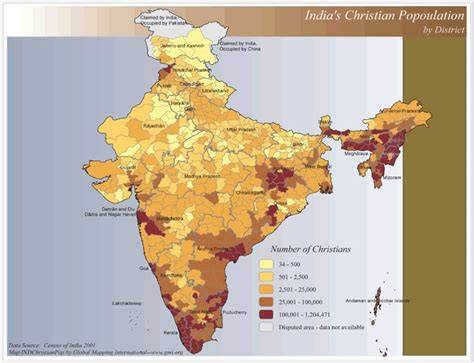
Today, there are millions of Christians in India, though relative to the population of India (over 1.4 billion), they make up just 2.4% of the total. Christianity has a long history in India and there are many ancient Christian communities in the country, particularly in the southern states of Kerala and Goa. The religion has also good hold over north east states of India.
Where Christians Live in India
Christians in India live across urban and rural settings, with significant populations in Kerala, Goa, Tamil Nadu, and the Northeast states like Nagaland, Mizoram, and Meghalaya, where they form majorities. The following figures show the distribution of Christians by state and territory.
| State or territory | Total population | Christian population | Christian percentage | Significance |
|---|---|---|---|---|
| Nagaland | 1,978,502 | 1,739,651 | 87.93 % | Majority |
| Mizoram | 1,097,206 | 956,331 | 87.16 % | Majority |
| Meghalaya | 2,966,889 | 2,213,027 | 74.59 % | Majority |
| Manipur | 2,855,794 | 1,179,043 | 41.29 % | Significant |
| Arunachal Pradesh | 1,383,727 | 418,732 | 30.26 % | Majority |
| Goa | 1,458,545 | 366,130 | 25.10 % | Significant |
| Andaman and Nicobar Islands | 380,581 | 80,984 | 21.28 % | Significant |
| Kerala | 33,406,061 | 6,141,269 | 18.38 % | Significant |
| Sikkim | 610,577 | 60,522 | 9.91 % | Minority |
| Puducherry | 1,247,953 | 78,550 | 6.29 % | Minority |
| Tamil Nadu | 72,147,030 | 4,418,331 | 6.12 % | Minority |
| Tripura | 3,673,917 | 159,882 | 4.35 % | Negligible |
| Jharkhand | 32,988,134 | 1,418,608 | 4.30 % | Negligible |
| Assam | 31,205,576 | 1,165,867 | 3.74 % | Negligible |
| Orissa | 41,974,218 | 1,161,708 | 2.77 % | Negligible |
| Chhattisgarh | 25,545,198 | 490,542 | 1.92 % | Negligible |
| Karnataka | 61,095,297 | 1,142,647 | 1.87 % | Negligible |
| Dadra and Nagar Haveli | 343,709 | 5,113 | 1.49 % | Negligible |
| Andhra Pradesh | 84,580,777 | 1,129,784 | 1.34 % | Negligible |
| Punjab | 27,743,338 | 348,230 | 1.26 % | Negligible |
| Daman and Diu | 243,247 | 2,820 | 1.16 % | Negligible |
| Maharashtra | 112,374,333 | 1,080,073 | 0.96 % | Negligible |
| Delhi | 16,787,941 | 146,093 | 0.87 % | Negligible |
| Chandigarh | 1,055,450 | 8,720 | 0.83 % | Negligible |
| West Bengal | 91,276,115 | 658,618 | 0.72 % | Negligible |
| Gujarat | 60,439,692 | 316,178 | 0.52 % | Negligible |
| Lakshadweep | 64,473 | 317 | 0.49 % | Negligible |
| Uttarakhand | 10,086,292 | 37,781 | 0.37 % | Negligible |
| Madhya Pradesh | 72,626,809 | 213,282 | 0.29 % | Negligible |
| Jammu and Kashmir | 12,541,302 | 35,631 | 0.28 % | Negligible |
| Haryana | 25,351,462 | 50,353 | 0.20 % | Negligible |
| Uttar Pradesh | 199,812,341 | 356,448 | 0.18 % | Negligible |
| Himachal Pradesh | 6,864,602 | 12,646 | 0.18 % | Negligible |
| Rajasthan | 68,548,437 | 96,430 | 0.14 % | Negligible |
| Bihar | 104,099,452 | 129,247 | 0.12 % | Negligible |
States with Christian Majorities
Christianity has its strongest demographic presence in the northeastern states. Nagaland has 1,739,651 Christians, representing 87.93 % of its population, while Mizoram has 956,331 Christians, representing 87.16 %.
Meghalaya has 2,213,027 Christians, or 74.59 % of the population. Arunachal Pradesh has 418,732 Christians, or 30.26 %, and the available classification identifies it as Majority.
Manipur has 1,179,043 Christians, representing 41.29 % of the population. Goa has 366,130 Christians, or 25.10 %, while Kerala has the largest listed Christian population among the states, with 6,141,269 Christians, representing 18.38 % of the population.
Christianity’s History in India
Christianity in India is believed to have been introduced by St. Thomas the Apostle in 52 AD, who arrived on the Malabar Coast (modern-day Kerala). The St. Thomas Christians are among the oldest Christian communities in the world, with deep roots in Indian culture and history.
Over centuries, Christianity spread through missionary efforts, colonial influence (Portuguese, British, French), and indigenous movements. Today, Christians in India represent a diverse group including Roman Catholics, Protestants, Orthodox, and independent churches, with a population of approximately 2.3% of the national population.
India’s Religious Context
From its early history onward, India has been a majority-Hindu nation. The every-day life of the modern Indian is still deeply affected by Hindu traditions and cultural rhythms. Even those who belong to different religions often still have traditional Hindu customs as part of their cultural experience.
Hindus make up about 81% of the population of India, with Islam coming in as the second largest group at 12%. Christians make up just 2.4% of all Indians, and researchers find that only 0.4% of those Christians are converts from Hinduism.
Much of this comes from the long history previously discussed of Hinduism and the ways it is deeply embedded in Indian society. In accordance with the statistics, most likely new generations are born to practicing Hindu families, meaning they would have to convert to a new religion - commonly Islam or Christianity - which is not an easy thing to do.
Conversion and Social Pressure
There are particular challenges when a practicing Hindu Indian chooses to convert to Christianity - a religion not widely accepted in the Hindu culture. For one to profess their change of faith, they risk the loss of their caste status, severing of family ties, and possible persecution.
For decades, laws against persuading others to convert to your religion were enacted to keep India primarily Hindu. Today there is still intense cultural pressure and disgrace towards those that choose to leave the prevalent religion of India.
Modern Indians do claim that they see themselves as a country that values religious freedom, and it is important to tolerate all religions held by Indians. However, as previously discussed, there still remains traditions of separation between various religious groups and crossing from one to the other can invoke disapproval, and even hostility from one’s family or community.
For example, interreligious marriage is heavily condemned by the majority of Hindus and Muslims in India.
Christian Communities and Social Background
Indian Christians come from disproportionately lower castes. About a quarter of all Christian Indians belong to Dalit tribes, a far larger amount than any other religious group in India.
Christianity is particularly attractive to this group because of the nature of their lives thus far. They have grown up being shunned from society and have come to understand that they are seen as “less than” by the majority of their fellow countrymen.
Typically, Christians are from such low status communities. There are very few from high status groups like the Brahmins and Rajputs.
The caste system, commerce, and other key aspects of life in India are all rooted in the teachings of Hinduism, including that of karma and reincarnation. Meaning, the majority of Indians believe that those born into lower castes did something in their former life to deserve such punishment and societal rejection.
These beliefs extend cycles of poverty, discrimination, and despair throughout the Dalit (“Untouchables,” the lowest caste) regions. Therefore, the unconditional love and relationship that Christ extends means more to them than we in the West can fully understand.
Daily Life, Work, and Institutions
Many are engaged in education, healthcare, social work, and government services. Christian institutions have played a major role in literacy, women's empowerment, and social reform.
Their worship practices vary widely, from liturgical traditions to charismatic expressions. The Bible is available in over 145 Indian languages, and resources like the JESUS Film, audio Bibles, and mobile apps support evangelism and discipleship.
Persecution and Religious Freedom
In fact, India is currently listed as number 11 on the World Watch List, making it a place of extreme persecution. India is 11th on the List of Countries That Face the Most Persecution of Religious Minorities, Making Indian Christians Devout in Their Faith.
The 2020s have been a decade of increased persecution of Christians. Rising hostility and anti-conversion laws in some states threaten Christian outreach and worship.
Despite facing false accusations under the anti-conversion laws and persecution from Hindu extremist groups, Christians in India still stand out amongst other religious groups for being more hospitable towards their friends and neighbors, even across stark differences of worldview.
However, of all the religious groups present in India, Christians are the least in favor of religious segregation. Fewer Christians than Hindus and Muslims say that their friends share their religion. In other words, Christians are more willing to engage and commune with people who don’t necessarily share their religious views.
Despite their long history, many Christians in India need spiritual renewal, especially in regions where faith is nominal or syncretized with local traditions. Dalit and tribal Christians often face persecution, exclusion, and loss of legal rights upon conversion.
Faith and Church Life
Additionally, Indian Christians say their religion is very important in their lives. The vast majority of Indian Christians read their Bible, pray daily, attend church weekly, and share their money and resources generously with their community and church.
In face of the discrimination and fear of persecution that Christians in India can face, the Indian Church remains steadfast in pursuing the Kingdom of Heaven. This dedication quite possibly stems from the sacrifices Indian Christians often face to proclaim their faith.
They are faced with losing much more when they profess their faith than many modern Christians, making their faith devout.
Christian Outreach and Community Needs
Despite opposition, diverse denominations need to work together for spiritual outreach, and community development.
Christian institutions have played a major role in literacy, women's empowerment, and social reform. Transformation in communities through education, healthcare, and social outreach remains an important concern.
Protection from persecution and legal discrimination, especially for Dalit and tribal believers, remains a major need. Unity among churches and ministries across India, as well as boldness and wisdom for Christian leaders and evangelists, are also important concerns.
How One Tiny People Group in India is Evangelizing Millions
Prayer Items
- Pray for spiritual revival among nominal Christians and deeper engagement with Scripture.
- Pray for the Holy Spirit to send revival to Christians all over India, leading to bold and loving outreach.
- Pray for protection from persecution and legal discrimination, especially for Dalit and tribal believers.
- Pray for unity among churches and ministries across India.
- Pray for boldness and wisdom for Christian leaders and evangelists.
- Pray for transformation in communities through education, healthcare, and social outreach.
tags: #how #many #christians #in #india