The Metropolitan Cathedral of San Pietro is Bologna’s cathedral and the episcopal church of the city. Dedicated to Saint Peter, the head of the apostles and first Pope, it represents a direct reference to Bologna’s loyalty to the Catholic Church.
The cathedral is located on Via dell’Indipendenza, one of the principal streets of Bologna, and is difficult to miss because of its imposing Baroque façade. The church is free to visit, while access to the crypt and bell tower is available as part of a combined visit on selected days and times.
Where is the Cathedral of San Pietro?
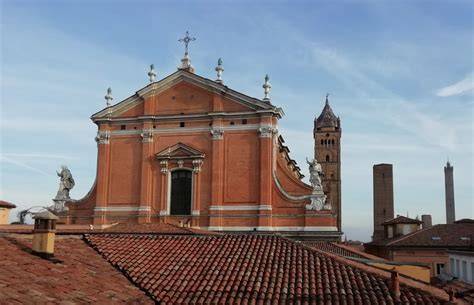
The Metropolitan Cathedral of San Pietro is placed in one of the principal streets of the city, St. Indipendenza: it is impossible not to notice it. Due to its location and its height it’s very hard to photograph the front of the cathedral.
It has a very bland appearance and is constructed out of red stone. The Metropolitan Cathedral of San Pietro is easily recognisable thanks to its typical Baroque red facade, that also has some white marble decorations.
At the top, it owns two sculptures that adorn the sides: on the left San Pietro and on the right San Paolo. Looking at the front of the cathedral, two statues may be seen - the one on the left is San Pietro and the one on the right is San Paolo (Saint Paul).
The height of the church’s facade that imposing itself in St. Indipendenza makes it difficult to take pictures. The only possible pictures of San Pietro are the ones shot from below, using a wide angle camera, or shot from a window or balcony of the houses nearby.
These two methods can make the sight of the Metropolitan Cathedral of San Pietro clearer and easier. A few steps away from the Cathedral you can reach another very important symbol of Bologna: the Neptune fountain.
When was the cathedral built?
The origins of the Cathedral of San Pietro are very old: some researchers say that it was one of the first structures designated to the cathedral and it dates back to the 4th century A.C. The church that is placed outside the walls, in 906 AC, was hit by an unexpected fire that led to its rebuild inside the walls.
These protected the ruins of the ancient city of Bononia (name that the Romans gave to the city of Bologna when they conquered it) and they are still visible today. The rebuilt church, that measured 57 meters in length, had short life.
In fact, another fire completely destroyed it in 1141, so the works of total reconstruction were started once again. These works started immediately and in 1184 the new church was finished and consecrated by Pope Lucio III.
He was born as Ubaldo Allucingoli, who entrusted to God the destiny of the cathedral. Not even God was enough… Unfortunately, in 1222 another calamity, an earthquake, hit Bologna and led to the fall of the roof of the Metropolitan Cathedral of San Pietro, that was rebuilded later thanks to additional reconstructions.
The Baroque façade
The façade that is seen today was built between 1743 and 1747 under the instructions of Pope Benedict XIV. The designs were completed by architect Alfonso Torregiani.
The Metropolitan Cathedral of San Pietro is easily recognisable thanks to its typical Baroque red facade, that also has some white marble decorations. Its restrained appearance contrasts with the majesty and artistic richness of the interior.
What can you see inside the Cathedral of San Pietro?
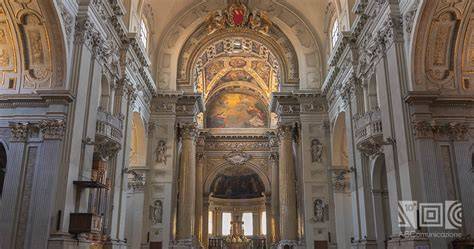
As you enter the Metropolitan Cathedral of San Pietro, you are stroken by the majesty of the central nave that is 42,8 meters wide and 89 meters long. For every lateral nave, we can find five chapels.
Starting from the left we find: the Chapel of the Baptistery, the one of the Holy Hearth, the one of the Saint Sacrement, theone of the Relics and the one of S. Ambrogio. On the right we can see: the Chapel of S.Carlo Borromeo, the one of S.Rocco, the one of S. Apollinare, the one of S. Anna and the one of B. Nicolò Albergati.
At the end of the nave, on the presbytery, there are the Major Chapel and the crypt, with frescoes of the typical catholic iconography. Among these, we notice Prospero Fontana’s fresco, which represents the eternal Father surrounded by the glory of the angels.
In the crypt there also are some reliques of the two Saints Vitale and Agricola, to which was dedicated one of the Seven Churches of the complex of Santo Stefano. On the basin of the apse there is Christ who gives the symbolic keys of Paradise to San Pietro: the fresco was painted by Giovanni Battista Fiorini and Cesare Aretusi.
At last, there is also the fresco of Maria’s annunciation made by Ludovico Carracci. These are some of the many artworks of the Cathedral.
The crypt and archaeological remains
A crypt is an underground vault which is normally used as a chapel or a burial place. Access to the crypt is permitted as part of a combined ticket with the bell tower and will cost you 5 euros and is only open on certain days and times.
Lucky enough for it to be open on my visit, I took a visit to the crypt where I found a chapel and an archaeological site. The site has found remains of 10th century Romanesque cathedral pillar beam, and also two beams from the 12th century.
In the nave they have put glass flooring in for viewing. The crypt therefore provides both a religious space and an opportunity to observe traces of earlier phases of the cathedral’s construction.
The unusual double bell tower
Not everyone knows that the bell tower of the Metropolitan Cathedral of San Pietro has a paleochristian bell tower inside. It is older the the external one for one century more or less.
We can define it as the soul of the bell tower: it was built in the 10th century and is 40 meters of high. Over time and with the construction of the new bell tower, it was entirely incorporated on his interior so the foundations were made.
Therefore we can notice two bell towers: the antique one on the inside and the latest one on the external. The detail of this bell tower is that, with its 70 meters of height, it is the highest structure after the famous Asinelli Tower, which reaches 97 meters.
The Bolognese bell-ringing tradition
The bell tower of the Metropolitan Cathedral of San Pietro also has one of the bigger bells that can be rung “in the Bolognese way of ringing”. The bolognese system is different from the others because it uses bronze bells that are lightweight compared to the other bells in the world.
In spite of this, it can produce oscillations that cross the bell tower and are called “waves”. This bell weighs 33 quintals and, with the other ones on the bell tower, forms a complex of 66 quintals.
The bell ringers, thanks to their abilities, modify the sound of the bells so, without their presence, it coul not be so clear in the entire city. The bell tower can therefore be understood not only as an architectural element, but also as a living part of Bologna’s religious and civic soundscape.
Campane della Cattedrale di San Pietro di Bologna - Calata
Why is it called a Metropolitan Cathedral?
It is very important to know the meaning of the word “Metropolitan Church” to understand better the relevance of the Metropolitan Cathedral of San Pietro. First of all we define the meaning of Cathedral: it is the most important church of the diocese and its name descends from the fact that inside there is a “desk” or a throne used by the bishop.
While the term “Metropolitan Church” is used when a church is the episcopal headquarters with jurisdiction over the bishop. The word metropolitan is also used concerning a bishop that presides over an ecclesiastical province and who has under him other bishops called suffragans.
To sum up, a Metropolitan Cathedral is the most important ecclesiastical province that has a metropolitan bishop like proponent who depends directly from the Holy Faith. The title therefore expresses the cathedral’s ecclesiastical rank and its relationship with the wider church structure.
Cathedral of San Pietro and other churches in Bologna
The Metropolitan Cathedral of San Pietro should not be confused with the Basilica of San Petronio, dedicated to the city's patron saint and located in Piazza Maggiore. The Basilica of San Petronio in Bologna, Emilia-Romagna, is the largest church in the city and the sixth largest in Italy, built with bricks and the largest Gothic church in the world constructed in this material.
Founded on June 7, 1390, it was commissioned by the Comune of Bologna in honor of San Petronio, the patron saint, as an act of faith and political autonomy. Initially designed by Antonio di Vincenzo, construction proceeded intermittently, with interruptions and subsequent modifications, including the construction of the Archiginnasio which prevented its completion according to the original Latin cross design.
The façade, divided into two bands, is unfinished and features reliefs by various sculptors, including Jacopo della Quercia. In 1530, it hosted the coronation of Charles V.
The interior, completed in different eras, is divided into three naves, which open onto twenty-two chapels decorated by artists, including Francesco Francia, Lorenzo Costa, Parmigianino and Donato Credi. Famous is the Music Chapel of San Petronio, the oldest musical institution in Bologna (1436), whose most prestigious symbol is a still functioning organ, which, built around 1470 by Lorenzo da Prato, is the oldest in the world still in use.
The Chapel of the Three Wise Men (IV) or Bolognini, is also very popular among visitors. Its walls were sumptuously frescoed by Giovanni da Modena with scenes representing “Heaven” and “Hell”.
The sundial by the astronomer Cassini is also well-known and is the longest in the world, measuring 67.27 metres. The Basilica of San Petronio, therefore, is a different major monument from the Metropolitan Cathedral of San Pietro, although both are central to Bologna’s religious and artistic heritage.
Visiting information
The church can be visited from Monday to Sunday from 7.30 a.m to 6.45 p.m. On Sundays you can visit the Cathedral from 8 a.m. to 6.45 p.m.
It is completely free! Additional information: the visit of the Treasure is possible with reservation and the visit to the tower bell is every Saturday from 2 p.m. to 4.30 p.m. and it costs 5 euros.
During summer the visit schedule is extended also from 7 to 11 p.m. Access to the crypt is permitted as part of a combined ticket with the bell tower and will cost you 5 euros and is only open on certain days and times.
| Feature | Information |
|---|---|
| Location | Via dell’Indipendenza, Bologna |
| Regular church visit | Monday-Saturday, 7.30 a.m.-6.45 p.m. |
| Sunday visit | 8 a.m.-6.45 p.m. |
| Church entrance | Completely free |
| Bell tower visit | Every Saturday, 2 p.m.-4.30 p.m. |
| Bell tower visit cost | 5 euros |
| Bell tower height | 70 meters |
| Inner paleochristian bell tower | 40 meters of high |
Religious and cultural landmarks nearby
Moreover, a few steps away from the Cathedral you can reach another very important symbol of Bologna: the Neptune fountain. Did you know that this fountain is one of the Seven Secrets of Bologna?
Did you know that in 1433 in the Basilica of San Luca the “miracle of rain” occurred? Furthermore, it is important to point out the fact that the Sanctuary and its porticoes are part of the Unesco Heritage, since 2021.
You cannot miss to visit the Salaborsa Library, characterized by many stories and curiosities. For further details, it is important to remember the story of the Botanical Garden as well, dedicated to Ulisse Aldrovandi and managed by the University, but that once was in the actual building of the Salaborsa Library.
Moreover, speaking of history, you cannot miss the visit of the ancient jewish ghetto of Bologna, a few steps from the Two Towers. These places help situate the Cathedral of San Pietro within Bologna’s wider concentration of religious, historical, academic, and cultural landmarks.