Jesus Christ Superstar, the rock opera by Andrew Lloyd Webber and Tim Rice and the film directed by Norman Jewison, retells the final days of Jesus Christ through the language of rock music, political drama, celebrity culture, and psychological conflict. Its central question is not simply what happened during the Passion, but why Judas betrayed Jesus and how a spiritual movement became entangled with fame, power, fear, and public expectations.
The work is best understood as an alternative dramatic interpretation rather than a straightforward biblical adaptation. It presents Jesus as a charismatic leader whose growing popularity threatens to overwhelm his message, while Judas becomes the character who recognizes the danger most clearly. The opera’s theme deals with fame and how popularity can deceive and corrupt.
What is Jesus Christ Superstar about?
The rock opera tells the story of the final days of Jesus. Superficially at least, Jesus Christ Superstar contains many elements of the biblical narrative: Jesus has disciples, and He teaches. The priests Caiaphas and Annas, out of jealousy and fear, foment a plot to destroy Jesus. Mary Magdalene and other women serve Him. Judas plans to betray Him.
Jesus enters Jerusalem amid celebration, cleanses the temple, and eats a meal with His disciples. After He prays in a garden, He is arrested, taken before several officials, and beaten. Peter denies knowing the Lord, and Judas hangs himself. Jesus is crucified. None of this conflicts with the biblical record.
The story stretches roughly from Palm Sunday to the Crucifixion. The singing roles are spread among Jesus Christ, and his followers, Judas Iscariot, Mary Magdalene, Peter, and Simon, the Pharisees Caiaphas and Annas, and the authorities of Pontius Pilate and King Herod.
Jesus Christ Superstar is loosely based on the gospels of the Bible, ‘loosely’ being the operative word! The musical is a more dramatic retelling of the last days of Jesus Christ’s life, homing in on his personal conflicts. Most notably, JCS is told through the eyes of Judas Iscariot.
A retelling rather than a literal adaptation
When a story is retold, a certain amount of interpretation is required. The author’s ideas, presuppositions, and opinions are injected. In this retelling of Jesus’ passion, the character and motivations of both Jesus and Judas are re-imagined and reinterpreted.
Tim Rice and Andrew Lloyd Webber did not set out to write a religious show. In the aftermath of its release, just like Peter, they denied that they were trying to make any kind of statement about Christianity or Judaism. In a 1971 New York Times interview, Rice said, “People have read so much more into this than we ever intended. We were simply trying to express our feelings about Christ at the time, trying to tell His story and make suggestions for the gaps.”
As author Robert Short put it, “It is a complete misunderstanding to view Jesus Christ Superstar as an expression of anyone’s answer… Its purpose is, first, to put to Jesus the question we have today about the meaning of life, and second, to put this question in our own way of putting it.”
Norman Jewison expressed a similar idea: “My hope is that audiences will take this for what it is - an opera, not history. These kids are trying to take Jesus off the stained-glass windows and get him down on the street. Some people are not going to like that.”
The show does not attempt to provide a complete account of Christian doctrine. Instead, it concentrates on the human, political, and emotional tensions surrounding Jesus during the last week of his life.
The origin of the rock opera
Jesus Christ Superstar began not as a stage production, but as a concept album. In the late 1960s, Tim and Andrew were young, ambitious, and eager to tell a story through the lens of modern music. Traditional theatre producers initially balked at the idea of a rock musical about the final days of Jesus.
So, the duo did something radical: they recorded it first. The 1970 concept album, with Deep Purple’s Ian Gillan as Jesus, quickly became a global sensation. With no visual cues Andrew and Tim had to rely solely on the music to tell this story, so, unlike other musicals at the time the show is almost entirely sung-through.
There’s no traditional dialogue: just driving rhythms, soaring melodies, and unforgettable riffs. Jesus Christ Superstar is a groundbreaking example of the rock opera genre: blending elements of rock and musical theatre.
At a time when musical theatre was dominated by traditional orchestrations, Andrew Lloyd Webber’s fusion of rock, soul, gospel, and symphonic elements turned the genre on its head. From electric guitars and pounding drums to strings and choral arrangements, the score is as complex as it is catchy. This wasn’t just theatre music-it was radio-ready rock.
The success of the concept album led to the opening of the first Broadway production of Jesus Christ Superstar in 1971. When Jesus Christ Superstar was first released in 1971 as a concept album, it was so controversial that it sparked mass protests every night of its original run on Broadway.
Why is the story told through Judas?
Judas, a once-loyal disciple of Jesus, has become frustrated with his leader’s growing fame whilst the plight of Jerusalem’s less fortunate remains ignored. The choice to focus the show on Judas rather than on Jesus lifted the show out of the category of mere cultural rebellion and into the realm of legitimate intellectual and artistic endeavor.
Tim Rice was initially inspired by Bob Dylan’s lyric “Did Judas Iscariot have God on his side?”. In Andrew’s own words: “Rather than telling the story of the last six days of the life of Jesus Christ, one is actually trying to examine why it was that Judas betrayed somebody that he clearly loved.”
Rice says he was first inspired by the lyric from Bob Dylan’s song “With God on Our Side”: “I can’t think for you, you’ll have to decide, did Judas Iscariot have God on his side?” Rice was quoted at the time saying, “We need to humanize Christ, because for me, I find Jesus as portrayed in the Gospels as a God as a very unrealistic figure… The same is true, on the other hand, for Judas who is portrayed just as a sort of cardboard cut-out figure of evil.”
This is Judas’ story; he is the only central character who changes, who learns, who goes on a journey. Jesus is the same at the beginning of the story as he is at the end. He can’t be the protagonist.
The show opened with Judas’ warnings of disaster in “Heaven on Their Minds” and ended with Judas’ I-Told-You-So song, “Superstar.” This structure makes Judas the dramatic center of the work, even though Jesus remains its title character and its historical subject.
Judas as a tragic and political figure
Judas has the first song. In it, he complains that Jesus has been caught up in His own fame and rages over the fact that Jesus won’t listen to him. Judas calls Jesus’ followers “blind,” accuses them of twisting Jesus’ words, and expresses a desire to “strip away the myth from the man.”
Considering these words come from Judas, we might be prone to dismiss them as a villain’s distortion. However, the insistence that Jesus is “just a man” is repeated later by Mary Magdalene in one of the opera’s most famous songs, “I Don’t Know How to Love Him.”
Inside the musical’s interpretation, Judas does not think of himself as a traitor. He does what he does, not because he is basically evil, but because he is intelligent. He can see Christ becoming something he considers harmful to the Jews.
Judas felt that they had been persecuted enough. As far as what Christ was saying, general principles of how human beings should live together - Judas approved of this. What Judas was worried about was that as Christ got bigger and bigger and more popular, people began switching their attentions from what Christ was saying to Christ himself.
They were saying that Jesus is God, here is the new Messiah, and Judas was terrified because he didn’t agree with it - he thought Christ was getting out of control and it was affecting Him, and Judas reckoned that if the movement got too big and people began worshipping Christ as a god, the Romans who were occupying Israel would come down and clobber them.
That interpretation transforms Judas from a simple villain into a political realist. He believes in Jesus’ ethical teaching but fears the consequences of the movement’s growing religious and popular intensity.
“Heaven on Their Minds”: the fear of celebrity
The title Jesus Christ Superstar itself embodies the reason for Judas’ betrayal - the “superstardom,” the hype, the baggage became more important than the very important philosophical message Jesus wanted to convey, a message Judas believed in.
To Judas, Jesus lost his stature as philosopher when he gained his status as superstar. The title is snide, sarcastic, and angry, representing Judas’ point of view: the idea that Jesus had become a “superstar,” a shallow, hyped personality worshipped merely for the hype like many pop stars of the 1960s and 70s and today.
The musical therefore treats fame as more than personal popularity. Fame changes how followers perceive their leader, changes the leader’s relationship with his own message, and creates political danger. Once Jesus becomes a public phenomenon, his words are no longer heard in isolation: they are interpreted as threats, slogans, promises, and claims to power.
Judas and Mary Magdalene: two responses to Jesus
In the next scene, Judas objects to Mary’s proximity to Jesus. He warns Jesus of the scandal that will erupt if Jesus is not more careful. Later, when Mary anoints Jesus, Judas objects again, reminding Jesus that their mission is to the poor.
Jesus’ response is for Judas to “enjoy the good” while he has it. Throughout this scene, we have the contrast of Mary’s telling Jesus to “close your eyes,” versus Judas’s trying to open His eyes to the needs of society; as Mary sings, “Relax,” Judas urges action on behalf of the poor.
No mention is made of Judas’s greed and thievery. This omission is significant because the opera replaces the biblical explanation of Judas’s motives with a sympathetic political and psychological interpretation.
Mary Magdalene is perhaps Jesus’s most devoted follower and, unlike in the Bible, her deep love and care for Jesus is depicted as potentially romantic. Her attraction to Jesus creates an additional tension between private feeling and public responsibility.
Critics found the relationship between Jesus and Mary Magdalene uncomfortably sexual. They were right - her physical attraction to Jesus is strongly implied; after all, when the show was written, people still thought Mary was a prostitute, although that is now understood as a misreading enshrined by Pope Gregory.
“I Don’t Know How to Love Him” does not simply function as a romantic song. It expresses Mary’s confusion about how to respond to a person who is at once intimate, charismatic, dangerous, and historically significant. Her uncertainty mirrors the wider uncertainty of the musical: is Jesus a teacher, a revolutionary, a prophet, a celebrity, a messiah, or something more?
Jesus as an ordinary man and public revolutionary
Rice and Lloyd Webber never intended to tell the “Biblical” story but instead an alternative story of famous events; and what’s more, they were telling the story of Judas, not Jesus.
The show never suggested that Jesus wasn’t divine, but neither did it reinforce the view that he was. This was not an entirely bizarre approach - though the canonical Christian gospels stress Jesus’ divinity, the Gnostic gospels, including the Gospel of Thomas, the Gospel of Mary, and others, came from a different strand of early Christianity in which Christians believed fully in the wisdom and philosophy of Jesus but never even mentioned the idea that he was God.
Likewise in Superstar that issue was off the table, irrelevant to the story Rice was telling. Everyone already knows the story of Jesus as the Son of God. This was the other, rarely examined side of the story of Jesus, an “ordinary guy” who became an unlikely star.
It is that ordinariness that gives the story resonance and life but it also outraged Christians. Most people think of Jesus as a religious icon, but the people who lived and worked around him saw him as just another guy.
But Superstar was also the story of Jesus the social revolutionary, political insurgent, radical philosopher, apocalyptic prophet, a speaker of truth to power that terrified the religious and secular authorities. His ascendancy from such humble roots makes him even more of a puzzle and therefore more dangerous to the priests.
Power, revolution, and religious authority
Power: Jesus’s growing popularity affects the relationships and dynamics of those around him, often negatively. JCS examines the value of questioning those in power, rather than following them mindlessly.
Faith: We also see the true extent the people in Jesus’s life will go to keep their faith and, through the exploration of the character Judas, what happens when that faith is lost.
Betrayal: Judas’s internal struggle deciding whether to stay loyal to Jesus or betray him is central to the story and this plight is explored throughout the show.
Revolution: In Tim and Andrew’s retelling, Jesus Christ is depicted as a rebel who is trying to revolutionise the status quo.
In setting the story of Judas’ betrayal of Jesus for the modern stage, lyricist Tim Rice approached the story as political history instead of revealed scripture, and Jesus as radical political activist rather than as the son of God.
This Jesus does not point the way to God half as much as he points the way toward living a moral, engaged life, and that’s why politics takes center stage here instead of religion. After all, politics is how humans decide collective morality, questions of how to live morally in a community of whatever size and of which values will be shared by that community.
Conversely, religion dictates those answers to humans, rather than allowing them to explore and form their own morality. The musical therefore places moral choice, political responsibility, and collective action at the center of the story.
The 1970s political context
It’s interesting to note the time period in which this show was written. The 1970s were a tumultuous time politically. The Vietnam War was raging, the United States contributing soldier’s lives and weapons to an overseas conflict, and that government was facing various protests often led by college students who sought for peace and an end to the fighting.
American culture was shifting, with the role of women becoming more prominent and less confined to the home. Coming out of the 1960s movement of folk protest songs, the culture was used to hearing biting, unabashed political analysis put to music.
Rock and roll music was the heartbeat and language of that generation, and Tim Rice’s lyrics masterfully painted a picture of a culture of people tired of occupation and military might.
Now, as in that time, the parallels between our current political climate and that of Jesus’ day are clear. In the wake of the Vietnam War, Tim Rice and Andrew Lloyd Webber could have been inspired by the encampments and groups of students marching for peace overseas, the same as we see now.
Jesus’s followers, like student activists in the 70s and today, were also students of peace. Now as then, and in Jesus’s time, people fight to be free of occupation, and able to live on their own lands in peace, even in the face of military powers that oppress them without mercy.
In Jesus’s time as in our own, the people are faced with tyranny from rulers that, while seeming to stand for different things, end up leading to the same misguided result: who is better, a Herod type of leader, all theatrical, big talking, full of flash and cynicism? Or a Pilate type, who means well but bends inevitably to the mob mentality of the crowd?
At the end of the day, aren’t they both oppressive? No wonder the followers of Jesus seek a different way.
The entry into Jerusalem and the politics of popularity
When Jesus enters Jerusalem, there is a celebration of His being a “superstar.” Interestingly, Jesus only rides on the donkey for a short time. When he enters the city, He walks with the crowd until he sits down with some children.
Also, unlike the biblical account, the praise is not quite spontaneous. Jesus initiates the singing at one point, and He even commands the crowd to “sing me your songs.” He briefly teaches about the Kingdom of God, saying, “You can win it.”
The next scene has Jesus surrounded by adoring multitudes. There is a mention of salvation and a belief in God as the crowd offers Him their devotion and a kingdom. Judas looks on in disgust and disbelief.
Jesus ends the celebration by speaking of death, which He says can only be conquered by dying. There is no mention of Jesus as the Life and no prediction of His resurrection.
The scene transforms the triumphal entry into a commentary on performance and mass adoration. Jesus is not only welcomed by a crowd; he is treated as a public spectacle. The crowd does not necessarily understand his teachings, but it knows how to celebrate his image.
The temple and the limits of Jesus’ authority
Jesus enters Jerusalem, cleanses the temple, and confronts a system in which religious space has become entangled with commerce and institutional power.
At the temple, Rice has Jesus belt, “My temple should be a house of prayer, but you have made it a den of thieves.” In the Gospel of Matthew, chapter 21, verse 13, Christ says, “My house will be called a house of prayer, but you are making it a den of robbers.”
This is just one example of lines that overlap. Tim Rice and Andrew Lloyd Webber have done their research, and the character portraits they paint are rich and well-crafted.
In the film, the temple sequence also demonstrates the production’s deliberate mixture of seriousness and anachronism. Even during “The Temple” Jesus manages to feel small while smashing up a marketplace, although what is inside the marketplace is straight up some of the funniest anachronisms in the movie.
Healing, exhaustion, and the burden of leadership
In a later scene, Jesus is surrounded by people who need healing. No one is healed; rather, an overwhelmed Jesus cries out, “There’s too many of you. There’s too little of me. Leave me alone!”
This moment presents Jesus not as an all-powerful miracle worker but as a leader crushed by the demands placed upon him. The crowd wants solutions, healing, certainty, and salvation, while Jesus experiences the limits of his own body and emotional strength.
The scene also extends the musical’s treatment of fame. Popularity creates an ever-growing audience, but it does not create unlimited capacity. The more people gather around Jesus, the less space he has for privacy, reflection, or direct human connection.
The Last Supper and the failure of remembrance
During the Last Supper, the disciples dream of lasting fame. Jesus bitterly accuses His disciples about not caring about Him: “For all you care, this wine could be my blood! For all you care, this bread could be my body!”
He tells them to remember Him when they eat, but then He says, “I must be mad, thinking you’ll remember me!” Judas leaves to complete the betrayal, because Jesus tells him he must.
This scene turns remembrance into a troubling question. Jesus wants his followers to preserve his meaning, but he doubts that they understand him. The disciples are concerned with their own future fame, while Jesus fears that the symbolic language of the meal will be ignored or misunderstood.
Another source of consternation came during the Last Supper scene, when Jesus sings, “For all you care about, this wine could be my blood. For all you care this bread could be my body.”
Superstar was making an entirely other point, that these men and women thought about what Jesus meant in their lives as little as they thought about what food or wine they put in their bodies - not complete apathy, but only minimal consideration. This was an accusation, not a clue to eternal salvation.
Jesus in the Garden of Gethsemane
Jesus’ prayer in the garden is very telling. He admits that He has changed, that He is no longer inspired. Now He’s only “sad and tired.” After three years of trying to serve God, Jesus has lost his original vision.
Considering becoming a martyr, Jesus selfishly asks, “Will I be more noticed? What will be my reward?” This statement is in direct contrast to Judas’s unselfishness in not wanting a reward for his betrayal.
At the end of His prayer, Jesus finally submits to God’s plan-sort of. The song ends with an equivocation: “Take me now, before I change my mind.”
Another bone of contention was the song “I Only Want to Say” that Jesus sings in the Garden of Gethsemane. Though Jesus has some doubt in the biblical version of the story, those doubts are articulated so completely and so intensely in the show that they sounded to some like more blasphemy.
The song makes hesitation the emotional center of the garden scene. Jesus knows what may be required of him, but he does not meet that prospect with serene detachment. Instead, he experiences fear, fatigue, resentment, and uncertainty.
Betrayal as an act of attempted rescue
When Judas meets with the Jewish council to betray Jesus, he makes it clear that he is only trying to “save” Jesus, who has let His own popularity spiral out of control. He takes the money they offer him unwillingly.
Through the various trials, Judas keeps close by, wanting to see what will happen. Judas then returns the money to the priests, again expressing his wish to “save” Jesus.
The opera therefore recasts betrayal as a desperate intervention. Judas believes that Jesus has lost control of the movement and that a betrayal may prevent a larger catastrophe. His action remains morally disastrous, but the musical gives it an intelligible motive.
His Judas is a man afraid, a follower so devoted he is willing to betray the man he has sworn his love and life and fealty to, if it means his death. The pain and friction in the relationship between these men is a controversial thing.
Judas struggles with his role as betrayer the same way Jesus struggles with his role as savior. They both eventually submit to their roles, Judas reluctant and recanting, Jesus strong and sure in the end. They do what they think they must, for the greater good and salvation of their people, but only one of them is condemned for it.
Judas’s suicide and the “Superstar” song
Judas has the first song, and he also sings the title song. The title anthem “Superstar” is sung by Judas Iscariot, which immediately establishes that the musical’s most famous statement about Jesus comes from the person traditionally remembered as history’s greatest traitor.
Did you mean to die like that? Was that a mistake or Did you know your mess death would be a record-breaker?
There’s not a lot written in the Bible about history’s greatest traitor, but Jesus Christ Superstar builds a character for him regardless. Judas is the most interesting thing about the musical, a musical that is most easily described as an anachronistic rock opera about the last week of Jesus Christ’s life told mostly from the perspective of Judas Iscariot.
The title song appears to address Jesus from beyond death. It turns Judas into an almost angelic or supernatural commentator who asks why Jesus allowed events to unfold as they did.
It’s bold to bring Judas back as an angelic presence after his suicide to sing the title song. By offering that perspective, Anderson is among the greatest Judas’ on film.
The song’s questions are deliberately unresolved. Did Jesus understand the historical consequences of his death? Did he intend to become a symbol? Did martyrdom serve a purpose, or did it merely transform a human teacher into a cultural icon?
Pilate, Herod, and the machinery of power
Pilate repeatedly calls Jesus “Someone Christ,” a name which emphasizes the fact that Jesus is a nobody-a fact which Jesus is desperately attempting to change through his martyrdom.
In Pilate’s second interview with Jesus, he asks Jesus if He is a king. Jesus’ answer is fuzzy at best: “I have no kingdom. In this world, I’m through. There may be a kingdom for me somewhere, if you only knew.”
When the mob cries out for His crucifixion, Pilate delivers a series of accusations against Jesus: “He’s mad, ought to be locked up . he’s a sad little man, not a king or god . he’s misguided, thinks he’s important . a misguided martyr . a misguided puppet.”
What Pilate actually said was, “I find no basis for a charge against him.” The musical therefore changes Pilate’s role from a reluctant official who recognizes a lack of legal grounds into a figure who diagnoses Jesus as misguided, deluded, and politically dangerous.
King Herod is presented as a powerful ruler who is usually depicted sinisterly in the show. His frighteningly wacky song and dance add humor and theatrical excess to a story otherwise dominated by betrayal, violence, and impending death.
In the political structure of the musical, Herod and Pilate represent two forms of oppressive power. Herod is theatrical, cynical, and flamboyant, while Pilate appears more restrained but ultimately submits to the mob mentality of the crowd.
The Crucifixion without the Resurrection
After Jesus is whipped, the music immediately and significantly shifts into the “Superstar” theme. This is a way of saying that the martyrdom has begun, and Jesus has won His fame.
This idea is stressed in Judas’s final song, in which he mentions both Buddha and Mohammed but says that Jesus has more appeal because of how He died.
The opera ends with Jesus’ crucifixion. There is no resurrection. The decision not to include the Resurrection is one of the work’s most important interpretive choices because it leaves the audience with death, uncertainty, and historical memory rather than Christian triumph.
The greatest objection from the religious critics was that the show did not include the resurrection. Rice told an interviewer that he did not believe Jesus was the son of God, but for him, that made the story all the more amazing.
The ending therefore refuses to resolve the central questions through a supernatural event. The audience is left to consider what Jesus’ death means if it is viewed through the framework of politics, psychology, celebrity, or martyrdom rather than Christian doctrine.
Is Jesus Christ Superstar biblical?
Upon closer inspection, however, the biblical failings of Jesus Christ Superstar become apparent. The opera preserves the broad outline of the Passion but changes the meaning of many events.
To summarize the theme of Jesus Christ Superstar, Jesus was not divine but was a fascinating and magnetic man of good intentions who let things get out of control. Overwhelmed by His own fame, He desired to return to a simpler, more sincere life, but He couldn’t.
Of the disciples, only Judas recognized what was happening. He hated what Jesus had become but still loved Him and wanted to help Him. Jesus saw only one way out of His predicament: to die as a martyr; then, perhaps, some of His good teaching might be remembered.
Of course, this is not biblical. Jesus is more than just a man; He is the Son of God. Jesus never lost sight of His mission to seek and save the lost, which required His sacrificial death on the cross as payment for our sin. Jesus did not just die; He rose again.
From this perspective, the work is not merely an opera that happens to get some facts wrong. It is an attempt to rewrite history. It makes the traitor Judas Iscariot a victim and reduces the Lord Jesus Christ to a burnt-out celebrity who is in over His head.
Religious controversy and artistic freedom
Theologians hated the show for its blasphemous depictions of romance between Jesus and Mary Magdalene, and its sensitive portrayal of Judas Iscariot, a man often considered to be the ultimate sinner. Many people just thought it was plain vulgar for depicting a biblical story through rock and roll.
The American Jewish Committee said that the show would spark anti-Semitism due to its depiction of the antagonistic high priests. This criticism reflects the complicated risks involved in presenting the priests and other Jewish authorities as antagonists in a story later interpreted through centuries of Christian anti-Judaism.
However, Pope Paul VI said, “I believe [this show] will bring more people around the world to Christianity, than anything ever has before.” Whether or not his prediction is accurate is up to debate, but it’s undeniably true that Jesus Christ Superstar has made its mark on history.
It has been revived on Broadway three times, sold hundreds of millions of copies as an album, and is well-cemented in the popular mind. As a religious adaptation of the Bible, it does not fully hit the mark with accuracy to Scripture or Christian meaning-but it was never meant to.
Many of the show’s critics believed that the story of Jesus should not be set to rock music. Of course, there are two problems with this position. First, merely because a music style is popular doesn't mean it can't treat serious subjects; Bach's music was popular in its time, yet no one today would complain that Bach's Passions are irreverent.
Though the King James Bible seems old and formal and therefore reverent to us today, when it was written its language was contemporary. Unfortunately, many people today equate seriousness and import with antiquity.
The second problem with the stand against Superstar is that Jesus himself was a major rebel of his time; he fought against the establishment, the high priests, the Pharisees, and the government. What better way to tell his story than with the musical language of rebellion?
Keeping the story of Jesus and his views in antique forms takes the teeth out of his activism. There’s no reason why people should not celebrate their beliefs in the language and music of their lives.
The film adaptation directed by Norman Jewison
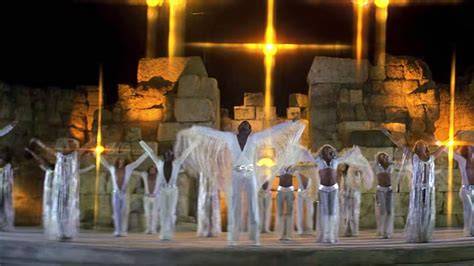
The 1973 film adaptation was shot primarily in Israel. Its visual approach preserves the theatrical artificiality of the stage musical instead of attempting to create a conventionally realistic biblical epic.
The primary cast literally pulls up in the middle of the desert on a bus loaded with props, and while the overture plays, the cast gets off the bus and gets into costume. The end result is a hodgepodge of influences that are constantly at odds with each other, but have a distinct and campy charm all of their own.
The hardest part of the production to get onto film though is the musical’s deliberate staging of artifice. On stage, you’re not supposed to build elaborate temples and period accurate sets. You’re supposed to call attention to the fact it’s a group of performers, and the film surprisingly manages to maintain that spirit in the first few minutes.
It might be a bit of a mess, but there’s not a lot on film like the 1973 adaptation of Jesus Christ Superstar, and I’m grateful that something so truly weird exists.
While the movie takes advantage of gorgeous desert locales and ruins, it does tend to look cheap and slap-dashed together, but that’s kind of the point, although it can still be distracting. The whole movie runs on a weird logic of the characters technically being performers, but not really, and it’s borderline surrealist at a certain point.
The film forces you to enter a mindset where you just have to roll with certain punches. Its visual language is deliberately inconsistent: ancient locations coexist with modern clothes, theatrical props, camp performance, rock instrumentation, and the sensibility of a touring company.
Anachronism as a central artistic method
Anachronism is built into the DNA of the musical. Since the incarnation I’m reviewing was made in the early 1970s, the cross pollination of hippy aesthetic with disco clothing was kind of inevitable.
The musical’s visual and musical anachronisms bring the biblical story into the cultural language of the period in which it was created. The result is not historical reconstruction but a deliberate collision between ancient subject matter and modern political and artistic forms.
The newest popular incarnation aired on TV on NBC with John Legend as Jesus, and that production seemed to choose a pop-punk/goth-ish aesthetic for the majority of its characters.
Various stage productions of the musical have interpreted the visuals in a wild variety of ways. The story’s structure allows each production to connect Jesus and Judas to the political anxieties, youth cultures, and performance styles of its own era.
The 1973 film’s performances
Most of the singers here perform pretty well, but the weakest link as a performer is definitely Ted Neeley as Jesus. He’s not outright bad, but he feels like a weak presence in basically every scene he’s in.
Even during “The Temple” he manages to feel small while smashing up a marketplace. By contrast, Carl Anderson’s performance as Judas is a larger-than-life presence in the film, and his voice is straight up the best of any performer in the film.
No one sounds as good as him, and since Judas has the best songs in the musical to begin with, every scene he’s in works like gangbusters. By default, Carl Anderson is still one of the greatest interpretations of Judas on film.
The story’s focus on Judas is reinforced by Anderson’s performance. He possesses the charisma, anger, vulnerability, and theatrical force that the musical assigns to its true dramatic protagonist.
Why Judas is the most interesting character
One of the biggest blindspots in reinterpreting the Bible on film is Judas Iscariot. Almost every story that deals with Jesus’ crucifixion on film never even attempts to explore the character, the psychology, or anything that might be interesting about Judas.
He shows up at The Last Supper to betray Jesus, gets his money, and hangs himself. Jesus Christ Superstar refuses to treat him as a cardboard cut-out figure of evil.
It’s worth saying that Jesus Christ Superstar’s version of Judas is mostly made up, with no Biblical text to support the idea that he’s been Jesus’ “right hand man all along.” But this Judas is a hybrid of sorts.
He’s not just the betrayer, but the modern perspective of the Christ mythology that wishes to spread its message, but believes that talk of miracles and powers have overshadowed the ideology.
That is a bold choice, but it gives the musical its psychological tension. Judas understands Jesus’ message, fears the movement’s political consequences, resents the transformation of a teacher into a celebrity, and remains emotionally attached to the person he believes he must betray.
Jesus and Judas as mirrors
This show is a deeply human story. A central belief of the Christian faith holds that Jesus Christ was “fully God and fully Man,” and this show lets us glimpse both sides.
The writers’ Jesus struggles with his role as savior in much the same way Judas struggles with his role as betrayer. Both men confront a public drama they believe is larger than their private desires.
Judas attempts to control the political consequences of Jesus’ popularity. Jesus attempts to understand whether he can continue his mission without being consumed by the expectations of his followers.
Their relationship is therefore not simply a conflict between good and evil. It is a conflict between two interpretations of the same movement. Judas wants the message protected from myth and spectacle, while Jesus becomes increasingly identified with the spectacle Judas fears.
Why the musical remains politically relevant
This is a deeply political show, and when read from that lens, it is beyond a doubt successful. Tim Rice and Andrew Lloyd Webber’s work asks how movements change when their leaders become more famous than their ideas.
It also asks whether a leader can remain faithful to a moral cause after becoming the focus of mass devotion. The musical’s language of celebrity, public image, political repression, and collective action remains recognizable in any period of mass media and charismatic leadership.
It is important, timely, and meaningful in our current cultural climate to let these historical, political, and religious figures be humanized and affect how we view this story and its impact on the world we live in.
In this country, the two topics that no one wants to bring up for fear of controversy are religion and politics. This show boldly combines the two, and offers plenty of food for thought alongside pure rock and roll.
Whether you’re a Christian or not, this is an important side to an important story in world history, and it’s a side rarely told anywhere else.
The score and its dramatic function
The most important aspect of a musical is in the name: the music. This was one of the many collaborations of Tim Rice and Andrew Lloyd Webber, and it’s my personal favorite of their collaborations.
The “Superstar” song is an all-time rock opera great, but other songs like “Heaven on Their Minds,” “Simon Zealotes,” “I Don’t Know How to Love Him,” “Damned For All Time/Blood Money,” and “King Herod’s Song” are great too.
The music of Jesus Christ Superstar is nothing short of revolutionary. The score pulses with energy, emotion, and invention, with each song advancing the story and revealing the inner lives of its characters.
Because the show is almost entirely sung-through, the music does not merely decorate the plot. It supplies the plot’s psychological movement. Characters reveal their ideologies through musical style, and changes in musical intensity signal changes in power, fear, intimacy, and public attention.
Camp, humor, and theatrical artificiality
The campiness is super over the top and almost never sobers up at any moment, and while I’m totally into that, if you’re not into the camp aesthetic and tone, this movie probably isn’t going to win you over.
While the movie takes advantage of gorgeous desert locales and ruins, it does tend to look cheap and slap-dashed together, but that’s kind of the point, although it can still be distracting.
Another complaint was the periodic humor in the show, though it was minimal. The drunken apostles at the Last Supper and King Herod’s frighteningly wacky song and dance did not amuse some people.
Rice and Lloyd Webber both felt the story of Christ, especially the crucifixion, had been too much romanticized into a beautiful, graceful event, instead of the brutal, savage act that it had been. To re-open our eyes to the horror and tragedy of the story, they decided they needed to shock the audience.
The humor and artificiality prevent the Passion from becoming a polished sacred tableau. The work insists that the audience notice its theatrical construction, its costumes, its performers, and its mixture of reverence with irreverence.
Different interpretations across productions
The stage musical is quite intense and ends on a rather dour note. The lack of resurrection and the final image of crucifixion can leave audiences with the feeling that the story ends abruptly, particularly if they expect the familiar Christian narrative to continue.
The 2012 recording of Jesus Christ Superstar set the story in modern times, where the authorities follow Jesus’s social media in the hopes of preventing the Romans from having a reason to wipe them all out.
The guards wear riot gear masks and have round plastic shields that remind one of the modern protests. This recording demonstrates how easily the musical can be adapted to contemporary political imagery.
Every production must decide how to represent the tension between ancient history and modern politics. Some emphasize celebrity culture, some focus on authoritarian violence, some foreground gender and sexuality, and others use the rock concert format to highlight collective rebellion.
The musical’s lasting legacy
Few musicals have left a mark on the world like Jesus Christ Superstar. First released as a rock opera album in 1970 before hitting the stage, the rock opera sparked conversation, controversy, and a revolution in musical theatre.
Decades later, Jesus Christ Superstar’s score remains one of the most celebrated in musical theatre history. To date, the music of JCS has been streamed more than 250 million times.
The work is a campy cult classic that ranks among my favorite musical films. It’s not one of the all-time greats, but it’s super fun and delightfully weird in its own right.
Its lasting power comes from the fact that it does not settle the questions it raises. It asks whether Jesus was a divine savior or a human revolutionary, whether Judas was a villain or a tragic political thinker, whether martyrdom creates meaning or merely creates fame, and whether followers can preserve a message once they begin worshipping its messenger.
tags: #jesus #christ #superstar #interpretation