The Jesus commercial at the Super Bowl is a 60-second advertisement from the “He Gets Us” campaign, run by the Christian nonprofit Come Near. Instead of promoting a product, asking for money, or featuring a celebrity, the ad questions the culture of endless consumption and asks viewers to consider whether Jesus shows people how to find more meaning in life.
The commercial begins with images of consumerism, gambling, social media, plastic surgery, luxury, entertainment, competition, and constant stimulation. After the chaotic sequence, the camera cuts to a quiet landscape and a woman looking toward the sky, followed by the message: “There’s more to life than more. What if Jesus shows us how to find it?”
What happens in the Super Bowl commercial
The 60-second spot, dubbed “More,” will air during the second half of the Super Bowl on Feb. 8, starts off with a young girl dressed in pink, clutching an armful of dolls while sitting in front of dozens more. “The one who dies with the most toys wins!” a child-like voiceover says.
Cameras flash and a frenetic soundtrack takes over. The rest of the spot is a series of short clips that run the gamut from gambling and scrolling social media to mirror selfies, plastic surgery, fast-moving traffic, fireworks displays, VR headsets, lavish buildings, car racing, body building, and crash test dummies.
Sprinkled throughout, the word, “more” flashes across the screen in different stylized lettering. “You’ve got to learn to get more pleasure out of this,” an old-fashioned voiceover says repeatedly, sometimes with a DJ-style stutter effect.
As the chaotic sounds give way to a quiet landscape and a serene hiker gazing at the sky, the screen says, “There’s more to life than more,” followed by, “What if Jesus shows us how to find it?” The spot then directs viewers to HeGetsUs.com.
A commercial that contrasts with typical Super Bowl advertising
The 2026 Super Bowl is almost here. And you know what that means: Super Bowl ads. Many brands have released their commercials (or previews) already. And if you can think of it, it’s probably being advertised: beer, potato chips, soda, mayonnaise, vodka, etc.
You’ll also see ads for weight loss drugs, medical tests, AI technology and even sports betting. Traditionally, Super Bowl commercials go big or go home-after all, brands who can afford the $8 million-plus 30-second spots want to get their money’s worth.
But one ad this year isn’t focusing on making money. You won’t see any famous faces in it. It won’t push any products or ask for your cash. It’s focused on the Good News.
Just after viewing the ad on NBC’s Today Third Hour, host Craig Melvin said, “That’s probably going to be the one commercial that sort of contradicts pretty much all of the other commercials you’ll see.”
Yep. I think he’s probably right. Out of all the ads I watched writing this, that was the one that actually stood out to me. What a poignant message to mix in with ads all about getting, doing, being more.
Who created the Jesus commercial?
Created by the He Gets Us campaign (run by the nondenominational nonprofit Come Near, which invites people to “consider Jesus and why He matters today”), this Super Bowl commercial has a simple message.
The ad is the latest in a long-running campaign under the He Gets Us banner, now run by the Christian nonprofit group Come Near, which was founded in 2023 to oversee the campaign.
“He Gets Us” is a campaign that “invites all people to consider Jesus and why He matters,” which started in 2021. The campaign “has brought Jesus into some of culture’s biggest spaces and conversations,” according to its website, and videos on its YouTube channel have amassed 10 million views, a spokesperson said.
The group behind a previous viral and controversial Super Bowl ad returns to the big game with a new spot and familiar mission: to “invite all people one step closer to the authentic Jesus from wherever they are.”
The “Loaded Words” campaign
Last fall, the group kicked off its 2025-2026 campaign, “Loaded Words,” with three spots called “Be,” “Do,” and “Don’t.”
The idea for “Loaded Words” came from focus groups that Come Near conducted last summer to identify people’s struggles and how they’re thinking about spirituality. Based on those conversations, the nonprofit developed the campaign around specific words the team felt tapped into those struggles.
While the first several years of the campaign focused on the idea that Jesus is for everyone, this year’s messaging has shifted in an attempt to feel more personal, explained Come Near chief creative officer Simon Armour.
It remains within “the same DNA of He Gets Us, which is driven by empathy, love and compassion,” Armour told ADWEEK. This year’s series of ads aim to communicate to viewers that “‘Hey, he gets you where you’re at specifically, and what you’re going through in your life,” he continued.
Simon Armour, Come Near's chief creative officer, says the group emphasizes a “neighbor-led” approach, which inspired the themes for this project.
“One of the things that kept coming up was this feeling of people just having a lot of noise in their life and being able to find peace [amongst] that noise, which is proving very difficult for them,” Armour told FOX Business.
After extensive research, Come Near designed the “Loaded Words” campaign, which looks at words in culture that “have a promise to them,” Armour said.
The message about materialism and fulfillment
Armour said the spot looks at the “absurdity” of chasing materialistic things such as money, but also things such as influence and recognition. He said the video attempts to “hold up a mirror.”
“Really, that’s our hope in the spot is that [viewers] feel seen and heard, that it is a reflection of where they’re at and what they’re doing,” Armour said. “Jesus never leaves us in the place that He finds us. He offers something more beyond that.”
The ad’s sequence connects material possessions with broader forms of modern striving. Toys, entertainment, social media, appearance, technology, luxury, status, physical achievement, speed, and recognition are presented as parts of a culture that continually promises satisfaction through having or becoming more.
What a poignant message to mix in with ads all about getting, doing, being more. And what a great reminder to us all that those things aren’t where we’ll find it. Rather, we’ll find more to life in and through Jesus.
When and where the advertisement will air
The group behind the “He Gets Us” campaign will air a new advertisement during the Super Bowl. The ad will air nationwide in the second half of the game, according to the release.
Come Near had an ad played during the Super Bowl in 2024, which was met with backlash on social media from both the right and left.
Come Near has two other ads that will air in various regional markets, including Portland, Oregon, San Francisco, Denver, Wichita, Kansas, Kansas City and Oklahoma City.
The group utilizes what Armour described as a “tent pole strategy.”
“We look at moments in culture where people are really gathering around … the Super Bowl represents another one of those moments where people are really coming together,” Armour said. “I think [it is] a good opportunity for us to again invite people to consider Jesus’ perspective on things that our neighbor is telling us they’re struggling with in their own lives.”
Armour says he hopes this video will help people “take a step” towards Jesus.
“We really judge success based on the pursuit of our mission,” he said. “There’s many ways in which we measure that idea of one step … our hope really is that whatever that looks like for them, that they do take a step towards Jesus.”
How the campaign began
Jesus Christ is now the center of a multimillion-dollar advertising campaign funded by the founder of Hobby Lobby and others, which is apparently just getting started.
The ads all stem from the central idea that “He Gets Us.” They discuss how “He” (Jesus Christ) was a refugee, had disdain for hypocrisy, and was also unfairly judged like other marginalized members of modern society.
In one of the commercials, a black and white slideshow of photos tells the story of Central American migrants who must flee their home to avoid persecution. At the end, it is revealed the story being told is that of Jesus and his parents, Mary and Joseph.
The ads are funded in part by the family that owns the notably religious craft store chain Hobby Lobby, according to Christianity Today, as well as other evangelical groups, including a foundation called The Signatry. Other donors have kept their identities anonymous.
| Campaign element | Information |
|---|---|
| Campaign | He Gets Us |
| Organization | Come Near |
| Commercial title | “More” |
| Length | 60-second spot |
| Placement | Second half of the Super Bowl |
| Creative campaign | “Loaded Words” |
| Director | Salomon Ligthelm |
| Agency partner | Lerma |
The scale and purpose of the campaign
It's part of a well-funded campaign that is just getting started. The advertisements are part of an effort to shift away from a negative public perception of Christians, and towards Jesus, says Bob Smietana, national reporter for Religion News Service, in an interview with NPR.
Smietana says that the campaign is attempting to appeal to groups that may have felt excluded or repelled by the church in recent years, like members of the LGBTQ community, different races and ethnicities, those who lean more liberal politically, or people who have kept up with scandals of abuse.
The group behind the campaign has also purchased an advertisement slot for this Sunday's Super Bowl, one of the most expensive brand platforms out there. The estimated costs for those ads will run around $20 million.
In an interview with Christianity Today, the branding firm for the campaign said the plan included investing $1 billion over the next three years, a budget comparable to that of a major brand.
Smietana told NPR the campaign comes at a time of decline in organized religion:
“I think spending that much money, again, is a kind of admission on their part that there's a problem. And, you know, there is a problem for organized religion in America. It's declining, congregations are declining. And these ads, too, are a way to chide their fellow Christians to say, 'This is what Jesus is like, and maybe we know it, and maybe we're not acting like Jesus.'”
“But I think it goes back to the problem that American evangelicals in particular face is that their political ambitions and their deeply held religious beliefs and ethical beliefs are in conflict right now. So the things that will help them win politically will alienate people.”
Public reaction to the “Jesus commercial”
And, of course, social media had some thoughts:
- every time i see those jesus commercials i just freeze and look around wondering if i'm the only one seeing them.
- Was that just a commercial for… Jesus Christ?
The upcoming Super Bowl is expected to see a boost in viewership, with an estimated 100 million-plus people watching the broadcast.
It means a lot more people will probably be sending out confused tweets about a “Jesus Commercial” - a search term on Twitter that already was flooded after “He Gets Us” ads aired during Sunday's Grammy awards.
The earlier “He Gets Us” Super Bowl advertisement
Among the ads at this year’s Super Bowl was one from the organization He Gets Us (HGU), the latest in a series of TV and social media videos that have appeared over the past few years.
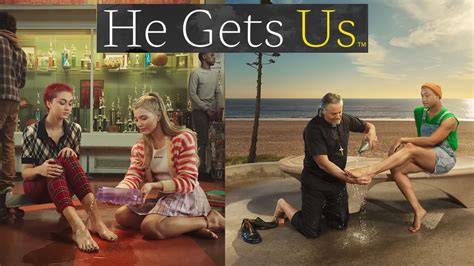
The 2024 Super Bowl ad features a series of still photographs of a wide variety of people washing the feet of others. No narrative or captions accompany the photos. Rather, at the end of the video, banner-style messages state, “JESUS DIDN’T TEACH HATE,” “HE WASHED FEET,” “He gets us. All of us.”
Staged in various contexts, the Super Bowl ad features unlikely photos of people washing the feet of others who are portrayed as having disparate interests and perspectives.
For example, an oil field worker washes the feet of an environmental activist against the backdrop of land riddled with oil drilling equipment; a rancher washes the feet of a native American; a woman washes the feet of another woman in front of a “Family Planning Clinic,” while anti-abortion protestors mill about indifferently in the background; an apparently non-Muslim woman washes the feet of an apparently Muslim woman, while the non-Muslim woman’s husband looks on suspiciously; an apparently Catholic priest washes the feet of a man in a caricature of an effeminate pose. And so forth.
Criticism of the campaign’s theology
Of course, it is certainly true that Jesus gets us. It’s not at all clear, however, that He Gets Us gets Jesus.
Indeed, it seems that the ads reduce the concrete particularity of Jesus Christ to a vague admonition to be nice and not to judge. Being nice and not judging others are good ideas. But you don’t need Jesus to know that. And knowing Jesus is much, much more.
More to the point, being nice and not judging are not means of salvation. HGU advocates that people act like Christians. But its ads and website are completely devoid of the central Christian message that conversion to the person of Jesus leads to salvation, which leads, in turn, to the kinds of virtues HGU advocates.
It reduces Christian virtue to tolerance and divorces tolerance from conversion and discipleship.
Foot washing and its Christian context
On its website, HGU provides a sympathetic account of the ad’s purpose. It is “built on the premise of Love and Unity.”
They explain that Jesus’s washing of feet of the “12 disciples” (not “apostles”) is “a symbol for all of his followers to see how they should treat one another.”
“Foot washing required humility on the part of both parties,” HGU continues, “the one willing to wash another’s feet and also the one willing to have their feet washed.” Thus, foot washing was “an act of mutual admiration. Jesus was shedding any notion of rank or caste among his disciples.”
While not an exhaustive analysis, this is not an illegitimate interpretation of the act of foot washing. And HGU is further correct in its explanation that “figurative foot washing” can take all kinds of forms, including simple gestures of kindness and charity.
“Acts of kindness done out of humility and respect for another person could be considered the equivalent of foot washing.”
The criticism is that the ad presents foot washing apart from the wider meaning assigned to it in the Gospel account.
For example, foot washing in the Super Bowl ad is wholly disconnected from the Last Supper and its radical call to obedience to Christ. In this context, foot washing is inextricably tied to Jesus’ preparation for his sacrificial death and to his institution of the Eucharistic feast that perpetuates that death through time.
In the Last Supper, Jesus is not admonishing his apostles to be nice, non-judgy people. He is commanding them to follow him. You would learn nothing of this from the ad or HGU’s interpretive essay about it.
The question of conversion and salvation
The problems lie in what HGU expects to accomplish by these ads and, more importantly, what they don’t say; indeed, what they implicitly deny.
Put in simplest terms, the ads seem to imply that being nice and nonjudgmental is the means of salvation rather than its effect.
Nor is the particularity of conversion to Christ present in other content from HGU, either in its ubiquitous ads or explanations of its organizational purpose.
HGU consistently encourages people to follow “Jesus’ teachings,” which “are a warm embrace, not a cold shoulder.” They very persistently invite their readers to “rediscover and share the compelling story of Jesus’ life.”
The vague phrase “story of Jesus” appears over and over on HGU’s website. Nowhere, however, does the organization suggest that it’s not the story of Jesus, but rather Jesus himself who saves.
HGU expressly states that their purpose is to “share an idea.” The problem, again, is that Jesus is not an idea. He is a living person who commands obedience.
“The scandal of particularity”
He Gets Us expressly rejects this scandal of particularity. Rather than a call to conversion, HGU’s website explains, the organization “simply invites all to consider the story of a man who created a radical love movement that continues to impact the world thousands of years later.”
But, as HGU concedes, there’s nothing particular about Jesus in all this. “All of us work together relentlessly to share the transformative power that unconditional love, forgiveness, and sacrificial generosity have to change us, our families, our communities, and our country.”
This is a good idea. But I can get it from the editorial page of The New York Times, to crib a line from the late Father Richard John Neuhaus.
Nowhere does Jesus command, suggest, admonish or advocate that we are saved by embracing an idea. Rather, he declares, “I am the way and the truth and the life. No one comes to the Father except through me” (Jn 14:6).
Transformation comes from conversion. No one is saved by “transformative power,” but rather by the life, death and resurrection of Christ.
He Gets Us doesn’t get Jesus. He did not create a “love movement.” He created a Church. And he did not teach that we can be saved by an “idea,” regardless how laudable it might be.
tags: #jesus #commercial #super #bowl