Jesu dulcis memoria-also known in English as “Jesus, the very thought of Thee,” “Jesu, name of sweetest thought,” and “Jesu, thou joy of loving hearts”-is a celebrated medieval Latin hymn about the sweetness, consolation, desire, and joy associated with the Holy Name of Jesus. It is traditionally attributed to St. Bernard of Clairvaux, although modern hymnological research considers that attribution uncertain and identifies the author more cautiously as probably an English Cistercian writer.
The hymn’s central message is that remembering Jesus leads the believer from memory to presence, from presence to desire, and from desire to the joy of finding Christ. Its best-known English translation is Edward Caswall’s “Jesus, the very thought of Thee,” while other important versions were produced by Alfred Edersheim and Ray Palmer. The Latin poem survives in manuscripts with between 42 and 53 stanzas, although only selected portions are commonly sung in worship.
The Latin opening and its meaning
The hymn begins with the famous lines:
Jesu, dulcis memoria,
dans vera cordis gaudia:
sed super mel et omnia
ejus dulcis praesentia.
“Jesus, sweet to remember, giving true joy to the heart. But sweeter than honey and all things is His sweet presence.”
The opening establishes the hymn’s characteristic movement. Memory leads to presence. The Name recalled with love draws Christ near. This is not magic. It is the logic of love. We become present to whom we love by remembering them. So it is with the Name of Jesus.
The hymn is not primarily a hymn of public triumph or thunder. It is a hymn of intimacy. It does not proclaim only what Christ does for the world, but what His very Name does to the soul. The language of sweetness, joy, desire, and longing expresses a personal encounter with Christ rather than an abstract theological definition.
Authorship and medieval origins
For many years, this hymn was considered to be the work of Bernard, Abbot of Clairvaux (1091-1153), who was an advocate for Pope Innocent II and the Second Crusade; this hymn is still sometimes erroneously attributed to him.
Iesu, Dulcis Memoria is a celebrated 12th century hymn attributed to St. Bernard of Clairvaux (1090-1153), Doctor Mellifluus. The hymn’s close resemblance to some of Bernard’s prose works, especially his commentary on the Song of Songs, helped create the traditional attribution. Bernard’s theology also strongly resembles the hymn’s language of sweetness, joy, affection, desire, and longing.
In the mid 20th century, Latin scholar Dom André Wilmart, O.S.B. (1876-1941) discredited this common attribution. In a paper released posthumously in Rome as “Le ‘Jubilus’ dit de Saint Bernard” in the series Storia e Letteratura (1944), and summarized by F.J.E. Raby in the Bulletin of the Hymn Society of Great Britain in October 1945, Wilmart noted that the earliest and best manuscripts were all produced in England, and from there spread to France, Germany, and Italy.
The hymn was known to the English poet John of Hoveden, who died in 1275. Bernard’s name was not associated with this hymn until the end of the thirteenth century. In reality, the author was probably an English member of the Order of Citeaux, or Cistercians, a form of monasticism popularized in part by Bernard.
The earliest manuscript
The earliest manuscript is held at the Bodleian Library: MS Laud. Misc. 668, fols. 101r-104r, dating from the 12th century. James Mearns, in John Julian’s Dictionary of Hymnology (1907), considered this copy to be “the best, and most probably the original.”
It contains 42 quatrains interlined with a melody, and it actually begins “Dulcis Jesu memoria,” unlike the later, common transposition “Jesu dulcis memoria.” This difference is significant because it shows that the opening form familiar in modern liturgical and hymn-book usage was not necessarily the original wording of the poem.
Subsequent manuscript copies contain numerous variations and extra stanzas, but the extra stanzas cannot be traced earlier than the 15th century. For example, a 15th century copy at Mainz, number 439, has 50 stanzas. Versions at this length were probably crafted for the purpose of Rosary prayers, for Rosaries containing five sets of ten beads, or five decades.
The hymn’s structure and surviving versions
The entire hymn has some 42 to 53 stanzas depending upon the manuscript. This variation reflects the transmission of the poem through different medieval collections, liturgical books, and devotional traditions.
Parts of this hymn were used for the Feast of the Holy Name of Jesus, which was formerly celebrated on the Sunday between the Circumcision and Epiphany, or, failing such a Sunday, on January 2. The part below was used at Vespers.
In the Roman liturgy, this hymn was appointed for the Feast of the Most Holy Name of Jesus, the second Sunday of Epiphany, beginning in 1722, and was divided into three short portions for Vespers, Matins, and Lauds.
| Liturgical use | Portion associated with it |
|---|---|
| Vespers | Jesu dulcis memoria |
| Matins | Jesu, Rex admirabilis |
| Lauds | Jesu, decus angelicum |
In the liturgical revisions of Vatican II, the feast was deleted, though a votive Mass to the Holy Name of Jesus had been retained for devotional use. With the release of the revised Roman Missal in March 2002, the feast was restored as an optional memorial on January 3.
Similarly, the Feast of the Holy Name of Mary was restored as an optional memorial on September 12 in the revised Missal.
The theology of the Holy Name
The Name “Jesus” means God saves. It is not chosen at random. It is given from Heaven. It declares His mission before He speaks a word or performs a miracle.
To invoke the Holy Name is to confess the Incarnation, Redemption, and Mercy of God in a single breath. The Fathers of the Church taught that the Name of Jesus contains what it signifies. When spoken with faith, it awakens trust, repentance, and hope.
This is why Scripture insists that “there is no other name under Heaven given to men, whereby we must be saved.” The power of the Name is not mechanical. It is personal. It works because it belongs to Someone who loves us.
The hymn expresses this theology through a sequence of sound, hearing, thought, and desire:
Nil canitur suavius,
nil auditur jucundius,
nil cogitatur dulcius
quam Jesus Dei Filius.
“Nothing is sung more sweetly, nothing is heard more joyfully, nothing is thought more delightfully than Jesus, the Son of God.”
The Name orders thought, speech, and song. It reorients the interior life. The hymn’s repeated emphasis on sweetness does not reduce Christianity to emotion; rather, it presents the experience of divine love as something that reaches the whole person through memory, hearing, speech, thought, and prayer.
Memory, presence, and interior prayer
The Church gives us the Feast of the Holy Name of Jesus as a quiet jewel after Christmas. The Child has been born. He has been circumcised according to the Law. His Name has been spoken aloud. And now the faithful are invited to linger over it, not as a title, but as a presence.
The Holy Name is not merely a sound. It is a sacrament of memory, a doorway into love. The hymn presents remembrance as an active spiritual practice: to remember Jesus with affection is to turn the mind toward His presence.
The saints understood what modern souls often forget: the Name of Jesus is a prayer in itself. To say “Jesus” slowly, attentively, lovingly, is already to pray. It is an act of faith. It is an act of hope. It is an act of love.
In moments of temptation, sorrow, fear, or dryness, the Holy Name becomes a refuge. The hymn expresses this movement from need to discovery:
Jesu, spes poenitentibus,
quam pius es petentibus!
quam bonus te quaerentibus!
sed quid invenientibus?
“Jesus, hope of the repentant, how gracious You are to those who ask, how good to those who seek, but what are You to those who find!”
Here theology reaches its limit and yields to wonder. Words fail. The soul that truly encounters Christ finds something beyond language. The Name that once consoled now overwhelms.
Sweetness that creates desire
The sweetness of the Holy Name is not sentimental. It wounds. Bernard often spoke of love as something that pierces. The more the soul tastes Christ, the more it longs for Him.
This is why Jesu dulcis memoria is both consoling and unsettling. It does not allow complacency. It awakens hunger:
Jesu dulcedo cordium,
Fons vivus, lumen mentium,
Excedit omne gaudium
et omne desiderium.
“Jesus, sweetness of hearts, living fountain, light of minds, You surpass every joy and every desire.”
Every created pleasure is relativized. Every lesser love finds its place. The Holy Name purifies desire by revealing its true object.
This theme is also developed in the later English verses commonly associated with the hymn:
“Celestial Sweetness unalloyed,
Who eat Thee hunger still;
Who drink of Thee still feel a void
Which only Thou canst fill.”
The paradox is deliberate. The more the soul receives, the more it desires. The experience of Christ does not eliminate longing; it gives longing its proper object.
Edward Caswall’s English translation
The much more popular translation in common use is “Jesu, the very thought of Thee” by Edward Caswall (1814-1878). Caswall’s text first appeared in his Lyra Catholica in London in 1849, in 15 quatrains, based on the Roman Breviary version for the Feast of the Most Holy Name of Jesus.
In contrast to Alfred Edersheim’s work, Caswall, in his preface, seems to have valued the devotional spirit of the texts rather than aiming for a strict English equivalent. His translation therefore became widely loved not because it reproduces every detail of the Latin literally, but because it conveys its devotional atmosphere in natural English verse.
Caswall’s commonly sung text
Jesus, the very thought of Thee
With sweetness fills the breast;
But sweeter far Thy face to see,
And in Thy presence rest.
Nor voice can sing, nor heart can frame,
Nor can the memory find
A sweeter sound than Thy blest Name,
O Savior of mankind!
O hope of every contrite heart,
O joy of all the meek,
To those who fall, how kind Thou art!
How good to those who seek!
But what to those who find? Ah, this
Nor tongue nor pen can show;
The love of Jesus, what it is,
None but His loved ones know.
Jesus, our only joy be Thou,
As Thou our prize wilt be;
Jesus, be Thou our glory now,
And through eternity.
Additional Caswall verses
Caswall expanded his work for The Masque of Mary in London in 1858, based on an unknown source containing 50 quatrains. The 1864 edition of C.E.P. Wackernagel’s Das deutsche Kirchenlied, volume 1, number 183, contains the same 50 quatrains as Caswall’s text, though in a slightly different order.
O Jesus, King most wonderful,
Thou Conqueror renowned,
Thou sweetness most ineffable
In Whom all joys are found!
When once Thou visitest the heart,
Then truth begins to shine,
Then earthly vanities depart,
Then kindles love divine.
O Jesus, light of all below,
Thou fount of living fire,
Surpassing all the joys we know,
And all we can desire.
Jesus, may all confess Thy Name,
Thy wondrous love adore,
And, seeking Thee, themselves inflame
To seek Thee more and more.
Thee, Jesus, may our voices bless,
Thee may we love alone,
And ever in our lives express
The image of Thine own.
O Jesus, Thou the beauty art
Of angel worlds above;
Thy Name is music to the heart,
Inflaming it with love.
O most sweet Jesus, hear the sighs
Which unto Thee we send;
To Thee our inmost spirit cries;
To Thee our prayers ascend.
Abide with us, and let Thy light
Shine, Lord, on every heart;
Dispel the darkness of our night;
And joy to all impart.
Jesus, our love and joy to Thee,
The virgin’s holy Son,
All might and praise and glory be,
While endless ages run.
Alfred Edersheim’s translation
Alfred Edersheim (1825-1889) published his complete translation, “Jesu, name of sweetest thought,” in The Jubilee Rhythm of St. Bernard of Clairvaux in London in 1847.
In his commentary on the hymn, Edersheim expressed his desire for his English translation to be faithful to the original. He endeavoured not only to be literal, but as much as possible to preserve the form of the original.
Edersheim recognized that in poetical writings much depends on the form in which a thought is presented, on the words in which it is expressed, on the precise succession of the lines, and occasionally even on the metre and the rhyme. His version therefore belongs to a more literal tradition of translation than Caswall’s.
Ray Palmer’s translation
Ray Palmer (1808-1887) prepared a partial translation, “Jesu, thou joy of loving hearts,” for the Sabbath Hymn Book in New York in 1858 and the subsequent Sabbath Hymn & Tune Book in New York in 1859.
Palmer’s text corresponds to quatrains 4, 3, 20, 28, and 10 of the Latin in Daniel’s edition. It is therefore not a complete translation of the entire medieval poem, but a carefully selected devotional adaptation.
Jesu, thou joy of loving hearts,
Thou fount of life, thou light of men,
From the best bliss that earth imparts
We turn unfilled to Thee again.
Thy truth unchanged hath ever stood;
Thou savest those that on Thee call;
To them that seek Thee, Thou art good,
To them that find Thee, all in all.
Hopkins’s English adaptation
Gerard Manley Hopkins produced another English rendering of the hymn. The following version is identified as the unaltered Hopkins text:
Jesus to cast one thought upon
Makes gladness after He is gone,
But more than honey and honeycomb
Is to come near and take Him home.
No music so can touch the ear,
No news is heard of such sweet cheer,
Thought half so dear there is not one
As Jesus God the Father’s Son.
Jesu, their hope who go astray,
So kind to those who ask the way,
So good to those who look for Thee,
To those who find what must Thou be?
To speak of that no tongue will do
Nor letters suit to spell it true:
But they can guess who have tasted of
What Jesus is and what is love.
Jesu, a springing well Thou art,
Daylight to head and treat to heart,
And matched with Thee there’s nothing glad
That men have wished for or have had.
Wish us Good Morning when we wake
And light us, Lord, with Thy day-break.
Beat from our brains the thicky night
And fill the world up with delight.
Who taste of Thee will hunger more,
Who drink be thirsty as before:
What else to ask they never know
But Jesus’ self they love Him so.
And a sweet singing in the ear
And in the mouth a honey zest
And drinks of heaven in the breast.
Thou art the hope, Jesu, my sweet,
The soul has in its sighing-fit;
The loving tears on Thee are spent,
The inner cry for Thee is meant.
Be our delight, O Jesu, now
As by and by our prize art Thou,
And grant our glorying may be
World without end alone in Thee.
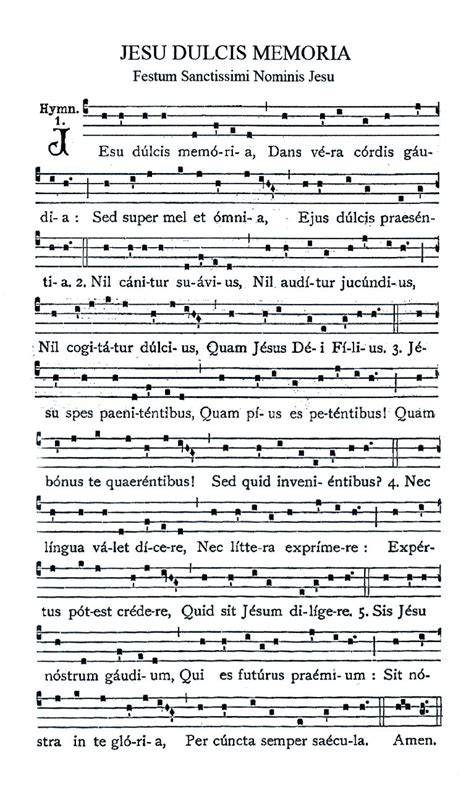
Latin lyrics of the principal four-stanza version
The following four-stanza form is the version most closely associated with the traditional Vespers hymn for the Holy Name of Jesus:
Jesu, dulcis memoria,
dans vera cordis gaudia:
sed super mel et omnia
ejus dulcis praesentia.
Nil canitur suavius,
nil auditur jucundius,
nil cogitatur dulcius,
quam Jesus Dei Filius.
Jesu, spes paenitentibus,
quam pius es petentibus!
quam bonus te quaerentibus!
sed quid invenientibus?
Nec lingua valet dicere,
nec littera exprimere:
expertus potest credere,
quid sit Jesum diligere.
Sis, Jesu, nostrum gaudium,
qui es futurum praemium:
sit nostra in te gloria,
per cuncta semper saecula.
Amen.
Meaning of the principal Latin phrases
| Latin phrase | Meaning |
|---|---|
| Jesu, dulcis memoria | Jesus, sweet to remember |
| dans vera cordis gaudia | giving true joy to the heart |
| ejus dulcis praesentia | His sweet presence |
| Nil canitur suavius | Nothing is sung more sweetly |
| Nil auditur jucundius | Nothing is heard more joyfully |
| Nil cogitatur dulcius | Nothing is thought more delightfully |
| Jesus Dei Filius | Jesus, the Son of God |
| Jesu, spes paenitentibus | Jesus, hope of the repentant |
| quam bonus te quaerentibus | how good You are to those who seek You |
| quid sit Jesum diligere | what it is to love Jesus |
| Sis, Jesu, nostrum gaudium | Be, Jesus, our joy |
| qui es futurum praemium | You who are the future reward |
Musical settings and hymn tunes
Gregorian chant
The well-known Gregorian chant setting of this hymn does not express the same interpretation for every listener. Chant’s proximity and fidelity to the text are among its finest characteristics. However, the rather minor-sounding chant can suggest a description of a solemn occasion, such as the presentation of the Child Jesus in the temple.
Another interpretation hears the text as a mystical prayer, a sublime union of the soul with its Creator and Spouse. It can also express what is found in the sacred mysteries of the Latin Mass and especially in the Most Blessed Sacrament. It boils down to this: His sweet presence.
ST. AGNES
Caswall’s translation is most frequently printed with the tune ST. AGNES, written for this text by John Bacchus Dykes (1823-1876) and first published in John Grey’s Hymnal for Use in the English Church in London in 1866.
The tune was popularized through its appearance in both Hymns Ancient & Modern in London in 1868 and The English Hymnal in Oxford in 1906. St. Agnes was a Christian martyr in 304 under Diocletian.
QUEBEC or HESPERUS
Palmer’s translation is frequently printed with QUEBEC, or HESPERUS, a tune written by Henry Baker (1835-1910), initially associated with the hymn “Sun of my soul” by John Keble.
MARYTON
MARYTON, another common tune for Palmer’s text, was also first associated with John Keble’s hymn, “Sun of my soul.”
Modern choral settings
Drake’s setting for SSA and SATB
One modern setting of Jesu Dulcis Memoria was composed in the traditional hymn style for a ladies’ choir. The music was written before the text was selected, and once St. Bernard’s Jesu Dulcis Memoria was rediscovered, it fit as if the music had been prepared for it all along.
The setting is for SSA, but it could easily be sung an octave down for men’s voices. A SATB version also exists in the original key of composition, although the three-part setting can sound somewhat sweeter.
The setting’s interpretation emphasizes the mystical character of the text rather than a solemn liturgical occasion. It presents the hymn as a prayer of intimate encounter, especially in the lines about Jesus as the hope of the penitent and the sweetness of His presence.
Daniel Pinkham’s setting
Daniel Pinkham set the Hopkins text in Eight Poems of Gerard Manley Hopkins: “Jesus to Cast One Thought upon,” “Spring, Heaven-Haven,” “Pied Beauty,” “Strike, churl,” “Spring and Fall,” “Christmas Day,” and “Jesu That Dost in Mary Dwell,” for baritone or tenor-baritone and viola.
Jesu dulcis memoria | Canto Gregoriano | Gregorian Chant
The hymn and the Feast of the Holy Name of Jesus
The Feast of the Holy Name of Jesus gives the hymn its clearest liturgical setting. The Child has been born, circumcised according to the Law, and named. The faithful are then invited to remain with the Name itself and to contemplate what it means.
The Holy Name is not merely a title. It communicates the identity and mission of Christ: the One whose Name means God saves. The hymn therefore links the spoken Name with salvation, mercy, repentance, hope, and eternal joy.
On the Feast of the Holy Name, the Church invites us to more than devotion. She invites us to conversion of speech, thought, and heart. How often do we speak the Name of Jesus casually, distractedly, or not at all? How rarely do we pause to let it echo within us?
The saints teach us to carry the Name into daily life: whispered in temptation, breathed in prayer, spoken in love. To live under the Holy Name is to live under mercy.
Why the hymn remains influential
Jesu dulcis memoria has endured because it unites several forms of Christian expression. It is at once a medieval Latin poem, a liturgical hymn, a prayer to the Holy Name, a meditation on divine desire, and a source for English hymns used in congregational worship.
Its many translations reveal different possibilities within the original. Edersheim sought a close and formal rendering. Caswall emphasized devotional poetry and became the best-known English voice of the hymn. Palmer selected and adapted particular stanzas for hymn-book use. Hopkins created a distinctive poetic version, and modern composers have continued to reinterpret the text for choral and instrumental settings.
The hymn’s spiritual logic remains consistent across these forms. Jesus is sweet to remember, sweeter in presence, the hope of those who repent, the goodness sought by those who search, and the joy that exceeds every created pleasure.
And so the hymn becomes a prayer: Jesus, be sweet to our memory when the world is bitter. Jesus, be present when our hearts are restless. Jesus, be our joy when lesser joys fail. Nothing is sweeter. Nothing is safer. Nothing is more necessary. For in the Holy Name is not only salvation promised, but salvation already near.