The history of violence associated with The Church of Jesus Christ of Latter-day Saints includes extensive persecution of Latter-day Saints by mobs, militias, and government authorities, as well as episodes in which some Church members committed defensive, retaliatory, or aggressive violence. A balanced account must examine both forms of violence without treating historical context as an excuse.
The Church is founded on the teachings of Jesus Christ, and the virtues of peace, love, and forgiveness are at the center of Church doctrine and practice. Latter-day Saints believe the Savior’s declaration, found in the New Testament and the Book of Mormon, that “blessed are the peacemakers: for they shall be called the children of God.” In Latter-day Saint scripture, the Lord has commanded His followers to “renounce war and proclaim peace.”
Why the Mormon movement faced violent opposition
From the first years of its existence, the Mormon Church sparked violent opposition from other Americans. This violence claimed many lives, including Mormon prophet Joseph Smith's, and eventually led to the Mormons seeking refuge outside the boundaries of the United States.
The hostility shown Mormons had many causes. Some of them were practical: Mormon settlers tended to arrive in a community in substantial numbers, and their ranks swelled as church leaders issued calls for "gatherings" of the faithful. Non-Mormons resented the economic competition the settlers brought; the rise in land costs; and the possibility that Mormons, voting as a bloc, would take control of local government.
Missourians had the additional concern that Joseph Smith had declared their state the site of a "New Jerusalem" for his flock. If God had decreed the land to Mormons, where did that leave everyone else?
Religious and social disagreements
Other opposition stemmed from Mormon doctrine. The church believed that the true church had been removed from the earth at the end of the Apostolic Age and that, as a result, all other Christian denominations (Protestant as well as Catholic) were not legitimate. Neither Joseph Smith nor the Mormon missionaries shied away from making these claims.
The Mormon practice of polygamy, a part of church doctrine at the time that was publicly announced in 1852 but rumored much earlier, sparked accusations of sexual immorality and even white slavery from other Christians.
Conversely, residents of Missouri, which had entered the Union as a slave slate, resented the fact that Mormons did not endorse slavery and feared that a Mormon majority would abolish the practice.
For many reasons, opposition to Mormons quickly grew violent. In the first two decades after the Church was organized, Latter-day Saints were often the victims of violence.
The early persecution of Latter-day Saints
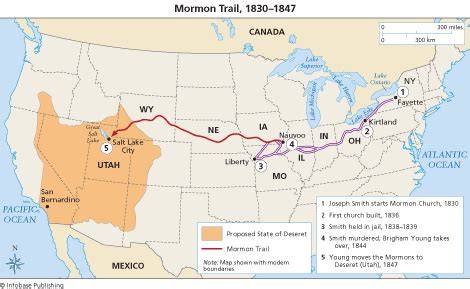
Soon after Joseph Smith organized the Church in New York in 1830, he and other Church members began settling in areas to the west, in Ohio, Missouri, and Illinois. Time and again, the Saints tried to build their Zion community where they could worship God and live in peace, and repeatedly they saw their hopes dashed through forcible and violent removal.
Mobs drove them from Jackson County, Missouri, in 1833; from the state of Missouri in 1839, after the governor of the state issued an order in late October 1838 that the Latter-day Saints be expelled from the state or “exterminated”; and from their city of Nauvoo, Illinois, in 1846.
Following their expulsion from Nauvoo, Latter-day Saints made the difficult trek across the Great Plains to Utah. As Latter-day Saints faced these difficulties, they sought to live by revelations to Joseph Smith that counseled them to live their religion in peace with their neighbors.
Tar and feathers in Kirtland
Just a few months after the Mormon Church was founded in 1830, Smith's preaching led to hostility from other clergymen and a charge of "being a disorderly person." He was acquitted but soon described an instruction he had received from God for the Mormons to migrate from New York to Ohio in 1831.
There, in Kirtland, Smith received his first taste of mob violence. Residents resented the Mormons' growing power, feared the poverty of some recent arrivals would lead to "pauperism," and even worried that local Mormon converts would deed their property to the church rather than relatives.
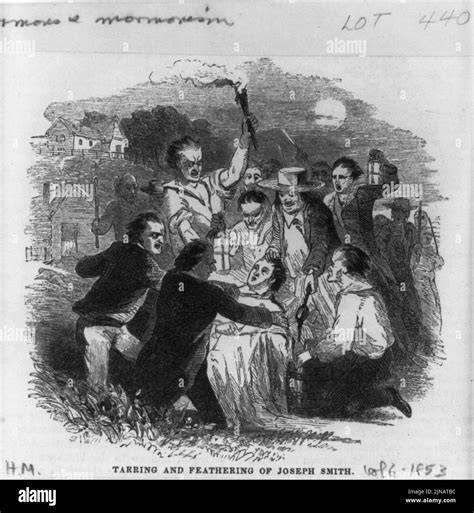
In late March 1832, a group of about 50 anti-Mormon agitators dragged Smith from his home and tarred and feathered him.
Missouri: shootings, arson, and expulsion
Smith was undaunted by this assault. But other Mormons in Missouri would soon face even greater violence.
In the summer of 1833, settlers in Jackson County came under attack -- homes were shot up, haystacks set ablaze, and in July the Mormon printing press was destroyed.
Autumn brought larger assaults, culminating in an attack on 200 Mormon cabins in November and the eviction of 1,200 Mormons, who fled across the Missouri River to safety in Clay County, where residents would shelter them for the next few years.
Church leaders and members repeatedly attempted to gain redress from local and state governments; when these petitions failed, they appealed unsuccessfully to the federal government to correct past wrongs and gain future protection.
Latter-day Saints long remembered the persecutions they experienced and the unwillingness of government authorities either to protect them or to prosecute their attackers. They often lamented that they experienced religious persecution in a land that promised religious freedom.
The Mormon-Missouri War
After the bank failed in the Panic of 1837, he abandoned Ohio for the northern Missouri counties of Caldwell and Daviess, which had been created for Mormon settlers forced to leave Clay County. Although these new counties were intended to provide safe haven, the calm was only temporary.
Reacting to anti-Mormon harassment, church leader Sidney Rigdon gave an intemperate July 4th oration in which he spoke of a "war of extermination" between Mormons and their neighbors.
When those neighbors tried to prevent Mormons from voting in the August state elections, a melee erupted, and soon groups of militia were roaming the countryside.
In late October, Missouri governor Lilburn Boggs issued an official decree, declaring, "The Mormons must be treated as enemies, and must be exterminated or driven from the State."
Just a few days later, a mob attacked the Mormon community of Haun's Mill, slaughtering 17 people at close range. Joseph Smith was jailed, and the Mormon community once again had to take flight, settling in Illinois.
The expulsion from Missouri-involving at least 8,000 Latter-day Saints-occurred during the winter months, heightening the suffering of the thousands of refugees who lacked adequate food and shelter and were sometimes subject to epidemic diseases.
The Hawn’s Mill Massacre
In the most infamous incident, at least 17 men and boys, ranging in age from 9 to 78, were slaughtered in the Hawn’s Mill Massacre. Some Latter-day Saint women were raped or otherwise sexually assaulted during the Missouri persecutions.
Vigilantes and mobs destroyed homes and stole property. Many of the Saints’ opponents enriched themselves with land and property that was not justly theirs.
In March 1839, when Joseph Smith, imprisoned in Liberty, Missouri, received reports of the suffering of the exiled Latter-day Saints, he exclaimed, “O God, where art thou?” and prayed, “Remember thy suffering saints, O our God.”
Violence, vigilantism, and the American frontier
In 19th-century American society, community violence was common and often condoned. Much of the violence perpetrated by and against Latter-day Saints fell within the then-existing American tradition of extralegal vigilantism, in which citizens organized to take justice into their own hands when they believed government was either oppressive or lacking.
Vigilantes generally targeted minority groups or those perceived to be criminal or socially marginal. Such acts were at times fueled by religious rhetoric.
The existence of community-based militias also contributed to this culture of vigilantism. Congress passed a law in 1792 requiring every able-bodied male between 18 and 45 years of age to belong to a community militia.
Over time, the militias turned into the National Guard, but in early America, they were often unruly, perpetrating acts of violence against individuals or groups perceived to be opponents of the community.
In the 1830s and 1840s, the Latter-day Saints’ communities in Ohio, Missouri, Illinois, and Utah were all located in the western frontier regions of the United States, where community violence was readily sanctioned.
The Danites and Mormon participation in violence
The isolated acts of violence committed by some Latter-day Saints can generally be seen as a subset of the broader phenomenon of frontier violence in 19th-century America.
In 1838, Joseph Smith and other Church members fled from mobs in Ohio and moved to Missouri, where Latter-day Saints had already established settlements.
Joseph Smith believed that opposition from Church dissidents and other antagonists had weakened and ultimately destroyed their community in Kirtland, Ohio, where only two years before they had completed a temple at great sacrifice.
By the summer of 1838, Church leaders saw the rise of similar threats to their goal of creating a harmonious community in Missouri.
A paramilitary organization
At the Latter-day Saint settlement of Far West, some leaders and members organized a paramilitary group known as the Danites, whose objective was to defend the community against dissident and excommunicated Latter-day Saints as well as other Missourians.
Historians generally concur that Joseph Smith approved of the Danites but that he probably was not briefed on all their plans and likely did not sanction the full range of their activities.
Danites intimidated Church dissenters and other Missourians; for instance, they warned some dissenters to leave Caldwell County.
During the fall of 1838, as tensions escalated during what is now known as the Mormon-Missouri War, the Danites were apparently absorbed into militias largely composed of Latter-day Saints.
These militias clashed with their Missouri opponents, leading to a few fatalities on both sides. In addition, Latter-day Saint vigilantes, including many Danites, raided two towns believed to be centers of opposition activity, burning homes and stealing goods.
Though the existence of the Danites was short-lived, it resulted in a longstanding and much-embellished myth about a secret society of Latter-day Saint vigilantes.
Nauvoo and the murder of Joseph and Hyrum Smith
After being driven from Missouri, the Saints were initially welcomed by the people of the neighboring state of Illinois and found peace for a time in Nauvoo. Ultimately, however, conflict arose again as non-Latter-day Saints and dissenters from the Church renewed their attacks.
In Illinois a familiar pattern repeated itself; the Mormons were initially welcomed, but relations broke down.
Smith founded a city called Nauvoo on the banks of the Mississippi River. The Mormons built a dynamic and beautiful city, one that shortly rivaled Chicago in size.
Smith received new revelations: Latter-day Saints could baptize the dead, and enter into celestial marriage, more commonly known as polygamy.
Concentration of political and military power
After the first mayor was excommunicated for adultery, Joseph Smith became the community's mayor, chief justice, and head of the local militia, worrying other Mormons and outsiders alike about the concentration of power in the prophet's hands.
Nauvoo looked like the perfect theocracy.
In 1844 Smith declared his intention to run for president of the United States, further sparking people's fears about Mormon dominance.
As Church president, territorial governor, and territorial superintendent of Indian Affairs, Brigham Young later held a similarly broad combination of ecclesiastical and civil authority in Utah.
The Nauvoo Expositor
When a local newspaper, the Nauvoo Expositor, criticized the Mormon doctrine of polygamy, Smith ordered it shut and the printing press smashed.
The destruction of an American printing press, in the eyes of the public at that time, was a horrific act.
Smith and his brother Hyrum were arrested, and charged with inciting a riot. Local newspapers blazed with rhetoric; one urged citizens to "arise, one and all," and make their comments "with powder and ball."
On June 27, a mob of some two hundred men took up the newspaper's invitation, shooting Smith and his brother to death in a local jail.
Joseph Smith and his brother Hyrum were brutally martyred by a mob in an Illinois prison despite the promise of the state’s governor that the brothers would be protected while in custody.
Smith's murder, which went unpunished, convinced Mormons they would never have peace in America, and the group made plans to seek safety beyond the borders of the United States.
Exodus to the West
In 1846 the Mormons' great migration began.
Eighteen months later, beginning in the cold winter month of February 1846, the main body of the Saints left Nauvoo under tremendous pressure.
They settled in temporary camps-what would now be called refugee camps-on the plains of Iowa and Nebraska. An estimated 1 in 12 Saints died in these camps during the first year.
Some of the elderly and poor initially remained in Nauvoo and hoped to join the main body of Saints later. But a mob forcibly expelled them from Nauvoo in September 1846 and then desecrated the temple.
One observer who passed through the Saints’ camps shortly thereafter wrote, “Cowed and cramped by cold and sunburn, alternating as each weary day and night dragged on, they were, almost all of them, the crippled victims of disease. … They could not satisfy the feeble cravings of their sick: they had not bread to quiet the fractious hunger cries of their children.”
Violence in Utah Territory
In Utah, aggression or retaliation by Latter-day Saints against their perceived enemies occurred most frequently during the first decade of settlement (1847-1857).
For many, the scars of former persecutions and the trek to the Rocky Mountains were still fresh and personal. As they tried to carve out a living in the Utah desert, the Saints faced continuing conflict.
Many factors worked against the success of the Latter-day Saint venture in Utah: tensions with Native Americans, who had been displaced by Latter-day Saint settlement and expansion; pressure from the U.S. federal government, particularly after the public announcement of plural marriage in 1852; uncertain land claims; and a rapidly expanding population.
Community leaders felt an unrelenting burden of responsibility, not only for the spiritual welfare of the Church but also for the physical survival of their people.
Many of these leaders, including Church president and territorial governor Brigham Young, simultaneously held ecclesiastical and civil offices.
Relations with Indigenous peoples
Like other settlers in frontier areas, Latter-day Saints occupied areas already inhabited by numerous Indigenous groups.
The tragic history of the annihilation of many Native peoples and the devastation of others at the hands of European immigrant settlers and the United States military and political apparatus has been well documented by historians.
Settlers throughout the 19th century, including some Latter-day Saints, mistreated and killed Native peoples in numerous conflicts, forcing them off desirable lands and onto reservations.
Unlike most other Americans, Latter-day Saints viewed Native Americans as a chosen people, fellow Israelites who were descendants of Book of Mormon peoples and thus heirs to God’s promises.
As Church president, territorial governor, and territorial superintendent of Indian Affairs, Brigham Young pursued a peace policy to facilitate Latter-day Saint settlement in areas where Native peoples lived.
Church members learned Native languages, established trade relations, preached the gospel, and generally sought accommodation with Indigenous groups.
This policy, however, emerged unevenly and was inconsistently applied. Peaceful accommodation between Latter-day Saints and Native peoples was both the norm and the ideal, but they frequently misunderstood one another and at times clashed violently.
Conflicting assumptions about land and property
The cultures of emigrant Latter-day Saints and those of various Indigenous groups were based on vastly different assumptions about the use of land and property.
Latter-day Saints settlers often accused local Natives of stealing. Native peoples, meanwhile, believed the settlers had a responsibility to share goods and livestock raised on Indigenous tribal lands.
In areas where Latter-day Saints settled, Native peoples’ experience with Europeans had previously consisted mostly of mutually beneficial interactions with trappers and traders, people who passed through the land or briefly dwelled on it, not staked permanent claim to it as the Latter-day Saints did.
These misunderstandings led to friction and violence between the peoples.
The conflict at Fort Utah
In late 1849, tensions between Utes and Latter-day Saint settlers in Utah Valley escalated after a Church member killed a Ute known as Old Bishop, whom he accused of stealing his shirt.
Together with two associates, he hid the victim’s body in the Provo River. Details of the murder were likely withheld, at least initially, from Brigham Young and other Church leaders.
Settlers at Fort Utah did, however, report other difficulties with the Utes, including the firing of weapons at settlers and the theft of livestock and crops.
Brigham Young counseled patience, telling them to “stockade your fort, to attend to your own affairs and let the Indians take care of theirs.”
Nevertheless, tensions mounted at Fort Utah, in part because local Latter-day Saints refused to turn over those involved in the murder of Old Bishop to the Utes or to pay reparations for his death.
In the winter of 1849-1850, a measles epidemic spread from the settlers to the Ute camps, killing many Utes and heightening tensions.
At a council of Church leaders in Salt Lake City on January 31, 1850, the leader of Fort Utah reported that the Utes’ actions and intentions were growing increasingly aggressive: “they say they mean to hunt our Cattle. & go & get the other Indians to kill us.”
In response, Governor Young authorized a campaign against the Utes. A series of battles in February 1850 resulted in the deaths of dozens of Utes and one Latter-day Saint settler.
In these instances and others, some Latter-day Saints committed excessive violence against Native peoples. Nevertheless, for the most part, the Saints had more amicable relations with Indigenous Americans than did settlers in other areas of the American West.
Brigham Young enjoyed friendships with several Native leaders and taught his people to live peacefully with their Indigenous neighbors whenever possible.
Some Native Americans even distinguished between “Mormonees,” whom they considered friendly, and other American settlers, who were known as “Mericats.”
The Nauvoo Legion and the limits of retaliation
As a result of their experience in Missouri, the Latter-day Saints created a large, state-sanctioned militia, the Nauvoo Legion, to protect themselves after they moved to Illinois.
This militia was feared by many who saw the Latter-day Saints as enemies. But the legion avoided offensive or retaliatory action; it did not respond even in the crisis leading up to the mob murders of Joseph Smith and his brother Hyrum in June 1844 or in the aftermath of those murders.
When the governor of Illinois ordered that the legion disband, the Saints followed the instruction.
The Mountain Meadows Massacre
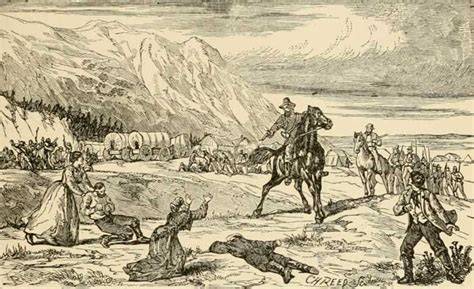
At some points in the 19th century, most notably in the Mountain Meadows Massacre, some Church members participated in deplorable violence against people they perceived to be their enemies.
On January 24, leaders of the Church of Jesus Christ of Latter-day Saints, more commonly known as the Mormon Church, penned a statement condemning the Netflix series American Primeval.
This historical fiction depicts the Mountain Meadows Massacre of 1857, as well as broader hostilities between the US government and Mormons at Salt Lake City during the Utah War of 1857-58.
The church has criticised the series for its portrayal of the Mormon prophet Brigham Young, who it claims is “egregiously mischaracterized as a villainous, violent fanatic”.
It also says the series inaccurately portrays [the Mountain Meadows Massacre] as reflective of a whole faith group, [when] the Church has long acknowledged and condemned this horrific tragedy.
The reality of the massacre was arguably even grimmer than what American Primeval shows. Contrary to what is depicted in the series, there were no adult survivors.
Official sources state up to 150 people were killed. Only 17 children under the age of six were spared, who were then discreetly adopted into Mormon families.
Historical context and responsibility
Although onscreen depictions of Mormon violence are common, most of these fail to explain the roots of this violence in both theological belief and history.
Canonised Mormon scripture, including in the Book of Mormon and The Doctrine and Covenants, and pronouncements from leaders such as Joseph Smith and Brigham Young, argue some violence is appropriate and required as per God’s commandment.
Justifications for violence had been used against both outsiders and insiders since the religion was founded in 1830 by Joseph Smith, who himself was assassinated in 1844.
The other driver is the lived experiences of Mormons. Throughout their history, Mormons had been forcefully removed from wherever they have settled, most prolifically under the Missouri “extermination order” of 1838.
This resulted in the slaughter, rape and violent relocation of Mormons from Missouri to their temporary home in Illinois, before they further migrated to Zion - a religious community established by Young and his followers in Utah - in 1847.
The Mormons’ establishment of Salt Lake City and surrounding cities in 1847 was based on the violent dispossession of Indigenous communities.
As shown in American Primeval, the Utah War and the period surrounding it was dominated by violence.
This included violence from Mormons and other settlers against Native Americans whose lands were being dispossessed, from Native Americans defending their lands, and from the US government against Mormons and Native Americans.
In the Mountain Meadows Massacre, Mormons and Native Americans allied against US emigrants travelling to California.
Doctrinal ideals and historical conduct
Latter-day Saints strive to follow the counsel of the Book of Mormon prophet-king Benjamin, who taught that those who are converted to the gospel of Jesus Christ “will not have a mind to injure one another, but to live peaceably.”
Despite these ideals, early Latter-day Saints did not obtain peace easily. They were persecuted, often violently, for their beliefs.
While historical context can help shed light on these acts of violence, it does not excuse them.
In the face of this extended persecution, some of the Saints, beginning in 1838, responded on some occasions with defensive-and at times, retaliatory-actions of their own.
Historical portrayals of Mormon violence
Mormonism first reached Australia’s shores in 1840 and remained a small religious minority in the 19th and 20th centuries. Converts were encouraged to migrate to Utah to help build Zion.
Australian newspapers reported widely on the Mountain Meadows Massacre of 1857. These articles were mostly reprints of the same information.
They were largely accurate, but inflated the number of victims. The articles explained how the slaughter had originally been assigned solely to Native Americans, but was later discovered to have been orchestrated by the Mormons, with assistance from some Indigenous tribes.
Interest began to wane in the 1860s, but picked up again in 1877 following the execution of perpetrator John D. Lee.
However, in his book and “confession”, Mormonism Unveiled (1877), Lee claimed he had been scapegoated by Young and other leaders.
The Danites in popular culture
Interest in Mormon violence wasn’t confined to the Mountain Meadows Massacre. Australian newspapers also discussed the Danites, a band of religiously motivated vigilantes involved in Mormon hostilities in Missouri and Illinois in the 1830s.
These vigilantes were inspired by Smith’s theological claims and a goal to defend Mormons from harm. They participated in both aggressive and defensive violence against their non-Mormon neighbours.
Historians have debated the extent of the Danites’ existence, with official church statements claiming they ceased to exist in 1838.
Yet in 1858, Brigham Young threatened, “if men come here and do not behave themselves, they will […] find the Danites, whom they talk so much about”.
The group is first mentioned in Australian media by the late 1850s, with descriptions of Danite “atrocities” disseminated widely, though largely uncorroborated.
By the 1870s and ‘80s, this had progressed to portrayals in popular culture, including in Australian theatres and Arthur Conan Doyle’s 1887 novel Sherlock Holmes: A Study In Scarlet.
Media representations of Mormon violence continued into the 20th century. The 1917 American film A Mormon Maid focused on theocratic violence and polygamy, which had been allowed in Mormonism until its ban in 1890.
Modern portrayals and public controversy
The modern Mormon is shaped by the religion’s marginal yet undeniable presence, both in Australia and overseas. There are about 17 million Mormons worldwide.
Of these, an estimated 157,000 are in Australia (about 0.6% of the population) compared with almost seven million in the United States (about 2% of the population).
Modern portrayals of Mormonism have tended towards the humorous (The Book of Mormon musical), scandalous (The Secret Lives of Mormon Wives), and even sympathetic (Heretic).
Even recent representations of Mormon violence, such as in Under the Banner of Heaven (2022), have focused on breakaway fundamentalists rather than the mainstream Mormon church.
Outrage towards Mormons has focused on the religion’s extreme wealth, influence over political issues such as opposition to same-sex marriage, and the rise of Mormon “tradwife” influencers.
But I argue these are divergences from the more prominent historical trend of painting Mormons as violent zealots (or in some cases as sexually amoral heretics).
And despite these, the spectre of Mormon violence remains - reinforced periodically over nearly 200 years of popular culture and media.
Under the Banner of Heaven
Craig Foster argued that if historical events are removed from their social context, a person or group can be portrayed in almost any desired way.
Craig Foster: Yeah. Yes. Because, once again, both Krakauer and then especially the series-I thought Krakauer was bad, but my heavens, the series-they tried to drum up every imaginable thing.
Craig Foster: And if you pull something out of historical and social context, you can paint a person or a group of people any way that you want. And both Krakauer and the Under the Banner of Heaven series did that.
Scott Gordon: Makes it so…we try to turn-can’t talk here-makes it, puts us in a non-Christian category. Right?
Craig Foster: Exactly. We become one of the “others.”
Religious identity and the meaning of violence
One explanation for the persistent association between Mormonism and violence is that portrayals of violent leaders or episodes can be used to challenge the religious movement’s legitimacy.
Craig Foster: Well, I think, I think one of the motivations is to-if they are able to portray the Church, especially the early Church, as being these religious, you know, crazed radicals, then it calls into question the veracity of the gospel message.
Craig Foster: And if they’re able to portray Joseph Smith, Brigham Young, and some of the other leaders as being violent, then it doubly calls into question the veracity of the gospel message.
Scott Gordon: Got it. Well, here’s a question we have. Would you likely attribute the violence cited as not necessarily endemic to the sects noted in your remarks?
Craig Foster: Absolutely, absolutely. I wanted to give examples from other denominations to show that we need to put it within the greater historical and social context.
Craig Foster: And so that wasn’t to make the other denominations look bad. The reality is, humans are going to be humans, and we have a very violent culture today, but we have a culture that doesn’t accept violence as much as the earlier culture did.
In other words, we have a violent culture-we have it on TV, we have it in movies everywhere-but we still are able, for the most part, to say, That’s bad, that’s wrong.
Back in the 18th and 19th centuries, it was almost expected. In fact, I’ve argued in other articles dealing with the culture of violence that, in many ways, it was not only accepted, it was expected that should someone feel insulted or wronged, they would attack physically, violently.
Hopefully, nowadays, we don’t have that attitude as much.
Vigilantism as a wider American pattern
Scott Gordon: I think also, we had a society back then in the 1800s where we did not have-and we always see the sheriff in town and things-but a lot of communities didn’t really have that.
Scott Gordon: And so people used extralegal methods to maintain peace, as they put it.
Craig Foster: Exactly. And I have, in the fuller article, mentioned the fact that vigilante groups included everyone.
Basically, you would have shop owners, bank owners-you name it.
There’s a phrase that I’m going to slaughter here, but it’s a famous phrase about justice by the hands of upstanding individuals.
In other words, when these vigilante acts took place, it was some of the finest people in the community who did the vigilante acts or encouraged them.
So that was their way of trying to have a type of law and order if they felt that the actual law was not doing the job or wasn’t present.
Child abuse controversies and the problem of generalization
In an era where perceptions often supersede reality, it’s critical to challenge long-held beliefs and seek verifiable truth.
Consider, for example, the widely accepted notion that child abuse rates are exceptionally high within religious organizations, including The Church of Jesus Christ of Latter-day Saints.
It has long been known that abuse rates among churches are significantly lower than those in public schools.
According to Charol Shakeshaft, who prepared a study on abuse rates for the U.S. Department of Education, “the physical sexual abuse of students in schools is likely more than 100 times the abuse by priests.”
And recent research by Jennifer Roach, a leading commentator on abuse within religious bodies, further adds that Latter-day Saints have notably low child abuse rates.
Data and perception
This raises the question, why does a stark discrepancy exist between perception and reality?
Recently, a horrific incident of family abuse perpetrated by a less active member of the Church of Jesus Christ caught headlines around the world.
This case, however brutal and undeniable, fueled a belief that the Church harbored an endemic abuse problem.
The crucial point is that such extreme instances, while distressing, can cast a disproportionately long shadow, distorting the perception of an entire community.
Perceptions often supersede reality.
Roach’s research, the first comprehensive analysis of abuse cases within the Church of Jesus Christ, looked at the religion of perpetrators in the recent Boy Scouts of America abuse settlement.
Roach found that while Latter-day Saint units made up 20-30% of BSA troops, they were responsible for only 5.16% of abuse cases, a significantly lower proportion than expected.
These statistics, backed by rigorous analysis, indicated a compelling trend of lesser-than-expected child abuse rates within Latter-day Saint communities.
Roach credits this to the Latter-day Saint Church’s unique system of “callings,” which assigns roles involving access to children, not volunteers, thereby creating a safeguard.
However, she stresses that while low, any occurrence of abuse is inexcusable, and the fight against it must remain undeterred.
Media narratives and cognitive bias
Media narratives wield considerable power in shaping public perceptions, often by simplifying complex realities.
Roach’s research, which contradicts a widespread belief that religious institutions are rife with hidden abuse, may invite skepticism.
This disbelief, however, does not necessarily stem from the data’s validity but rather from its divergence from prevailing narratives.
In fact, her findings align with other smaller analyses.
In our quest for a nuanced understanding, it’s paramount to challenge our assumptions and examine the facts closely.
In fact, in an environment where no real quantitative research had been done on this question previously, it’s even more important to challenge our assumptions that were likely developed without regard for the prevalence of the problem.
The previous absence of data did permit some dramatic conclusions.
Jana Riess, for example, wrote in the Salt Lake Tribune, “I have not seen any credible evidence that the incidence of sexual abuse is higher in Latter-day Saint communities than anywhere else,” but somehow uses that as a springboard to criticize what she believes are ways the Church mishandles abuse.
Now that credible evidence exists that the incidence of sexual abuse is much lower in Latter-day Saint communities, will she be willing to re-evaluate her criticisms?
And even if she does, will her readers who absorbed her narrative re-evaluate?
All this is based on an assumption that proved to be contrary to the evidence.
Why controversy receives attention
In my background in media criticism, the concept of “disequilibrium” often emerges, suggesting that stories involving conflict and controversy draw audiences.
This theory sheds light on the persistent focus on abuse scandals within the Catholic Church and high-profile cases like the Penn State scandal.
While these stories deserve attention, media bias towards controversy can distort understanding and inflame public perception of abuse rates in religious institutions.
For example, female teachers who sexually assault students make the news much more frequently even though they are much less likely to sexually assault students.
And nothing is as effective at generating traffic as making your readers feel angry.
So anything that can intersect with the culture war is more likely to be noted as newsworthy by journalists and their editors.
This includes religious institutions.
The reality is that what we talk about deeply influences how frequently we think that happens.
This is why we consistently believe terrorism, ebola, and shark attacks are much more likely than they are, in fact.
And this conclusion can prevent us from recognizing good solutions where they exist.
Religious institutions are often caught up in this distortion, caught in the crossfire of a culture war where the negative stories that do exist about them are amplified because there is an appetite to feel angry at religion, which in turn creates the misunderstanding of how frequent these problems actually are.
Criticism, underreporting, and evidence
The continual focus on child abuse within these groups, while not entirely unfounded, disproportionately magnifies the issue, perpetuating the perception that religious institutions are predisposed to such misconduct when the best available data seems to suggest that they reduce such misconduct in general and that the Church of Jesus Christ is especially effective in reducing abuse.
Cognitive biases, such as confirmation bias and the availability heuristic, further exacerbate this distortion.
They prompt us to interpret information that aligns with our beliefs and overestimate the prevalence of readily available events, distorting our understanding of the true abuse rates within religious institutions.
This results in a kind of fallacy sometimes referred to as a special pleading, and this kind of response was common to those whose pre-existing ideas were challenged by Roach’s research.
They often suggested that individuals may have been abused by the Church outside of BSA or that abuse was underreported.
Both of these could be true, but there is no evidence to suggest these issues appear disproportionately among Latter-day Saints.
But critics insist on this special critique of the Church of Jesus Christ in order to dismiss the findings and avoid challenging their preconceived notions.
Institutional responses and the limits of available data
These established narratives then become self-reinforcing.
These preconceived notions are likely why journalists such as Cara Kelly at the Washington Post report that there are more claims against The Church of Jesus Christ of Latter-day Saints than any other organization, without even thinking to check that the Church had overwhelmingly more scouts than any other organization.
Or, perhaps because this matched her preconceived notion, that led her to claim that more than half didn’t report their charter when simply opening up the claims would have shown that not to be the case.
But why go through that additional work when your preconceived notion is already confirmed?
It’s essential to resist generalizations based on isolated cases and acknowledge the potential for their disproportionate influence on our perception.
Obtaining reliable data on abuse rates within religious organizations has been historically challenging due to data limitations.
Anecdotal evidence, while emotionally compelling, often amplifies extreme cases, leading to skewed perceptions.
With the first real introduction of comprehensive data, we move beyond the confines of individual narratives, advancing our understanding of the issue.
Preventing abuse without minimizing harm
It is a difficult challenge. No case of abuse is ever okay.
Yet when identifying how to reduce abuse on an institutional scale, we need to look at what works-what reduces abuse.
And since no one has been able to eradicate abuse, we will need to look at communities that do a good job reducing overall harm.
If we resist the approaches that reduce harm because of our righteous desire to eradicate all harm, we aren’t fixing the problem.
Latter-day Saints have notably low child abuse rates.
A common retort might be, ‘Why not err on the side of caution by assuming abuse is pervasive everywhere?’
While this perspective is born from a desire to protect, it risks obscuring effective solutions, such as those Roach identified, like the Church’s system of callings, membership records, or abuse hotline.
Mischaracterizing the issue risks deploying resources inefficiently and missing out on strategies that could more effectively mitigate harm.
Back to Riess, in her same article, she specifically called out Latter-day Saints who believe their church did better on issues of abuse as problematic.
Any who listened to her would have been less likely to share the solutions that we now have evidence are working.
The Church of Jesus Christ of Latter-day Saints’ successful strategy in combatting abuse offers a beacon of hope, presenting a case study that merits further examination.
It underscores the importance of focusing not just on eradicating the bad but also on promoting the good.
This isn’t about winning an argument but safeguarding our children.
We owe it to them to welcome solutions that shield them from harm, even those from unexpected quarters.
It is our shared societal duty to protect children and in doing so, challenge our preconceptions and strive to build a safer world.