The Liturgy of Addai and Mari is an ancient Eucharistic liturgy of the Church of the East, traditionally attributed to the apostles Addai and Mari. Its distinctive significance lies in the fact that its classical form does not contain an explicit institution narrative with the words “This is my body” and “This is my blood,” yet the liturgy includes the biblical, Eucharistic, intercessory, and epikletic elements by which the Church celebrates the mystery of Christ’s Body and Blood.
Rome has given the answer Yes; but not all people in the Traddisphere trust what modern Rome says. The Liturgy of Addai and Mari has been in continuous use in the Church of the East since at least the 7th century. Parts of it may be from as early as the fifth century.
Name, apostolic tradition, and historical setting
This is an Oriental liturgy, sometimes assigned to the Syrian group because it is written in the Syriac tongue; sometimes to the Persian group because it was used in Mesopotamia and Persia. It is known as the normal liturgy of the Nestorians, but probably it had been in use before the rise of the Nestorian heresy.
According to tradition, it was composed by Addeus and Maris, who evangelized Edessa, Seleucia-Ctesiphon and the surrounding country. This tradition is based on the narrative contained in the “Doctrine of Addai”, a work generally ascribed to the second half of the third century.
The account states that King Abgar the Black, having heard of the wonderful works of Christ, besought Our Lord to come and cure him of a serious malady, but that he obtained only the promise that Our Lord would send one of His disciples, a promise which was fulfilled after the ascension, when Thaddeus, in Syriac Addai, one of the seventy-two disciples, was sent by St. Thomas to Edessa to cure the King.
Addeus and his disciple Maris are said to have converted the King and people of Edessa, to have organized the Christian Church there, and to have composed the liturgy which bears their names. There seem to be no documents earlier than the “Doctrine of Addai” to confirm this tradition.
Although good historical evidence concerning the foundation of the Church of Edessa is wanting, still it is quite certain that Christianity was introduced there at a very early date, since towards the end of the second century the king was a Christian, and a bishop, Palouth, of the see was consecrated by Serapion of Antioch, 190-203.
It was only natural that the Edessans should regard Addeus and Maris as the authors of their liturgy, since they already regarded these men as the founders of their Church. The Nestorians attribute the final redaction of the text of the Liturgy of Addeus and Maris to their patriarch Jesuyab III who lived about the beginning of the seventh century.
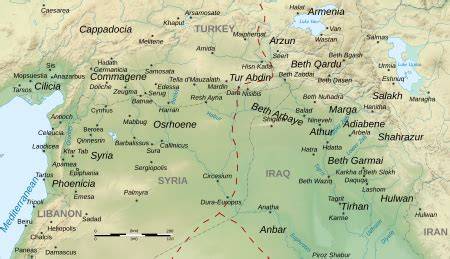
Spread through the Church of the East
After the condemnation of Nestorianism, the Nestorians retreated into the Persian kingdom, and penetrated even into India and China, founding churches and introducing their liturgy wherever the Syriac language was used.
At the present time this liturgy is used chiefly by the Nestorians, who reside for the most part in Kurdistan. It is also used by the Chaldean Uniats of the same region, but their liturgy has, of course, been purged of all traces of Nestorian tenets.
Finally, it is in use among the Chaldean Uniats of Malabar, but it was very much altered by the Synod of Diamper held in 1599.
Two principal divisions of the liturgy
The liturgy may be divided conveniently into two parts: the Mass of the catechumens, extending as far as the offertory, when the catechumens were dismissed, and the Mass of the faithful, embracing all from the offertory to the end.
Or again, it may be divided into the preparation for the sacrifice extending as far as the preface, and the anaphora or formula for consecration corresponding to the Roman canon.
| Division | Content |
|---|---|
| Mass of the catechumens | Opening prayers, psalms, lessons, Gospel, litanies, and dismissal of the unbaptized |
| Mass of the faithful | Offering of the bread and wine, preparation, anaphora, Communion, thanksgiving, and blessing |
| Preparation for the sacrifice | Rites extending as far as the preface |
| Anaphora | The Eucharistic prayer corresponding to the Roman canon |
Opening rites and the liturgy of the catechumens
The “order of the Liturgy of the Apostles, composed by Mar Addai and Mar Mari, the blessed Apostles” begins with the sign of the cross, after which the verse “Glory to God in the highest” etc. from Luke 2:14, the Lord’s Prayer, and a prayer for the priest on Sundays and feasts of Our Lord, or a doxology of praise to the Trinity on saints’ days and ferials are recited.
Several psalms are then said, together with the anthem of the sanctuary, variable for Sundays and feasts or Saints’ days, and a prayer of praise and adoration. The deacon then invites the people “to lift up their voices and glorify the living God”, and they respond by reciting the Trisagion.
Then the priest says a prayer and blesses the reader of the lessons. Ordinarily two lessons from the Old Testament are read, but during Eastertide a lesson from the Acts of the Apostles is substituted for the second Old Testament lesson.
After an anthem and a prayer the deacon reads the third lesson, called the Apostle, which is taken from one of the epistles of St. Paul. The priest prepares for the Gospel by reciting the appropriate prayers and blessing the incense, and after the alleluia is sung he reads the Gospel.
This is followed by its proper anthem, the diaconal litany, and a short prayer recited by the priest, after which the deacons invite the people “to bow their heads for the imposition of hands and receive the blessing” which the priest invokes upon them.
The Mass of the catechumens is thus concluded, so the deacons admonish those who have not received baptism to depart, and the Mass of the faithful begins.
Preparation of the offerings
The priest offers the bread and wine, reciting the prescribed prayers, covers the chalice and paten with a large veil, goes down from the altar and begins the anthem of the mysteries. The recital of the Creed at this point is a late addition to the liturgy.
Having entered within the arch, the priest makes the prescribed inclinations to the altar, washes his hands and begins the preparatory prayers for the anaphora.
He recites an invitation to prayer corresponding to the Roman Orate fratres, and then beseeches the Lord not to regard his sins nor those of the people, but in all mercy to account him worthy to celebrate the mysteries of the Body and Blood of Christ and worthily praise and worship the Lord, after which he crosses himself and the people answer “Amen.”
At this point on Sundays and feasts of Our Lord the deacon seems to have read the diptychs, called by the Nestorians the “Book of the Living and the Dead.” The kiss of peace is then given, and a prayer recited for all classes of persons in the church.
The anaphora and Eucharistic prayer
The anaphora proper begins with the preface. The deacon now invites the people to pray, and the priest recites a secret prayer, lifts the veil from the offerings, blesses the incense, and prays that “the grace of our Lord Jesus Christ, and the love of God the Father, and the fellowship of the Holy Ghost be with us all now and ever world without end”, and signs the mysteries, and the people answer “Amen.”
The priest then begins the preface with the words: “Lift up your minds.” The preface is followed by the sanctus and the anamnesis, the commemoration of Christ.
In present usage the words of institution are here inserted, although they seem to have little connection with the context. He pronounces a short doxology, and signs the mysteries, and the people answer “Amen.”
After the deacon says “Pray in your minds. Peace be with us,” the priest recites quietly the great intercession or memento. The epiclesis, or invocation of the Holy Ghosts follows as a sort of continuation of the intercession.
The question of the institution narrative
The most “controversial” aspect of this is that the Assyrian Church does not include the “words of institution”, “This is my body. This is my blood”, in their Liturgy, something that is considered the focal, and necessary, part of the Mass of the Roman Church.
The version presented below includes the Words of Institution, but originally it did not, and so for many years it was questioned as a valid rite for use in the church.
Is the Anaphora of Addai and Mari which lacks an Institution Narrative and thus does not include the Words of the Lord a valid Consecration of the Most Holy Eucharist? Rome has given the answer Yes; but not all people in the Traddisphere trust what modern Rome says.
The fact that some Roman Catholics opposed the agreement does not necessarily mean that they deny the validity of the Assyrian Liturgy. The Pope who first received Nestorian Christians within the Catholic Communion made them add the Words of Institution but never taught explicitly that their previous liturgies were invalid or sacrilegous or something like that.
The thing here is that all the rites of the Universal Church from the Non-Chalcedonean to the Orthodox and the Western Church no matter how ancient their rites have been, including other rites that are celebrated in Syriac, contain these words of consecration as well as the epiclesis except the Assyrian Liturgy.
It’s reasonable to think that the Assyrians after signing the agreement with JPII must have added these words to their liturgy, and not the Roman Catholic Church to grant this concession.
No - the Assyrians have not added explicit Words of Institution. In conjunction with the pastoral care provisions of the agreement on intercommunion between the Assyrians and Chaldeans, the Assyrians allow their clergy to insert them, if their congregation includes Chaldean Catholics and the cleric chooses to do so.
Theological significance of the epiclesis
My own view is that this type of resistance has to do with a lack of clarity on the part of some RCers' concerning the very significance of the Epiclesis in the Eastern liturgies altogether. So it is not just about the Assyrians, but relates to all Eastern Churches with the Epiclesis.
And the general Eastern teaching on the matter is that the Words of Christ represent the historical reality connected to the Mystical Supper. But it is only the action of the Holy Spirit in the Epiclesis, and in all other Sacraments and actions of the Church, that actually transforms the elements of bread and wine into the Most Precious Body and Blood of OLGS Jesus Christ i.e. the Holy Spirit as the Successor of Christ on earth Who recalls all that Christ said and did etc.
So the Epiclesis of the Holy Spirit itself is not a mystical action separate from Christ in the Liturgy. The Spirit Himself is the One Who proclaims Christ to us and re-tells all that He did for us.
He is the Spirit of Power Who transforms and dwells in us who are His Temples - especially the Body of Christ, the Church. Conversely, the only way we can know about the power and Person of the Holy Spirit is by way of the teaching of Christ Who sends the Spirit into the world from the Father.
So the Epiclesis is, for the East, the most significant event of the Divine Liturgy for these reasons. It is, in and of itself, the way by which the Spirit re-presents Christ Himself, truly and really.
The Liturgy of Sts. Addai and Mari therefore does indeed contain the Words of Institution “This is My Body” “This is My Blood” because of the Epiclesis, even though the words are not specifically recited.
For the Eastern Orthodox Churches as well, the Words of Institution must have the Epiclesis to fulfill what they indicate in reality. So the disagreement is rooted in an ignorance concerning the role of the Epiclesis as a whole.
Institutional and historical perspectives
I think a great part of the issue has to do with a major Latin focus on “institution”. Since the old Roman Canon only had an indirect epiclesis, supplices te rogamus etc., they simply don't have the perspective or informed understanding of eplicetic-focused liturgical anaphorae such as Addai and Mari.
It has worked for two thousand years, and no one questions the validity of the Eucharistic presence and efficacy of the received Assyrian Qurbano, the “mother liturgy” of the Chaldeans as well.
I don't know what Fr. Taft would say, or has said on this issue, but I suspect he would say to leave the anaphora of Addai and Mari alone in terms of inserting anything into it.
If we are inserting words into a venerable and immemorial Anaphora simply for “tourist” purposes, isn't that just a bit superfluous? It is clear Rome doesn't consider it a necessity for validity if in the guidelines clergy are only suggested to use the words of institution, and not required.
It's also seems a bit ironic as with the traditionalist Latins one of their arguments about the Novus Ordo is precisely this, that the traditional received Canon was changed, altered, etc.
The 1978 permission to insert the words
Actually, the Assyrians granted their clergy the option to insert explicit Words of Institution back in 1978, long before the pastoral provision was ever initiated. The Holy Synod of the Assyrian Church of the East, assembled in 1978 in Baghdad, offered ministers in the Assyrian Church the option of reciting the words of the Institution in the Anaphora of Addai and Mari.
Thus, the permission was an option for ministers rather than a permanent alteration of the inherited anaphora. The Assyrians allow their clergy to insert them, if their congregation includes Chaldean Catholics and the cleric chooses to do so.
Intercommunion between the Assyrian and Chaldean Churches
Back in 2001, the Vatican approved inter-communion between the Chaldean Catholic Church and the Assyrian Church of the East, thus declaring the validity of the Assyrian Church's sacraments.
One of the consequences of the agreement concerned pastoral situations in which Chaldean faithful participate in an Assyrian celebration of the Holy Eucharist. When Chaldean faithful are participating in an Assyrian celebration of the Holy Eucharist, the Assyrian minister is warmly invited to insert the words of the Institution in the Anaphora of Addai and Mari, as allowed by the Holy Synod of the Assyrian Church of the East.
The agreement raised questions within Roman Catholic discussions because the absence of an explicit institution narrative appeared to challenge a traditional emphasis on the liturgical form of sacramental celebration.
However, a recent Vatican journal ran a number of articles on this decision, both pro and con, which shows a definite resistance to this decision in Rome. He mentions how it shows a serious disagreement between the traditional emphasis on form and the modern emphasis on intention.
Textual features of the Eucharistic prayer
With these heavenly hosts we give you thanks, O my Lord, even though we your servants are weak and frail and miserable, for you have given us great grace by taking on our human flesh that you might enliven it by your divinity, and have exalted our low estate, restored our fall, raised our mortality, forgiven our trespasses, justified our sinfulness, and enlightened our knowledge.
Lord our God, you have condemned our enemies and have granted victory to the weakness of our frail nature in the overflowing mercies of your grace.
For all your help and grace toward us, let us give you praise and honor and confession and worship, now and forever. Amen. Pray in your minds. Peace be with us.
The epiclesis, or invocation of the Holy Ghosts follows as a sort of continuation of the intercession. The priest then says a prayer for peace and one of thanksgiving, and incenses himself and the oblations, reciting the appropriate prayers in the meantime.
Fraction, consignation, Communion, and dismissal
While the deacon recites a hymn referring to the Eucharist, the priest, taking the Host in both hands, says a prayer alluding to the life-giving power of this bread which came down from Heaven.
In the Chaldean Uniat liturgies the words of institution are placed after the first part of this prayer. The priest breaks the Host into two parts, one of which he places on the paten, while with the other he signs the chalice, and after dipping it into the chalice signs the other half of the Host, reciting meanwhile the proper prayers for the consignation.
Joining the parts together he says a prayer referring to the ceremonies just completed, cleaves with his thumb the Host where it was dipped in the chalice, signs his forehead with his thumb, and recites a prayer of praise to Christ and to the Trinity.
After kissing the altar, he invokes a blessing upon all “The grace of Our Lord” etc., as quoted above. While the priest breaks the Host, the deacon invites the people to consider the meaning of these holy mysteries and to have the proper dispositions for receiving them; to forgive the transgressions of others, and then to beseech the Lord to forgive their own offences.
The priest, continuing this idea, introduces the Lord's Prayer, which all recite, and says a prayer that expands the last two petitions. After a short doxology the priest gives the Chalice to the deacon, blesses the people, and then both distribute Communion.
A special anthem is said during the distribution. The deacon then invites all who have received Communion to give thanks, and the priest recites aloud a prayer of thanksgiving and one of petition. Mass is concluded with a blessing pronounced by the priest over the people.
Distinctive liturgical characteristics
The chief characteristic in this, as in the other Nestorian liturgies, is the position of the general intercession or memento. It occurs, not after the epiclesis as in the Syrian liturgies, but immediately before it. It seems to be a continuation of the anamnesis.
Of minor differences, it might be noted that the Nestorians use one large veil to cover paten and chalice; they use incense at the preface; and they have two fractions of the Host, one symbolical recalling the passion of Christ, the other necessary for the distribution of Communion.
| Feature | Characteristic of the rite |
|---|---|
| Liturgical language | Syriac |
| Traditional setting | Mesopotamia and Persia |
| Institution narrative | Absent from the classical form; explicit words may be inserted by permission |
| Epiclesis | Invocation of the Holy Spirit following the great intercession |
| Intercession | Placed immediately before the epiclesis |
| Veil | One large veil covers the paten and chalice |
| Fraction | Two fractions of the Host |
| Incense | Used at the preface |
Continuity, adaptation, and textual integrity
As a traditional Latin-rite Catholic with great love for the traditions of the Christian East, from which we can learn a lot today, I am deeply disturbed by the Addai and Mari issue.
The version presented below includes the Words of Institution, but originally it did not, and so for many years it was questioned as a valid rite for use in the church. Parts of the eucharistic prayer are the basis of the Prayer of Thanksgiving in The Service: Setting Two in Christian Worship: Hymnal (2021).
There are two distinct methodologies in conflict here. One, call it the a priori, works out from scratch, from theological basics, what a liturgical formula should be or should include. The other, the historical, looks at what actual liturgical phenomena have actually said or done over two actual millennia, and makes that study its basis.
It has become axiomatic that the Lex Orandi should prescribe the Lex Credendi. You want to know what the Catholic Church teaches? Look at the words with which the Catholic Church prays.
I disapprove of the notion that what we believe, which can vary quite a lot as theological fashions morph, can or should license us to us mess around with the words Tradition gives us in the Liturgy.
This error lies at the basis of the mistakes made in the post-Conciliar period, when committees in Rome arrogantly presented to themselves the competence to change whatever they wished.
The Liturgy of Addai and Mari is therefore significant not only as an ancient Eucharistic text but also as a witness to the diversity of early Christian liturgical theology. Its history connects Edessa, Mesopotamia, Persia, India, and China; its structure preserves a distinctive Syriac form of Eucharistic prayer; and its reception in modern Catholic-Assyrian relations demonstrates that Eucharistic theology cannot be reduced to one liturgical arrangement alone.