Mexican representations of Jesus Christ emerged from the encounter between Spanish Catholicism and the Indigenous religious traditions of Mesoamerica. Christian images, rituals, materials, and festivals were adapted to local artistic practices and beliefs, creating a distinctive Mexican Catholic culture rather than simply reproducing European Christianity.
Among the most striking examples are the intensely bloody Cristos de Caña, or Corn Christs, feather mosaics such as Christ as Salvador Mundi, images of Christ associated with Holy Week, and representations connected with the Virgin of Guadalupe. These works show how Christianity changed Mexico and how Mexican communities changed the visual language of Christianity.
From Spanish Catholicism to Mexican Christianity
The Columbian Exchange was the movement of animals, people, and diseases across oceans. But people brought more than biological goods. Cultural symbols, including gods, traveled too. Many came as colonizers seeking to force their way of life on those they met. But it didn’t work out that neatly. Religious syncretism happened. That’s when different belief systems blend to create something new.
The Spanish conquistador, Hernán Cortés, took over Tenochtitlán in 1521. They tore up the city’s temples and pyramids, and renamed it Mexico City. Historians often describe the motivations of the Spanish conquistadors as “Gold, God, and Glory.” The conquerors wanted to win treasure and spread Christianity.
Soon after Cortés defeated the Aztecs, Catholic missionaries arrived in Mexico. Missionaries are people who travel to foreign places to promote their religion and try to convert people to it. The Spanish wanted to convert indigenous people to Christianity. However, they worried that people would cling to their old symbols. This might lead groups to revolt.
The Spaniards burned temples, symbols, and books of the indigenous peoples in an attempt to convert them to Catholicism. Often, when they tore down a temple, Spanish missionaries built a Catholic church over its ruins. They did this in order to gain the Pope’s support.
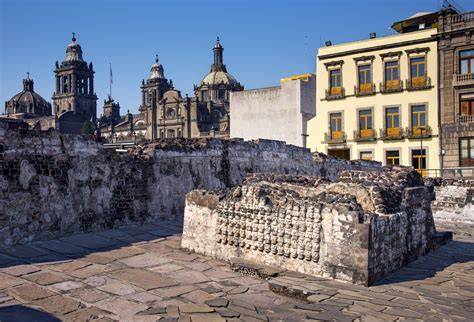
Layers of belief in Mexico City
Below is a picture of the Plaza del Zócalo in Mexico City. That big church is the Metropolitan Cathedral, a center of Mexican Catholicism. But this square was once also the center of the Aztec religion. Just across the street from the Cathedral lie the ruins of Templo Mayor. It was the most important temple in the Aztec capital Tenochtitlán.
This one area in Mexico City has served as a center of Aztec belief, Catholicism, and Mexican nationalism. For centuries, the ruins of an indigenous temple lay buried beneath a Catholic cathedral. This view might look like it represents Christianity paving over indigenous religion. However the real story is more complex.
The early years of the Spanish conquest were brutal. The Spanish also forced people into slavery, tore families apart, and killed those who resisted. This started a cycle of indigenous resistance and Spanish violence. Indigenous peoples also watched millions in their communities die from European diseases. Their bodies’ immune systems were not prepared to fight the illnesses.
This led many indigenous people to question their gods’ protection. Some were motivated to convert willingly. Meanwhile, Spanish missionaries’ less brutal methods were more effective than the brutal ways of conquistadors.
Conversion, adaptation, and Indigenous agency
For example, in Mexico City, missionaries took the sons of Aztec nobility from their families. The religious leaders moved the Aztec boys to new Christian schools. There they were taught the Catholic religion and obedience to colonial leaders.
The conversion of the Americas often gets called a “religious conquest.” But elements of both religions blended together. Some indigenous peoples saw similarities between Christianity and their religion. For example, each had a ranking system for priests. Each shared similar symbols and rituals.
The Aztecs were familiar with conquering nations pushing their gods on new people. After the Spanish takeover, indigenous peoples often did not totally abandon old rituals and gods. Catholic missionaries often found images of Jesus alongside statues of Aztec gods.
Some indigenous people converted for protection. The Dominican priest Bartolomé de las Casas convinced the Spanish king to outlaw the abuse of indigenous peoples. Converting was also an opportunity for many people. Indigenous Christians had a better position in colonial society. Again, we see that converting was not a simple act of accepting or rejecting.
Mexican Jesus and religious syncretism
As indigenous communities converted, beliefs and rituals blended. Catholic missionaries appropriated indigenous symbols. That means they re-used the symbols for their own purposes. Converts brought old practices to the new religion.
Indigenous festivities fell on the same days as Catholic holy days. The Catholic practice of confession mixed with similar indigenous rituals. Indigenous symbols were added onto Christian crosses. Catholic tradition was translated into indigenous Nahuatl. The languages of faith blended.
Religious syncretism created a new Catholic culture in Mexico. Christian images could retain European theological meanings while also acquiring Indigenous associations through their materials, settings, ceremonies, colors, and forms.
Cristos de Caña: the Corn Christs of Mexico
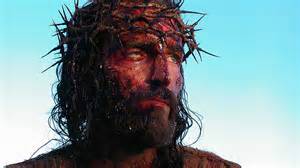
This photo of the tortured Christ, which I saw carried in procession this past Good Friday in Merida is one of many such statues you will see in the churches of Mexico. They are made from corn in a process that I will describe and for this reason are known as Cristos de Caña, or Corn Christs.
The one thing that all these statues have in common is that they are bloody, very bloody. Figures like these need to be light-weight because they were and are frequently carried in religious processions.
A material that had been used in pre-Hispanic times was a kind of paper mache made of corn products. The indigenous sculptors actually held workshops to teach the process to the Christian priests and their workers.
To make the material the corn husk was opened and the pith removed. A framework was made of dried maize leaves fastened together and then covered with a mixture of corn pith paste and a sticky substance from orchid bulbs.
After it was dry, a fine layer of the paste was spread over it and modeled. The red color used in the blood came from insects that fed on the fruit of the sacred (to the Aztecs) nopal cactus.
Materials and their symbolic meanings
| Material or element | Role in the image | Symbolic significance |
|---|---|---|
| Dried maize leaves | Framework of the sculpture | Connected the image to Indigenous agricultural materials |
| Corn pith paste | Modeling material and surface layer | Corn had been an Aztec god and maize was a sacred life-giving food |
| Sticky substance from orchid bulbs | Binder for the corn material | Supported the lightweight construction |
| Red color from insects feeding on nopal cactus | Representation of blood | Connected the sculpture to the sacred nopal cactus and Indigenous symbolism |
The materials that form these Christs were full of symbolism and significance for the indigenous. Corn had been an Aztec god and maize was a sacred life-giving food.
In these Corn Christs the two symbol systems, Christian and indigenous, are merged creating something that is completely new. In their own unique way, they are a god within a god.
Why are Mexican Christ figures so bloody?
There has been much scholarly speculation as to why these figures are universally so bloody. True, there had been precedents in bloody Passion-week Spanish figures of Christ.
But, for the meso-american indigenous, the bloodiness had a different meaning and this is the point of view espoused by Jennifer Scheper Hughes. If we think back to their religious practices, a lot of blood was involved because of the sacrificial tradition.
The Aztec priests are described as having been blood-covered from head to toe. When you consider that one of the ways Jesus was described in scripture was as the “Great High Priest”, it would make sense for those trying to “sell” the indigenous converts on Christ to make these Christs resemble the Aztec priests of old.
In the Aztec tradition, blood had meant power and the bloodiness of these figures is something the indigenous would have immediately understood and revered.
Remember, part of the conversion effort was to convince the indigenous that the new god was more powerful than the old ones and the bloodiness of the Christ figures is believed to have been a part of this initial effort.
Holy Week and the image of Santo Entierro
You may have noticed that in one of the photos, the Christ is lying in a glass casket. This is a specific representation of Christ, Santo Entierro, that you will see in every Mexican church.
It is Christ, but a very particular representation of Him with a very specific use during Holy Week.
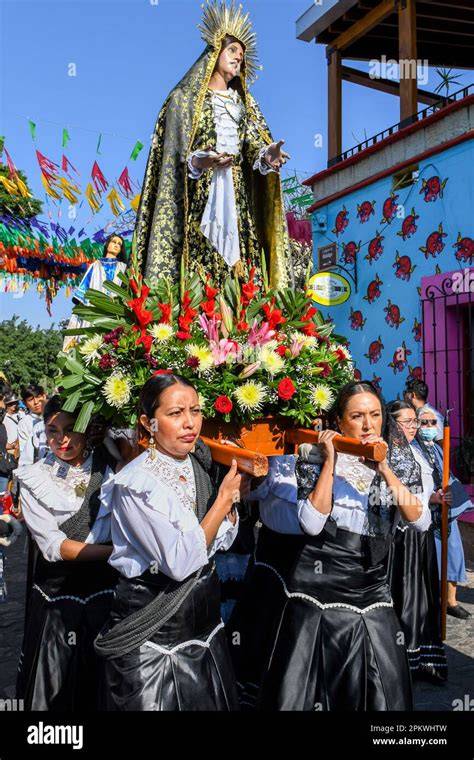
The tortured Christ carried in the Good Friday procession in Mérida, Yucatán, belongs to a wider tradition in which the suffering and death of Jesus are made physically present through processions, statues, and public acts of devotion.
The lightweight construction of many Mexican Christ figures made it possible for communities to carry them through streets, churches, and ceremonial routes. Their movement transformed the image from a static object into a participant in communal religious life.
Christ as Salvador Mundi: feathers, gold, and Indigenous technique
With fingers raised in blessing and left palm resting upon an orb, this image of Christ as Salvador Mundi (“Savior of the World”) is made of feathers and gold. Indigenous craftsman created it in central Mexico, working under the watchful eye of European-born friars.
Feather mosaic technique
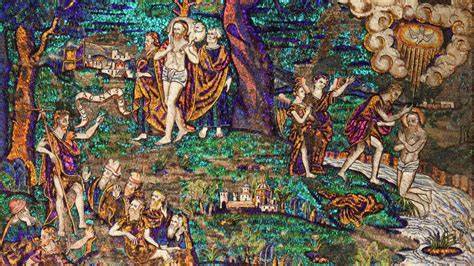
Although called a “feather painting,” the technique is closer to mosaic, with feathers glued onto a paper base made of amatl (indigenous-made paper) or cotton. The shimmering quality comes from the feathers.
Under-feathers were sometimes dyed, but the top layer was not. Feathers came from both local birds and ones only found in tropical zones of the country, like parrots and quetzals.
The techniques for working feathers into images are of pre-Hispanic origin. In the century before this work was created, Aztec imperial rulers commissioned feather paintings of extraordinary beauty and craftsmanship, prized for their ephemeral and shimmering qualities.
The multi-colored feathers that comprise this painting were acquired via trade networks established in pre-Hispanic times but still extant in the 16th century.
Iconography of the Savior of the World
The visual model for the Christ with a hand raised in blessing was most likely a European print, perhaps an engraving friars brought to New Spain. The orb with a cross on top symbolizes Christ’s role as savior of the globe of the earth.
The letters around the edge do not add up to a meaningful text, and may have been a Nahua craftsman’s creative appropriation of the Latin alphabet.
| Element | Meaning or function |
|---|---|
| Raised hand | Christ’s blessing |
| Orb with a cross | Christ’s role as savior of the globe of the earth |
| Feathers and gold | Shimmering visual effect and continuation of pre-Hispanic feather-working traditions |
| Letters around the edge | Possibly a Nahua craftsman’s creative appropriation of the Latin alphabet |
Colonial patronage and cultural translation
The friars who commissioned such Christian works did so for many reasons, including their own aesthetic appreciation of Aztec feather-working.
In addition, they needed to demonstrate-both at home and abroad- their “success” in converting native people and in turning indigenous hands to Christian work.
The indigenous craftsmen who made works such as the Salvador Mundi must have had their own ideas about such creative projects. The translation of a Christian print into an image of feathers and gold required they re-imagine the purposes and aesthetics of traditional, pre-Hispanic feather working.
At the same time, the friars expanded their own notions of aesthetic beauty and possibilities for religious expression.
Context and cultural interpretation
The work is located at Tepozotlán, MEX, Museo Nacional del Virreinato (current location). While many feather paintings were sent to Europe and treasured by collectors, this one seems to have remained in Mexico, where it is now.
The original context of this work is not known, but scholars believe it hung upon a sanctuary wall, where lighting by candles would have further enhanced Christ’s otherworldly appearance.
Although Christian iconography was a recent introduction in 16th-century New Spain, the use of feather-works in religious rituals, including those involving sacrifice, had roots in the pre-Hispanic past.
Thus, in the creation of the Salvador Mundi, its creators joined in the long, and often inchoate, process of recasting indigenous beliefs and practices into new parameters established by the colonial church and state.
The Virgin of Guadalupe and the Indigenous image of the sacred
Perhaps the most important example of religious syncretism in Mexico City is the Basilica of Our Lady of Guadalupe. According to later stories, in 1531, an indigenous man named Juan Diego was on the Hill of Tepeyac in Mexico City. He claimed to see the Virgin Mary.
In his vision, she directed him to build a church. Her image miraculously appeared on his cloak, he said. Juan Diego convinced the Catholic leaders to build a shrine and church. They dedicated it to “the Virgin of Guadalupe.”
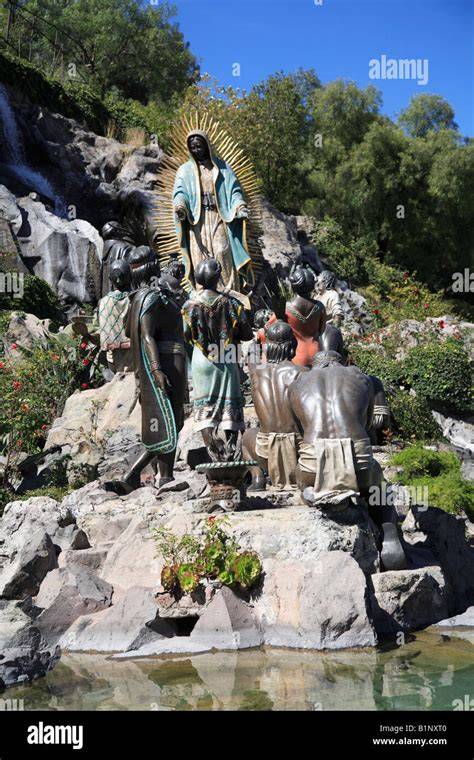
By the seventeenth century, the shrine was a popular religious site for visitors. The image of the Lady of Guadalupe emerged as an important symbol. Indigenous converts especially saw her as their protector.
Some historians argue that this story was planned by the Spanish. Juan Diego’s Catholic church was built on the ruins of an Aztec shrine for the goddess Tonantzin.
Other historians claim that this is the result of syncretism. Worshippers of Tonantzin combined their imagery with the black Virgin of Guadalupe of Extremadura.
Whatever the truth, the popularity of the virgin soared among both Spanish and indigenous communities. The Catholic Church celebrated the story of Juan Diego and his vision.
Visual symbolism of Guadalupe
The original small chapel expanded into a huge modern basilica, or church. The Lady of Guadalupe also became a symbol of Mexican nationalism.
Revolutionaries carried her image into battle during the Mexican War of Independence in 1810. She appeared again during the Mexican Revolution in 1910.
The Basilica is visited by 20 million people each year. Less people visit the Vatican in Rome, where the head of the Catholic church lives.
The Lady of Guadalupe site was a religious destination for centuries before the Spanish arrived. It remains so today.
In images, she is portrayed in a European style but with dark skin. She stands on a moon, wreathed by the sun. Both are important elements in the Aztec religion.
Some indigenous still call her Tonantzin. And three centuries later, Guadalupe remained a symbol of Mexican unity.
Jesus in Mexican cultural identity
Throughout history, depictions of Jesus Christ have taken on a remarkable diversity of racial and cultural forms. In Western European paintings, Christ often appears with pale skin, light brown or blond hair, and distinctly European features.
In Latin American murals, he may be depicted with brown skin and native clothing, while in East Asian Christian art, he is shown with local facial characteristics and fashion.
These differences are not merely artistic liberties-they reflect how religious imagery operates within particular cultural, political, and theological contexts.
Jesus of Nazareth was a historical figure: a Jewish man born in first-century Roman-occupied what is now Israel. No one is certain what he looked like, though he likely had olive-toned skin, dark hair, and Semitic facial features common to the region.
Yet Christian art has rarely aimed for strict historical realism. Instead, it has prioritized symbolic meaning, emotional resonance, and cultural familiarity.
Across time and place, Christian communities have adapted Jesus’s image to reflect themselves, to inspire identification, and to communicate spiritual truths in relatable ways.
European models and Mexican reinterpretation
As Christianity spread from the Middle East into Europe and beyond, depictions of Christ began to align with dominant cultural aesthetics. By the Middle Ages and Renaissance, European artists had standardized a white, European-looking Jesus.
This image became not only familiar but authoritative, reinforcing the cultural identity of European Christians and, later, aiding in the religious and political agendas of European colonial powers.
During colonial expansion, missionaries carried this version of Jesus to the Americas, Africa, and Asia, where it became entrenched as a symbol of both Christian doctrine and Western dominance.
In more recent centuries, however, many Christian communities have reimagined Christ in their own image.
These depictions are not attempts to assert the historical appearance of Jesus, but to make theological and cultural statements. Ultimately, Jesus functions as a theological metaphor, symbol, and teaching aid.
Inculturation and the universality of Christ
Theologically, many Christian traditions support this diversity. The Catholic Church teaches that Jesus Christ is the visible image of the invisible God and the perfect reflection of humanity made in God’s image.
As such, Jesus represents not just one people, but all of humanity. Catholic theology embraces the principle of inculturation-the adaptation of Christian teachings, symbols, and imagery to different cultural contexts.
The Second Vatican Council emphasized the need for the Church to communicate in the “language of the people,” which includes visual and symbolic forms.
As a result, Catholic communities around the world are encouraged to depict Christ in ways that reflect their own ethnic and cultural identities, reinforcing the universal accessibility of divine grace.
Mexican Catholicism as a living cultural tradition
In 2020, Mexico is the second-largest Catholic nation on Earth, behind only Brazil. Latin America is home to 425 million of the world’s 1.2 billion Roman Catholics.
Pope Francis is the current head of the Catholic church. He was born in Argentina. And every year, millions of Catholics travel to the Shrine of Our Lady of Guadalupe.
They pray at a site that once celebrated the Aztec goddess Tonantzin. The basilica during the annual celebration in December. The Hill of Tepeyac-where the original shrine to Tonantzin and later the Lady of Guadalupe-rises behind the basilica.
Mexican representations of Jesus therefore belong to several overlapping histories: the history of Christianity, the history of Indigenous Mesoamerican symbolism, the history of colonial conversion, and the continuing history of Mexican community and national identity.