An Orthodox blessing cross is a visible sign of faith, a reminder of the sacrifice of Jesus Christ, and an instrument used in prayer and blessing. In Orthodox Christian practice, the Cross may be worn around the neck, held in the hands, placed on walls, used by clergy during blessings, or traced over oneself through the Sign of the Cross.
The Cross is not merely ornamental. It physically indicates the direct relevance of the Cross and the sacrifice of Jesus Christ to one's person or surroundings. It is an engagement of the body that affirms what the faithful profess. It is also a sign to others of what one professes.
What an Orthodox blessing cross means
The Cross is a symbol of suffering, self-denial, obedience, and discipleship. The Sign of the Cross expresses our willingness to follow Our Lord as He commanded, “Whoever desires to come after Me, let him deny himself, and take up his cross, and follow Me” (St. Mark 8:34). The cost of discipleship is self-denial, carrying one's cross, and obedience to Our Lord and Savior Jesus Christ.
The Byzantine cross pendant became one of the most powerful expressions of Christian faith. Many designs included sacred symbols within the cross, turning each piece into both jewelry and devotion. Jewelry wasn’t just ornamental-it carried deep spiritual meaning, especially in the form of the Byzantine cross and cross necklace.
When people ask us what we have around our necks and why, we should respond: “I bear on my body the Marks of the Lord Jesus!” The Cross may therefore function both as a personal reminder of Christ and as an outward confession of Christian faith.
The blessing cross and the Sign of the Cross
The Sign of the Cross is a symbolic ritual gesture which marks the four points of the Cross on Calvary over one's body. It also represents loving God with all one's heart, soul, mind and strength.
The sign of the Cross is most often made at the name of the Holy Trinity, to show reverence for a Saint, holy object, or person, at the beginning or end of a prayer, to show humility or agreement, or on numerous other occasions which may vary slightly according to regional/ethnic practice or personal piety.
Some Orthodox Christians may make the sign of the Cross a hundred or more times during a Divine Liturgy or lengthy divine service. Upon entering a church, and the sanctuary within the church, one will make the Sign partly as an outward sign of reverence and veneration.
Orthodox Christians will make the Sign as one way of venerating a holy icon. Many members of the Faith will make the Sign in a way that may seem idiomatic to some; for example, if a member is exposed to blasphemy, he or she may make the Sign, partly to suggest subtly and politely to the speaker that an offense has been committed.
Some members of the Faith will use the Sign in what almost appears to be as part of an unsaid prayer for God's blessing, as when beginning a journey. The sign of the Cross is most often made at the name of the Holy Trinity, because it confesses the Father, the Son, and the Holy Spirit.
How Orthodox Christians make the Sign of the Cross
In Eastern Orthodox prayers, the sign of the Cross is usually made wherever all three persons of the Trinity are addressed, or even alluded to. Before commencing any prayer, in fact, the Sign is typically made.
The use of the right hand betokens His infinite power and the fact that He sits at the right hand of the Father. That the sign begins with a downward movement from above signifies His descent to us from heaven.
Again, the movement of the hand from the right side to the left drives away our enemies and declares that by His invincible power the Lord overcame the devil, who is on the left side, dark and lacking strength.
By the signing of the Holy and Life-Giving Cross, devils and various scourges are driven away. For it is without price and without cost and praises him who can say it.
The traditional Orthodox form joins the thumb, index finger, and middle finger together, while the ring finger and little finger are tucked into the palm. The three joined fingers symbolize the Holy Trinity, while the two fingers held against the palm represent the two natures of Christ.
The thumb, index finger and middle finger were joined together to symbolize the Holy Trinity, while the ring finger and little finger were tucked into the palm to represent the Two Natures of Christ.
The Sign should be made slowly and reverently rather than mechanically. Making the sign of the Cross should always be made with care, faith, respect, understanding, humility, love and true conviction.
The theological symbolism of the fingers
Peter of Damascus (12th century) gave the following instruction: The two fingers and single hand with which it is made represent the Lord Jesus Christ crucified, and He is thereby acknowledged to exist in two natures and one hypostasis or person.
The Holy Fathers have, by their words, transmitted to us, and even to the unbelieving heretics, how the two raised fingers and the single hand reveal Christ Our God in His dual nature but single substance.
Holding three fingers together evenly-the thumb and the last two fingers-confesses a mystery in the image of the Trinity: God the Father, God the Son, and God the Holy Spirit.
There are not three gods, but one God in Trinity; there is a distinction of names, but One Godhead. The Father is unbegotten; the Son is begotten of the Father, yet not created; the Holy Spirit is neither begotten nor created, but proceeds.
They are three in one Godhead; but one in power, one in honor, one in the adoration of all creation, angels and men. Such is the explanation of these three fingers.
Joining two fingers together-the index and the middle finger-and extending them, with the middle finger slightly bent, represents the two natures of Christ: His divinity and His humanity.
He is God according to His Divinity and Man according to His humanity, perfect in both natures. The index finger represents His divinity, while the middle finger represents His humanity, since He came down from on high and saved those below.
The bending of the middle finger is interpreted to mean that He bowed the heavens and came down upon the earth for our salvation.
The direction of the hand movement
The right hand proclaims His immeasurable strength, His sitting on the right hand of the Father, and His coming down unto us from Heaven.
Again, by the movement of the hands to our right the enemies of God will be driven out, as the Lord triumphs over the Devil with His inconquerable power, rendering him dismal and weak.
The sign begins with a downward movement from above, signifying Christ's descent to us from heaven. The movement from the right side to the left declares the Lord's victory over the devil and the driving away of enemies.
History of the Orthodox Sign of the Cross
The first mention of Christian making the sign of the Cross is in the 2nd Century by Tertullian who said: “In all our travels and movements, in all our coming in and going out, in putting of our shoes, at the bath, at the table, in lighting our candles, in lying down, in sitting down, whatever employment occupieth us, we mark foreheads with the sign of the cross” (De cor. Mil., iii).
In the early Church it is believed that the Cross was made on the forehead. Therefore Tertullian also says: “We Christians wear out our foreheads with the sign of the Cross.”
It is also believed that Christians would use one finger to make the sign of the Cross on their foreheads or on other items. In the life of Saint Barbara, she stood by the pool facing the east and said, “In the name of the Father, the Son and the Holy Spirit,” and she miraculously drew the sign of the Cross in the marble wall of the bathhouse with her finger.
That the Cross was made with only one finger is also confirmed by Saint Epiphanios in his Panarion, where he speaks of a certain Josephus, who imparted to a vessel of water the power of overthrowing magical incantations by “making over the vessel with his finger the seal of the Cross,” pronouncing the while a form of prayer.
Again half a century later Sozomen, the Church Historian, describes how Bishop Donatus when attacked by a demon “made the sign of the Cross with his finger in the air and spat upon the monster.”
By the 4th Century it appears as more than one finger began to be used for making the sign of the Cross. Thus Saint Cyril of Jerusalem, in his Catecheses, remarks: “Let us then not be ashamed to confess the Crucified. Be the Cross our seal, made with boldness by our fingers on our brow and in everything; over the bread we eat and the cups we drink, in our comings and in goings; before our sleep, when we lie down and when we awake; when we are traveling, and when we are at rest.”
It is believed that two fingers began to be used to make the sign of the Cross as a guard against Monophisitism, the heresy of one nature of Christ. Thus by using two fingers, one would profess the two natures in Christ, divine and human.
At least by the 9th Century, the practice had become prevalent throughout the Orthodox East and West for the sign of the cross to be made using three fingers instead of two.
The blessing cross in Orthodox worship
Blessing and cursing have to do with language. Just about any time the Bible mentions God or someone else blessing, there are words spoken, such as when God creates mankind, where the Scripture reads, “Then God blessed them, and God said to them, ‘Be fruitful and multiply; fill the earth and subdue it; have dominion over the fish of the sea, over the birds of the air, and over every living thing that moves on the earth’” (Gen. 1:28).
In the Biblical witness, we also see that there are sometimes actions that go along with blessing, such as in Mark 10:16, where Jesus places His hands on children and blesses them, or in Luke 24:50, where He lifts up His hands to bless His disciples before the Ascension.
In Leviticus 9:22, the high priest Aaron lifts up his hands to bless the people of Israel. The Psalms also speak in several places about lifting up our hands when blessing the Lord.
In Nehemiah 8:6, while the prophet Ezra blessed the Lord, the people all lifted up their hands and answered, “Amen! Amen!” then bowed down and worshiped God. So there are also often physical actions, usually using the hands, either laying them on someone or lifting them up before someone.
During a blessing, the physical gesture of the hand and the spoken words belong together. A blessing means language is perhaps obvious to those who first heard the word for “blessing” in ancient languages.
In Greek, for instance, it is evlogia, which means literally “a good word.” In Latin, it is benedictus, again, “a good word,” specifically a good spoken word.
These good words are spoken with a specific purpose in mind, with a specific action being intended. The same goes for whatever gestures are made in giving a blessing.
Why blessings use words and gestures
Blessings have power. And so curses also have power. Words really do have power to shape who we are.
Good words-blessings-have power to do good. And evil words-curses-have power to do evil.
Words spoken by God and by us are inherently creative. They make things happen. God’s power to make things happen in His blessings and curses is much greater than ours, but we also have power in our blessings and curses.
Words are never just words. It is true that our actions can disfigure our words when they do not match. That is why we sometimes say that someone is “just talk” or that we have to prove our words to be true by our actions.
But we can’t disconnect words from actions and pretend that words do not matter at all. There is a reason why the devil is called the “father of lies,” and that is because lies are not “mere” words but are actually evil actions-they are curses.
That is why language is so critical to our worship, why God speaks the world into being, why the Son of God Jesus Christ is called in both the Old and New Testaments “the Word of God,” most notably in John chapter 1. He is the Word.
The priestly blessing cross
The Alexandrian tradition prescribes the use of the hand Cross for priests and bishops. When one approaches an Ethiopian priest, for example, one kisses his extended hand Cross and then presses it against one's forehead.
In the Orthodox tradition, the priestly blessing is not merely a greeting or polite nicety. Instead of simply greeting her and giving her a blessing, Fr. Sophrony took her by the wrist and brought her to the church.
There, he stood before the iconostasis and put his priestly stole around his neck. Then, very deliberately and solemnly, he lifted up his hand and gave her the blessing.
Priests have many more specific occasions upon which to make the Sign. The blessing may include spoken words, the lifting of the hand, and the use of a hand cross as a visible sign of the Cross of Christ.
Who may use a blessing cross?
There is no reason why we lowly laity cannot use such Crosses to great spiritual profit. We should have the Cross on our necks, in our hands, on our lapels, on our walls and trace everything, beginning with ourselves with the powerful Sign of the Holy Cross of the Lord Jesus, using the Jesus Prayer as protection against all evil.
For a member of the Faith, perhaps the essential element of the Sign is that it physically indicates the direct relevance of the Cross, of the sacrifice of Jesus Christ, to one's person or surroundings.
The Cross can be used in personal prayer, before and after worship, during journeys, when entering a church, before sleep, upon waking, and in moments when a Christian wishes to confess faith, reverence, humility, or agreement.
It is most important that we do not make the Sign of the Cross without knowing what it means to us as Christian believers. The gesture should express faith rather than function as an empty movement.
The blessing cross as jewelry and sacred art
Byzantine style is characterized by a fusion of classical Greek and Roman heritage with Christian themes and symbolism.
Hallmarks of Byzantine art include religious focus, symbolism over naturalism, lavish materials, and architectural masterpieces.
- Religious Focus: Sacred imagery dominated-icons, mosaics, frescoes, and illuminated manuscripts were created primarily to inspire devotion.
- Symbolism over Naturalism: Figures were often stylized and frontal, emphasizing spiritual presence rather than lifelike realism.
- Lavish Materials: Gold, enamel, ivory, and precious stones were frequently used, especially in mosaics, icons, jewelry, and church decoration.
- Architectural Masterpieces: Buildings like Hagia Sophia showcased soaring domes, intricate mosaics, and light-filled spaces designed to convey the divine.
What makes Byzantine jewelry unique is that it was lavishly decorated with colorful gemstones, vibrant enamel, and high-design details in gold and silver.
The Byzantine cross pendant became one of the most powerful expressions of Christian faith. Many designs included sacred symbols within the cross, turning each piece into both jewelry and devotion.
A cross necklace can therefore serve as a personal devotional object, a visible confession of Christian identity, and a reminder of Christ's suffering and victory. Its value lies not only in its material, design, or decoration, but in the faith and reverence with which it is used.
The Cross as a visible confession of faith
By making the Sign of the Cross openly or publicly, one identifies that he or she is a Christian. By making the Sign of the Cross according to Orthodox Christian tradition, one identifies himself or herself as an Orthodox Christian, loyal to the authentic Church of Christ.
The Cross may be worn around the neck, held in the hand, placed on a lapel, displayed on a wall, or used in the movement of prayer. These uses bring the sign of Christ into ordinary activities and surroundings.
In all our travels and movements, in all our coming in and going out, in putting of our shoes, at the bath, at the table, in lighting our candles, in lying down, in sitting down, whatever employment occupieth us, we mark foreheads with the sign of the cross.
It is also a sign to others of what one professes. The outward Cross and the inward faith are meant to correspond.
The Cross, suffering, and love for Christ
When Mary, Queen of Scots, was being led to her beheading, she held a large Crucifix in her right hand. Upon seeing this, the Protestant chaplain accompanying her chided her for her “superstition” and counselled her to have the Cross in her heart instead.
To this, the holy Queen replied that looking upon such a beautiful Cross depicting our Saviour's sufferings inflamed her internally with love for the One depicted.
The example expresses the relationship between the visible Cross and the inward life of prayer. The Cross is not intended to replace faith in the heart, but to direct the heart toward Christ and His suffering.
May this be said of all of us!
Using the blessing cross with reverence
Regrettably, however, I witness Orthodox Christians making some kind of a sign, but failing in their attempt. The sign that is made is one of distortion, mockery, and I would even go as far as to say, blasphemous.
Take your time when you are making the Sign of the Cross and reverently. The gesture should be made with care, faith, respect, understanding, humility, love and true conviction.
The purpose of the blessing cross is not superstition or display. Its use belongs to prayer, worship, reverence, confession of faith, and remembrance of the Lord Jesus Christ.
Today we hear Paul telling us to avoid evil, to love one another, to be diligent, fervent, serving the Lord, rejoicing, patient, steadfast in prayer, meeting needs and being hospitable. And then he finally says, “Bless those who persecute you; bless, and do not curse.”
Give that blessing, that good movement of the heart in words and hands and actions, and see how God gives that blessing power.
“Glory Be To GOD For All Things!”-Saint John Chrysostom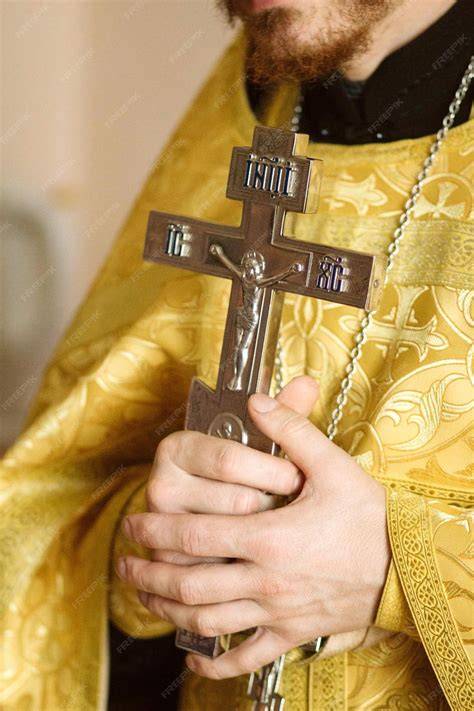
Key meanings and uses of the Orthodox blessing cross
| Aspect | Meaning or use |
|---|---|
| Cross pendant | A visible expression of Christian faith and personal devotion |
| Sign of the Cross | A bodily confession of the Holy Trinity and the sacrifice of Jesus Christ |
| Priestly hand Cross | A sacred instrument used by priests and bishops in blessing |
| Right hand | Christ's infinite power and His sitting at the right hand of the Father |
| Downward movement | Christ's descent to humanity from heaven |
| Three joined fingers | The Holy Trinity |
| Two fingers held against the palm | The two natures of Christ, divine and human |
| Cross in daily life | Prayer, protection, reverence, humility, and public confession of faith |