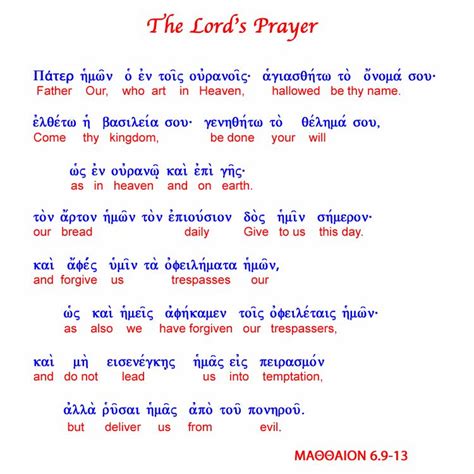
The Lord’s Prayer is presented below in Greek, followed by an English phonetic interpretation and an English translation. This makes it possible to learn to say the prayer in the original Greek language even if you do not read Greek.
The Lord’s Prayer is so called because we were taught to pray it by our Lord Jesus Christ himself (Matthew 6:9), for which reason it is the most important and most frequently recited prayer used in Orthodox worship services.
The Lord’s Prayer in Greek
Πάτερ ἡμῶν ὁ ἐν τοῖς οὐρανοῖς· ἁγιασθήτω τὸ ὄνομά σου· ἐλθέτω ἡ βασιλεία σου· γενηθήτω τὸ θέλημά σου, ὡς ἐν οὐρανῷ καὶ ἐπὶ τῆς γῆς· τὸν ἄρτον ἡμῶν τὸν ἐπιούσιον δὸς ἡμῖν σήμερον· καὶ ἄφες ἡμῖν τὰ ὀφειλήματα ἡμῶν, ὡς καὶ ἡμεῖς ἀφίεμεν τοῖς ὀφειλέταις ἡμῶν· καὶ μὴ εἰσενέγκῃς ἡμᾶς εἰς πειρασμόν, ἀλλὰ ῥῦσαι ἡμᾶς ἀπὸ τοῦ πονηροῦ. ἀμήν.
English phonetics
Pater hêmôn ho en toes ouranoes; hagiasthêtô to onoma sou; elthetô hê basileia sou; genêthêtô to thelêma sou, hôs en ouranô, kae epi tês gês.
Ton arton hêmôn ton epiousion dos hêmin sêmeron; kae aphes hêmin ta opheilêmata hêmôn, hôs kae hêmeis aphiemen toes opheiletaes hêmôn; kae mê eisenenkês hêmas eis peirasmon, alla rhysae hêmas apo tou ponerou. H oti sou estin hê basileia kae hê dynamis kae hê doxa eis tous aeônas; amên.
The phonetics can be challenging to read, so listening to the prayer spoken slowly in Greek can help with pronunciation and rhythm.
The Lord's Prayer recited very slowly in Greek with Phonetics provided
English translation
Our Father, who art in the heavens, hallowed be Thy name.
Thy kingdom come, Thy will be done on earth as it is in heaven.
Give us this day our daily bread, and forgive us our debts, as we forgive our debtors; and lead us not into temptation, but deliver us from the evil one.
Prayer text and pronunciation at a glance
| Greek prayer | English phonetics |
|---|---|
| Πάτερ ἡμῶν ὁ ἐν τοῖς οὐρανοῖς | Pater hêmôn ho en toes ouranoes |
| ἁγιασθήτω τὸ ὄνομά σου | hagiasthêtô to onoma sou |
| ἐλθέτω ἡ βασιλεία σου | elthetô hê basileia sou |
| γενηθήτω τὸ θέλημά σου | genêthêtô to thelêma sou |
| ὡς ἐν οὐρανῷ καὶ ἐπὶ τῆς γῆς | hôs en ouranô, kae epi tês gês |
| τὸν ἄρτον ἡμῶν τὸν ἐπιούσιον δὸς ἡμῖν σήμερον | ton arton hêmôn ton epiousion dos hêmin sêmeron |
| καὶ ἄφες ἡμῖν τὰ ὀφειλήματα ἡμῶν | kae aphes hêmin ta opheilêmata hêmôn |
| ὡς καὶ ἡμεῖς ἀφίεμεν τοῖς ὀφειλέταις ἡμῶν | hôs kae hêmeis aphiemen toes opheiletaes hêmôn |
| καὶ μὴ εἰσενέγκῃς ἡμᾶς εἰς πειρασμόν | kae mê eisenenkês hêmas eis peirasmon |
| ἀλλὰ ῥῦσαι ἡμᾶς ἀπὸ τοῦ πονηροῦ | alla rhysae hêmas apo tou ponerou |
| ἀμήν | amên |
The structure of the prayer
The Lord's prayer opens with addressing God as “Father who art in Heaven”. There are then seven petitions. The first requests are connected with the worship of God (“Hallowed be thy name”) and His ways.
The next four concern the needs of man-his physical (“Give us today our daily bread”), mental (with temptation), spiritual (against evil) and relational needs (forgiveness). The prayer then concludes with a doxology.
“Our Father, Who art in the heavens”
In one sense, everyone can describe God as their Father, since he is the maker of all things. When Christians refer to God as Father, however, they mean first and foremost that he is the Father of his only-begotten Son, our Lord Jesus Christ.
While Jesus alone can call God ‘Father’ in a true sense, the same privilege is granted to us when we become God’s children by adoption, when we are united to Jesus Christ as members of his Body, the Church, through baptism and the Eucharist.
To “dare to call upon the God of heaven as Father”, as we say in the Liturgy, is thus a great gift of grace, given to baptised members of the Christian Church.
“Hallowed be Thy name”
In the Gospels, Jesus exhorts us: “Let your light so shine before men, that they may see your good works, and glorify your Father which is in the heavens” (Matthew 5:16).
What we are asking for here, then, is for God to help us live in such a way that our lives become witnesses to his grace in us, thus bringing others to faith in him.
“Thy kingdom come”
God’s kingdom is his presence. We are here praying for him to come into our lives, into our hearts, and be present with us in every moment (“Behold, the kingdom of God is within you” - Luke 17:21).
“Thy will be done, on earth as it is in heaven”
Just as the angels of God do his will in heaven, we pray that God will help us to manifest his will-his love, peace, justice-here on earth.
“Give us this day our daily bread”
The Greek usually rendered ‘daily’ here is epioúsion, which literally translates to ‘super-essential’.
In this petition, we are praying that God provides us with our basic needs each day, but we are also asking for that Bread which is ‘above the essence’: Christ himself.
This is one of the reasons the Lord’s Prayer is recited just before we receive Holy Communion in the Liturgy. “I am the bread of life; he who comes to Me will not hunger, and he who believes in Me will never thirst” - John 6:35.
“And forgive us our debts, as we forgive our debtors”
Our Lord tells us: “For with the judgment you pronounce you will be judged, and with the measure you use it will be measured to you” (Luke 7:2) and “if you forgive others their trespasses, your heavenly Father will also forgive you” (Matthew 6:14).
Quite simply, God will treat us as we treat others.
“And lead us not into temptation”
The Bible says clearly that “God cannot be tempted with evil, and he himself tempts no one” (James 1:13).
Why then, do we ask God not to lead us into temptation? The Greek here uses the aorist subjunctive of eisphérō, and so the idea being expressed is therefore ‘Do not allow us to be tempted’.
It should also be noted that the Greek word peirasmos has broader connotations than the English ‘temptation’, and can also mean something like ‘trial’.
“But deliver us from the evil one”
The Greek word ponerou here can be both masculine or neuter, and therefore ‘deliver us from evil’ and ‘deliver us from the evil one’-that is, the devil-are equally valid translations.
Greek forms of the prayer
Greek (Classical)
Πάτερ ἡμῶν ὁ ἐν τοῖς οὐρανοῖς· ἁγιασθήτω τὸ ὄνομά σου· ἐλθέτω ἡ βασιλεία σου· γενηθήτω τὸ θέλημά σου, ὡς ἐν οὐρανῷ καὶ ἐπὶ τῆς γῆς· τὸν ἄρτον ἡμῶν τὸν ἐπιούσιον δὸς ἡμῖν σήμερον· καὶ ἄφες ἡμῖν τὰ ὀφειλήματα ἡμῶν, ὡς καὶ ἡμεῖς ἀφίεμεν τοῖς ὀφειλέταις ἡμῶν· καὶ μὴ εἰσενέγκῃς ἡμᾶς εἰς πειρασμόν, ἀλλὰ ῥῦσαι ἡμᾶς ἀπὸ τοῦ πονηροῦ. ἀμήν.
Greek (Modern)
Πάτερ ἡμῶν ὁ ἐν τοῖς οὐρανοῖς· ἁγιασθήτω τὸ ὄνομά σου· ἐλθέτω ἡ βασιλεία σου· γενηθήτω τὸ θέλημά σου, ὡς ἐν οὐρανῷ καὶ ἐπὶ τῆς γῆς· τὸν ἄρτον ἡμῶν τὸν ἐπιούσιον δὸς ἡμῖν σήμερον· καὶ ἄφες ἡμῖν τὰ ὀφειλήματα ἡμῶν, ὡς καὶ ἡμεῖς ἀφίεμεν τοῖς ὀφειλέταις ἡμῶν· καὶ μὴ εἰσενέγκῃς ἡμᾶς εἰς πειρασμόν, ἀλλὰ ῥῦσαι ἡμᾶς ἀπὸ τοῦ πονηροῦ. ἀμήν.
The Classical Greek and Modern Greek forms presented here use the same written prayer text.
Learning the Greek pronunciation
Read the phonetic text slowly, phrase by phrase, while following the Greek text. Repeating each line aloud helps preserve the pauses and rhythm of the prayer.
The Greek text remains unchanged while English translations may use different words. The English translation used here is the approved translation by the Greek Orthodox Archdiocese of America.
The prayer is part of a wider project that includes dozens of languages.