The Gospel at Colonus is a musical-theater adaptation of Sophocles’ Oedipus at Colonus that retells the ancient Greek tragedy as a Black Pentecostal church service. Conceived and adapted by Lee Breuer, with music composed by Bob Telson, the work transforms prophecy into testimony, suffering into spiritual elevation, and tragedy into a path toward deliverance.
The story follows the blind and exiled Oedipus as he arrives at Colonus with his daughter Antigone, seeks sanctuary, confronts the political claims of Thebes, and finally receives a peaceful resting place. Gospel choruses, ritual movement, sermon, call-and-response, and the Pentecostal “holy dance” re-create the catharsis of Greek tragedy while placing the audience inside a contemporary religious gathering.
What The Gospel at Colonus is about
The Gospel at Colonus is a curious blend of the ancient Greek drama of Sophocles and a modern gospel musical. The text is an adaptation of Sophocles’ Oidipous epi Kolōnōi (401 B.C.E.; Oedipus at Colonus, 1729), the second play in the cycle of the Theban Trilogy, although it makes references to certain occurrences in both Oidipous Tyrannos (c. 429 B.C.E.; Oedipus Tyrannus, 1715) and Antigonē (441 B.C.E.; Antigone, 1729).
The immediate setting of The Gospel at Colonus is a black Pentecostal church service, where the play opens with the black preacher taking the text for his sermon from the “Book of Oedipus.” Through flashback, musical performance, and dance, the audience is transported back in time to the suffering of Oedipus, the King of Thebes’ self-imposed banishment from his home city, and his difficult journey in search of sanctuary.
Oedipus’s journey and his constant suffering are dramatized in the audience’s imagination as the Pentecostal preacher re-creates the classic story of redemption through suffering. A man condemned from birth searches for grace. A choir lifts him up. The congregation - the audience - bears witness to his tale.
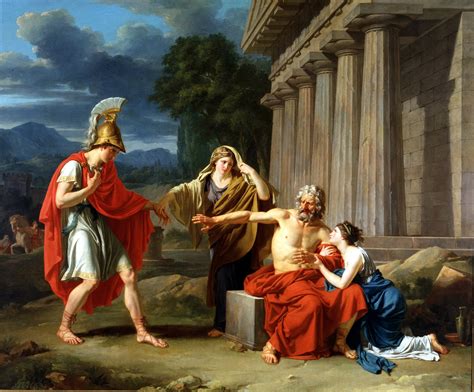
Plot and story
Oedipus arrives at Colonus
The first scene shows Oedipus on the road, accompanied by his younger daughter, Antigone, as he approaches the gates of Colonus, the city in which he will ultimately be granted a resting place. Although the townspeople attempt to refuse his entry out of fear that his sins will infect them, Oedipus is granted entry to the city by King Theseus, himself a victim of angry gods and thus sympathetic to Oedipus’s needs.
Oedipus is blind, exiled, and burdened by the crimes and misfortunes that have defined his life. Yet the play does not present his final years solely as a continuation of punishment. His arrival at Colonus begins a movement from exclusion toward sanctuary, from public condemnation toward recognition, and from endless wandering toward rest.
Ismene brings news from Thebes
Ismene, Oedipus’s elder daughter, arrives from Thebes with the news that he is now welcome to return to Thebes, but Oedipus refuses. His former city does not offer the kind of refuge he needs, and its political interest in him is inseparable from the prophecy surrounding his death.
In the play’s moral universe, Oedipus’s value is no longer limited to his former position as king. The question is where he will die and which city will receive the power associated with his final resting place.
Creon seeks to reclaim Oedipus
In the meantime, Creon, the present ruler of Thebes, who is also the brother-in-law and uncle of Oedipus, arrives to persuade Oedipus to return to his home city, fully aware that the Delphic oracle has prophesied that the city that grants Oedipus a final resting place will forever prosper.
Oedipus refuses the invitation, and in an effort to force Oedipus to return to Thebes, Creon kidnaps Oedipus’s daughters. Theseus speaks movingly of Oedipus’s plight and vows not to rest until he restores Oedipus’s daughters to him.
The conflict between Creon and Oedipus is therefore both personal and political. Creon treats Oedipus as a resource whose burial can benefit Thebes, while Oedipus insists on his right to choose the place where he will finally find peace.
Polyneices asks for a blessing
Shortly after Oedipus’s arrival at Colonus, he is visited by Polyneices, one of his two warring sons. Polyneices has been driven from Thebes by his brother Eteocles and has traveled to Argos to raise an army to attack his home city.
Polyneices asks for his father’s blessing in battle, but Oedipus rebukes him for his foolish fighting and for his refusal to help his father when he had the chance. The encounter brings the violence of Thebes into the sanctuary Oedipus has sought, but it does not restore the broken family.
Sanctuary and death
Shortly thereafter, Theseus keeps his promise and returns Antigone and Ismene to Oedipus and grants Oedipus official sanctuary in the city of Colonus. There Theseus presides over Oedipus’s death, a situation in which he is caught up in a whirlwind, a Pentecostal rapture.
Thus Oedipus gains his final resting place in peace though he has suffered endlessly. The ending changes the emotional direction of the myth: death is not merely the last consequence of guilt but an arrival at release, protection, and transcendence.
From Greek tragedy to Pentecostal ritual
Flashbacks are interspersed with the contemporary preacher’s sermon, and, as the sermon builds to its high point, it is augmented by gospel music. The preacher does not simply narrate an old story; the sermon actively re-creates it for the congregation.
At the end of the play, a catharsis is experienced, and the shout-the Pentecostal “holy dance”-is performed as the audience’s emotions are purged of pity and fear, as they were in ancient Greece upon Oedipus’s rapturous death.
Indeed, the audience-both that of the play and that of the preacher-understands that if there was a celebration of Oedipus’s triumph over intense and long-term suffering, then it can happen for them as well. Here, tragedy is not an ending - it’s the road to deliverance.
Characters
| Character | Role |
|---|---|
| Black Preacher | A contemporary religious figure who doubles as a Greek messenger |
| Oedipus | The ancient Greek literary character who doubles as a gospel singer |
| Antigone | Oedipus’s daughter and the princess of Thebes |
| Ismene | Oedipus’s daughter and the princess of Thebes |
| Creon | King of Thebes |
| Theseus | King of Colonus |
| Polyneices | Oedipus’s son and the prince of Thebes |
The cast of the 2025 Little Island production
The cast of The Gospel at Colonus. Photo: Julieta Cervantes. Gospel legend Kim Burrell, Davóne Tines, and serpentwithfeet join vocal powerhouses Samantha Howard, Ayana George Jackson, and more, with the “Duke of Gospel” James Hall and his Worship & Praise choir, to tell the story of Oedipus in a gospel sermon.
Leading these proceedings is Stephanie Berry, assuredly depicting the Preacher in a flowing gown and a compassionate glow. At various times, Oedipus also is voiced by Berry, but mostly this central character is interpreted singly or together by veteran blues singer Frank Senior and operatic bass-baritone Davóne Tines.
Looking strikingly unalike, perhaps to suggest the mortal and spiritual sides of Oedipus as he seeks rest, their distinctive vocals contrast but also can blend harmoniously. Frank Senior is credited as Singer Oedipus, while Davóne Tines is also credited as Singer Oedipus.
Oedipus’ loyal daughters are contrasting figures in Samantha Howard’s earthy Antigone and Ayana George Jackson’s glamorous Ismene. A charismatic vocalist, Kim Burrell fires up both the score and drama.
So does the fevered artistry of Jon-Michael Reese as Oedipus’s snaky son Polyneices, perhaps most notably among other able performances from Brandon Michael Nase, Vischon Robinson and Dr. Kevin Bond.
Cast list
- Stephanie Berry
- Dr. Kevin Bond
- Kim Burrell
- Little Charles
- Schanel Crawford
- JacQuetta Fayon
- Angie Goshea
- Samantha Howard
- Ayana George Jackson
- Robyn McLeod
- Brandon Michael Nase
- Jon-Michael Reese
- Teddy Reid
- Vischon Robinson
- Davóne Tines
- Frank Senior
- Serpentwithfeet
- Lenny VanCooten
- Eugene Marcus Walker
- Darlene Nikki Washington
Production team
| Position | Artist |
|---|---|
| Conceived and adapted by | Lee Breuer |
| Music composed by | Bob Telson |
| Directed by | Shayok Misha Chowdhury |
| Co-music director | James Hall |
| Co-music director | Dionne McClain-Freeney |
| Scenic designer | David Zinn |
| Costume designer | Montana Levi Blanco |
| Lighting designer | Stacey Derosier |
| Sound designer | Garth MacAleavey |
| Hair and wig designer | Cookie Jordan |
Lee Breuer and Bob Telson
Lee Breuer was one of contemporary theatre’s most singular creative minds. He created wildly inventive work around the world both independently and with Mabou Mines, the company he co-founded in 1970.
Breuer blended disciplines and techniques from widely different cultures, creating unique performance genres. His writing expands the concept of character and the use of biography in performance in works such as: Hajj, The Shaggy Dog Animation, A Prelude to Death in Venice, An Epidog, Red Beads and Porco Morto.
Breuer’s celebrated stagings of radically adapted classics include: The Gospel at Colonus, Mabou Mines DollHouse, The Lost Ones, Peter and Wendy, Mabou Mines Lear, and Un tramway nommé désir (La Comédie-Française, Paris).
His accolades include a MacArthur Fellowship and a Chevalier des Order of Arts and Literature. The Beinecke Rare Book & Manuscript Library houses his archive. Lee has five children all of whom are artists.
Bob Telson is an American composer, singer/songwriter, and pianist best known for his work in musical theater and film, for which he has received Tony, Pulitzer, and Academy Award nominations.
Telson grew up in Brooklyn, studying classical piano from the age of five. He studied pipe organ, counterpoint, and harmony with Nadia Boulanger and received his B.A. in music from Harvard.
During the ’70s he played keyboards with the Philip Glass Ensemble, Tito Puente, The Five Blind Boys of Alabama, and Machito, among others. Telson’s collaboration with Lee Breuer began in 1979 with “Sister Suzie Cinema,” a doo-wop opera.
Their major music theater works include The Gospel at Colonus, which received a 1984 Obie award for ‘Best Musical’ as well as Pulitzer, Tony, and Grammy nominations, and The Warrior Ant (BAM 1988).
Telson’s Chronicle of a Death Foretold, an adaptation of the Gabriel Garcia Marquez novel, won a Tony nomination for Best Musical. Telson’s first movie score, for “Bagdad Café”, received an Oscar Nomination for the song “Calling You.”
Shayok Misha Chowdhury and the 2025 staging
Shayok Misha Chowdhury is an Obie Award-winning director and Whiting Award-winning writer, born in India, based in Brooklyn. His playwriting debut Public Obscenities (Soho Rep, NAATCO, Woolly Mammoth, TFANA) was one of three finalists for the 2024 Pulitzer Prize in Drama.
The bilingual play, in Bangla and English, was a New York Times Critic’s Pick and named Best Theater of 2023 by the New Yorker. Misha is also the recipient of a Princess Grace Award, The Mark O’Donnell Prize, a Jonathan Larson Grant, and the Relentless Award for his musical How the White Girl Got Her Spots and Other 90s Trivia.
Such smart design reflects the music-drama’s own imaginative mix of ancient and modern elements that inspire the beautiful new production smartly staged in high style by director Shayok Misha Chowdhury, whose fine artists frequently move in rhythmic, ritualistic patterns.
Music and choral performance
Bob Telson’s bluesy, gospel-suffused score is grand, glorious and performed with gusto by a vibrant company. The Gospel at Thebes remarkably delivers both meaningful classical themes and a really good time driven by some irresistible music that soon has spectators swaying in their seats.
Pumped by an electric organ throbbing at the heart of the orchestra and whipped up by James Hall’s filigreed gestures as choir director, the vibrant choral musicianship is rich and celebratory.
The Greek Chorus, represented in The Gospel at Colonus by two gospel-singing choruses, is also an important dramatic device in its function as the Aristotelian notion of the ideal spectator and in the role of a contemporary gospel chorus.
In the former sense, the two groups often provide point-counterpoint or strophe-antistrophe in order to give the audience different views of the same incident and to advance the plot by illustrating the preacher’s next point in the text.
The fact that both choruses are singing the same song at the end of the play confirms and underscores the play’s important theme of reconciliation. In the latter sense, the choruses keep the play moving and add resonance to the preacher’s intonations, functioning in the same manner as a church choir does in the black religious tradition.
Selected songs
- Live Where You Can - Ismene and Choir
- Stop, Do Not Go On - The Singer and Soul Stirrers
- Who Is This Man? - Choragos and Messenger
- How Shall I See You Through My Tears? - Ismene and the J. D. Steele Singers
- A Voice Foretold - Oedipus, Five Blind Boys and The Singer
- No Never - Choragos and Soul Stirrers
- All My Heart’s Desire - Oedipus, Five Blind Boys, Choir, Creon and Messenger
- Numberless Are the World’s Wonders - Steele Singers, Guest Choir Director and Janice Steele Choir
- Lift Me Up - Oedipus and Five Blind Boys
- Evil Chorus - The Choir Soloist
- You Break My Heart - The Singer and Singers
- Oh Sunlight of No Light - The Singer
- Eternal Sleep - Soul Stirrers
- Lift Him Up - Choir and The Choir Soloist
- Now Let the Weeping Cease - Soul Stirrers, Choir and Ensemble
Dramatic devices
Flashback and sermon structure
The most obvious dramatic device employed in The Gospel at Colonus is the use of flashback. Even as the preacher mounts the podium to begin his sermon, the impulse to “look back” is present.
Thus, as the preacher introduces his text from the Book of Oedipus, he begins to draw the picture of the once mighty King of Thebes, who is brought down so that he might be exalted, or “saved” in the Christian context.
At one juncture, obviously to impart to the congregation just how low Oedipus was brought, the preacher recounts how Oedipus blinded himself by plunging the golden brooches from his wife/mother’s garments into his eyes so that he could look no more on the sins he had committed.
The power of such imagery is palpable for the audiences-the one listening to the sermon within the play, as well as the one experiencing the play.
Call-and-response
The interior audience-the church congregation-interacts in a call-and-response manner with the preacher in the play, while the exterior audience-the theatergoers-responds to Oedipus’s plight as it is dramatized onstage.
Moreover, because all elements, including the external audience, interact with one another in the grand finale of the musical-the catharsis and the exodus-the author’s unique vision of reconciliation once again resonates with all who witness The Gospel at Colonus.
Amphitheater staging
The amphitheater-style seating of the audiences replicates the ancient Greek outdoor amphitheater, which creates a sense of verisimilitude as the spectators view the action of the play down below.
The similar seating arrangement of the church congregation in the play itself not only replicates the actual arrangement of the churchgoers as they view the dramatic performance of their preacher, but also suggests a connection between the form and content of the ancient and contemporary.
Design of the Little Island production
Right now, weather permitting, there are few places in Manhattan sweeter than The Amph at Little Island Park, where a thrilling staging of The Gospel at Colonus bowed on Sunday for a too-brief stay.
The semi-circle of the 700-seat Greek-style amphitheater looks towards the Hudson River and the greenery of Castle Point on the New Jersey side. From sunset into evening, this vista glimmers beyond the 90-minute performance of a distinguished 1983 music-theater work that is classically suited to outdoor presentation.
The last time The Gospel at Colonus was seen in these parts also was staged outdoors, at the Delacorte Theater in 2018. The stadium-like pitch of The Amph’s horseshoe seating focuses viewers towards the central area where scenic designer David Zinn situates most of the show’s ten musicians at the middle of a circular deck painted in hot reds and pinks.
Tracing its outer edge is a bench for the key performers and ten members of the chorus. In view, too, is a pretty patch of tall grasses and wildflowers that represents a sacred grove outside Colonus, a city where the blind, exiled Oedipus seeks refuge.
Melding modern and classical shapes, designer Montana Levi Blanco dresses everyone similarly in lilac shades yet accents their individuality by jewelry and different headgear; the usually billowy clothes look comfy for summer weather wear.
Cookie Jordan created the complimentary hair and wigs. Stacey Derosier’s lighting design is practical, richly colorful and dramatic to the point when at times, like Oedipus, some viewers may feel as if their eyes were being stabbed out by the glaring luminaires.
In spite of the acoustic support provided by sound designer Garth MacAleavey, some lyrics get lost in the singing, but the work’s essential story of refuge, sanctuary and redemption remains clear.
Production history
| Milestone | Details |
|---|---|
| First produced | 1983, at the New Wave Festival, Brooklyn Academy of Music, New York |
| First published | 1989 |
| Original beginning | Washington Square United Methodist Church at the ReCherChez Studio for the Avant-Garde Performing Arts in December 1981 |
| Brooklyn Academy of Music | The show played for four and half weeks as part of the Next Wave Festival in November and December 1983 |
| Broadway opening | The production later transferred to Broadway, opening at the Lunt-Fontaine Theatre on March 24, 1988 |
| Broadway closing | The Broadway production played for a total of 61 performances before closing on May 15, 1988 |
| Carnegie Hall | In 1996, the original cast celebrated the 1000th performance of the show at Carnegie Hall |
| Delacorte Theater | The Public Theater and Onassis Foundation USA presented a 35th anniversary 6-performance-concert at the Delacorte Theater in September 2018 |
| Little Island | The Gospel at Colonus opened July 13, 2025, at The Amph at Little Island and runs through July 26 |
The Gospel at Colonus has been widely performed around Europe and the United States, and continues to be produced. The Broadway production was nominated for a Tony Award for Best Book of a Musical.
Critical context and awards
Even before its formal debut at the New Wave Festival at the Brooklyn Academy of Music in 1983, The Gospel at Colonus reached a number of enthusiastic workshop audiences in the United States and England.
Its energy, its unique and intriguing blend of seemingly opposing traditions, and its moving conclusion offered audiences a fresh experience and drew rave reviews from the critics.
Although many saw the play as one in a long line of gospel musicals, it is clear to the discerning reviewer that The Gospel at Colonus transcends that genre in accomplishing what interviewer Patrick Pacheco called “a song of joyous affirmation.”
In fact, Lee Breuer says of the play, “It’s not a gospel show, but gospel music is used as an inspiration for re-creating a classic Greek experience, and I believe it is the correct metaphor for our time.”
Audiences and critics alike agreed with Breuer. Among the praise offered by the critics, Alan Rich noted in Newsweek that the play was “a great theatrical exultation, a jiving, shouting, hand clapping celebration.”
Jack Kroll, also from Newsweek, observed that The Gospel at Colonus is “a triumph of reconciliation, bringing together black and white, pagan and Christian, ancient and modern in a sunburst of joy that seems to touch the secret heart of civilization itself.”
Critical responses emphasized the production’s ability to join traditions without reducing either of them to decoration. The ancient chorus becomes a living gospel choir, while the Pentecostal service provides a contemporary structure through which the emotional force of Greek tragedy can be experienced collectively.
According to an anonymous reviewer of Atlanta’s Alliance Theater production, “The Gospel at Colonus is galvanizing theater, both a gigantic theatrical experiment and a return to roots, a celebration and an affirmation of faith.”
The 1985 filmed production
The Gospel at Colonus was filmed during its run at the American Music Theater Festival, Philadelphia. The taping was aired on PBS’ Great Performances on WNET/Thirteen in 1985.
In reviewing the television program for the New York Times, critic John J. O’Connor noted that “The Gospel of Colonus survives the transformation [from stage to screen] with its unique spirit remarkably intact.”
The filmed production featured Morgan Freeman as The Messenger, Clarence Fountain as Oedipus, Isabell Monk as Antigone, Carl Lumbly as Theseus, Robert Earl Jones as Creon, Jevetta Steele as Ismene, Kevin Davis as Polyneices, and Martin Jacox as Choragos.
It also featured Clarence Fountain and the Five Blind Boys of Alabama, The Original Soul Stirrers, The J.D. Steele Singers, and The Institutional Radio Choir.
Production credits for the filmed version
- Theatre: Annenberg Center, Philadelphia
- Producer: David Horn, Yvonne Smith, John Walker, Liza Lorwin
- Book: Lee Breuer
- Music and lyrics: Bob Telson
- Arrangements and conductor: Bob Telson
- Director: Lee Breuer
- Film: Kirk Browning
- Scenic design: Alison Yerxa
- Costume design: Ghretta Hynd
- Lighting design: Julie Archer
- Sound design: Shelton Lindsay
Format, setting, and characters
| Element | Description |
|---|---|
| Type of plot | Musical |
| Time of work | Ancient Greece and the late twentieth century United States |
| Locale | Ancient Greece and a black Pentecostal church service |
| Running time | 90 minutes |
| Immediate setting | A black Pentecostal church service |
| Central transformation | Sophocles’ tragedy becomes a gospel sermon with music and dance |
Why the adaptation matters
The play’s central achievement lies in its simultaneous preservation and transformation of Sophocles. It retains the major movement of Oedipus at Colonus-exile, contested refuge, political pressure, familial conflict, and a mysterious death-while changing the theatrical language through which those events are understood.
The ancient Greek chorus becomes two gospel-singing choruses. The messenger becomes a preacher. The audience becomes a congregation. The ritual of the Pentecostal service becomes a contemporary equivalent of the communal and religious dimensions of Greek tragedy.
The play’s important theme of reconciliation operates on several levels: between ancient and modern, pagan and Christian, tragedy and celebration, individual suffering and communal witness, and theatrical spectatorship and religious participation.
“The marriage of Black Pentecostal ritual and Greek ritual” opened what Mimi Gisolfi D’Aponte described as “psychic space” in American theater. The work therefore offers not merely a new setting for an old story but a different way to understand what a classical tragedy can do in performance.
THE GOSPEL AT COLONUS - Live Where You Can
Weather and outdoor performance conditions
The Gospel at Colonus runs for 90min. As an outdoor venue, however, inclement weather may require us to delay, pause or cancel a performance.
Ticket holders for shows in The Amph will also be notified of cancellations via email and text. Delays or pauses in the show do not qualify for vouchers as long as the performance plays 40 minutes or more.