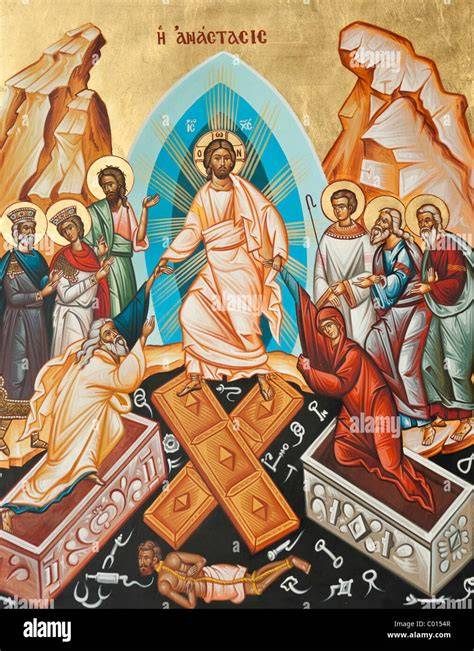
The Orthodox Resurrection icon, known as the Anastasis, Christ’s Descent into Hades, or the Harrowing of Hades, depicts the results of Christ’s Resurrection for humanity and the world rather than the moment when He rose from the tomb. Christ stands at the center, grasps Adam and Eve by the hands, and raises them from death, symbolizing the salvation and restoration of all humankind.
The icon is the primary image of Pascha (Easter) in the Orthodox tradition. It celebrates Jesus Christ’s triumph over death, His descent into Hades, the liberation of the righteous dead, and the general resurrection of the body before the Final Judgment.
The Orthodox Resurrection Icon and the Western Depiction
The first thing to note is that it is entirely different from the Western-style depiction, which shows Christ emerging triumphantly from the tomb, holding a little flag. The astonished guards have fallen to the ground.
The Western-style icon presents a scene that no-one ever saw. The moment of the Resurrection is a concealed secret. The Orthodox approach is entirely different. It depicts the results of the event of the Resurrection for people and for the world.
Icons are not meant to be “photo recordings” of what happened. They are symbolic tools that assists us in comprehension of the gospel truth through our sense of sight.
What the Anastasis Represents
The Anastasis icon represents the fulfillment of the Resurrection and confirms that Christ descends to Hades to enter into the full depth of the Fall. He confronts Hades and He prevails. He liberates the righteous dead and He restores humanity - Christ doesn’t rise alone; He depicts humanity rising in Him.
Not only is it about the holy identity of Jesus, but it is also about the reconciliation with God and major turning point in the New Testament. Its cardinal importance explains why so much attention was paid to the representation of the resurrection scene in iconography.
With this action, which is dynamic (we might almost say explosive) our attention immediately focuses on the central meaning of the scene: “and raising Adam up with Himself”, the Salvation of humankind.
Christ at the Center of the Icon
Christ, in the centre, is wearing shining white garments and is within a mandorla. He is holding the hands of Adam and Eve and raising them from death, into which they were brought by their erroneous choice in Paradise.
Jesus Christ is a key figure of the icon. Standing in the center of the scene, He grasps the hands of Adam and Eve and pulls them from a tomb. It signifies the fact that His victory redeems all humankind.
In some versions, Christ’s robe and figure are dynamic, which means that the Savior descents from Heaven to Hades to save those who died in the flesh. That is why the icon is also called the Harrowing of Hades.
Christ’s cape/robe is flowing upward, which symbolizes his radical descent into Hades to save those who have died in the flesh.
Adam and Eve: Humanity Raised from Death
The two figures whom Christ has grasped and is pulling from tombs are Adam and Eve. This gesture symbolizes his victory which redeems all mankind, even back to the beginning. It also foreshadows the general resurrection of the body before the Final Judgment.
Christ grabs Adam and Eve by the wrists, lifting them from their tombs. Pulling them up by their wrists depicts:
- Divine Initiative: Salvation is entirely God’s action; humanity does not “reach up.” This is not a partnership.
- Total Dependence: The limp hands of Adam and Eve emphasize human inability to save itself.
- Universal Representation: as Adam represents all humanity (the “Old Adam”).
- Resurrection: Rising from sarcophagi signifies real transformation.
Christ as the New Adam restores fallen humanity, “As in Adam all die, so in Christ shall all be made alive” (Rom 5; 1 Cor 15).
Both are emerging from tombs. Adam and Eve symbolize the human race, as they are the first human beings God created.
Besides, every Orthodox Resurrection icon depicts Adam and Eve as old individuals, which is probably one of the methods to point out a sign of the time.
The Broken Gates of Hades
Christ is standing firmly on two pieces of wood lying in such a way as to form a cross. These are the gates of Hell, which Christ demolished through the grace of His cross. With death, they closed, but were not powerful enough to hold Him in thrall.
The golden bars by his feet are the gates of Hades, which he has broken and torn apart. Christ stands on what appears to be two boards, sometimes also depicted as crossed which represent the bronze gates to Hades that have been broken by his descent to Hades.
Christ stands on the gates of Hades, represented by two golden bars of iron. It is the very depiction of the moment of freedom because all the dead become free of imprisonment.
The gates beneath His feet signify decisive victory and storming of Hades. The Cross, as the instrument of death is also the very means of liberation and the key that opens Hades.
From the Gospel of Nicodemus: Hades and Satan attempt to secure the gates to Hades with locks, bars and chains; however, Christ descends and breaks them open, liberating the righteous dead from their tombs. Christ has destroyed death from within.
Locks, Chains, Keys, and the Defeat of Death
All around, there are broken and now useless bits of locks and chains which, until then had sealed off any escape route from Hell.
Typically, we also see broken locks, bars & chains underneath these shattered gates. Scattered locks and keys indicate that death’s hold on power is broken.
Keys are floating in the abyss below, which symbolizes that he has entered and conquered both death and Hades.
In the darkness below, keys, locks & chains symbolize that He has entered and conquered both death and Hades.
Christ has trampled down death by death.
The Bound Figure Beneath Christ
Below all this there this the blackness of Hell, which, until the Resurrection was the end of the road for humankind.
You may also note the skeletal figure who is chained up: that is Death and/or Satan. Christ has bound and killed him, which is why all throughout Pascha we sing “Christ has trampled down death by death.”
The bound figure in the dark abyss beneath Christ who stands on the shattered gates of Hades is Satan/Hades who has been defeated by Christ and is entangled by his own chains.
Sometimes, you can see a chained skeletal figure beneath Christ: that is Satan and/or Death. According to the Bible, he was bound and killed by Jesus.
This shows the defeat of the “Strong Man” (cf. Matthew 12:29 - “Or how can anyone enter a strong man’s house and steal his property, unless he first ties up the strong man? Then he can plunder his house.“)
Broken chains mean that death no longer has power over us. The dark abyss has been penetrated by divine light.
Christ doesn’t just come down and free the dead, he overthrows the ruler of Hades.
The icon depicts Hebrews 2:14, “that through death he might destroy him who has the power of death, that is, the devil.” The power of the devil and death were destroyed by the life-giving death of our Savior.
The Mandorla and the Light of Christ
The blue shape around Christ is called the Mandorla (which is Italian for almond, which describes its shape). The Mandorla is the uncreated, eternal light of Christ.
Christ, in the centre, is wearing shining white garments and is within a mandorla. The white raiment worn by Christ symbolizes the joy of the Resurrection and prefigures our own Resurrection, which will follow.
In the writings of the Eastern Orthodox mystics, God is often prayerfully experienced as light. This is not simply a pretty bright light.
It’s the light which filled the apostles with wonder when they witnessed His Transfiguration. Christ Himself described it as the power of the Kingdom of God (Mark 9:1 Matt 16:28 Luke 9:27).
It is the light that filled the once perpetual darkness of Hades when Christ descended and brought life into the realm of death. Lastly, it is the light that is seen when one purifies their heart and mind (Blessed are the pure in heart, for they shall see God.)
The Mandorla is progressively darker as it moves toward its center, which is Christ. If God is represented by light, the Mandorla may seem confusing.
However, those who seek God will find that the more they know Him, the less they comprehend Him. To know God, to experience Him, is to walk in the darkness of His light, to enter into the mystery of His presence.
The Kings, Prophets, and Saints
To the left and right of Christ stand people who had lived on earth before Him. All turn to Him in expectation of their salvation.
The people on either side of Christ typically include King David, King Solomon, Moses, Abel, St. John the Baptist and various other patriarchs and prophets.
These people show us that salvation extends beyond time and that Christ comes to redeem those who have died in the past, in the present and those who will die in the future.
King David and King Solomon
To the left, we see three characters: David and Solomon, two of his ancestors according to his fleshly nature. We also see, closest to him, John the Baptizer, who was his forerunner in both life and death.
David & Solomon: symbolize the royal lineage of Christ.
On the left of the icon, we see David and Solomon, representing those who died before Jesus' crucifixion, waiting patiently in Hades for their Messiah.
Saint John the Baptist
Among them there is, first, Saint John the Baptist, and also the prophets and the righteous of the Old Testament, such as the Prophet King David.
St. John the Baptist: continues his role as Forerunner showing the way, even in Hades.
On the right side of the icon, we see Abel as a shepherd, the first person to die as a result of the Fall, as well as Saint John the Baptist, the final prophet before the Christ.
Prophets, Patriarchs, and the Righteous
The figures on the right vary from icon to icon, but usually represent Old Testament prophets and saints such as Moses, Abel as a shepherd, and the three youths who were thrown into the fiery furnace (Daniel 3).
Abel: is the first righteous victim who is now vindicated.
Various Patriarchs & Prophets: are shown awaiting the Messiah.
At the rear of the composition there are hills, which, in some depictions feature representations of prophets (e.g. David and Jonas), who had foretold the mighty event of the Resurrection. They are holding scrolls with their prophecies written upon them.
The Historical and Literary Background
Across Greece, Russia, the Balkans, and Constantinople, its visual elements remain remarkably consistent-even though they are not derived directly from the canonical Gospels.
The event we see in the Anastasis is the visual representation of what is described in the extra-canonical Gospel of Nicodemus (also called the Acts of Pilate - linked text here) especially in the section called the Descent into Hell.
The conversation in this writing takes place between Satan and Hades, or the collective demons in the underworld.
If you would like to read further about the intriguing ancient account from which this icon is taken, check out The Harrowing of Hades.
The Anastasis at the Chora
The Anastasis fresco shown here was painted between 1315-1321 and is one of the most famous Resurrection images. We find it in Istanbul inside The Chora.
“Chora” is defined to mean countryside, suburbs, or township suggesting that the Chora Church was named for its location outside the city limits of Constantinople.
However, one could argue that the Chora Church was not simply named for its surroundings, instead for a philosophy described in Plato’s Timaeus.
The Philosophy of Chora
Chora is a complex philosophy that could be simplified to mean receptive space, a place where the uncontainable becomes present - a screen that allows things to appear.
In Christian theology and Byzantine tradition, Chora (Greek: χώρα, meaning “land,” “space,” or “receptacle”) represents a sacred space or vessel and is used to describe Mary as the “Container of the Uncontainable” and Christ as the “Land of the Living,” signifying the threshold between the divine and earthly.
A paper written by scholar Alexander Lidov (specialist in Byzantine Iconography), “Icon as Chora: Spatial Aspects of Iconicity in Byzantium and Russia” argues that the icon functions as a sacred space where the divine presence is made perceptible through non-naturalistic space - especially reverse perspective - transforming the viewer from observer into participant.
In this case, the icon is “Chora.”
Anastasis at Chora
How to Read the Icon as a Whole
The conceptual and stylistic difference is especially felt if you compare the Orthodox Resurrection icon with the versions created by the Western icon painters. Once you know more about the characters of the Orthodox Resurrection icon, you can better understand its meaning.
It also gives you the necessary knowledge to analyze the hidden and visible symbolism of the icon.
The icon depicts Jesus Christ descending into Hades and pulling Adam and Eve from the tombs, symbolizing His victory back to the very beginning of mankind.
The Anastasis icon therefore presents the Resurrection not as an isolated moment involving Christ alone, but as the liberation and restoration of humanity. Christ descends into the realm of death, breaks its gates, defeats Death and Satan, and raises Adam and Eve as representatives of the entire human race.
tags: #resurrection #icon #orthodox