Saint Padre Pio Catholic Church is dedicated to St. Pio of Pietrelcina, one of the most revered saints of the twentieth century. St. Padre Pio was an Italian priest who was known for his piety and charity, as well as the gift of the stigmata, which has never been explained.
St. Padre Pio, born Francesco Forgione, joined the Capuchin Franciscans and became a renowned priest confessor and spiritual guide and teacher. His life was marked by prayer, humility, suffering, service to the sacraments, and deep trust in Christ’s mercy.
Who Was Saint Padre Pio?
St. Padre Pio, born Francesco Forgione, is one of the most revered saints of the twentieth century. He joined the Capuchin Franciscans and became a renowned priest confessor and spiritual guide/teacher. He endured serious demonic attacks because of his fruitful ministry, similar to those experienced by St. John Vianney, a legendary priest confessor of the 1800s who also reconciled many souls to Jesus and his Catholic Church and provided faithful guidance.
Padre Pio is also known for his great piety and humility, including obeying his superiors while bearing unjust accusations that severely restricted his ministry at times. Because of his remarkable holiness, Padre Pio received the stigmata and had other mystical experiences.
St. Padre Pio’s feast day is celebrated on September 23 each year.
Early Life in Pietrelcina
St. Padre Pio was born Francesco Forgione, on May 25, 1887, in Pietrelcina, Italy. His parents were peasant farmers. He had an older brother and three younger sisters, as well as two other siblings who died in infancy.
Born in 1887 in Pietrelcina, Italy, Francesco Forgione exhibited a deep religious fervor from an early age, often spending hours in prayer. As a child, he was very religious and by the age of five he reportedly made the decision to dedicate his life to God.
Fortunately, his parents were also very religious and they supported his Catholic development. His family attended daily Mass. Francisco served as an altar boy at his local parish.
Francisco was known for taking on penances and his mother once scolded him for sleeping on a stone floor. Francisco's community was also supportive. Saint's days were popular celebrations and commonly celebrated in his town.
Childhood Faith and Mystical Experiences
From his tender age, Francisco had a peculiar ability. He could see guardian angels, spoke with Jesus and the Virgin Mary. This was not something taught to him, but occurred so naturally that he assumed other people could see them too.
Born in 1887 in Pietrelcina, Italy, Francesco Forgione exhibited a deep religious fervor from an early age, often spending hours in prayer. He also suffered from poor health, battling illness throughout his childhood.
Francisco was sickly as a child. He suffered an attack of gastroenteritis at age six and when he was ten, he had typhoid fever.
Family Poverty, Work, and Education
Although Francisco and his family was very religious, they were also very poor, which required that he work. He spent many years as a child tending to a small flock of sheep owned by his family.
Unfortunately, the work meant he was unable to attend school regularly, so he quickly fell behind other kids his age. To prepare Francesco, his parents decided to hire a private tutor.
To pay the cost of the tutor, Francesco's father traveled to America to find work, and sent the money home.
In 1897, after three years of schooling, Francisco expressed to his parents that he wanted to become a friar. His parents traveled to a nearby community of monks and asked if Francesco could join them.
He was evaluated, despite his young age, and was told that he needed more education before he could join.
Joining the Capuchin Franciscans
At the age of 15, Francisco was finally ready and he entered the novitiate of the Capuchin friars at Morcone. He took the name of "Pio" in honor of Pope Pius I, whose relic he often saw at his local chapel.
At age fifteen, he joined the Capuchins, taking the name Brother Pio. His life was marked by a commitment to simplicity and caring for his “flock of sheep,” the many people who sought absolution for their sins and his spiritual guidance.
At the age of 17, Brother Pio became extremely ill and could only digest milk and cheese. He was sent to the mountain for better air, and when this did not work, he was sent home to his family.
Amid all this, he continued to study for the priesthood. On one occasion during prayer, a fellow monk astonishingly reported he saw Pio levitate during an episode of ecstasy.
Ordination and Military Service
Brother Pio became a priest in 1910, but was permitted to remain at home because of his poor health. In 1915, with World War I afflicting the world, Padre Pio was summoned for military service.
He was compelled to leave a tiny community of monks, with whom he was then housed, and drafted into medical service. However, he was so sickly that he was often sent home, only to then be recalled for service.
In March 1916, he was finally dismissed because of his poor health.
The Stigmata of Padre Pio
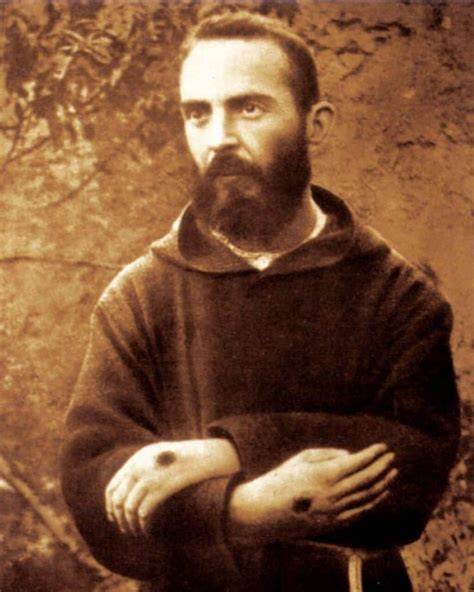
On September 20, Padre Pio was hearing confessions when he felt pain in his hands and feet. He noticed the stigmata, the wounds of Christ, appearing on his hands and feet.
Padre Pio is famously associated with the stigmata-the wounds associated with Christ’s crucifixion, which miraculously appeared on his hands, feet, and side in 1918. The stigmata remained imprinted on his body until Padre Pio’s death in 1968.
The experience was painful. Bleeding occurred. The wounds smelled of roses, and although they continued to weep, they never became infected.
Doctors who later examined the stigmata were amazed at their perfectly round shape. Despite skepticism, scrutiny, and severe sanctions that his superiors, including some Vatican officials, levied upon him at times, the Church came to recognize Padre Pio’s stigmata and holiness as authentic-and thus as powerful testimonies to his closeness with Christ.
Public Attention and Church Investigation
By 1919, word began to spread about Padre Pio's stigmata and people came from far away to examine him. Padre Pio became popular with the people he encountered and soon began to attribute supernatural occurrences to him.
For example, he was said to levitate, and able to perform miracles. His popularity became a source of concern for the Church and the Vatican began to restrict his activities to minimize public interaction.
Padre Pio himself was uncomfortable with his newfound popularity and the attention he received because of his stigmata. A Church investigation into his stigmata concluded that his condition was not faked.
By 1934, the Vatican began to change its attitude towards Padre Pio and he was again allowed to perform public duties. He could preach, despite never being officially licensed by the Church to do so. Pope Pius XI encouraged people to visit him.
Meeting Karol Wojtyla
In 1947, Fr. Karol Wojtyla visited Padre Pio who prophetically told him he would rise to the highest post in the Church. Fr. Karol Wojtyla became Pope John Paul II in 1978.
Pope St. John Paul II himself had a deep devotion to Padre Pio and sought his guidance during challenging times. He often spoke of Padre Pio’s influence on his life and pontificate.
Pope St. Paul VI and other Church leaders also admired Padre Pio’s faithfulness and spiritual wisdom.
Padre Pio as Priest and Confessor
Padre Pio led a life devoted to his work on the Altar and in the Confessional, embracing his role as a spiritual teacher to all. He would spend twelve to fifteen hours a day in the confessional and endured attacks from the devil because of the many souls he reconciled through the sacrament.
He joined the Capuchin Franciscans and became a renowned priest confessor and spiritual guide/teacher. His life was marked by a commitment to simplicity and caring for his “flock of sheep,” the many people who sought absolution for their sins and his spiritual guidance.
St. Padre Pio remains a beacon of faith and a model of total surrender to Christ in the modern world.
Spiritual Teachings
Padre Pio’s spiritual teachings emphasize the importance of prayer and offering up one’s suffering. He believed that suffering, when united with Christ’s one sacrifice of Calvary, could aid the salvation of souls (see 2 Cor. 1:6).
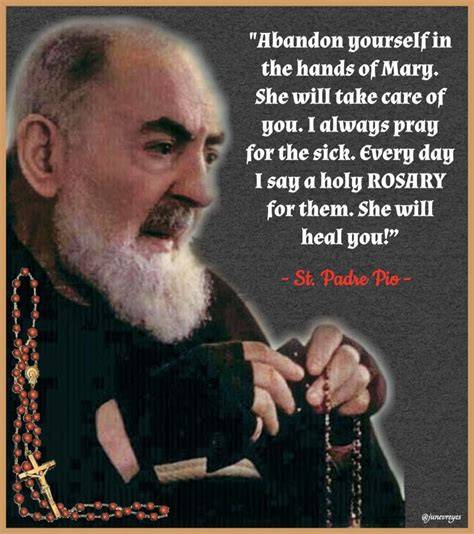
Padre Pio always had the rosary in his hands and prayed a full fifteen-decade rosary multiple times a day. He recommended weekly confession and also twice daily examination of one’s conscience-once in the morning and once in the evening.
Padre Pio’s famous maxim, “Pray, hope, and don’t worry,” summarizes the way he lived his life-in humble obedience and trust, submitting himself to Christ’s mercy in spite of physical and other forms of suffering.
“Worry is useless,” Padre Pio would add. “God is merciful and will hear your prayer.”
- Prayer was central to Padre Pio’s daily life.
- He recommended weekly confession.
- He recommended examining one’s conscience twice daily.
- He encouraged Catholics to unite suffering with Christ’s sacrifice.
- He repeatedly advised, “Pray, hope, and don’t worry.”
Mystical Gifts and Reported Miracles
In the years after Padre Pio receiving the stigmata, reports abounded of miracles he performed, as well as other accounts of other mystical gifts. Those extraordinary gifts included his ability to read souls, bilocate, heal others before they even asked, and experience visions, including assaults from the devil.
Pio himself wrote of some of these supernatural and preternatural experiences in letters to his spiritual director.
Padre Pio became internationally famous. He was known for his piety, charity and the quality of his preaching.
He had other illnesses, as well, including cancer which was miraculously healed after just two treatments. Other problems, such as arthritis, which plagued him in his later years, never went away.
Prayer and Devotion to Padre Pio
Padre Pio is also venerated for his healing prayers and the fruitfulness of his intercession. His devotees often recite the Padre Pio Healing Prayer or participate in the Padre Pio Novena, seeking spiritual and physical healing.
His feast day of September 23 is a time of special devotion for many modern Catholics worldwide. St. Pio of Pietrelcina, also known as Padre Pio, is the patron saint of civil defense volunteers, stress relief, and adolescents.
St. Padre Pio is the patron of civil defense volunteers, adolescents, and the village of Pietrelcina.
St. Padre Pio Healing Prayer
Heavenly Father, I thank you for loving me. I thank you for sending your Son, Our Lord Jesus Christ, to the world to save and set me free. I trust in your power and grace that sustain and restore me.
Loving Father, touch me now with your healing hands, for I believe that your will is for me to be well in mind, body, soul, and spirit. Cover me with the most Precious Blood of your Son, our Lord Jesus Christ, from the top of my head to the soles of my feet.
Cast away anything that should not be in me. Root out any unhealthy and abnormal cells. Open any blocked arteries or veins and rebuild and replenish any damaged areas.
Remove all inflammation and cleanse any infection by the power of Jesus’ Precious Blood. Let the fire of your healing love pass through my entire body to heal and make new any diseased areas so that my body will function the way you created it to function.
Touch also my mind and my emotion, even the deepest recesses of my heart. Saturate my entire being with your presence, love, joy, and peace, and draw me ever closer to you every moment of my life.
And Father, fill me with your Holy Spirit and empower me to do your works, so that my life will bring glory and honour to your Holy Name. I ask this in the name of the Lord Jesus Christ. Amen.
The National Centre for Padre Pio
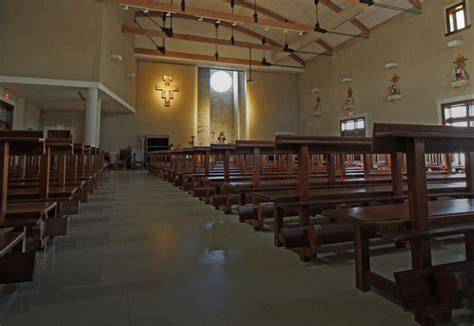
The National Centre for Padre Pio is a scenic spiritual destination honoring one of the most beloved Saints of our time. Padre Pio led a life devoted to his work on the Altar and in the Confessional, embracing his role as a spiritual teacher to all.
On grounds that are beautifully modeled after his friary in San Giovanni Rotondo, Italy, visitors to the National Centre are immersed in Padre Pio’s powerful faith and the setting of his humble life.
In our Museum & Cultural Center, we bring his story to life with the largest collection of authentic Padre Pio relics in the United States. Pilgrims can also visit Our Lady of Grace Chapel, a historically accurate Franciscan site based on Padre Pio’s own church.
Padre Pio is many things to many people: a priest, a teacher, a mystic, a saint, and a friend.
Hospital and Service to the Sick
Padre Pio used his newfound popularity to open a hospital in San Giovanni Rotondo. The facility opened in 1956.
Padre Pio’s legacy continues to inspire millions worldwide, and his life’s work includes the building of a hospital in San Giovanni Rotondo, Italy, the town where he served most of his life and also died.
Death and Canonization
Padre Pio died on September 23, 1968. His funeral was attended by over 100,000 people.
Pope John Paul II recognized Padre Pio as a saint on June 16, 2002. Pope St. John Paul II canonized him a saint in 2002, and the faithful continue to flock to his gravesite, seeking his intercession and learning from his faithful witness.
St. Padre Pio’s feast day is celebrated on September 23 each year.
Padre Pio’s Continuing Legacy
Padre Pio’s legacy continues to inspire millions worldwide. The Shrine of St. Padre Pio receives eight million pilgrims each year, second only to the Basilica of Our Lady of Guadalupe in Mexico City.
Many films and documentaries have presented Padre Pio’s remarkable life. One notable movie is Padre Pio: Miracle Man, with Sergio Castellito giving an outstanding performance in the title role.
His dedication to Jesus through prayer, his miraculous stigmata, and his profound spiritual teachings continue to touch the lives of believers and non-believers alike, offering solace in our troubled modern world.
Despite undergoing many hardships, sufferings, and suspicion from Church officials, Padre Pio never wavered in his faith. St. Padre Pio remains a beacon of faith and a model of total surrender to Christ in the modern world.
The Extraordinary Life of Padre Pio - The Origins and The Stigmata
Key Dates in the Life of Padre Pio
| Year or date | Event |
|---|---|
| May 25, 1887 | St. Padre Pio was born Francesco Forgione in Pietrelcina, Italy. |
| 1897 | Francisco expressed to his parents that he wanted to become a friar. |
| Age 15 | Francisco entered the novitiate of the Capuchin friars at Morcone and took the name Pio. |
| 1910 | Brother Pio became a priest. |
| March 1916 | He was finally dismissed from military service because of his poor health. |
| September 20, 1918 | The stigmata appeared on his hands, feet, and side. |
| 1934 | The Vatican again allowed Padre Pio to perform public duties. |
| 1947 | Fr. Karol Wojtyla visited Padre Pio. |
| 1956 | The hospital in San Giovanni Rotondo opened. |
| September 23, 1968 | Padre Pio died. |
| June 16, 2002 | Pope John Paul II recognized Padre Pio as a saint. |