St. Thomas Cathedral Basilica, a magnificent church located in Mylapore, Chennai, stands as a testament to centuries of history, faith, and architectural splendor. This revered site marks the burial place of Thomas the Apostle, who brought Christianity to India.
Saint Thomas the Apostle died in St. Thomas Mount and was buried in Mylapore, over which the first tomb was raised. St. Thomas Cathedral Basilica stands as a monumental symbol of the spread of Christianity in India, marking the final resting place of Thomas the Apostle.
Origins and the Portuguese Foundation
Thomas sailed to Malabar, the southwestern region of the Indian subcontinent, in AD 52 to spread the Good News, making him the first to introduce Christianity in India. He died in Chennai (formerly Madras) a martyr in AD 72.
The church, originally founded by Portuguese explorers in 1523, has evolved through various phases of construction and renovation, reflecting the rich tapestry of its historical and religious significance. Portuguese missionaries arrived to Mylapore, and constructed the church funded by John III.
This magnificent church was built over the tomb of Thomas the Apostle, who died in Chennai and whose body was buried in Mylapore. First, the Portuguese searched for the remains of Thomas. Then they built a church over it. They built a church in his honor.
Portuguese explorers founded it in 1523 after sailing to India following Vasco de Gama's discovery of a sea route in the 15th century AD, which contributed to the further spread of Christianity in the Indian subcontinent.
Thomas the Apostle and the Sacred Tomb
The exact place where St. Thomas was buried is marked by the second small tower in the center of the cathedral. One of the chapels was built below the ground; it houses Thomas' tomb.
The small Mount St. Thomas Church stands on a small hill over a cave near the cathedral. Thomas hid himself in this place after he was attacked with a spear. He escaped to another hill, known as St. Thomas Mount, through the cave opening.
The cathedral has a museum to keep religious collections safe. This museum houses the lance head that took Thomas' life. The church houses the bones of St Thomas, the spearhead used to kill him, and the relics of St Francis Xavier and St Bartholomew the Apostle.
Also known as Doubting Thomas, Thomas is mentioned in the historical traditions of churches in Southeast Asia and the Middle East as the evangelist who established their churches. In the books and traditions of the Syrian Christians of India, Thomas was mentioned to have traveled to China, then back to India.
The German Protestant theologian and writer Kurt E. Koch believed Thomas sailed to Indonesia with Indian traders. Thomas is the patron saint of India. His feast is celebrated on July 3 as Christians' Day in India.
Pilgrims and Early Visitors
Marco Polo, the famous Venetian explorer, merchant, and writer, visited this tomb in 1292. He wrote in his travel diary: "The Christians who go thither in pilgrimage take of the earth from the place where the saint was killed (or buried) and give a portion thereof to anyone who is sick of a quartan or a tertian fever; and by the power of God and of St. Thomas, the sick man is incontinently cured."
1291-John of Montecorvino visited the tomb in Mylapore. 1292-Marco Polo visited the tomb. 1545-Saint Francis Xavier visited Santhome Church.
St. Francis Xavier also lived in the presbytery of the old version of this church in 1545, before he sailed to Taiwan (formerly Ilha Formosa, which means 'beautiful island' in the Portuguese tongue) for a mission. Francis was heavily involved in the Catholic missions in Portuguese India, and he led the first mission to Japan.
Cathedral Status and Reconstruction
Pope Paul V elevated the church to the status of a cathedral in 1606. Pope Paul V also created the Diocese of St. Thomas of Mylapore.
British rule led to the reconstruction of the church in 1896. Da Silva, the first bishop of the Archdiocese of India, consecrated the church in 1896.
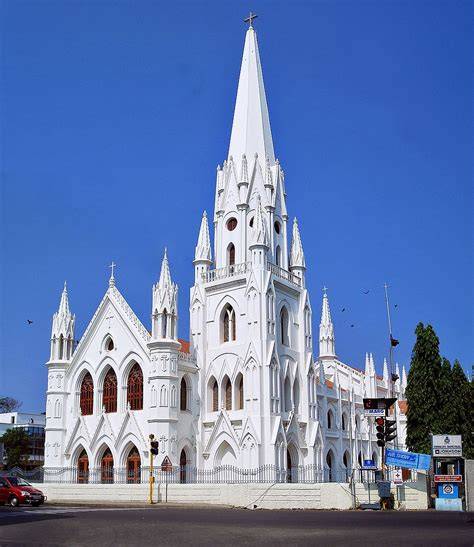
Later this church was rebuilt with a status of cathedral in 1896 by British in late 19th century style as Gothic Revival architecture. The British version still stands today.
In 1954, Pope Pius XII elevated the church to the status of basilica minor. Pope Paul II visited this church in 1986. In 2006, the church was declared national shrine by the Catholic Conference Bishops of India.
The church was extended as National Shrine in 2004 by Catholic Bishops' Conference of India and architecturally restored. Also known as Santhome Church, this cathedral is one of the only three churches built over the tomb of an apostle.
Neo-Gothic Architecture
The architects gave it a neo-Gothic design. This church was rebuilt as a church with the status of a cathedral by the British. It was designed in Neo-Gothic style, favoured by British architects in the late 19th century.
Two spires support the cathedral. The one with a higher elevation-183 feet tall-is located on the left side of the church's entrance. This spire, visible from a distance, serves as a guide for locating the cathedral. At the same time, it is the church's bell tower.
The other spire was built, rising from the center of the cathedral. Its position tells the people where Thomas' tomb is located below.
Known as St. Thomas Cathedral Basilica, Teak wood was harnessed in the construction of its vault ceiling, providing the classic dark texture. Sixteen windows ventilate the interior.
One of the 34 stained glass panels depicts Thomas touching Christ's wound. This particular stained glass panel is located over the altar. Other stained glass panels depict the apostles.
On the main altar, there is an image of Christ. The church's nave measures 122 feet long and 33 feet wide.
The Tomb Chapel, Museum and Theater
Following modern renovations, this church also boasts two chapels. One of the chapels was built below the ground; it houses Thomas' tomb.
The cathedral has a museum to keep religious collections safe. This museum houses the lance head that took Thomas' life.
The cathedral also has a small theater. In this theater, a film narrates the life of an apostle.
Three Apostle-Tomb Churches
San Thome Church is one of the three known churches in the world built over the tomb of an apostle of Jesus that are still standing today, the other two being St Peter's Basilica in Vatican City and Santiago de Compostela Cathedral in Galicia, Spain.
The one is the St. Peter's Basilica in Rome (over the tomb of St.Peter); the other in the Santiago de Compostela Cathedral in Spain (over the tomb of St. James).
In antiquity, there was a basilica built over the tomb of the Apostle Philip in Hierapolis of Phrygia, near modern day Pamukkale.
| Church | Location | Apostolic tomb |
|---|---|---|
| St. Thomas Cathedral Basilica | Mylapore, Chennai, India | Thomas the Apostle |
| St. Peter's Basilica | Vatican City | St. Peter |
| Santiago de Compostela Cathedral | Galicia, Spain | St. James |
Relics, Memorials and Religious Collections
The cathedral's collections and monuments preserve several layers of Christian and regional history. The church houses the bones of St Thomas, the spearhead used to kill him, and the relics of St Francis Xavier and St Bartholomew the Apostle.
St. Francis Xavier's connection with the church adds another important chapter to its religious history. St. Francis Xavier also lived in the presbytery of the old version of this church in 1545, before he sailed to Taiwan (formerly Ilha Formosa, which means 'beautiful island' in the Portuguese tongue) for a mission.
The museum and the underground chapel connect the cathedral's architectural form with the devotional traditions associated with Thomas's martyrdom and burial.
San Thome as a National Shrine
Also known as Santhome Church, this cathedral is one of the only three churches built over the tomb of an apostle. In 2006, the church was declared national shrine by the Catholic Conference Bishops of India.
The church was extended as National Shrine in 2004 by Catholic Bishops' Conference of India and architecturally restored. Its status as a basilica minor and national shrine reflects both its religious importance and its continuing role as a destination for pilgrims and visitors.
St. Thomas Cathedral Basilica stands as a monumental symbol of the spread of Christianity in India, marking the final resting place of Thomas the Apostle. From its Portuguese origins to its British architectural influences and modern-day recognition, the church embodies a rich historical legacy.
The Incredible Story of Santhome Cathedral Basilica
The Separate St. Thomas Cathedral in Mumbai
St Thomas's Cathedral is the oldest British house of worship in India. A Grade I heritage building, it gives its name to the surrounding area (Churchgate) and stands at Mumbai's "zero point," that is, the point from which all distances to and from the city are measured.
This information comes from the signboard outside the cathedral. The equivalent spot in London is the monument at Charing Cross, first erected there in the late thirteenth century.
The Mumbai cathedral is a separate historic building from St. Thomas Cathedral Basilica in Mylapore, Chennai. Its history belongs to the British presence in Bombay, while the San Thome Basilica in Chennai is associated with the tomb of Thomas the Apostle.
Origins in the East India Company Period
Few buildings in India put us more directly in touch with the East India Company's early years there. The first governor of Bombay (as it was known then), Sir John Oxinden, had been keen to attend to the religious needs of his men, and building work began under the next governor, Gerald Aungier: the first foundation stone was laid in 1676.
After this work had stalled, another was laid in 1715, as a direct result of a powerful sermon by the Chaplain in Bombay, the Rev. Richard Cobbe. Funded by charitable donations, the church building was finally completed in December 1718, and inaugurated on Christmas Day that year.
Edward Eastwick's nineteenth-century account of St Thomas's picks up the story, explaining that it "stands in the Fort, close to the Green," and having been built largely as a garrison church, was "made a cathedral on the establishment of the See of Bombay, in 1833, on which occasion the only change in the structure was the conversion of the low belfry into a high tower, which was done at the expense of the E.I.C." (123).
Original Design and Interior Arrangement
As Eastwick goes on to explain, "[T]he plan is simple; the columns approach the Tuscan, the roof is vaulted, and the whole building is of stone. The body of the church is roomy, but there is no gallery" (123).
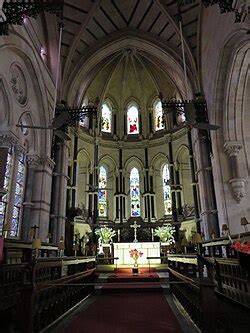
From the church website we also learn that the three arches of the vaulted roof are "supported by two pillars and pilasters on each side," and that the arrangement at the east, with the semi-dome of the apse, and the communion table reached by three steps, is similar to that of St Paul's in London; also that the church "was planned to hold a congregation of 1,000 people.”
The interior includes a nave leading towards the chancel, a vaulted roof, a semi-dome of the apse, and a communion table reached by three steps. The building's stone construction and Tuscan-influenced columns express the restrained character of its original design.
Victorian Extension and Gothic Revival Influence
Like so many other churches, Bombay Cathedral was extended and restored during the Victorian period, most notably by having "the grand eastern wing" added during the 1860s.
Grand it may be, but, unfortunately for purists, it is in Gothic Revival style, in contrast to the neo-classical style of the original. This was not down to sheer thoughtlessness, as Jan Morris suggests (29), but because James Trubshawe (architect of nearby Elphinstone College) had envisaged a total rebuild.
The plan seems to have been fraught from the beginning, and, as so often, funds ran out. The Bombay Builder of 5 August 1865 foresaw the resultant mismatch: "Were it not now too late, we might enlarge upon the absurdity of attempting to convert the present Cathedral into a perfect Gothic structure" (2).
While the church website maintains that the "multiple additions and alterations" made to the fabric have always "respected the integrity of the previous designs," architectural historians have thought otherwise, Philip Davies, for example, finding the "apsed chancel . curiously incongruent" (164).
Be that as it may, the Cathedral is still impressive and still thriving. Its congregation is now best characterised as "protestant cross denominational," since in 1970 "the Anglican Church (Church of England) joined the Union of the Church of North India along with other Protestant Churches" ("History").
Stained Glass, Metalwork and Memorials in Mumbai
Stained glass windows, by important British designers like Henry Holiday (in the apse) and Charles Eamer Kempe, are among the glories of this Cathedral.
These five lancet windows were installed by the Royal Engineers in memory of fallen comrades. The cathedral also contains notable metalwork, including a chancel gate and a brass lectern standing on tiny stone lions.
The eagle is a symbol of St John, and the lions of St Mark. The tessellated pavement is dedicated to Archdeacon Fletcher (1802-1867), who had "spearheaded" the restoration project of the 1860s.
Monuments Connected with Bombay History
St Thomas's also receives many visitors, drawn in particular by its wealth of impressive memorials to figures connected with East India Company history in this region.
Ismat Tahseen picks out the remarkable one by the sculptor John Bacon the Younger, celebrating (in the words of the inscription) the "early fame and . patriot valour" of Captain Hardinge, who died in a naval engagement off the coast; another, by Charles Peart, recalls the heroic young Lieutenant-Colonel John Campbell, who acquitted himself heroically in the Siege of Mangalore only to fall ill and die in Bombay.
Such memorials, as Tahseen says, "give an immediate, anecdotal flavour of life and death in British Bombay."
But perhaps the most touching is the one shown above, also by John Bacon the Younger, paid for by local people, to an administrator rather than an officer: the Hon. Jonathan Duncan, Governor of Bombay from 1795-1811.
A Hindu mourns and hangs his head by the urn, on which the female figure of Justice writes, "He was a good man and a just." Despite having developed a warm respect for Indian culture, Duncan did his utmost to repress both slavery and infanticide.
He was, apparently, exploited by less scrupulous administrators, but the words just written on the funeral urn seem fully deserved.
- Monument to Captain Hardinge
- Monument to Lt.-Col. John Campbell
- Monument to Lt.-Col. John Nugent
- Monument to the Crew of the Cleopatra, a steamship with Indian convicts bound for Singapore
- Memorial to the Hon. Jonathan Duncan, Governor of Bombay from 1795-1811
Architectural and Cultural Significance
The two cathedrals associated with the name of St. Thomas represent different historical contexts. The San Thome Basilica in Chennai is a Portuguese-founded Catholic shrine built over the tomb of Thomas the Apostle, while St Thomas's Cathedral in Mumbai is a British-era house of worship shaped by East India Company history.
The Chennai basilica combines apostolic tradition, Portuguese origins, British Gothic Revival architecture, an underground tomb chapel, relics, stained glass, and the status of a national shrine. The Mumbai cathedral combines a seventeenth- and eighteenth-century foundation, a stone vaulted interior, Victorian restoration, Gothic Revival additions, stained glass, metalwork, and memorials connected with colonial Bombay.
As one of only three churches built over the tomb of an apostle, St. Thomas Cathedral Basilica in Chennai continues to attract pilgrims and visitors, celebrating its enduring spiritual and cultural significance.