The Gospel accounts of Jesus healing blind men present physical restoration as a sign of his messianic identity, compassionate attention to suffering, and authority over both bodily illness and spiritual blindness. In Matthew 9:27-31, two blind men follow Jesus, call him the “Son of David,” confess their faith, and receive sight. In Mark 8:22-26, Jesus heals a blind man at Bethsaida in two stages, using the miracle to illuminate the disciples’ gradual understanding. In John 9, Jesus heals a man blind from birth, rejects the assumption that his blindness resulted from a specific sin, and leads him toward spiritual sight and worship.
These stories must not be reduced to the idea that disabled people are merely broken objects who need fixing. The blind men and the man born blind are active participants whose voices, faith, agency, suffering, and witness remain central after the miracles. Jesus sees people with disabilities, moves toward them, respects their agency, and grants them a share in God’s salvific mission.
The Main Biblical Accounts
Two Blind Men: Matthew 9:27-31
“As Jesus went on from there, two blind men followed Him, crying out, ‘Have mercy on us, Son of David!’ When He entered the house, the blind men came up to Him, and Jesus said to them, ‘Do you believe that I am able to do this?’ They said to Him, ‘Yes, Lord.’ Then He touched their eyes, saying, ‘It shall be done to you according to your faith.’ And their eyes were opened.”
The account is short, but every part of it is significant. The men follow Jesus, cry out for mercy, identify him as the “Son of David,” answer his question with a simple confession of faith, and receive sight when he touches their eyes. Jesus then sternly warns them not to tell anyone, but they go out and spread the news about him throughout the land.
The phrase “Son of David” is a rich messianic title. The two blind men were openly recognizing Jesus as the Messiah. Their sole appeal was to mercy. There was no talk about merit, no pleading of their past sufferings, or their persevering endeavors, or their resolves for the future; but, “Have mercy on us.”
The phrase “have mercy” is eleeo in the Greek and in this case the best definition is to help one who is afflicted. The men did not approach Jesus as people demanding a right. They came as sufferers asking for compassionate help.
The Blind Man at Bethsaida: Mark 8:22-26
“And they came to Bethsaida. And they brought a blind man to Jesus and implored Him to touch him. So taking the blind man by the hand, He brought him out of the village; and after spitting on his eyes and laying His hands on him, He asked him, ‘Do you see anything?’ And the blind man looked up and said, ‘I see men, for I see them like trees, walking around.’ Then again Jesus laid His hands on his eyes; and he looked intently and was restored, and began to see everything clearly. And Jesus sent him to his home, saying, ‘Do not even enter the village.’”
The healing of the blind man at Bethsaida is radically different from the other miracles Jesus performs, in that it explicitly takes place in two stages. After Jesus’ first touch, the man could see partially, but human beings appeared like trees walking around. It is only after the second touch that the man was able to “see everything clearly.”
The miracle is deliberately placed between Jesus’ frustration with the disciples’ failure to understand and Peter’s declaration, “You are the Messiah!” The healing of the blind man bridges between the disciples’ partial spiritual perception and their emerging recognition of Jesus’ identity.
The stories in Mark are deliberately placed. The event before us today comes in Mark 8:22-26, the healing of the blind man in Bethsaida. The healing of the blind man bridges between the disciples’ “brain deadness” as to Jesus’ identity and Peter’s grandiose proclamation in verse 29, “You are the Messiah!”
The miracle is not merely another act of compassion. The healing of blindness speaks directly to Jesus as the Messiah sent by God. The sequence of stories in Mark’s Gospel is deliberate, not by chance. The healing of the Bethsaida blind man becomes the foundation of Peter’s bold declaration: “You are the Christ, the Messiah.”
The Man Born Blind: John 9
John 9 begins with a man who had been blind from birth: “As he passed by, he saw a man blind from birth.” He was a man now, but he had been born blind. He was also a beggar, because his parents were no longer able to care for him, and his neighbors remembered him as the man who used to sit and beg.
The disciples asked Jesus, “Rabbi, who sinned, this man or his parents, that he was born blind?” Their question reflected a widespread assumption that blindness was a punishment for sin. Jesus rejected the categories they were using: “It was not that this man sinned, or his parents, but that the works of God might be displayed in him.”
Jesus then declared, “I am the light of the world,” made mud with saliva, placed it on the man’s eyes, and told him to wash in the pool of Siloam. The man went, washed, and returned seeing.
The miracle did not end when the man received sight. His neighbors questioned him, the Pharisees interrogated him, and the religious leaders rejected his testimony. He was eventually thrown out of the synagogue. Jesus found him and asked whether he believed in the Son of Man. When Jesus revealed his identity, the man replied, “Lord, I believe,” and worshiped him.
| Account | Text | Distinctive features | Central emphasis |
|---|---|---|---|
| Two blind men | Matthew 9:27-31 | They follow Jesus, ask for mercy, confess him as the Son of David, and are healed by his touch. | Messianic faith, mercy, persistence, and obedience. |
| Blind man at Bethsaida | Mark 8:22-26 | Jesus leads him away from the crowd and heals him in two stages. | Compassion and the disciples’ gradual spiritual understanding. |
| Man born blind | John 9 | Jesus rejects the assumption of specific personal guilt and gives the man physical and spiritual sight. | God’s works, agency, witness, judgment, and the contrast between seeing and spiritual blindness. |
| Bartimaeus | Mark 10:46-52; Luke 18:35-43 | He cries out, “Jesus, Son of David, have mercy on me,” receives sight, and follows Jesus. | Personal and persistent faith, recognition of Jesus as Savior and Lord. |
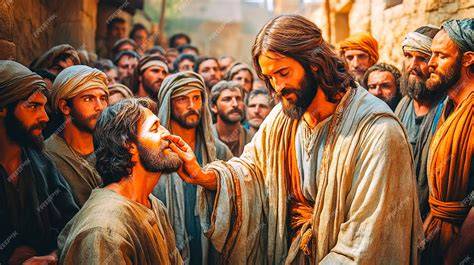
Why Blindness Is So Important in the Gospels
Blindness was, sadly, a fairly common condition in Biblical times, with causes from poor hygiene and bacterial or parasite infections to cataracts, glaucoma, and genetic causes. As in most cultures, blindness intensifies poverty and increases insecurities and social isolation.
In Jesus’ day, to be blind was considered to be a curse from God. To be blind had stark theological issues. To be blind was right up there with those that had leprosy-untouchable and cursed.
That is why the disciples asked Jesus in John 9, while looking at a blind man, “Who sinned? This man or his parents?” The question was real, but Jesus refused to treat the man’s disability as evidence of a particular moral failure.
Every physical miracle that Jesus performed in the New Testament teaches that Jesus Christ is the Messiah who was promised in the Old Testament. The New Testament records more cases of Jesus healing the blind than any other disease. In the Old Testament there is not a single account of a blind person being healed.
One of the signs of the Messiah was that he would open blind eyes: “Then the eyes of the blind shall be opened, and the ears of the deaf shall be unstopped.” Jesus giving sight to the blind was proof-positive that he was the Messiah.
When John the Baptist sent his disciples to ask Jesus whether he was the expected one, Jesus told them to report what they heard and saw: “The blind receive sight.” Jesus said that one of the great marks of his identity was rooted in the fact that the blind got their sight back in real time.
Jesus Sees and Moves Toward People With Disabilities
John 9 does not begin with the disciples seeing the blind man. It begins with Jesus seeing him: “As he passed by, he saw a man blind from birth.” The disciples became engaged because Jesus was engaged.
Children, young people, and adults should see people with disabilities. This does not mean seeing them like the priest and the Levite on the Jericho Road, passing by on the other side. The natural reflex is to see and avoid. But followers of Jesus have been seen and touched in all their brokenness by an attentive, merciful Savior.
If you want to be one of the most remarkable kinds of human beings on the planet-a Jesus kind-see people with disabilities. See them. And move toward them. God will show you what to say.
Jesus’ treatment of the blind man at Bethsaida illustrates this attention. When the community brought the man to him, Jesus took him by the hand and led him away from the village and the crowd. He did not turn the man into a public spectacle.
Jesus knows the scorn directed toward the blind. He sees past disdain, touches the man, and leads him away from the crowd’s peering eyes into his inner circle with his disciples. The man was already an outcast and did not need more community pressure.
Jesus Redeems Awkward and Insensitive Moments
The disciples’ question in John 9 was probably not the most compassionate thing to say at the moment. People will make ill-informed and insensitive comments about disability, and they will sometimes cause pain without understanding the situation.
Jesus is merciful, and he redeems awkward moments and callous words. In John 9, he answers the disciples’ question, but not within the categories they are using.
The disciples ask for an explanation in the category of cause: What happened in the past that caused the blindness? Was it the man’s sin or his parents’ sin? Jesus gives an explanation in the category of purpose: What might God display through this man’s life?
Jesus says that specific sins in the past do not always correlate with specific suffering in the present. The decisive explanation for this blindness is not found by looking for its cause but by looking for its purpose.
Specific Suffering Is Not Proof of Specific Sin
The point Jesus is making is not that suffering did not come into the world because of sin. It did. If there never had been sin, there never would have been suffering.
But Jesus is not saying that the man’s blindness resulted from a specific sin committed by the man or his parents. Specific suffering is often-not necessarily always, but often-not owing to specific sin.
The existence of sin in the world is the cause of suffering in the world, but specific sins in the world are usually not the cause of specific sufferings in the world. This distinction is crucial for pastoral care, theological reflection, and the treatment of people with disabilities.
Jesus says, “It was not that this man sinned, or his parents.” In other words, this blindness-this specific suffering-is not owing to the specific sins of the parents or the man. Do not look there for the explanation.
Then Jesus tells the disciples where to look: “It was not that this man sinned, or his parents, but that the works of God might be displayed in him.” The explanation of the blindness lies not in the past causes but in the future purposes.
God’s Purposes and the Question of Disability
Some pastors and teachers dislike intensely the idea that God might will that a child be born blind so that some purpose of God might be achieved. One attempt to escape the teaching of John 9 is to say that Jesus is pointing only to the result of the blindness, not the purpose of the blindness.
However, the disciples are asking for an explanation of the blindness, and Jesus’ answer is given as an explanation of the blindness. If God had no purpose, plan, or design in the blindness but simply found the blindness later and used it, that would not answer the disciples’ question, “Why is he blind?”
Jesus really does give an answer: there is purpose in it, there is divine design, and God means for his work to be displayed in him.
God knows all things. When there is a defective chromosome or some genetic irregularity in the sperm that is about to fertilize an egg, God can simply say no. He commands the winds, the waves, the sperm, and the genetic makeup of the egg.
If God foresees and permits a conception that he knows will produce blindness, he has reasons for this permission. Those reasons are his purposes, his designs, and his plans. God never has met a child from whom he had no plan. There are no accidents in God’s mind or hands.
Exodus 4:11 says, “The Lord said to Moses, ‘Who has made man’s mouth? Who makes him mute, or deaf, or seeing, or blind? Is it not I, the Lord?’” Psalm 139:13 says, “You formed my inward parts; you knitted me together in my mother’s womb.”
The meaning of Jesus in John 9:3 is not obscure. He is telling the disciples to turn away from a fixation on causality as the decisive explanation of suffering. He is also telling them to turn away from futility, absurdity, chaos, and meaninglessness, and to turn toward the purposes and plans of God.
There is no child and no suffering outside God’s purposes. This is not the whole explanation of suffering in the Bible, because there are dozens of other relevant passages and important points. But this passage and this point are massively important.
Disability, Agency, and the Danger of Ableist Readings
In the popular story in John 9, Jesus’ disciples assume that something has gone wrong with the man born blind upon encountering him. Readers often make the same mistake. When focusing exclusively on Jesus as a noble healer, they often assume that disabled people need or want healing because they are broken and need fixing.
Thankfully, Jesus does not share such assumptions. It is dangerous and harmful to assume that the lives of those with ability-differences are painful and meaningless.
Such a reading establishes incorrect dichotomies: the opposite of illness is assumed to be health, and the opposite of impairment is assumed to be the normal body. Normality is a social construction of acceptable or unacceptable deviation.
To take a step toward a positive reading of the healing story requires us to see the story as more than just a healing. When we examine the relationship between Jesus and the man born blind and the comparison between the spaces they respectively take up, we see that Jesus’ interaction with the man is inherently uplifting.
Jesus not only respects the man’s agency; he also grants him a share in God’s salvific mission. The story can avoid ableist interpretations because Jesus subverts expectations: the story is not all about him, because he is largely absent.
This is significant because it embodies the crucial theme of believing without seeing. In typical Gospel miracle stories, Jesus is present throughout the whole narrative, since they are meant to draw the reader’s attention to Jesus, not to the people being healed.
John 9:8-9 in particular draws the reader’s attention to the reaction of the man’s neighbors, demonstrating that the story’s attention is now on the man, who is not a mere object of the miraculous cure that furthers the plot. The author’s interest in him continues after the miracle has happened.
Many people with disabilities do not wish to be healed at all. The man born blind in John 9 does not ask Jesus for healing, but takes control of understanding Jesus’ messianic identity through being fully attentive to what has happened to him.
He is stern in his responses to the doubters and religious authorities when facing their interrogation and intimidation. His lived experience is not erased by the miracle; instead, it becomes the basis of his testimony.
The Man Born Blind as a Disciple and Witness
The story grants the blind man discipleship and agency in a dramatic way. He receives discipleship not because he is blind or because he needs to be fixed. Rather, Jesus sees him and chooses him, and he has the agency to accept the invitation or to decline.
The man’s faith is rooted in Jesus’ word, not in the healing. It is only through his conversation with the synagogue leaders that he comes to recognize Jesus’ identity.
When he is brought to the Pharisees and questioned about the identity of the one who opens his eyes, he first responds that Jesus was a prophet. Through further interrogations, he senses the Pharisees’ anxiety and preoccupation with Jesus’ identity, which sends him back to Jesus to learn for himself.
Upon hearing Jesus’ confirmation that he is the Son of Man, the man comes to firmly believe. No further question is asked. Interestingly, it is the Pharisees who call the man a disciple of Jesus before he claims such an identity for himself.
His faith is intensified by understanding, not seeing. The story’s focus moves from physical sight to discernment, testimony, courage, and worship.
The Blind Man’s Parallel With Jesus
The most telling aspect of John 9 is that the blind man parallels Christ in significant ways. Jesus is “the sent one” or “the anointed one,” while the man is sent to wash in Siloam.
Jesus is the incarnation of God who comes to reveal the truth, while the man is born to manifest the work of God. Both have disputed origins or birth, and both have their true identity doubted.
Both are divisive figures in the community and are rejected by their own people. Both employ the plural “we” in John 9:4 and 9:31. Both are regarded as sinners, yet both reject the polemical use of the term “sin.” Both are reviled by community leaders, and both provoke crises between believers and non-believers.
The most striking parallel is the interrogation of the blind man by the Jewish leaders. He is first interrogated by seemingly well-disposed neighbors, who then take him to the Pharisees to gain a better grip on the matter.
These religious elites cannot come to a firm judgment about his witness. With the non-believers perplexed, the man offers very short responses, refuses to exaggerate, and does not hog the limelight-much like Jesus at his trial.
He refuses to testify to anything except what he has seen and heard, just like Jesus throughout the Gospel. At the end, the man is elevated from a defendant to a judge who astonishes the authorities into shame and silence.
They are condemned out of their own mouths and according to their own laws, again resembling the way Jesus reverses his role with Pilate in the Passion narrative.
The Meaning of “I Am” in John 9:9
The man is also able to boldly claim this identity for himself, stating “I am” in verse 9. “I am” statements have special importance in the Gospel of John and occur 24 times in the text.
Fourteen of these have predicates, and ten do not. Out of these ten “I am” statements, nine come from Jesus, except the one from John 9:9, and nine of these signify or suggest divine identity.
The phrase “I am” is likely drawn from Exodus 3 and functions as a divine name. Therefore, when the man “anointed” and “sent” by Jesus responds with “I am,” it is very likely that it means more than simply “that is me.”
Hearing, Following, and the Reversal of Rejection
The intense intra-communal conflict in John 9 foreshadows Jesus’ promises of care and protection in John 10. Jesus says that when the gatekeeper has brought out all his own, he goes ahead of them, and the sheep follow him because they know his voice.
Once again, Jesus puts the emphasis of discipleship on hearing and following, not on the basis of sight. The word for “brought out” in John 10:4 and the word for “thrown out,” which is what happened to the man in John 9:35, are both ekballō.
Thus, the man born blind becomes a figure who represents the sheep in a unified flock. This theme of reversal draws a connection between the promises of persecution and protection: the social outcast now becomes the substitute for the Son of God.
The man’s rejection does not remove him from God’s mission. Instead, his exclusion becomes the setting in which Jesus finds him, reveals himself to him, and receives his worship.
Compassion in the Healing at Bethsaida
The healing at Bethsaida displays the compassion of Jesus. When the blind man is brought to Jesus by the community, Jesus takes him by the hand and leads him away from the crowd’s attention.
The term “touched” is related to the English word “sympathy.” It does not signify a sympathetic understanding that is ready to condone, but a relationship that derives from full acquaintance with the seriousness of the situation.
Hebrews 4:15 says that we do not have a high priest who cannot be touched with the feeling of our infirmities, but one who has been tempted like us, yet without sin. Jesus’ compassion and sympathy were clearly seen in his interaction with those among whom he moved during his earthly ministry.
Because his heart is immersed in compassion, he steps into our struggles, feels our hurts, and hears our cries. When we are afflicted with disease and pain, he cares. When we are grieving the loss of dear ones, he cares. When we are confused and desperately need leadership, he has compassion for us.
When we are mistreated, he feels for us. When we fall into the mire of sin, he grieves over that disaster. Even when people hatefully oppose him, he continues to feel for them.
Why Jesus Used Touch, Spit, Mud, and the Pool
In Bethsaida, Jesus leads the man outside the village, spits on his eyes, lays his hands on him, and asks whether he sees anything. This appears unusual and even disturbing, but Jesus never does anything randomly. He is always intentional.
No one knows with certainty why Jesus used spit. Suggestions range from the belief in that day that saliva had some kind of healing power to the possibility that it symbolized to the blind man that healing was coming.
Jesus’ spit had no healing power. By touching the man with his hands, Jesus removed the man’s social hopelessness and treated him with personal attention.
In John 9, Jesus could have spoken a word to heal, but this time used dirt and saliva to cover the blind eyes. He then told the man to wash off the dirt in the pool of Siloam.
Why did Jesus not heal him right where he stood? Why make him go to the pool? The text does not answer every question, but the man went, washed, and came home seeing.
The act of washing emphasizes trust and participation. The man did not merely become an object of a miracle; he responded to Jesus’ instruction and became an active participant in the event.
The Two-Stage Healing and Spiritual Perception
The two stages of the Bethsaida miracle are especially important in Mark’s narrative. After the first touch, the man’s vision is partial. After the second touch, he sees everything clearly.
Mark uses this physical process as a metaphor for the disciples’ spiritual condition. They have witnessed Jesus’ marvelous acts, yet they do not fully understand who he is or trust him to provide for their needs.
Jesus asks them, “Do you still not perceive or understand? Do you have eyes, and fail to see?” The key words-perceive, understand, eyes, and see-connect the disciples’ lack of understanding with the blind man’s healing.
The disciples’ vision is still partial. They cannot distinguish adequately between Jesus the teacher, Jesus the miracle worker, and Jesus the Savior, even though they have been called to be with him and have been entrusted with the mysteries of the kingdom.
The gradual healing therefore provides a picture of discipleship. Understanding may develop progressively, and partial perception is not the same as complete spiritual clarity.
Physical Blindness and Spiritual Blindness
Jesus says in John 9:39, “I came into this world, so that those who do not see may see.” The physical healing points beyond the eyes of the body to the eyes of the soul.
It is possible to see physically and still be spiritually blind. The Pharisees have physical sight, religious knowledge, and social authority, yet they refuse to recognize the work of God in Jesus.
Jesus gives an important truth: the physical healing of the blind symbolized the need for spiritual healing from sin’s darkness. The blind man’s physical healing led to seeing the truth of Jesus, giving spiritual sight, and worshiping him.
The contrast is not between disabled people and healthy people. The contrast is between those who recognize their need and those who claim they can see while refusing the light.
The saddest person in the world is not the person who is blind and cannot see, but the person who is blind and thinks he can see. Multitudes are blind to their darkness, blind to their sin, blind to their destiny, blind to their hopelessness, and spiritually out of touch.
The first step to receiving spiritual sight is to admit that you are spiritually blind. The blind man saw his need for physical sight and his need for a Savior.
Without the work of the Holy Spirit, people fail to see how spiritually blind and sinful they are and how much they need the grace of God. “The god of this world has blinded the minds of the unbelievers, to keep them from seeing the light of the gospel of the glory of Christ.”
God, who commanded light to shine out of darkness, shines in human hearts to give the light of the knowledge of the glory of God in the face of Jesus Christ.
Bartimaeus: What the Blind Man Saw
In Mark 10:46-52 and Luke 18:35-43, Bartimaeus is sitting beside the road in Jericho, begging. Jericho was a place of beauty, fragrances, palm trees, balsam trees, and wealth, but Bartimaeus was physically blind and socially impoverished.
Jesus went through Jericho not to see the sights but to save souls. He saved Bartimaeus on the way into the city and Zacchaeus on the way out of the city.
Bartimaeus, sitting by the roadside and begging, could see more than many of the people following Jesus. When Jesus asked what he wanted, Bartimaeus answered, “Lord, let me receive my sight.”
He was a beggar and needed money, but he did not ask Jesus for money because he knew he had a need greater than money. He saw that his greatest need was to receive his sight.
He also saw his need for a Savior. The rich man’s material wealth prevented him from seeing his spiritual poverty, and he went away unsaved. Bartimaeus would have been much better off as a blind beggar who could see his spiritual poverty than as a wealthy man who could not recognize his need for Christ.
This is what everyone needs to see: the need for Jesus, specifically the need for him to save us from the blindness of sin.
Bartimaeus: What the Blind Man Said
Bartimaeus cried out, “Jesus, Son of David, have mercy on me.” Other people identified Jesus as “Jesus of Nazareth,” but the blind man called him “Son of David.” Though he could not see Jesus with his physical eyes, he knew who Jesus was.
By calling Jesus the “Son of David,” Bartimaeus was declaring him to be the Messiah, the Savior God had promised to send. When Jesus asked him what he wanted, Bartimaeus addressed him as Lord.
This was more than a sign of respect. He was acknowledging Jesus as the supreme authority-the one who has authority over sin, sickness, blindness, and death.
There is no way to separate salvation in Christ from the lordship of Christ. Jesus is both Savior and Lord. To receive him as one is to receive him as the other, for the only Savior is the Lord Jesus Christ.
Personal Faith
Bartimaeus’ faith was personal. He called out to Jesus for salvation, believing that Jesus could give him physical sight and spiritual salvation.
God calls everyone to trust personally in his Son Jesus Christ. No one can place faith in Jesus for someone else.
Personal faith involves knowledge of who Jesus is. It is impossible to have faith in Jesus without knowing who he is and what he has done.
Personal faith involves belief from the heart that Jesus really did die on the cross. Personal faith also involves trust-the volitional dimension of faith, in which a person calls on the Lord and places faith in him as a personal Savior.
There is a difference between faith that believes what is said about God is true and faith that throws itself on God. Personal saving faith rests on Jesus for salvation.
Persistent Faith
Bartimaeus’ faith was persistent. He was sitting beside the road while a great crowd passed by, yet he cried out so loudly that people told him to be quiet.
This was the opportunity of a lifetime. Jesus was passing down the very road beside which he sat, and Bartimaeus was determined to gain his attention.
The people rebuked him and told him to stop. But when someone becomes aware of spiritual need and recognizes Jesus as Savior, many voices may try to stop the cry for mercy.
Satan will try to stop the cry and doom people to destruction. The world may mock the cry for God’s mercy, and the flesh may resist admitting the need for mercy.
The blind man did not allow anyone to stop his cry. His urgency provides a picture of persistent faith: he followed, called out, endured opposition, identified Jesus as Messiah, and continued asking for mercy.
Jesus Stops for the Cry of Mercy
Jesus heard Bartimaeus crying out for mercy, and Jesus stood. “Jesus stood still, and commanded him to be called.”
Jesus was surrounded by a multitude and was on his way to Jerusalem to die on the cross. It was noisy, with people talking and animals making sounds, but the cry of mercy brought him to a halt.
Jesus hears the cry of the desperate heart and the prayers of the needy. His ears are tuned to the cry of a sinner.
Jesus teaches the “art of stopping.” His followers need ears to hear and eyes to see the spiritually blind and hurting around them. They need to stop, tell people about Jesus, and pray with them.
When Jesus called Bartimaeus, the people said, “Be of good comfort, rise; he is calling you.” Jesus called him to get up and come to him.
Responding to Jesus’ Call
When Bartimaeus heard that Jesus was calling him, he threw aside his garment, rose, and came to Jesus. This was an extreme gesture for a blind man, who would normally keep his cloak where he could touch it.
Throwing off his old garment and walking away from it is a picture of repentance. It represents turning away from an old life and coming to Jesus for a new life.
The story calls people to examine what they are holding on to: religious works, church membership, baptism, alcohol, drugs, or ungodly relationships. Jesus came to seek and to save the lost.
Bartimaeus stopped shouting, threw off his beggar’s garment, and came to Jesus. His response combines faith, urgency, action, and surrender.
Faith, Mercy, and Healing
Jesus asks the two blind men in Matthew 9 whether they believe he is able to heal them. They answer, “Yes, Lord.” Their simple faith and persistence lead to their healing, and their eyes are opened.
Jesus says, “It shall be done according to your faith.” This does not mean “in proportion to your faith,” as though a certain quantity of faith automatically produces a corresponding quantity of sight. It means, “Since you believe, your request is granted.”
The faith of the two blind men is worthy of notice. They had the faith to follow Jesus, forsaking other paths and directions. They had the faith to cry out and put their desire into words.
They had the faith to make noise and risk embarrassment. They had the faith to identify Jesus as the Son of David, recognizing him as the Messiah. They had the faith to ask for mercy, knowing they did not deserve healing. They had the faith to believe that Jesus was able to heal them, and they had the faith to say, “Yes, Lord.”
Other accounts also connect healing with faith. Blind Bartimaeus cried out, “Rabbi, I want to see.” Jesus said, “Go, your faith has healed you.” Immediately he received his sight and followed Jesus along the road.
Luke records Jesus saying, “Receive your sight; your faith has healed you,” and immediately the man received his sight and followed Jesus, praising God.
In Matthew 9:27-29, two blind men call out, “Have mercy on us, Son of David!” Jesus touches their eyes and says, “According to your faith let it be done to you.” Their sight is restored.
Faith was essential to the response of those who came to Jesus. Only God, who heals bodies and forgives sins, can do the impossible.
Healing and the Glory of God
John 9:3 says that the man was born blind “that the works of God might be displayed in him.” The purpose of the blindness is to put the work of God on display.
For Jesus, blindness from birth is sufficiently explained by saying that God intends to display some of his glory through this blindness. In this case, the display happens to include healing-the glory of God’s power to heal.
But there is nothing that says the display of God’s work must always take the form of healing. When Paul cried out three times for his thorn in the flesh to be healed, Jesus said, “My grace is sufficient for you, for my power is made perfect in weakness.”
Jesus says, in effect, “I will put my power on display, not by healing you, but by sustaining you.” Healing displays the works of God in John 9, and sustaining grace displays the works of God in 2 Corinthians 12.
What is common in both cases is the supreme value of the glory of God. The blindness is for the glory of God. The thorn in the flesh is for the glory of God. The healing is for his glory, and the non-healing is for his glory.
Suffering can only have ultimate meaning in relation to God. For suffering to have ultimate meaning, God must be supremely valuable-more valuable than health and life.
Many things in the Bible make no sense until God becomes the supreme value. The biblical perspective does not call suffering light or momentary in the subjective experience of the sufferer. Disability is expensive financially, emotionally, and relationally, and it often seems neither light nor momentary.
Yet the promise remains that “this light momentary affliction is preparing for us an eternal weight of glory beyond all comparison.” The Christian hope does not deny the seriousness of disability; it places suffering within the purposes and future glory of God.
Jesus’ Ministry of Healing and Dying
John 9:4 says, “We must work the works of him who sent me while it is day; night is coming, when no one can work.” This means that the works of God referred to in verse 3 will be done through the hands of Jesus.
Jesus is going to heal the man’s blindness. The works of God are the works of Jesus. He must do this quickly because night is coming and his work will be over.
Jesus will turn from a ministry of healing to a ministry of dying. He will turn from the day-work of relieving suffering and do the night-work of suffering himself.
He will finally submit totally to the plan of his Father that the Son be swallowed up by the sin and suffering of the world.
Jesus, the Light of the world, fulfilled the messianic prophecies of bringing freedom for prisoners of darkness and recovery of sight for the blind.
What the Healing Accounts Teach About Jesus
- Jesus is the Messiah. The restoration of sight fulfills the expected messianic sign that the blind would see.
- Jesus is compassionate. He touches sufferers, leads them away from public spectacle, hears their cries, and moves toward their pain.
- Jesus has authority over sickness. He heals through touch, command, mud, saliva, and progressive action.
- Jesus has authority over spiritual blindness. He gives people understanding of his identity and leads them to faith and worship.
- Jesus is Lord. The blind men call him Lord, recognizing his supreme authority over sin, sickness, blindness, and death.
- Jesus’ power is not limited by distance. Across the Gospel accounts, he heals people through presence, touch, command, and faith.
- Jesus does not need a public spectacle. In Bethsaida and in other accounts, he takes individuals away from the crowd and gives personal attention.
- Jesus’ work brings reversal. The marginalized person becomes a witness, while those who claim to see are exposed as spiritually blind.
What the Healing Accounts Teach About Suffering
- Suffering should not automatically be blamed on a specific person’s sin. John 9 directly rejects the disciples’ assumption about the man born blind.
- Disability is not evidence of worthlessness. The man born blind is not a disposable object; he becomes a central witness and participant in God’s mission.
- God has not abandoned people to meaninglessness. Jesus directs attention away from futility and toward the purposes of God.
- Healing is not the only way God displays his work. God may reveal his power through healing or through sustaining grace in weakness.
- Disability does not erase agency. The people who come to Jesus speak, ask, follow, respond, testify, and worship.
- Compassion requires movement. Followers of Jesus are called not merely to notice people with disabilities but to see them and move toward them.
- People with disabilities belong in the center of the church’s life. Everyone, regardless of ability and social location, has potential to share in God’s mission.
What the Healing Accounts Teach About Faith
- Faith recognizes Jesus. The blind men call him the Son of David rather than merely Jesus of Nazareth.
- Faith asks for mercy. The men do not claim entitlement; they appeal to compassion.
- Faith is personal. No one can believe in Jesus on behalf of another person.
- Faith is persistent. Bartimaeus continues calling out despite opposition from the crowd.
- Faith responds to Jesus’ word. The man born blind washes in Siloam, and the man at Bethsaida participates in the process of healing.
- Faith can grow in understanding. The man born blind moves from identifying Jesus as a prophet to worshiping him as Lord.
- Faith follows Jesus. Those who receive sight are not merely healed and dismissed; they follow Jesus and worship God.
- Faith does not require complete physical sight. The man born blind recognizes Jesus through hearing, testimony, and understanding.
The Mission of the Healed and Marginalized
Everyone, regardless of ability and social location, has a potential share in God’s mission. When the blind man becomes the other Christ, he also bears the face of God.
His “sentness” means that, as the man stands in for Christ, he comes to testify to Jesus as Jesus testifies to the Father. Just as Jesus reveals the Father’s salvific plans on earth, the man testifies to Jesus’ salvation.
The man grows into the faith and agency with which God identified God’s very own Son. Therefore, God is to be found in everyone, including those whom society deems under-deserving and marginalized.
The nameless man born blind is the “everyman” in the Gospel of John, a figure with whom everyone, regardless of ability, can and should identify.
“Our being ‘born blind,’ that is, having only the life ‘from below,’ is indeed a grievous situation, but God intends that the Light coming into the world will enlighten every human being, making us children of God born not of human initiative but of God.”
The mission, therefore, is to make space for those with ability-differences by uplifting their agency and imitating them-something the man’s community would not do-so that all shall become children of God.
Why Jesus Warned Some Healed People to Remain Silent
In Matthew 9, Jesus sternly warns the two men, “See that no one knows about this!” Yet they go out and spread the news about him throughout the land.
In Bethsaida, Jesus sends the man to his home and says, “Do not even enter the village.” This is not the first time Jesus has instructed a recipient of a miracle to remain quiet.
Jesus did not want to draw crowds merely for the thrills of miracles. His identity would become known soon enough, but he would not allow the crowd’s fascination with miracles to control his ministry.
The healings reveal who Jesus is, but they are not entertainment. They point to the Messiah, his kingdom, his compassion, his authority, and the deeper need for spiritual sight.
Healing, Salvation, and Worship
The Pharisees did not believe that the man born blind had been healed. The man answered, “Nobody has ever heard of opening the eyes of a man born blind. If this man were not from God, he could do nothing.”
The Pharisees accused him of being steeped in sin at birth and threw him out of the synagogue. Jesus heard that he had been rejected and found him.
Jesus asked, “Do you believe in the Son of Man?” The man replied, “Who is he, sir? Tell me so that I may believe in him.” Jesus said, “You have now seen him; in fact, he is the one speaking with you.” Then the man said, “Lord, I believe,” and worshiped him.
Each account of healing the blind is ultimately a matter of faith in the Healer. The result is not simply improved physical functioning but recognition, discipleship, witness, and worship.
Jesus said, “For judgment I have come into this world, so that the blind will see and those who see will become blind.” When some Pharisees asked whether they were blind, Jesus answered, “If you were blind, you would not be guilty of sin; but now that you claim you can see, your guilt remains.”
The physical healing of the blind symbolizes the need for spiritual healing from sin’s darkness. The light of Christ transforms a sinner into a saint, being forgiven, cleansed, healed, and made whole.
Living the Lessons Today
These accounts call Christians to trust Jesus with physical suffering, emotional pain, disability, confusion, and spiritual need. They also call the church to become a community in which people with disabilities are seen, heard, respected, and welcomed as participants rather than treated as problems.
People with disabilities should not be approached with pity that erases their identity or with assumptions about what they want. The man born blind does not ask Jesus for healing, yet he receives agency, grows in understanding, testifies boldly, and worships.
Christians should resist the impulse to explain another person’s suffering by assigning blame. Jesus does not permit the disciples to turn a suffering man into a theological puzzle or a moral accusation.
Christians should also learn to stop. Jesus hears the cry of the desperate heart, and his followers need eyes to see the spiritually blind and hurting around them, ears to hear their cries, and courage to move toward them.
Prayer for healing is appropriate, and the biblical accounts show Jesus’ willingness to heal. When healing does not come in an expected way, the promise remains that God is working out his purposes and that sustaining grace displays his power in weakness.
Healing may display the works of God, and non-healing may display the works of God. The common center is not human health but the supreme value of God’s glory.
Jesus continues to seek the blind, give sight to the blind, and save the blind, both physically and spiritually. The accounts of the blind men therefore invite readers to ask not only whether they have physical sight, but whether they recognize Jesus, hear his word, follow him, and see the people whom he sees.