The story of the woman with the issue of blood is found in Matthew 9:20-22, Mark 5:25-34, and Luke 8:43-48. After suffering from a bleeding condition for twelve years, spending all she had on physicians, and growing worse rather than better, she encountered Jesus and was immediately healed.
Her encounter with Jesus teaches us about persistent faith, desperate hope, the power of Christ, restoration from isolation, and the loving way Jesus sees and receives people who feel invisible. Jesus told her, “Daughter, your faith has made you well. Go in peace, and be healed of your affliction.”
The biblical account of the woman with the issue of blood
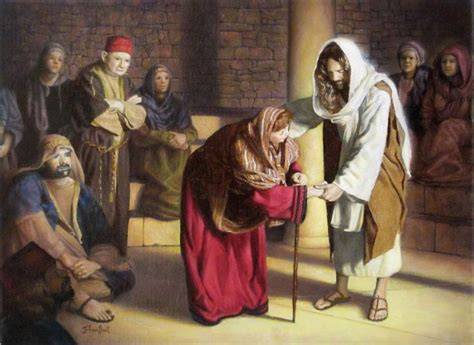
Let’s go ahead and pick up the story which is found in Mark 5:24-34(NKJV) 24 So Jesus went with him, and a great multitude followed Him and thronged Him. 25 Now a certain woman had a flow of blood for twelve years, 26 and had suffered many things from many physicians. She had spent all that she had and was no better, but rather grew worse.
27 When she heard about Jesus, she came behind Him in the crowd and touched His garment. 28 For she said, “If only I may touch His clothes, I shall be made well.” 29 Immediately the fountain of her blood was dried up, and she felt in her body that she was healed of the affliction.
30 And Jesus, immediately knowing in Himself that power had gone out of Him, turned around in the crowd and said, “Who touched My clothes?” 31 But His disciples said to Him, “You see the multitude thronging You, and You say, ‘Who touched Me?’ ” 32 And He looked around to see her who had done this thing.
33 But the woman, fearing and trembling, knowing what had happened to her, came and fell down before Him and told Him the whole truth. 34 And He said to her, “Daughter, your faith has made you well. Go in peace, and be healed of your affliction.”
Where the story is found
This woman's story can be found in Matthew 9:20-22, Mark 5:25-34, and Luke 8:43-48. Each of the three accounts varies in detail, but together they give us a great deal of insight into this woman and her encounter with Jesus.
“The woman with an issue of blood” is told in three of the four gospels: Matthew, Mark and Luke.
The setting: an interruption on the way to Jairus’s house
The story of this woman takes place within a larger story. Jesus is on his way to a synagogue leader’s house to heal his dying daughter when an unnamed woman causes an interruption to His progress.
During this time, he calmed stormy waters for the terrified disciples, cast Legion out of a possessed man into a large herd of pigs, and agreed to visit Jairus, a leader of the local synagogue, whose daughter was dying.
Jesus is on his way to heal a little girl, the daughter of Jairus, a synagogue leader, who urgently needed help. Jesus wasn’t mad or annoyed. He allowed her to take up space.
The accounts of the woman with the issue of blood and the raising to Jairus daughter are interleaved.
A woman who had suffered for twelve years
This anonymous women had been hemorrhaging for 12 years as a result of this hemorrhage she was deemed unclean. The issue had continued for twelve years. That’s a very long time.
We have no indication of the approximate age of this woman. We don't have a clue if she was married, lived alone, lived on the streets, or had children. We don't even know what town she was from since the crowds had gathered from all over the area.
What happened to cause her chronic illness? We don't know. Her issue of blood could have been due to trauma, childbirth, miscarriages, hormonal imbalance, or any number of reasons.
At the time of her healing we don't know that she was actively in physical pain. Regardless, she suffered at the hands of the physicians. Even without their help, blood flowing from your body for 12 years would sap your strength and leave you with a host of other physical complications.
The meaning of ceremonial uncleanness
To be unclean during this time, meant that person had to avoid others, along with things that were holy. Jewish Law declared her to be ceremonially unclean due to her bleeding issue.
Back then, when a woman had her monthly, she was considered unclean while her blood flowed plus for seven days thereafter. You can read more about this in Leviticus chapter 12 and Leviticus 15:19-33.
Because of this law, this woman and anything and anyone she touched was considered contaminated; unclean. Anyone who touched her would have been unclean by association, and even things she sat on would have been considered unclean.
She couldn’t go to the temple for festivals to worship in community. Functionally, I bet she felt like an outcast.
God gave Moses those laws not to insinuate that having your monthly was so shameful that woman needed to hide away for two weeks each month. That wasn't it at all. God created women to bring forth life. Having a monthly period was part of the process God created. God gave Moses the laws out of love to protect us.
With her unclean status, it would be near impossible to get close to Jesus. People were all around Jesus on every side.
The physical, emotional, and spiritual burden
Physical suffering
According to Luke, a physician himself, she suffered a great deal at the hands of the doctors, and they made her worse, not better.
This poor women and endured so much at the hands of medical men at the time. Not only did these medical professionals not heal her, they actually made things worse.
Think about that, you go into the doctor thinking that they are going to heal you when in reality, they exasperated the problem. I am sure these medical professionals had the best intent and wanted the best for their patient. Yet, they were limited in what they could do for her.
Thank the Lord, He is not limited to helping people!
Emotional suffering
Although it hits everyone differently, all chronic conditions cause emotional turmoil. This woman had strict procedures she had to follow.
So this woman had twelve years of no hugs, no kisses, no handshakes, pats on the back, or shared meals. She couldn't go out in public, couldn't get together with the other women to draw water from the well, and couldn't venture out to worship at the temple. Nothing. For twelve years!
I don't care how strong you think you are, 12 years without human contact would take a toll on anyone's emotional state.
With the Levitical Law in place, she was an outcast and shunned until she is ceremonially clean again. To some around her, she would have been a burden, to others she would have been so unimportant that she was almost invisible.
Spiritual suffering
Chronic illness is a prolonged spiritual battle. God hears us and answers the moment that we pray. But that doesn't mean we don't have a spiritual battle to endure, learn, and grow from.
Satan's end game is always the same; to get us to doubt God's love and character. When we doubt Him, we pull away from him and try to hide.
Although she is weary, the woman moves through the crowd with a grief-stricken hopefulness that pushes her beyond the temporal reality of her physical condition.
One must understand that she carries a psychological, physical, and spiritual weariness, weariness with social implications; it is unyielding because her bleeding is unyielding.
A nameless woman who felt invisible
We don’t know her name. We actually know very little about her background, but it is likely her bleeding was an issue in more ways than one.
Have you ever felt invisible, like you were struggling in silence, all alone? You might relate to the story of the woman with the issue of blood in the gospels.
Her struggle was like having a never-ending period for 12 years, and Scripture tells us that she suffered. Her constant bleeding made her unclean under Mosaic Law, and if someone else touched her, they would also be unclean.
But, for this unnamed woman with the issue of blood, who had suffered in silence for 12 years, an encounter with the living God ended her years of invisibility.
She lived in a state of paradoxical invisibility, an invisibility that ultimately empowers her to touch the clothes of Jesus.
She did not give up seeking help
This poor woman had endured so much at the hands of medical men at the time. She had spent all her money on treatments from many doctors, and nothing had helped; in fact, the blood issue had only grown worse.
But the invisible prison walls and the guilt and shame that would have accompanied them didn't stop this woman from pushing forward, going from doctor to doctor, spending all that she had seeking a cure.
We don't know if she saw all these doctors early on in her illness or if her visits to them were spread out over time. But the point is, she didn't stop trying.
Sometimes we don't know how much we need Jesus, until Jesus is all we have.
Tenacious faith
Two things that stand out to me about this woman was tenacious and she had faith!
Tenacious: keeping a firm hold on something; clinging or adhering closely. Not relinquishing a position or course of action, determined. Persisting in existence, not giving up easily.
For years before seeing Jesus face to face, this woman had invisible prison walls surrounding her 24/7. They weren't walls she erected around herself but was put there by her Jewish culture based on laws God had given Moses years before.
She did not accept her condition as the final word. Her faith produced movement, courage, and determination.
“If only I may touch His clothes”
When she heard about Jesus, she came behind Him in the crowd and touched His garment. For she said, “If only I may touch His clothes, I shall be made well.”
The Bible says that “when she had heard the reports concerning Jesus, and she came up behind Him in the throng and touched His garment, for she kept saying, If I only touch His garments, I shall be restored to health” (Mark 5:27-28).
Since she was in isolation, how did she hear about Jesus? Did she see the crowds going past her home? Maybe she heard them carrying on about this man named Jesus who was doing amazing and wonderful things.
What we know for sure is that she had faith. How do we receive faith? By hearing the Word of God.
For her to have the understanding that she only needed to touch Jesus to be healed means that she knew Jesus as her healer; not the church leaders, doctors, or the apostles. Just Jesus.
She was willing to reach Jesus despite the crowd
People often gather because of curiosity or interest. There is always some reason that people gather.
There were those who GATHERED. A gathering is a group of people who are brought together for a specific purpose.
It did not seem possible for this woman to reach Jesus. People were all around Him, and her condition meant that she should not have been in the crowd. Yet she came behind Him and reached for His garment.
After bending down and somehow breaking through the crowd, this women was able to touch the hem of Jesus garment. This is an amazing feat. There were loads of people around, making it almost impossible to get through.
Many theologians have surmised that this women got down on her hands and knees and crawled her way to Jesus.
She must have heard about Jesus, she must heard about the miracles that He performed. She made it up in her mind that I am going to get to Jesus no Matter what!
I would venture to say that she was desperate for Jesus. She was determined that nothing was going to stop her from encountering Jesus. Nothing!
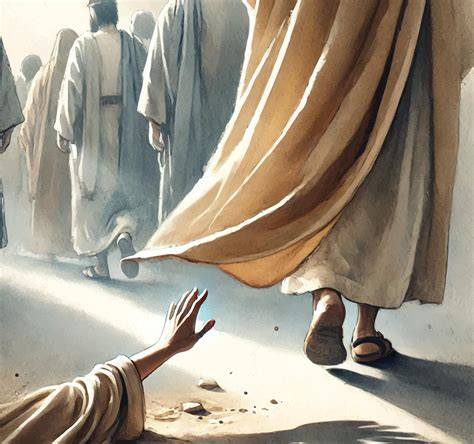
Her desperate hope became purposeful action
Her purpose was to be healed. Her body is a symbol of justification; it is “revelatory”; the touch, not her speech, causes a biological alteration.
Her body as voice, prayer, protest against sickness, an evangelistic model, and justification drags itself gracefully into the crowd in search of healing.
She does not bemoan her sickness of bleeding. Guided by the Holy Spirit, she moves quietly, inspirationally, and passionately.
The woman with the issue of blood was led by the Holy Spirit to position herself for healing. Her actions speak of her belief.
This woman had hope. Hope energized her to get out of her house, and go into the crowd because Jesus was in the crowd.
That woman, my sister in Christ, went out into the crowd-weak. I kept asking myself, What drove her? My answer: She is trapped in a promise.
The healing was immediate
It did not take twelve more years for this women to receive healing in her body. In fact, as we read earlier that this healing took place immediately.
With just one touch of Jesus' garment, her physical symptoms, the flow of blood, immediately dried up. After twelve years of symptoms, She knew that her body had changed. She was healed physically!
As soon as the woman touches Jesus, her bleeding stops and she knows she’s been healed. In an instant, Jesus does what no doctor in twelve years had been able to.
This proves the power of Christ, of course, but it also illustrates an important point about Jesus and the Law.
Jesus is not contaminated by human uncleanness
In Leviticus 15:31 God says, “You must keep the Israelites separate from things that make them unclean, so they will not die in their uncleanness for defiling my dwelling place, which is among them.”
In the Old Testament, the temple was where God dwelt among the Israelites, but in the New Testament, God dwelt among men in the person of Jesus Christ.
Through Jesus the penalties of the Law are reversed, and the contamination of this world had no effect on Christ. The woman did not make Jesus, God’s dwelling, unclean-He made her clean!
In a time when a rabbi, or Jewish teacher, like Jesus, definitely would not have touched an unclean woman, Jesus saw her and spoke kindly to her.
Jesus stopped and asked, “Who touched me?”
Jesus immediately responds to the woman who touched His clothing and was healed. People were pushing and pressing into Him from all over, yet He stops, turns, and asks, “Who touched my clothes?”
The disciples were incredulous, but Jesus knew that healing power had gone out of Him. We can’t “steal” a miracle from God.
It is important to note that the woman’s community does not seem to notice, sense, or embrace her existence. The members of her community do not realize this: the unclean woman is pressing on them; therefore, like her, they are unclean.
Although she thinks it will be a quick, unnoticed, one-way meeting, she soon learns that Jesus engages those who encounter him, especially one who draws power from him.
Sometimes an encounter with Jesus is not private or unnoticed. Jesus brings the person into the open so that healing can include more than a physical change.
She came forward and told Jesus everything
After the woman comes forward and explains herself, Jesus clears up any misconceptions about her healing, saying, “Daughter, your faith has healed you. Go in peace and be freed from your suffering.”
But the woman, fearing and trembling, knowing what had happened to her, came and fell down before Him and told Him the whole truth.
Can you imagine the fear this woman felt when Jesus drew attention to what happened? This woman hadn't touched or been touched in years.
In my opinion, the bravest thing this woman did was step forward in front of everyone, fall at the feet of Jesus, and confess that she was a lawbreaker.
She touches people, bringing them in contact with blood. All are drawn into an unexpected orbit around the holy mystery of life because of her desperate desire to become ordinary again.
Jesus called her “Daughter”
Instead of condemning her, He took time and acknowledged her. He called her daughter; publicly claiming her as his own.
Jesus, who, by society’s standards, should have been upset, shows her love. He called her daughter, publicly honored her and her faith, and sent her away in peace.
He said to her, “Daughter, your faith has healed you. Go in peace and be freed from your suffering.”
The word “Daughter” restored more than her body. It spoke identity, belonging, dignity, and relationship into the life of someone who had lived as an outsider.
Faith made her whole
There is irony in this healing moment: it was not the touching that actually healed the woman. It was, says Jesus Christ, the touch of “faith that . made [her] whole” (Luke 8:48).
I love how the KJV puts this; He told her her faith made her whole. Not cured, and not just healed, but whole!
She received her healing because she had tenacious faith. As I was moving through the story, I realized that just as chronic illness affects us physically, mentally, and spiritually, we must be healed in all three areas as well. This is called complete or whole healing.
Jesus restored both parts of her silent struggle, her health and her everyday life.
What this encounter teaches about Jesus
Jesus sees the overlooked
In the contemporary sense, what this means is Jesus’ bodyguards-the disciples-do not know who is in their presence.
But He didn’t do that. Jesus stopped what He was doing and acknowledged the result of this woman’s faith: her complete and instantaneous healing.
Though she may have felt alone, she gave her burden to Jesus and stopped carrying it alone. His response? Jesus cared.
Jesus welcomes the desperate
This woman seeks to birth a new text by merging her infirmed body with the cloak of Jesus Christ.
She has one objective-to touch Jesus so that she can be healed. She is desperate.
Jesus has the power to make all things new in our lives, and that’s what He does with the woman with the issue of blood.
Jesus honors faith that acts
No verbal announcement that she is a believer in Jesus was said. Her actions speak of her belief.
What strikes me most is that in Scripture, no one tells this woman what to do. We don’t read that she received a prophecy, vision, or instruction. She likely heard about the miracles of Jesus and decided to act.
She took a risk that changed everything. She focused on the target of healing: Jesus.
Jesus gives peace, not condemnation
Jesus cared about her, and about her years of pain and shame, and friend, He cares about your silent struggles, too.
There is room enough for Him to carry all of our burdens. Yours, mine, and every child of God on earth.
Jesus restored both parts of her silent struggle, her health and her everyday life. On his way to heal one daughter, he stopped and healed another.
Practical lessons for believers
1. Faith may lead us toward healing
The woman with the issue of blood was led by the Holy Spirit to position herself for healing. Like the protagonist in a story, she stirs the narrative into being when she journeys out of her house to find healing.
Her following the leading of the God who carries her in the direction of Jesus exemplifies her faith.
Sometimes illnesses, the challenges in a Christian’s life, are the avenues by which we find healing.
2. Faith can move through weakness
That woman went out into the crowd-weak. Her walk into the crowd to find the Jesus she heard would heal her is a performance of protest against the issue that had betrayed her body.
When the believer becomes trapped in a promise that God has imparted into the spirit, the believer is fueled with an expectation that provides strength to one who may be physically, psychologically, or spiritually weak.
Although she lived in the not yet of being healed, God, in His grace and mercy, empowered this woman and her weak body to leave her house, to go out into the crowd to find Jesus.
3. Challenges can draw people to Christ
This woman was trapped in the promise of healing. The consciousness of the Comforter, I imagine, the Holy Spirit, available to each and every believer, spoke to her; she heard, and listened.
The result: the restoration of the woman’s womb, her healing, and a pedagogical testimony for the contemporary believer on possible steps involved in finding healing.
The woman with the issue of blood was trapped in the promise of healing. She went to what many call “ground level” to receive the promise of healing. That is a lesson for the Christian believer about the healing God offers each one of us.
4. We must bring the whole truth to Jesus
The woman was healed physically when she touched Jesus’ garment, but Jesus also brought her into a personal encounter. She fell before Him and told Him the whole truth.
Isn't that what Jesus wants from all of us? To willingly come before him, bow down, and spill our hearts regardless of our circumstances, despite what others might say about us?
Have you been honest with God about your feelings, hopes, and desires, or are you hiding those things away from the only one who can make them possible?
5. Jesus restores identity and community
If she had people in her life who loved her, she probably had some contact with them at certain times, but in many ways, she was cut off from community.
At the very least, she faced barriers and a burden that set her apart from normal life for over a decade.
Jesus called her daughter, publicly honored her and her faith, and sent her away in peace.
In what was potentially a matter of hours, He changed two daughters’ lives, having a ripple effect on every loved one around them.
How far will you go to Jesus?
The woman with the issue of blood was willing to touch Jesus when the others around weren’t going that far.
There were those who gathered, but this woman moved beyond gathering. She did not merely watch Jesus, listen to reports about Jesus, or stand near Jesus. She reached for Him.
She was not concerned about the crowd. If she were, she would not have gone out because bona fide bleeding women knew they were “unclean” and should not be among people.
A powerful message exists in this evangelistic performance act for the believer who reads this story, and that is this: a healing emerges when a sick person is psychologically healthy enough to recognize illness and becomes determined enough to crawl into the presence of God and touch the bottom of His garment.
By going to the bottom, the woman with the issue of blood was able to get up. She was healed.
When healing does not happen immediately
We like to think that because we pray we will be immediately healed. But that isn't always the case.
God alone determines the how, the when, and the why of our healing. As our creator, He alone has that right.
This woman walked a lonely, isolated road for years. I am sure her health issues felt overwhelming. Through no fault of her own, she wasn't like everyone else.
There is so much the Bible doesn't tell us about her. But, as I said in the beginning, we don't have to share identical stories to realize we share her path.
Questions for personal reflection
- How are you doing with whatever it is that you are still struggling with, friend?
- Are you tenaciously going to the Lord's door and knocking?
- Are you staying close to God in Scripture and prayer, even when you don't feel like it?
- Have you been honest with God about your feelings, hopes, and desires?
- Are you hiding those things away from the only one who can make them possible?
Our culture is different, but human nature, afflictions, and spiritual warfare have not changed.
Her story gives me hope. Jesus sees us and loves us. He finds us, alone and suffering in silence, restores us, making us new, and sends us away in peace.