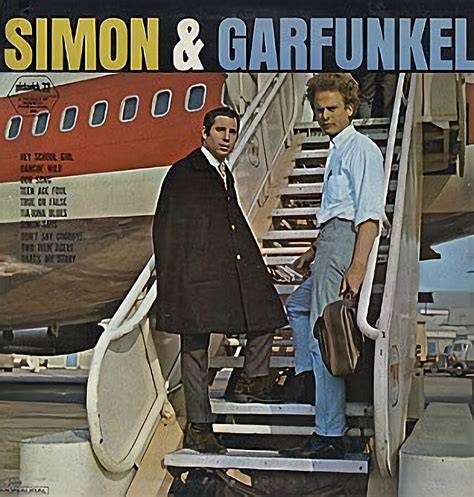
Simon & Garfunkel’s “Silent Night” is not a conventional Christmas cover. Released in 1966 as “7 O’Clock News/Silent Night,” the recording places the gentle carol over a simulated news bulletin describing political conflict, violence, racism, and social unrest. The contrast transforms a familiar hymn into a powerful statement about the distance between the ideal of peace and the reality of the modern world.
Paul Simon and Art Garfunkel released their rendition on their third studio album, Parsley, Sage, Rosemary and Thyme, turning the traditional carol into a radical sound collage. The beautiful melody continues in the background while radio DJ and announcer Charlie O’Donnell reads headlines from August 3, 1966, creating a jarring paradox between Christmas serenity and contemporary disorder.
The origins of “Silent Night”
“Silent Night” is a Christmas staple. Christmas wouldn't be the same without hearing the charming, heart-warming carol “Silent Night”, and it's been that way since the early 19th century. Originating in Austria, the song came into being after Josef Mohr and composer Franz Gruber teamed up to provide music for a festive celebration.
On Christmas Eve in 1818, the first-ever public performance of “Stille Nacht” or as we know it “Silent Night” unfolded. Since then, it's become a Christmas carol close to every Westerner's hearts, and has been covered by over three hundred artists.
The serene and poignant melody that Gruber composed shares the simplicity of a folk song, which relates given his first performance alongside Mohr was accompanied by a lone acoustic guitar. Though he had composed the music for organ, he kept the melody a simple one, and one that translated into various forms of music in the decades since.
The beautiful, gentle words written by Father Mohr feel like a hymn. The likes of Julie Andrews, The Carpenters, Stevie Nicks, Sinead O'Connor, tenor Andrea Bocelli, Bon Jovi, and even actor Christopher Lee have covered the perennial Christmas favourite.
Undoubtedly the most famous, recognised as the standard for the best part of a century however, is Bing Crosby's 1935 version which he re-recorded in 1945. There was a version by legendary folk-pop duo Simon & Garfunkel that resonated with listeners, but for a very different reason.
Why Simon and Garfunkel changed the carol
Some years back, Paul Simon was asked if there was any song in the entire history of music that he could have written, what would it be? He replied “Silent Night”, which seemed like an odd choice given its festive connotations, yet it makes perfect sense.
Simon & Garfunkel used that sentiment, and placed their version against a stark political backdrop. The duo created a radical sound collage from what could have easily (and for some regrettably) been a gorgeous, straightforward cover version.
Titled “7 O'Clock News/Silent Night”, Simon & Garfunkel juxtaposed the warming Christmas carol against dialogue from a newsreader. Reading out some of the horrors that took place throughout the previous year, they hired radio DJ and announcer Charlie O’Donnell to read out headlines which bleed in and out of the tender song.
Accompanied by a simple piano, the two-part harmony emphasises the joy and warmth of a more innocent time, contrast peace against the unrest of the decade. Music was increasingly becoming an artistic vehicle to communicate political ideology, and Simon & Garfunkel couldn't have made their feelings more clear.
The structure of “7 O’Clock News/Silent Night”
This song is a two-part harmony featuring the carol “Silent Night” and a simulated “7 O'Clock News” bulletin documenting the various events of August 3, 1966. The news was actually scripted and read by Charlie O’Donnell, who was a radio DJ and the announcer on many TV game shows, including The Wheel of Fortune.
As the lyrics of the carol are sung in the background, the news items-covering political tensions, violent events, and societal unrest-create a jarring paradox. The calm musical setting does not soften the news; instead, it makes the violence and uncertainty more difficult to ignore.
| Element | Function in the recording |
|---|---|
| “Silent Night” | The gentle Christmas carol and musical expression of peace |
| “7 O’Clock News” | A simulated bulletin documenting events of August 3, 1966 |
| Charlie O’Donnell | Radio DJ and announcer who read the scripted news report |
| Simple piano | A restrained accompaniment beneath the vocal harmony and bulletin |
| Two-part harmony | It emphasises the warmth of the carol against the unrest of the news |
The news stories behind the song
The topics covered throughout O'Donnell's newsreader part include the indictment of murderer Richard Speck, the premature death of comedian Lenny Bruce and the civil rights march in Cicero, Illinois organised by Dr. Martin Luther King, Jr.
In the bulletin, political tensions surrounding housing discrimination appear alongside reports of Lenny Bruce’s death. The report describes Bruce as having died in Los Angeles at the age of 42 from what was believed to be an overdose of narcotics.
The recording also refers to Dr. Martin Luther King’s plans for an open housing march into the Chicago suburb of Cicero. Cook County Sheriff Richard Ogleby asked King to call off the march, while the police in Cicero said they would ask for the National Guard to be called out if it took place.
The report then turns to Richard Speck, who was accused of murdering nine student nurses in Chicago. He was brought before a grand jury for indictment, while the nurses were reported to have been found stabbed and strangled in their Chicago apartment.
The final portion focuses on anti-Vietnam War protests and the escalation of the war effort. A special subcommittee of the House Committee on Un-American Activities continued its probe into anti-war protests, and demonstrators were forcibly evicted from the hearings when they began chanting anti-war slogans.
Former Vice-President Richard Nixon is reported as saying that, unless there was a substantial increase in the present war effort in Vietnam, the United States should look forward to five more years of war. He also said that opposition to the war in the country was “the greatest single weapon working against the US”.
The contrast between peace and unrest
The recording’s power comes from its simultaneous presentation of two incompatible emotional worlds. The carol speaks of stillness, holiness, tenderness, and heavenly peace, while the news bulletin describes death, racial tension, political repression, murder, and war.
Mentioning the issues that painted a picture of the summer of 1966 is a powerful message, that harmony and disarray with always co-exist. A time capsule of the disillusionment and uncertainty that the youth were experiencing throughout that period, Simon & Garfunkel understood the social and political upheaval that was desired.
The difficult tension between the beauty of the quickly approaching gift of the Incarnation and the harshness of the world is something deeply moving about this song. It challenges us, I think, to acknowledge and seriously wrestle with the profound brokenness of the world without surrendering to despair.
Some people feel like the more sombre a Christmas song is, the more poignant it becomes. In Simon & Garfunkel's case, that's certainly true.
Simon and Garfunkel - 7 O'Clock News/Silent Night (6B)
“Silent Night” as a political statement
When Simon & Garfunkel covered the Christmas carol “Silent Night”, they turned the gentle song into a poignant political statement. Simon & Garfunkel made a powerful political statement from their version of “Silent Night”.
The song does not present Christmas as an escape from history. Instead, it places the carol directly inside a particular historical moment, allowing the promise of peace to confront the violence and anxiety of 1966.
The song's message still resonates to this day, with indie singer-songwriter Phoebe Bridgers, Fiona Apple, and The National's Matt Berninger covering “Silent Night” in a similar style, replacing the newscaster section with updated issues society faces today.
The continued relevance of the arrangement lies in its method: the carol remains recognisable, but the surrounding world changes. Each new version can place the same language of peace beside the fears and conflicts of another period.
The spiritual paradox of the recording
This difficult tension between the beauty of the quickly approaching gift of the Incarnation and the harshness of the world is something I find deeply moving about this song. It challenges us, I think, to acknowledge and seriously wrestle with the profound brokenness of the world without surrendering to despair.
In The Promise of Paradox, Quaker writer and educator Parker Palmer writes, “The way we respond to contradiction is pivotal to our spiritual lives.” Paradox requires “both/and” rather than “either/or” thinking.
The Gospels are full of paradoxes like this: “For those who want to save their life will lose it, and those who lose their life for my sake will save it.” “The greatest among you will be your servant.” “But whatever gain I had, I counted as loss for the sake of Christ.”
“Unless a grain of wheat falls into the earth and dies, it remains just a single grain; but if it dies, it bears much fruit.” “When I am weak, then I am strong.” “The last will be first, and the first will be last.”
G.K. Chesterton reflected that Christianity is most hospitable to paradox, welcoming as it does the pessimistic and the optimistic, the bold and the meek. In this Advent season, we have been invited to embrace these paradoxes, especially as they are embodied in the coming of Jesus in the ultimate display of humility.
The Incarnation and the reality of suffering
There's something deeply grounding in this paradox being offered in Simon and Garfunkel’s song-an invitation not to retreat from the enormity of the world's pain, but to enter into it with our eyes wide open, looking for the places where grace is at work even when it's hard to locate.
I feel that we are all called to be agents of that renewal, to keep our hearts tender and our spirits alive to the possibility of change, no matter how discouraging this act of defiance can be.
This speaks to the heart of the paradox of Advent: a reminder that the Incarnation is not just a beautiful, tranquil event but one that enters into the messiness of collective and individual pain. This is the scandal of the Incarnation: God entering the world as a helpless infant in a place marked by strife and fear.
Romero’s homily insists that the birth of Christ is not a distant, sanitized moment but a profound and ongoing act of solidarity with the depth of human suffering. Romero’s words, and Simon and Garfunkel’s lyrics, do not offer either easy consolation or a denial of pain; rather, they demand a reorientation, a refusal to allow despair to have the final word.
The connection with Oscar Romero
The song’s confrontation with suffering recalls a homily by St. Oscar Romero, delivered on Christmas Eve in 1979 amidst rapidly escalating political violence in El Salvador. Romero’s words echo the paradox of Advent as he is speaking to a people weighed down by unimaginable suffering.
“I congratulate you, dear brothers and sisters,” he writes in the opening of his homily, “not only because it is Christmas but because you are courageous.”
His message advises: “Let us not seek Christ in the opulence of the world or among the idolatries of wealth. Let us not seek him in the struggles for power or among the intrigues of the mighty. God is not there.”
“Let us seek God where the angels say he is: lying in a manger on a little straw, wrapped in the poor bit of cloth that a humble woman of Nazareth could afford. There we find resting the God who has become man, the King of the ages who makes himself available to us as a poor little child.”
In reflecting on the great mystery of the Incarnation, St. Romero is reminding us, as are Simon and Garfunkel, that, in spite of everything, we cannot run the risk of becoming numb to love, indifferent to evil, and paralyzed into inaction.
Why the song remains powerful
Perhaps by nature, it hasn’t always been easy for me to believe. Most days, this feels both like a blessing and a curse- a restless tension that places me somewhere in between the wild, beautiful gladness of being alive and the crushing weight of all that is broken.
In the midst of these doubts and questions, I have always sought something expansive enough to hold this world in both its starkness and beauty. The story of the Incarnation is the only story that continues to meet me where I am, with all these paradoxes, and still cradle my heart in hope.
In the mystery of God becoming flesh, I find not an answer, but a presence-one that enters into the mess of human life, embraces it, and transforms it. The Incarnation invites me to wrestle with the tension with which I am all too familiar- to let the sharp pain and distinct wonder of this world be held in something infinitely larger than I can comprehend.
It helps me keep my gaze on a fundamental mystery, and it is here, in the heart of this paradox, that I find the resilience to keep seeking, the grace to keep questioning, and the courage to believe.