The mercy seat was the pure-gold cover of the ark of the covenant in the tabernacle. It was the place where God promised to meet Moses, where the high priest sprinkled sacrificial blood on the Day of Atonement, and where the forgiveness, atonement, reconciliation, and mercy of God were symbolically displayed.
In the New Testament, the mercy seat points to Jesus Christ. Christ is the fulfillment of what the Old Testament mercy seat represented: He is the meeting place between God and His people, the atoning sacrifice for sin, the perfect High Priest, and the definitive covering for those who approach God through faith.
What Was the Mercy Seat?
The mercy seat was the closure, or covering, of a holy box called the Ark of the Covenant. It housed, among other things, the stone tablets inscribed with the Ten Commandments. The tablets with the Ten Commandments stored underneath bore witness to the sin of the people.
The mercy seat is first introduced in Exodus 25:10-22. This is part of a larger passage that is dealing with the construction of the tabernacle and its furnishings. These thirteen verses describe what came to be known as the Ark of the Covenant.
The first few verses describe the ark itself - a wooden box that is about 45 inches long and 27 inches wide and tall. It has legs, rings, and carrying poles, and is overlaid with gold. Contained within the ark were the stone tablets with the words of the covenant written on them.
The rest of this passage describes the cover, or lid, that was made for the ark. The Hebrew word used for this lid was kappōret. Some Bible versions, such as the CSB, translate this word as “a mercy seat.” Others, like the NIV, translate it as “an atonement cover.”
| Feature | Description |
|---|---|
| Location | The top of the Ark of the Covenant in the Most Holy Place |
| Material | Pure gold |
| Shape and size | The same width and length as the ark |
| Decoration | Two cherubim facing each other and the mercy seat |
| Primary significance | The place where God met with His people and where atonement was represented |
It is the same width and length as the ark, and it was made of pure gold. And on top of the mercy seat were a pair of cherubim.
After the description of the mercy seat, God told Moses that it would be the place where he would communicate with Moses, passing on his laws for Israel. This was also where the atoning sacrifice was offered. And in the description of that sacrifice, discussed below, we find that it was where God lived, at least symbolically.
The mercy seat represented God’s presence among his people.
The Meaning of the Hebrew Word
The Hebrew word for mercy seat means “to cover up or wipe out, hence to atone for offenses, to forgive.” The NIV translates it “an atonement cover,” but I like “mercy seat.”
Interestingly enough, the Hebrew word for the mercy seat is “kaporet”, which has the same root as “kippur”. Which means atonement.
As far as the Ark of the Covenant is concerned, the words covering and shield are more appropriate to describe the purpose of the mercy seat. Above or rather on the mercy seat the blood of sacrifice was sprinkled by the High Priest for the atonement of sin.
This is why emphasis is placed on the word covering. The mercy seat was the place of transference of sin for forgiveness, of reconciliation between God and His people.
The Mercy Seat and the Presence of God
God gave Moses specific instructions about building the tabernacle, the place where God would meet with people. The mercy seat was the lid on the ark.
God promised Moses that He would meet Moses at the mercy seat and speak to him from there. Exodus 25:22 declares, “There I will meet with you.”
“Set the mercy seat on top of the ark and put the tablets of the testimony that I will give you into the ark. I will meet with you there above the mercy seat, between the two cherubim that are over the ark of the testimony; I will speak with you from there about all that I command you regarding the Israelites.”
God promised to meet him at the place where sins are forgiven, atonement is made and mercy is offered. What a beautiful picture!
The ark of the covenant, the chest containing the two stone tablets inscribed with the Ten Commandments, was the most sacred object of the tabernacle and later in the temple in Jerusalem, where it was placed in an inner area called the Holy of Holies.
On top of the ark was a lid called the mercy seat on which rested the cloud or visible symbol of the divine presence. Here God was supposed to be seated, and from this place He was supposed to dispense mercy to man when the blood of the atonement was sprinkled there.
In a manner of speaking, the mercy seat concealed the people of God from the ever-condemning judgment of the Law.
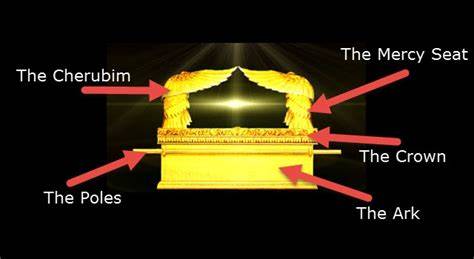
The Cherubim Above the Mercy Seat
“Make one cherub on the one end, and one cherub on the other end. Of one piece with the mercy seat shall you make the cherubim on its two ends.” - Exodus 25:19
If you didn’t know, a cherub is an angel. So, now, visualize this seat on top of the Ark of the Covenant with two angels on it.
The cherubim on the top of the mercy seat are described as facing each other and the mercy seat itself. Their wings were outstretched and overshadow the mercy seat.
These cherubim are an interesting feature, one that is not explained anywhere. But from their use elsewhere I believe we can draw some conclusions.
The first mention of cherubim in the Bible is in Genesis 3:24. After Adam and Eve were banished from the Garden of Eden, cherubim were placed on the east side of the garden, along with a flaming sword, to guard the way to the tree of life.
The garden represented God’s presence on earth and so the cherubim also seem to serve as gatekeepers to God’s presence. In 1 Samuel 4:4, and other places, God is described as being enthroned between the cherubim over the ark.
Psalm 18:10 describes God as mounting the cherubim and flying. The first chapter of Ezekiel describes creatures that are later identified as cherubim. These creatures are strange indeed. But above their heads is the throne of God.
It seems like the cherubim are closely associated with God’s presence. And so, these images of cherubim atop the mercy seat could symbolize God’s presence and holiness.
No image of God was allowed. But the images of the cherubim point to God’s presence.
The Mercy Seat and the Ark of the Covenant
The Ark of the Covenant was in the Old Testament Jewish tabernacle/temple. The Ark of the Covenant was a chest that contained The Ten Commandments, a pot of manna, and Aaron’s staff.
On the top of it was the Mercy Seat. This was, in fact, where God’s presence dwelled. The priests sprinkled the sacrificial blood there, and He gave mankind mercy.
“Behind the second curtain was a second section called the Most Holy Place, having the golden altar of incense and the ark of the covenant covered on all sides with gold, in which was a golden urn holding the manna, and Aaron’s staff that budded, and the tablets of the covenant. Above it were the cherubim of glory overshadowing the mercy seat. Of these things we cannot now speak in detail.” - Hebrews 9:3-5
The ark included the testimony of God’s covenant, the provision of God in the wilderness, and the sign of Aaron’s priestly authority. The mercy seat covered these covenant objects and stood above them as the place associated with divine presence and atonement.
The Day of Atonement
The mercy seat initially was where God met with Moses to communicate the Law to him. But it had a second more significant role in the ritual worship practice of Israel.
Leviticus 16 describes the Day of Atonement, an annual time of sacrifice for Israel. And the mercy seat played a significant part in this sacrifice.
On the Day of Atonement, there were a series of sacrifices made. Of these, one was a bull for the sin of the high priest and a second was a goat for the sin of the people.
Leviticus 16:11-17 describes the process for offering these two sacrifices, and it was unique among all the other sacrifices offered. For each of these two sacrifices, the high priest would take some of the blood of the sacrifice through the curtain and into the most holy place.
He would also take a censor of coals and some incense whose smoke would hide the mercy seat so that the priest would not die. God was dwelling above the mercy seat, so to see the mercy seat would be to see God. And that was fatal.
The high priest would then sprinkle blood on the mercy seat as well as in front of it. And in that way, he made atonement for his own sin and the sin of the people.
Understanding the Day of Atonement or Yom Kippur
There were other sacrifices made over the course of a year, including the sin and guilt offerings. These were to be made when either a person or the community had sinned.
But these offerings seemed to be restitution for the sin - it was payment of a penalty. But only the sacrifices on the Day of Atonement actually made atonement for sin.
Only this sacrifice would serve to wash away the stain of sin. Although, as the author of Hebrews makes clear, the blood of bulls and goats could not actually take away our sin (Heb. 10:4).
Mercy and Grace
“Let us then with confidence draw near to the throne of grace, that we may receive mercy and find grace to help us in time of need.” Hebrews 4:16
Mercy and grace are the “true north,” so to speak, of God’s character. Both convey His heart towards His children in a way that wrath, though warranted, does not.
God actually delights in showing mercy and grace, and He does so abundantly. Many times we are not even aware of the profound magnitude of God’s mercy. Other times, we are transformed by the realization of it.
And He is also a God of grace. He knows we are weak and broken, but it is His grace that gives our lives worth.
The Difference Between Mercy and Grace
Sometimes the two words are used so synonymously that you may have wondered if there is in fact a difference in their meaning. Well, you shouldn’t be surprised to learn that there is a difference - and not just a small one.
Although both relate to God’s unlimited goodness, mercy and grace describe different aspects of just how loving and compassionate He is.
First off, let’s recognize these words in Hebrew. Mercy is pronounced rachamim, which is very closely linked to compassion. Meanwhile Hebrew word for grace, which is hesed, sometimes gets translated into favor.
Already these synonyms clarify a lot. While mercy points to a loving forgiveness of wrongdoing, grace goes a step further. It is ‘unmerited favor’, as many are quick to point out.
Which means, we experience the wondrous goodness of God that we absolutely do not deserve.
| Concept | Meaning |
|---|---|
| Mercy | A loving forgiveness of wrongdoing, closely linked to compassion |
| Grace | Unmerited favor and goodness that people do not deserve |
| Mercy seat | The place associated with covering sin, atonement, reconciliation, and God’s presence |
The Mercy Seat in the New Testament
The mercy seat, using the Greek word hilastērion, is mentioned twice in the New Testament. In Hebrews 9:1-9 the author describes the arrangement of the furnishings of the tabernacle.
And in verse five he mentions the mercy seat with its overshadowing cherubim of the Glory. Following that, he describes the annual activity of the high priest offering the blood of the atonement sacrifices.
He closes this description with the comment that this earthly tabernacle and its offering were only temporary, until the new order ushered in by Christ had come.
The rest of Hebrews 9, and on into the next chapter, describe how Christ came as a better high priest, serving in the heavenly tabernacle and offering a superior sacrifice of atonement.
The author of Hebrews goes to great lengths to show that what Leviticus 16 described was only looking forward to the more perfect sacrifice that Jesus would make on our behalf.
The blood of the sacrificed animals could never make atonement for our sin. But the blood of the sacrificed Jesus could, and did.
Jesus as the Mercy Seat
The connection to Romans 3 concerns the Greek word used for the Hebrew word for mercy seat. The Greek translation of the Old Testament, known as the Septuagint, uses the word hilasterion to translate the Hebrew word.
The Hebrew word is kappuret, related to the word for atonement, which is kippur. This Greek word, hilasterion, usually gets translated as “propitiation” in the New Testament.
“Propitiation” only occurs a handful of times in the New Testament. One of those times comes in Romans 3:25. Referring to Christ and His work of redemption, Paul states that God put forward Christ “as a propitiation.”
Christ is the acceptable, wrath-satisfying sacrifice on our behalf.
Romans 3:25 says that Jesus is “our mercy seat because of His death on the cross. We come to Him for mercy, for God has made a provision for us to be forgiven by faith in the sacred blood of Jesus.”
But, regardless of the translation, it is God who presented Christ as the means of making atonement. And this atonement is received by faith in the blood of Jesus.
I believe the translation of the CSB in this passage is very intriguing. The mercy seat in the Old Testament was God’s dwelling place among his people, and that is really a good description of Jesus as well.
He was God, wrapped in human flesh, and dwelling among us - Emmanuel (Matt. 1:23). In a very real way, Jesus was the fulfillment of what the Old Testament mercy seat was pointing toward.
And not only was he the mercy seat, but as Hebrews points out, he was also the high priest that Aaron and his descendant could never be (Heb. 9:11).
And he was himself a sacrifice that was superior to the animals offered by the priests under the old covenant (Heb. 9:12).
Jesus fulfilled all aspects of the Old Testament sacrifice of atonement. He was the high priest, the atoning sacrifice, and the mercy seat.
In Matthew 5:17, Jesus declared that he was the fulfillment of the Law and the Prophets. We often take that to mean that Jesus fulfilled the prophecies related to a coming Messiah.
But I believe it means much more than that. All the Old Testament points to Jesus and finds its ultimate meaning and fulfillment in him.
And this is dramatically illustrated by the Old Testament mercy seat pointing ahead to Jesus and his atoning sacrifice.
The Cross and the Mercy Seat
In the Old Testament, the mercy seat was the physical location where the blood of the atoning sacrifice was offered. In the New Testament, it is the cross that was the physical location where Jesus, our atoning sacrifice, was offered up and his blood poured out on our behalf.
The Old Testament mercy seat looked ahead to the atoning work of Jesus, while the cross looks back at the atoning work of our Lord.
In this way the cross has become a useful symbol to represent Jesus as both the mercy seat and the atoning sacrifice that was offered there.
You need to remember that all of this Old Testament imagery was actually foreshadowing (or pointing to) Jesus Christ.
The Empty Tomb and the Mercy Seat
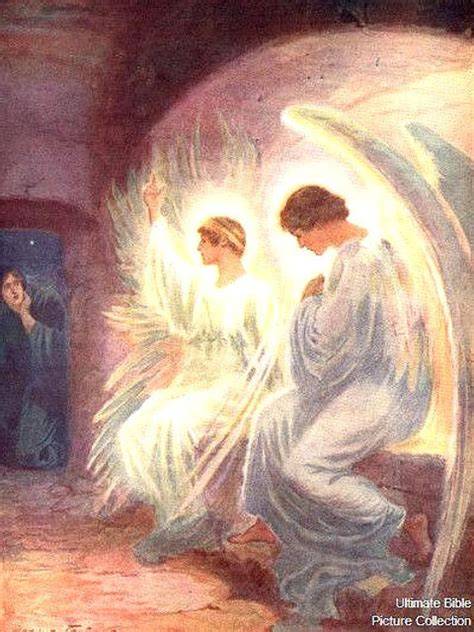
Then there is John 20:12. Mary Magdalene had come to the tomb of Christ only to find it empty. As she stooped down to look in, “She saw two angels in white, sitting where the body of Jesus had lain, one at the head and one at the feet.”
Back in Exodus 25, two carved angels took their places at either end of the mercy seat. Now all we need to do is connect the dots.
Mary saw something only the priest saw in the Holy of Holies once a year! Did you catch it?
Jesus died for our sins. Then they laid His bloody, broken body in the tomb. And when Mary looked in, she saw one angel at the head and another at the foot of the stone.
Without question, the Old Testament Mercy Seat was pointing to this moment!
God desires to meet with His people, and the blood of the spotless lamb is the only means by which that meeting is made possible.
The mercy seat of the Old Testament, and the blood sprinkled upon it by the high priest, prefigured Christ to come.
Christ did come, and Christ did make the sacrifice, and Christ was raised from the dead.
Make no mistake about it, these are historical realities. The tabernacle was real. The ark of the covenant was real. The mercy seat was real. The cross was real. The empty tomb was real. And a real woman stooped to look at real angels.
Why the Mercy Seat Matters for Believers
God’s throne is a throne of grace, a mercy seat. We can draw near with confidence, boldness, that we will receive mercy and find grace.
All this is possible because Jesus has atoned for us-He is our mercy seat.
Through the blood of the Messiah, God does not see our sins when He looks upon us. Jesus’ covering puts us in right standing before God, once and for all.
The Messiah perfected and satisfied the sacrificial system that the Father established in the Hebrew Scriptures.
Jesus’ covering puts us in right standing before God, once and for all. The mercy seat therefore communicates not merely the removal of guilt, but also access to God’s presence through the completed work of Christ.
Approaching God with Confidence
It reminds me of these verses: “For we do not have a high priest who is unable to sympathize with our weaknesses, but one who has been tempted in every way as we are, yet without sin. Therefore, let us approach the throne of grace with boldness, so that we may receive mercy and find grace to help us in time of need.”
Meet me at the mercy seat.
Today, I will come to the Father in Jesus’ name, knowing that He will meet me at the mercy seat-His throne of grace-and give me the mercy and grace I need.
I’m so grateful Lord that I can come to You with confidence and know that You’ll meet me with mercy and grace. Thank you!!
tags: #tabernacle #mercy #seat