The Bible does not mention marijuana or cannabis directly. Instead, Scripture offers broader principles about sobriety, self-control, obedience to authority and avoiding behaviors that impair judgment or cause harm.
Because the question is not answered with a single verse, Christians must evaluate this modern issue using the biblical framework. The question is less about finding a single verse and more about how marijuana use aligns with values like self-control, sobriety, and responsibility.
Does the Bible Mention Cannabis?
The Bible does not mention marijuana directly. Marijuana use was likely a contemporary issue when the books of the Bible were written, yet the Scriptures were silent on the topic. There may not be an explicit verse in the Bible about weed or getting high, but it has plenty to say about similar vices, such as alcohol.
In summary, the Bible has essentially nothing to say about the use of cannabis or other drugs. Even though many Christians now are attempting to find justification for the use of marijuana, nothing they point to in the Bible holds up under scrutiny.
People have been using marijuana for medicinal and recreational purposes for thousands of years. The cannabis plant is one of the oldest crops.

Historical Cannabis Use in the Ancient Near East
Although its mention by name is uncertain, little question exists that the hemp plant was used in the Ancient Near East, and likely in Israel, in a variety of ways, other than as a drug, such as textiles, cords, incense, oils, and even seeds used for food.
It is true that as early as 5000 BC what was called a “joy plant,” possibly cannabis, was indulged in to induce sleep or a trance. Whether used in Israel, it is well known that drugs from plants were tied both to medical applications and pagan activities, including especially magic.
The ancient Hebrews came into contact with many cultures - the Scythians, Persians, Egyptians, Assyrians, Babylonians, and Greeks - that consumed cannabis. And these cultures influenced the Hebrew’s use of the plant in fumigation rituals and as a key ingredient in the holy anointing oil applied as a topical to heal the sick and reward the righteous.
Biblical scholars have written about the role of cannabis as a sacrament in the ancient Near East and Middle East. Archeological evidence confirms the use of the plant in fumigation rituals in ancient Israel.
Archaeological Evidence from Ancient Israel
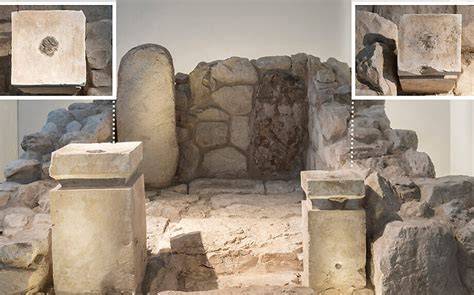
Compelling evidence of the ritual use of cannabis in ancient Israel was reported in a 2020 archaeological study, “Cannabis and Frankincense at the Judahite Shrine of Arad,” by the Journal of the Institute of Archaeology of Tel Aviv University.
The authors noted that two altars with burnt plant residues had been found in a shrine at an ancient Hebrew outpost in tel Arad. One of the altars tested for frankincense, a well-known Biblical herb, and the other altar tested positive for cannabis resin.
The research, expectedly, caused a storm of controversy, with Biblical historians, religious authorities, and other parties weighing in. An article in Haaretz, headlined “Holy Smoke | Ancient Israelites Used Cannabis as Temple Offering, Study Finds,” raised a key question: “If the ancient Israelites were joining in on the party, why doesn’t the Bible mention the use of cannabis as a substance used in rituals, just as it does numerous times for frankincense?”
“Kaneh” and “Kaneh Bosm” in the Hebrew Bible
Actually, several scholars have drawn attention to indications of cannabis use in the Bible. Polish anthropologist and etymologist Sula Benet contends that the Hebrew terms kaneh and kaneh bosm refer to cannabis.
Benet identified five specific references in the “Hebrew Bible” (aka the Old Testament) - Exodus 30:23, Song of Songs 4:14, Isaiah 43:24, Jeremiah 6:20, and Ezekiel 27:19 - that mention kaneh and kaneh bosm.
The identity of kaneh and kaneh bosm has long been a topic of speculation. Benet’s view was that when the Hebrew texts were translated into Greek for the Septuagint, a mistranslation took place, deeming it as the common marsh root “calamus.”
This mistranslation followed into the Latin, and then English translations of the Hebrew Bible. It should be noted that other botanical mistranslations from the Hebrew to Greek in the Hebrew Bible have been exposed.
Exodus 30:23 and the Holy Anointing Oil
In Exodus 30:23, the reference is to an ingredient in the Holy Oil, which was used in the Holy of Holies, the inner chamber of the Temple in Jerusalem.
The argument is that the qaneh-bosem of Exodus 30:22-29 is, in fact, a reference to cannabis, and that the common view that it should be translated “sweet calamus” is a mistranslation.
Such is not the case. The Hebrew qenêh-ḇōśem in Exodus 30:23 is the “sweet cane” of Scripture, probably the Andropogon calamus aromatics, native to India.
Qaneh refers to a “water-plant” or “stalk of grain”and bosem refers to “sweet” or a “sweet odor.” Even if one could demonstrate that the etymology of the word traced back to the Hebrew qenêh-ḇōśem was cannabis, there is no evidence that the priests ingested or smoked it.
Jeremiah 6:20 and the Rejection of Foreign Influence
However, when one reads these passages individually and compares them, a stark contrast emerges. In Exodus 30:23, the reference is to an ingredient in the Holy Oil, which was used in the Holy of Holies, the inner chamber of the Temple in Jerusalem, whereas in Jeremiah 6:20, this same previously sacred substance is wholly rejected as an item of foreign influence and disdain.
It appears that Yahweh, the Jealous God, frowned upon the idolatrous use of cannabis, the polytheistic drug of choice.
The Old Testament chronicles the embrace of One God instead of many, a major shift that coincided with the displacement of cannabis as a ceremonial substance, as Chris Bennett reports in his latest book, Cannabis: Lost Sacrament of the Ancient World.
Song of Songs, Isaiah, and Ezekiel
Benet identified five specific references in the “Hebrew Bible” (aka the Old Testament) - Exodus 30:23, Song of Songs 4:14, Isaiah 43:24, Jeremiah 6:20, and Ezekiel 27:19 - that mention kaneh and kaneh bosm.
The argument has been made that the reference to herbs in Isaiah 18:4-5 concerns the cannabis plant, but it simply does not use a designation that defines the term as hemp.
Does Genesis Say That Cannabis Is Permitted?
Purportedly the Bible supports the use of all the various seeds and herbs because they were created and blessed by God and could not be wrong to use. Consequently, the plant called hemp is proper for Christians to use for food, medicine, and enjoyment (Gen. 1:12).
In Genesis 1:29-31, the Bible further indicates that all herbs are given for food.
First, I agree that God created everything, but this argument does not address the problem that not all plants that are part of creation are edible, or the fact that the original creation was impacted by sin, so that some things created may no longer be in their original state.
One must use wisdom in discerning the use of something made by God. It may be that its intended use is for various products that do not involve ingestion.
Remember that hemlock and poison mushrooms are part of creation but are deadly as food.
The curse changed our relation to the things of the Earth, so that many uses of plants are harmful to us, such as hemlock and poisonous mushrooms. They have a purpose, but this does not mean they are a food to eat or an herb to smoke.
Does Ezekiel Mention a “Plant of Renown”?
Much is made about the statement, found in the KJV, which supposedly speaks of hemp being the plant spoken of in Ezekiel 34:29, called a “plant of renown,” which would heal (Rev. 22:1-2).
First, there is no indication in the context of Ezekiel 34:29 or Revelation 22:1-2 that the hemp plant is in view, but in Ezekiel 34:29, marijuana supporters have based their thinking on a wrong translation of the Hebrew.
The Hebrew maṭṭāʿ lešēm that the KJV translates as “plant of renown” should rather be translated in regards to the place of planting and not to the plants themselves.
There is no indication in the context of Ezekiel 34:29 or Revelation 22:1-2 that the hemp plant is in view.
Cannabis as Food, Fiber, and Medicine
Humankind’s connection to cannabis reaches back tens of thousands of years. The role of cannabis in the ancient world was manifold: with its nutritious seeds, an important food; with its long, pliable strong stalks an important fiber; as well as an early medicine from its leaves and flowers; and then there are its psychoactive effects.
Due to its usefulness, cannabis has a very long history of human cultivation. How long, exactly, remains unknown.
“No other plant has been with humans as long as hemp,” says ethnobotanist Christian Rätsch. “It is most certainly one of humanity’s oldest cultural objects. Wherever it was known, it was considered a functional, healing, inebriating, and aphrodisiac plant. Through the centuries, myths have arisen about this mysterious plant and its divine powers. Entire generations have revered it as sacred. The power of hemp has been praised in hymns and prayers.”
Food and Agriculture
Professor Richard E. Schultes, of Harvard University, considered the father of modern ethnobotany, believed it was likely in the search for food that humanity first discovered cannabis and its protein-rich seeds.
Today, hempseed products are touted as a modern “super food” due to their richness in essential fatty acids.
“Early man experimented with all plant materials that he could chew and could not have avoided discovering the properties of cannabis (marijuana), for in his quest for seeds and oil, he certainly ate the sticky tops of the plant,” Schultes has written.
Fiber and Textiles
A hemp rope dating back to 26,900 BC was found in Czechoslovakia; it’s the oldest evidence of hemp fiber.
Hemp fiber imprints over 10,000 years old in pottery shards in Taiwan, and remnants of hemp cloth from 8,000 B.C. have been found at the site of the ancient settlement Catal Hüyük in Anatolia (modern day Turkey).
Much older tools for breaking hemp stalk into fibers indicate humanity has been using cannabis for cloth “since 25,000 B.C. at least,” according to prehistoric textiles expert Elizabeth Wayland-Barber.
Medicine
Cannabis was also among our first medicines. A recent study by Washington State University scientist Ed Hagen suggests that our prehistoric ancestors may have ingested cannabis as a means of killing of parasites, noting a similar practice among the primitive Aka of modern-day central Africa.
We do know that references to cannabis medicine appear in the world’s oldest pharmacopeias, such as China’s Shennong Ben Cao Jing, in ancient Ayurvedic texts, in the medical papyrus of Egypt, in cuneiform medical recipes from Assyria, first on a list of medicinal plants in the Zoroastrian Zend Avesta, and elsewhere.
Theories About Cannabis and Early Human Development
The “Great Leap Forward” Hypothesis
There has been interesting scientific speculation that the psychoactive properties of cannabis played a role as a catalyst in the “Great Leap Forward,” a period of rapid advancement for prehistoric humanity, which started about 50,000 to 65,000 years ago.
In their fascinating paper, “The Evolution of Cannabis and Coevolution with the Cannabinoid Receptor - A Hypothesis,” Dr. John M. McPartland and Geoffrey W. Guy explain how ingestion of this plant may have aided prehistoric humans.
“In a hunter-gatherer society,” they write, “the ability of phytocannabinoids to improve smell, night vision, discern edge and enhance perception of color would improve evolutionary fitness of our species.
Evolutionary fitness essentially mirrors reproductive success, and phytocannabinoids enhance the sensation of touch and the sense of rhythm, two sensual responses that may lead to increased replication rates.”
The authors postulate that plant compounds, which interact with the human body’s endocannabinoid system, “may exert sufficient selection pressure to maintain the gene for a receptor in an animal.
If the plant ligand [plant-based cannabinoid] improves the fitness of the receptor by serving as a ‘proto-medicine’ or a performance-enhancing substance, the ligand-receptor association could be evolutionarily conserved.”
In essence they are suggesting that there’s a coevolutionary relationship between “Man and Marijuana” - and that somehow as we have cultivated cannabis, it may have cultivated us, as well.
Language, Tools, and Civilization
McPartland and Guy reference others who propose that cannabis was the catalyst that facilitated the emergence of syntactic language in Neolithic humans: “Language, in turn, probably caused what anthropologists call ‘the great leap forward’ in human behavior, when humans suddenly crafted better tools out of new materials (e.g. fishhooks from bone, spear handles from wood, rope from hemp), developed art (e.g. painting, pottery, musical instruments), began using boats, and they evolved intricate social (and religious) organizations.
This recent burst of human evolution has been described as epigenetic (beyond our genes) - could it be due to the effect of plant ligands?”
In his study on the botanical history of cannabis and man’s relationship with the plant, Mark Merlin, Professor of Botany at University of Hawaii, referred to hemp as one of “the progenitors of civilization.”
Merlin was not alone in suggesting that hemp “was one of the original cultivated plants.”
In The Dragons of Eden: Speculations on the Evolution of Human Intelligence, the late Carl Sagan conjectured that early man may have begun the agricultural age by first planting hemp.
Sagan, who was known to have a fondness for cannabis himself, cited the pygmies from southwest Africa to demonstrate his hypothesis.
The pygmies had been basically hunters and gatherers until they began planting hemp, which they used for religious purposes.
The pygmies themselves profess that at the beginning of time the gods gave them cannabis so they would be both “healthy and happy.”
Biblical Warnings About Intoxication
These cautions against getting drunk and losing the ability to make sound judgments would probably apply to activities like smoking marijuana as well.
Intoxication clearly is forbidden in Scripture (e.g., Eph. 5:18), but though one can have a nonintoxicating dose of wine, this is not so with cannabis, especially with the potent varieties in today’s market.
Ephesians 5:18
In Ephesians 5:18 (ESV), Paul says 18 And do not get drunk with wine, for that is debauchery, but be filled with the Spirit,
Ephesians 5:18 says that we’re not to be drunk with wine, but to be filled with the Spirit.
We are to be controlled by the Holy Spirit, not by anything that alters our mind.
Be controlled by the Holy Spirit, not by something that alters the mind.
Proverbs 23:20 and Proverbs 23:30-35
In Proverbs 23:20 (ESV), Scripture cautions, 20 Be not among drunkards or among gluttonous eaters of meat,
Proverbs 23, and this one is maybe a little more well-known, and it’s actually kinda funny: “Those who tarry long over wine, those who go to try mixed wine, do not look at wine when it is red, when it sparkles in the cup and goes down smoothly.
In the end, it bites like a serpent and stings like an adder. Your eyes will see strange things and your heart utter perverse things.
You will be like one who lies down in the midst of the sea, like one who lies on the top of a mast.
‘They struck me,’ you will say, ‘But I was not hurt. They beat me, but I did not feel it. When shall I awake? I must have another drink.’” - Proverbs 23:30-35
Galatians 5:19-21
Galatians 5:19-21 (ESV) 19 Now the works of the flesh are evident: sexual immorality, impurity, sensuality, 20 idolatry, sorcery, enmity, strife, jealousy, fits of anger, rivalries, dissensions, divisions, 21 envy,[a] drunkenness, orgies, and things like these.
I warn you, as I warned you before, that those who do[b] such things will not inherit the kingdom of God.
This passage highlights behaviors associated with the loss of self-control and excess. While marijuana is not mentioned, many Christians view intoxication of any kind through this lens.
Hosea 4:11 and Related Warnings
Hosea 4:11, it’s a warning, “beware” literally is the word that’s used.
Proverbs 20 says that wine is a mocker. Strong drink is a brawler. The effect of wine can be very negative.
Proverbs 21 says he who loves wine will not be rich.
At this point, it’s a blessing, wine is a blessing, but it’s also loaded with danger.
Marijuana, Alcohol, and the Question of Moderation
The Bible recognizes the use and abuse of drugs. This is an argument by association of alcoholic beverages in the New Testament-which is clearly discussed, both as to the benefits of moderate use and as to the disastrous impact of excessive use-with intoxicating plants.
Usually the fact that Jesus made wine at the wedding at Cana (John 2:1-10) and passages such as Proverbs 31:6-7 show the positive side, and Isaiah 5:10 gives the negative.
Those who support the use of marijuana are correct that the Bible presents alcohol in a positive light when used in moderation and in a negative light when abused, as seen in the verses above and others, but there is no mention at all of hemp plants being used as a drug in the Bible.
The attempt is to try to bring a connection with wine, and thus to say marijuana is OK. This is false.
Wine is a beverage used often with meals in the Bible, and its effects are small and even healthy in moderation.
On the other hand, the Bible does not provide for moderate use of other intoxicating substances, so that sufficient parallels cannot be drawn between the two substances to sustain a biblical case for the Christian’s recreational or medical use of marijuana; the Scripture does not mention either.
1 Corinthians 6:12 and Self-Mastery
In 1 Corinthians 6:12 (ESV), Paul says, 12 “All things are lawful for me,” but not all things are helpful. “All things are lawful for me,” but I will not be dominated by anything.
The Bible doesn’t specifically mention addiction or marijuana use disorder. However, this verse can apply to marijuana use and the hold that it can have over someone.
While weed use may technically be permissible according to the New Testament’s law of grace, its benefits may be questionable in a recreational context, particularly if it begins to influence judgment, motivation, or self-control.
This distinction between freedom and self-mastery is also why many Christians compare marijuana use to alcohol in Scripture.
So wine or beer (strong drink) is lawful, but is it controlling me?
The Difference in Effect
Obviously, there isn’t a direct connection between alcohol and marijuana. An individual can drink a small amount of alcohol without becoming drunk.
The Bible doesn’t forbid drinking - only drunkenness. Many Christians abstain from alcohol to avoid the appearance of evil (1 Thessalonians 5:22).
However, some drink with self-control and moderation. Those who only have a couple of drinks may be able to do so with a clear conscience if drinking doesn’t lead to drunkenness.
For marijuana, a much lower dosage creates a state of intoxication. In fact, it takes just 7 milligrams of THC to make the individual high.
Depending on their weight and other personal factors, this is between four and eight puffs of a marijuana cigarette.
In theory, very small amounts of THC may not produce noticeable intoxication. However, in most cases, the purpose of smoking pot is to get high, so many Christians conclude that smoking even a small amount of weed is a sin.
Whereas wine will intoxicate only with sustained use (and thus with restraint can have a strictly dietary use), marijuana immediately intoxicates the user.
Marijuana immediately intoxicates the user.
THC, CBD, and Intent
Cannabis is not a single substance, but much of the debate centers on THC, the compound responsible for marijuana’s intoxicating effects.
THC alters perception, judgment and cognitive functions which is why its most often compared to drunkenness in biblical discussions.
CBD (cannabidiol) by contrast, does not produce the same psychoactive high.
It is commonly used for pain, inflammation, anxiety, and seizure disorders, and many CBD products contain little to no THC.
Because CBD does not impair judgment or induce intoxication some Christians view it’s medical use differently than recreational marijuana use.
Scripture repeatedly warns against intoxication and loss of self-control, but it also allows for medical care and treatment of illness.
As with many modern substances, the question is less about the plant itself and more about intent, dosage and effect.
Self-Control, Judgment, and Dependence
Marijuana can be a powerful vice. At first glance, the increasing popularity of weed may raise concerns about addiction.
However, the truth is that about nine out of 10 people who use marijuana don’t develop an addiction to it.
Particularly among those who didn’t begin using weed until adulthood, quitting marijuana is easy compared to quitting harder drugs such as cocaine or heroin.
Addiction to medical marijuana may be rare, but about 30 percent of those who use weed have some degree of marijuana use disorder.
This is similar to dependence, which is when an individual experiences withdrawal symptoms when they’re not using a drug.
Common Withdrawal Symptoms in Regular Users
- Irritability
- Sleep disruptions
- Nervousness
- Decreased appetite
- Food cravings
- Depressed mood
- Difficulty regulating mood
- Anxiety
- Restlessness and physical discomfort
- Digestive issues
These symptoms can last up to two weeks after quitting weed, making it very difficult to abstain.
Particularly as marijuana products have become more concentrated - marijuana use disorders have become more commonly reported.
Impaired Decision-Making
Marijuana use can lead to impaired decision making. While marijuana is often viewed as relatively harmless, an increasing body of research points to impaired decision-making and cognition.
One study notes that chronic weed use disrupts normal decision-making processes.
It influences the individual’s impulsivity, their ability to switch between cognitive tasks, and their working memory.
Like alcohol, marijuana can impact the individual’s cognitive function and affect their ability to complete necessary tasks.
Part of the reason the Bible prohibits drunkenness, it seems, is so that believers will not find themselves in a state in which they are not able to discern the will of God.
Certainly, marijuana use jeopardizes this in a way that the moderate use of wine does not.
Romans 14:20 and Concern for Others
One important factor the Bible emphasizes is how personal behavior affects others.
Romans 14:20 (ESV) states, 20 Do not, for the sake of food, destroy the work of God. Everything is indeed clean, but it is wrong for anyone to make another stumble by what he eats.
In it’s original context, this passage addresses disputes over food that was once considered unclean. However, the principles extends beyond diet.
Paul’s concern is whether a believer’s freedom could unintentionally harm someone else’s faith.
Applied to marijuana, a person may feel justified in their own use if it does not impair judgment or lead to dependence.
Yet, that use could still influence others, particularly those vulnerable to substance misuse.
In situations where marijuana use could contribute to another person’s relapse or spiritual struggle, many Christians conclude that abstaining is the more loving and responsible choice.
Romans 14 is where we read about causing someone to stumble, like maybe God’s giving you the freedom to enjoy something, but don’t use that freedom in a way that it would cause someone else to stumble.
Alcohol can be enjoyed, but don’t enjoy it at the expense of someone else who might fall into slavery to it.
Obeying Civil Law
Another biblical consideration when evaluating marijuana use is obedience to civil law.
Scripture consistently instructs believers to respect governing authorities and follow the laws under which they live.
Romans 13:1-2 (ESV) Paul says, 13 Let every person be subject to the governing authorities. For there is no authority except from God, and those that exist have been instituted by God.
2 Therefore whoever resists the authorities resists what God has appointed, and those who resist will incur judgment.
Paul teaches that governing authorities are instituted by God, and resisting them carries consequences.
Similar guidance appears in Hebrews 13:17 and 1 Peter 2:13 reinforcing the expectation that Christians live as law-abiding citizens.
Hebrews 13:17 (ESV) 17 Obey your leaders and submit to them, for they are keeping watch over your souls and will have to give an account.
Let them do this with joy and not with groaning, for that would be of no advantage to you.
1 Peter 2:13 (ESV) 13 Be subject for the Lord’s sake to every human institution,[a] whether it be to the emperor[b] as supreme,
The laws governing marijuana use vary widely by location so whether a Christian can legally use weed depends on where they live.
In some states recreational use is legal; in others, only medicinal use is permitted.
Further complicating the situation, it may be illegal but decriminalized.
From a biblical standpoint, this distinction matters.
When marijuana use violates local law many Christians conclude that abstinence is not just a personal preference but an act of obedience.
Where use is legal, the question shifts away from legality and toward wisdom, self-control and the broader spiritual questions discussed earlier.
Given how frequently marijuana laws change, believers who travel should be mindful that what is permitted in one place may be prohibited in another.
Ultimately, Christians are called to honor God not only through personal conviction but also through respect for lawful authority.
Additional Biblical Principles
1 Thessalonians 5:22
1 Thessalonians 5:22 (ESV) 22 Abstain from every form of evil.
This verse is often cited by believers who choose abstinence to avoid practices that could impair judgment or spiritual clarity.
1 Corinthians 6:19
1 Corinthians 6:19 (ESV)
Will drinking alcohol or smoking weed hurt your testimony as a Christian?
We need to think seriously about these topics and guard ourselves against worldly perspectives that can creep in.
Is it profitable or useful? Are you dependent on it?
We can not justify drunkenness because we need our minds to be controlled by the Holy Spirit.
Let’s make sure that we’re not using our freedom in Christ in a way that would cause someone else to stumble.
Views from Christian Thinkers
Augustine on Use and Enjoyment
St Augustine in On Christian Doctrine says the following, Book 1 Chapter 4-5 For to enjoy a thing is to rest with satisfaction in it for its own sake.
To use, on the other hand, is to employ whatever means are at one’s disposal to obtain what one desires, if it is a proper object of desire, for an unlawful use ought rather to be called abuse.
[AB] We have wandered far from God; and if we wish to return to our Father’s home, this world must be used, not enjoyed, that so the invisible things that are made, - that is, that by means of what a material and temporary we may lay hold upon that which is spiritual and eternal.
The true objects of enjoyment, then, are the Father and the Son and the Holy Spirit, who are at the same time the trinity.
C. S. Lewis on Temperance
C.S. Lewis in Mere Christianity, speaking on the topic of Temperance An individual Christian may see fit to give up all sorts of things for special reasons-marriage, or meat, or beer, or the cinema; but the moment he starts saying the things are bad in themselves, or looking down his nose at other people who do use them, he has taken the wrong turning.
One great piece of mischief has been done by the modern restriction of the word Temperance to the question of drink.
It helps people to forget that you can be just as intemperate about lots of other things.
A man who makes his golf or his motor-bicycle the centre of his life, or a woman who devotes all her thoughts to clothes or bridge or her dog, is being just as ‘intemperate’ as someone who gets drunk every evening.
Of course, it does not show on the outside so easily: bridge-mania or golf-mania do not make you fall down in the middle of the road.
But God is not deceived by externals.
John Piper on Drug Use
The primary focus [of the church] should be to do what only the Bible and only the gospel and only the Holy Spirit and the truth and Jesus can do in transforming human beings into the kind of Christ-exalting, Spirit-dependent, God-glorifying people who freely choose not to use drugs - whether caffeine or alcohol or cannabis or cocaine or meth or heroin - to escape into a world where Christ is less clearly perceived, and the Scriptures are less understood and precious, and the Spirit is less personal, and the glory of God is less satisfying, and the way of righteousness is less defined, and the path of obedience is less compelling.
We want Christians who freely reject anything that would put them in that kind of mindset.
John Calvin on Spiritual Lethargy
John Calvin, Commenting on 1 Peter 5:8 said, Surfeiting (over-indulging) produces sloth and sleep; even so they who indulge in earthly cares and pleasures, think of nothing else, being under the power of spiritual lethargy.
How Christians Apply These Principles
Deciding whether using weed is a sin depends on how Christians apply broader biblical principles.
Because Scripture addresses intoxication and self-control rather than specific substances, conclusions Christians draw are based on broader biblical principles rather than explicit prohibition.
Rather than asking whether smoking weed is permissible, Scripture often pushes believers to consider the broader impact of their choices.
First, intoxication clearly is forbidden in Scripture (e.g., Eph. 5:18), but though one can have a nonintoxicating dose of wine, this is not so with cannabis, especially with the potent varieties in today’s market.
Second, wine in the Bible is connected to dietary concerns and is involved in, for example, the practice of table fellowship and weddings in the Bible.
We may contrast this to cannabis, which seems to have an exclusively intoxicating function.
Third, part of the reason the Bible prohibits drunkenness, it seems, is so that believers will not find themselves in a state in which they are not able to discern the will of God.
Fourth, if the Bible intended for us to use marijuana in moderation, as with wine, then why do we not find the same kinds of detailed guidelines for drugs (including marijuana) that we do for wine and other alcoholic beverages, since we know that many drugs were available and in use in the first century?
Also, to argue that all plants are acceptable for our use because God created the universe is mistaken.
Though the plant was known in the Ancient Near East, it does not seem to be used in ancient Israel, as far as the biblical record is concerned.
The attempt to find the hemp plant in Old Testament passages cannot be substantiated from the Hebrew.
Lastly, the attempt to compare the use of marijuana with the moderate use of alcohol fails, since the Bible presents wine as a table beverage, not harmful to the body unless abused.